
Best AI Voice Bots for Customer Service in 2026
Phone support isn't going away — but the way companies handle it is changing fast. AI voice bots now resolve routine calls end-to-end, cut wait times to zero, and free human agents for conversations that actually need empathy and judgment.
The challenge? The market is flooded with options ranging from developer-only APIs to $300K/year enterprise platforms. Some take months to deploy. Others hallucinate answers that damage customer trust.
We evaluated dozens of AI voice bot platforms across accuracy, deployment speed, pricing transparency, language support, and real-world customer outcomes. Here are the 10 best options for customer service teams in 2026.
What to Look for in an AI Voice Bot
Before diving into the list, here are the criteria that matter most:
Accuracy and hallucination control
— A voice bot that makes up answers is worse than no bot at all. Look for platforms with grounding mechanisms that validate responses against your actual knowledge base and data.
Deployment speed
— Some platforms take months of professional services. Others go live in hours. Factor in your team's technical capacity.
Pricing model
— Per-minute, per-resolution, per-seat, or flat-rate? Each model has different cost implications as your volume grows.
Language support
— If you serve global customers, multilingual capabilities are non-negotiable.
Integration depth
— The voice bot needs to connect with your helpdesk (Zendesk, Salesforce, Freshdesk) and backend systems to actually resolve issues, not just deflect them.
Omnichannel capability
— Can the platform handle chat and email too, or is it voice-only?
The 10 Best AI Voice Bots for Customer Service
1. IrisAgent
Best for: Support teams that need fast deployment, high accuracy, and predictable costs
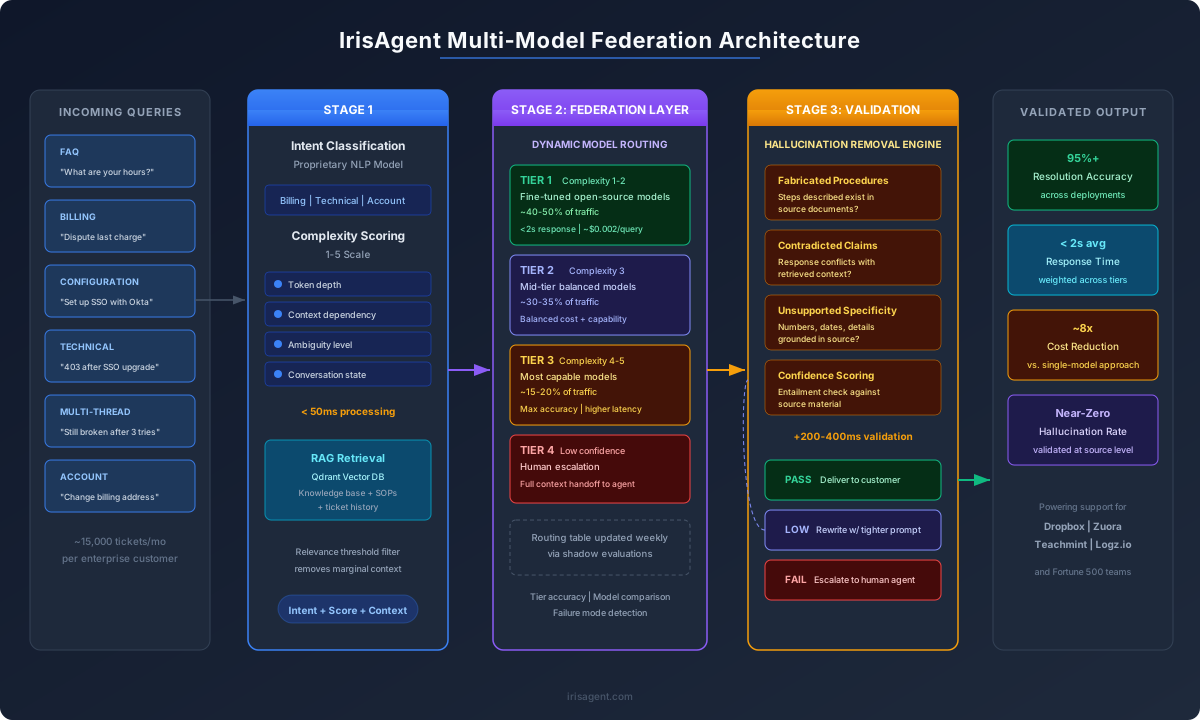
IrisAgent delivers AI-powered voice, chat, and email resolution from a single platform. What sets it apart is the proprietary Hallucination Removal Engine that validates every AI response against your knowledge base, SOPs, and backend system data — achieving 95%+ accuracy with zero hallucinated answers.
Most customers go live within 24 hours with no engineering required. The platform ingests your existing knowledge base and ticket history to auto-configure voice workflows, and non-technical teams can create complex automation using natural language through Smart Operating Procedures.
Key features: - Hallucination Removal Engine with 95%+ accuracy - Multi-LLM federation (OpenAI, Anthropic, Azure, and more) - Smart Operating Procedures for no-code workflow building - Omnichannel: voice, chat, email in one platform - Real-time sentiment analysis and customer health monitoring - Intelligent escalation to human agents with full context
Pricing: Free tier available (no credit card). Standard and Enterprise tiers with flat, feature-based pricing — no per-resolution or per-minute fees.
Integrations: Zendesk, Salesforce, Intercom, Freshworks, Zoho, Jira, PagerDuty, Slack, MS Teams
Languages: Multilingual support
Performance: 60%+ auto-resolution rate, 50% reduction in handle time, 60% fewer escalations
Pros | Cons |
|---|---|
24-hour deployment — fastest in the market | Newer brand compared to legacy CCaaS vendors |
Only platform with dedicated hallucination removal | Paid tier pricing requires contacting sales |
No per-resolution or per-minute fees | |
Free tier for evaluation | |
No engineering or developer resources required |
2. Google Contact Center AI (CCAI)
Best for: Enterprises already invested in Google Cloud needing a full CCaaS replacement
Google CCAI is a comprehensive contact center suite built on Google Cloud, combining virtual agents (powered by Dialogflow), agent assist, and analytics. It leverages Google's world-class speech recognition and NLU models.
The platform is powerful but complex. Implementation typically takes months and requires Google Cloud expertise or a systems integrator partner. It's best suited for organizations replacing an entire contact center infrastructure, not teams looking to add voice AI to an existing setup.
Key features: - Virtual Agent powered by Dialogflow CX - Agent Assist with real-time suggested responses - CCAI Insights with live sentiment analysis - Built on Google's LLMs and speech models - VoIP, SMS, chat, and IVR routing
Pricing: ~$100-$200/month per agent for full contact center. Individual API components priced separately. $300 in free Google Cloud credits for new customers.
Integrations: Google Workspace, Salesforce, major telephony providers
Languages: 30+
Pros | Cons |
|---|---|
Google-grade NLU and speech recognition | Complex setup requiring Google Cloud expertise |
Massive scalability | Months of implementation time |
Strong analytics layer | Pricing can escalate quickly at scale |
Integrates with existing telephony | Not a quick-deploy solution |
3. Amazon Connect + Lex
Best for: AWS-native enterprises wanting deep cloud integration and pay-as-you-go pricing
Amazon Connect paired with Lex provides a cloud-native contact center with conversational AI. The pay-as-you-go model means no per-seat licensing — you only pay for actual usage. Amazon Q in Connect adds generative AI capabilities for agent assistance.
The trade-off is complexity. Building sophisticated voice workflows requires developer resources and AWS expertise. It's ideal for engineering-led organizations that want maximum control over their infrastructure.
Key features: - Pay-as-you-go telephony and AI - Amazon Lex for NLU and ASR - Amazon Q in Connect for generative agent assist - Deep AWS ecosystem integration (Lambda, DynamoDB, S3) - Real-time call analytics
Pricing: ~$0.018/min for voice, $0.004/message for chat. Lex: $0.004 per speech request. No upfront costs or long-term contracts.
Integrations: Full AWS ecosystem, Salesforce, major CRMs via custom Lambda functions
Languages: 25+
Pros | Cons |
|---|---|
True pay-as-you-go with no minimums | Requires AWS/developer expertise |
Highly scalable and reliable | Significant development effort for complex flows |
No per-seat licensing | Less polished out-of-box than purpose-built platforms |
Strong generative AI roadmap | Lex V1 deprecated; migration to V2 required |
4. Cognigy
Best for: Large European enterprises needing on-premise deployment and 100+ language support
Cognigy is an enterprise agentic AI platform recognized as a Leader in the 2025 Gartner Magic Quadrant for Conversational AI. It offers a visual low-code builder for conversation flows and supports cloud, on-premise, or hybrid deployment — a differentiator for regulated industries.
The platform supports 100+ languages, the most of any vendor on this list. However, pricing starts at approximately $300K/year, putting it out of reach for most SMBs.
Key features: - Visual low-code conversation flow builder - Multi-LLM orchestration - Agentic AI with autonomous decision-making - Pre-built skills for payments, scheduling, and more - Cloud, on-premise, or hybrid deployment
Pricing: Enterprise contracts starting ~$300K/year. Base subscription ~$2,500/month with separate charges for voice, chat, and LLM workloads.
Integrations: Genesys, NICE, Avaya, Amazon Bedrock, Salesforce
Languages: 100+
Pros | Cons |
|---|---|
Gartner Magic Quadrant Leader | Very expensive ($300K+/year) |
100+ language support | Complex, layered pricing |
On-premise deployment option | Steep learning curve |
Enterprise-grade security | Overkill for SMBs and mid-market |
5. PolyAI
Best for: Enterprises in hospitality, healthcare, and travel needing voice-first automation
PolyAI takes a voice-first approach with proprietary voice models — not just wrappers around OpenAI. Their Agent Studio provides fine-grained governance and real-time optimization tools, making it strong for regulated industries where transparency matters.
With $200M+ in total funding (including an $86M Series D in December 2025), PolyAI is well-capitalized. However, contracts typically start around $150K/year with no self-serve option.
Key features: - Proprietary voice models (not API wrappers) - Agent Studio for governance and real-time optimization - Build once, deploy across voice, chat, and SMS - Transparency and compliance tools - 50%+ containment rates reported
Pricing: Per-minute pricing (custom-quoted). Most contracts start ~$150K/year.
Integrations: Salesforce, NICE, Genesys
Languages: 10+
Pros | Cons |
Proprietary voice models (superior voice quality) | Expensive ($150K+ minimum) |
Strong governance and transparency tools | No self-serve or free tier |
Well-funded with strong trajectory | Voice-first; chat/digital is secondary |
Voice-first design philosophy | Limited language support (10+) |
6. Microsoft Nuance / Dynamics 365 Contact Center
Best for: Large enterprises in the Microsoft ecosystem needing voice biometrics and fraud prevention
Microsoft acquired Nuance for $19.7B and has integrated its conversational AI capabilities into Dynamics 365 Contact Center with Copilot Studio. The standout feature is voice biometric authentication — callers can be verified by their voice, eliminating security questions and reducing fraud.
Important caveat: on-premise support is ending in June 2026. Microsoft is actively migrating all customers to cloud, creating uncertainty during the transition.
Key features: - Industry-leading voice biometric authentication - Fraud prevention and detection - Copilot-powered agent assistance - Deep Microsoft ecosystem integration (Teams, Power BI, Azure, Dynamics) - Emotion detection and context-aware responses
Pricing: Custom enterprise pricing tied to Dynamics 365 licensing.
Integrations: Microsoft Teams, Dynamics 365, Azure, Power BI
Languages: 40+
Pros | Cons |
Industry-leading voice biometrics | On-premise support ending June 2026 |
Decades of NLP/NLU research | Complex Dynamics 365 licensing |
Strong in healthcare (Dragon Medical) | Heavy implementation requiring SI partners |
Seamless Microsoft integration | Platform in major transition period |
7. Parloa
Best for: Large European enterprises needing real-time multilingual translation and strict regulatory compliance
Parloa positions itself as an AI Agent Management Platform for enterprise contact centers. Its standout capability is real-time translation across 35+ languages, enabling a single voice agent to handle callers in their native language.
The platform runs on Microsoft Azure and holds certifications including ISO 27001, SOC 2, PCI DSS, GDPR, DORA, and HIPAA. Pricing starts at approximately $300K/year with no self-serve option.
Key features: - Real-time translation across 35+ languages - Voice-first IVR replacement - Comprehensive compliance certifications - Azure-based global infrastructure - Deep integrations with Genesys, Verint, Salesforce
Pricing: Custom enterprise pricing. Minimum ~$300K/year.
Integrations: Salesforce, Microsoft, Genesys, Verint
Languages: 35+ with real-time translation
Pros | Cons |
Excellent real-time multilingual translation | Very expensive ($300K+ minimum) |
Comprehensive compliance certifications | Reported latency issues (700-900ms) |
Enterprise-grade Azure infrastructure | Multi-month implementation timeline |
Strong European market presence | No self-serve or SMB options |
8. Replicant
Best for: Contact centers wanting to replicate their best agents' behavior for Tier 1 automation
Replicant takes a unique approach: it studies your top-performing agents and replicates their behavior in an AI model. The "Thinking Machine" technology handles Tier 1 calls autonomously while intelligently escalating complex issues.
Deployment takes weeks rather than months, faster than most enterprise competitors. Reported CSAT scores reach 90%, with 50% of calls resolved without human handoff.
Key features: - "Thinking Machine" that learns from your best agents - Autonomous Tier 1 resolution - Multi-channel: voice, chat, SMS - Intelligent escalation with context preservation - Out-of-box CRM and contact center integrations
Pricing: Custom enterprise contracts based on call volume and complexity.
Integrations: Major CRMs and contact center platforms
Languages: English-primary with limited multilingual
Pros | Cons |
Unique "replicate best agents" approach | Primarily English-focused |
Faster deployment (weeks vs. months) | Limited pricing transparency |
90% CSAT scores reported | Less flexible for complex multi-step workflows |
No AI expertise required | Smaller integration ecosystem |
9. Retell AI
Best for: Engineering teams building custom voice AI with maximum control and model flexibility
Retell AI is a developer-focused platform that gives you full control over your voice AI stack. Bring your own LLM (GPT-4, Claude 3, or custom models), bring your own telephony (Twilio, Telnyx, Vonage), and build exactly what you need via WebSocket-based real-time streaming.
It's the most flexible option on this list — but that flexibility comes at the cost of requiring developer resources. There's no visual builder or no-code option.
Key features: - Bring your own LLM (GPT-4, Claude, custom models) - Bring your own telephony (Twilio, Telnyx, Vonage) - WebSocket-based real-time audio streaming - Natural barge-in handling - SOC 2 certified, HIPAA-ready
Pricing: Pay-as-you-go starting at $0.07/min. Real-world cost: $0.13-$0.31/min depending on model stack. $10 free credits to start.
Integrations: Twilio, Telnyx, Vonage, any LLM provider
Languages: 30+
Pros | Cons |
Maximum flexibility (BYOLLM, BYOC) | Requires developer resources |
Transparent pay-as-you-go pricing | No visual builder or no-code tools |
Low barrier to entry ($10 free credits) | You manage the full stack complexity |
30+ languages, no platform lock-in | Per-minute costs add up at scale |
10. Synthflow
Best for: SMBs and agencies wanting white-label voice AI with no-code building
Synthflow stands out with its no-code drag-and-drop Flow Designer and strong white-label features. Agencies can rebrand the platform, create subaccounts, and even rebill clients through Stripe integration. Sub-100ms latency on their telephony stack keeps conversations natural.
It's the most accessible option for non-technical teams, but the real per-minute cost is 2-3x the advertised rate once you factor in underlying AI provider fees.
Key features: - No-code drag-and-drop Flow Designer - White-label and agency features (custom branding, subaccounts, Stripe rebilling) - AI IVR, appointment booking, voicemail detection - Sub-100ms telephony latency - SOC 2, ISO 27001, HIPAA certified
Pricing: Pro: $375/month (2,000 min). Growth: $900/month (4,000 min). Agency: $1,400/month (6,000 min). Real per-minute cost: $0.16-$0.39 after AI provider fees.
Integrations: CRMs via webhooks, SIP trunking, Twilio
Languages: 20+
Pros | Cons |
True no-code builder for non-technical users | Real costs are 2-3x advertised rate |
Best-in-class white-label/agency features | Less suitable for complex enterprise use cases |
Transparent published pricing | Quality depends on underlying LLM selection |
Fast setup (minutes, not weeks) | Removed affordable Starter plan after Series A |
Comparison Table: All 10 AI Voice Bots at a Glance
Platform | Best For | Deployment Speed | Starting Price | Languages | Hallucination Controls |
IrisAgent | SMB to Enterprise | 24 hours | Free tier | Multilingual | Dedicated Hallucination Removal Engine |
Google CCAI | Enterprise | Months | ~$100/agent/mo | 30+ | Limited |
Amazon Connect + Lex | Enterprise (AWS) | Weeks-Months | $0.018/min | 25+ | Limited |
Cognigy | Large Enterprise | Months | ~$2,500/mo | 100+ | Configurable guardrails |
PolyAI | Mid-Enterprise | Weeks | ~$150K/yr | 10+ | Agent Studio controls |
Microsoft Nuance | Large Enterprise | Months | Custom | 40+ | Limited |
Parloa | Large Enterprise | Months | ~$300K/yr | 35+ | Limited |
Replicant | Mid-Enterprise | Weeks | Custom | English-primary | Agent replication model |
Retell AI | Developers | Days | $0.07/min | 30+ | BYOLLM (you configure) |
Synthflow | SMB / Agencies | Minutes | $375/mo | 20+ | Limited |
How to Choose the Right AI Voice Bot
Choose IrisAgent if you want the fastest path to accurate, hallucination-free voice automation without per-resolution fees or engineering overhead.
Choose Google CCAI or Amazon Connect if you're an enterprise already deep in that cloud ecosystem and have the technical team to manage a multi-month implementation.
Choose Cognigy or Parloa if you're a large European enterprise that needs on-premise deployment or real-time multilingual translation and can invest $300K+/year.
Choose PolyAI if you're in hospitality, travel, or healthcare and want proprietary voice models with strong governance tooling.
Choose Microsoft Nuance if your organization runs on Microsoft and needs voice biometric authentication or fraud detection.
Choose Replicant if you want to replicate your best agents' behavior for Tier 1 call automation.
Choose Retell AI if you have a developer team that wants full control over the LLM, telephony, and conversation stack.
Choose Synthflow if you're an SMB or agency that needs no-code voice AI building with white-label capabilities.
Frequently Asked Questions
What is an AI voice bot for customer service?
An AI voice bot is software that uses natural language processing and large language models to handle phone-based customer interactions. Unlike traditional IVR systems that force callers through rigid menu trees, AI voice bots have natural conversations — understanding intent, pulling data from backend systems, and resolving issues end-to-end without human intervention.
How much do AI voice bots cost?
Costs vary widely. Developer platforms like Retell AI start at $0.07/min. SMB-focused tools like Synthflow start at $375/month. Enterprise platforms like Cognigy and Parloa start at $300K/year. IrisAgent offers a free tier with paid plans based on features rather than per-minute or per-resolution charges, making costs predictable as volume grows.
Can AI voice bots handle complex customer issues?
The best platforms can handle multi-step workflows including order lookups, account changes, troubleshooting, and payment processing. However, all platforms include human escalation for edge cases. The key differentiator is accuracy — platforms like IrisAgent with hallucination removal ensure the bot only provides verified answers, escalating when uncertain rather than guessing.
How long does it take to deploy an AI voice bot?
Deployment timelines range from minutes (Synthflow) to months (Google CCAI, Microsoft Nuance). IrisAgent deploys in 24 hours by auto-configuring from your existing knowledge base and ticket history. Developer platforms like Retell AI can be up in days but require engineering effort to build conversation flows.
Do AI voice bots support multiple languages?
Language support varies significantly. Cognigy leads with 100+ languages. Parloa offers real-time translation across 35+ languages. Google CCAI and Retell AI support 25-30+. Some platforms like Replicant are primarily English-focused. Check that your target languages are supported before committing.
Will AI voice bots replace human agents?
No. AI voice bots automate routine Tier 1 interactions (password resets, order status, FAQ answers), freeing human agents for complex issues requiring empathy, judgment, and creative problem-solving. The best implementations use AI and humans together — the bot handles volume while humans handle value.