




Conversational AI for Ecommerce and Retail that Resolves 60%+ of Tickets
By Palak Dalal Bhatia, CEO & Co-founder, IrisAgent · Updated July 30, 2026



What Is Conversational AI for Ecommerce?
Conversational AI for ecommerce is software that reads a shopper's question in plain language, looks the answer up in your own systems (order management, catalog, returns policy, carrier and 3PL feeds), and finishes the request inside the conversation. The word that matters is finishes. A scripted ecommerce chatbot matches a keyword and hands back a help article. Conversational AI in ecommerce retrieves the specific order, applies your specific policy, takes the action, and confirms it.
The practical test is one question: can it answer "where is my order" with the actual tracking status for that order, or only with a link to your shipping policy? Everything else about the category follows from that difference, including the metric you should be measuring. Deflection rate counts conversations that did not reach an agent. Resolution rate counts conversations that ended with the customer's problem solved. They are not the same number, and the gap between them is where repeat contacts live.
The intents that actually automate in ecommerce and retail:
- Order status and WISMO. The highest-volume ticket type in ecommerce, and the one that most needs a live lookup rather than a canned reply.
- Returns and exchanges. Eligibility check against your window and condition rules, then the return label or the exchange, issued in the conversation.
- Sizing and fit. Answered from your own size charts and product data, not from the model's general knowledge of clothing.
- Delivery exceptions and lost packages. Carrier status read directly, with proactive notification before the customer has to ask.
- Cancellations and order changes. Handled inside the fulfillment window, escalated outside it.
- Refund status. The single most repeated follow-up question in post-purchase support.
- Loyalty and account questions. Points balances, tier status, saved addresses, subscription state.
- Peak-season surges. Not an intent, but the condition that decides whether any of the above matters.
What should not be automated is just as important. Fraud and chargeback disputes, damaged or safety-related product issues, high-value order changes, and policy exceptions belong with a human. A deployment that draws that boundary up front performs better than one that tries to automate everything and then walks it back. For the broader definitional background on how chat became a commerce channel, see our guide to conversational commerce.
Automate order tracking, returns, and product queries at scale
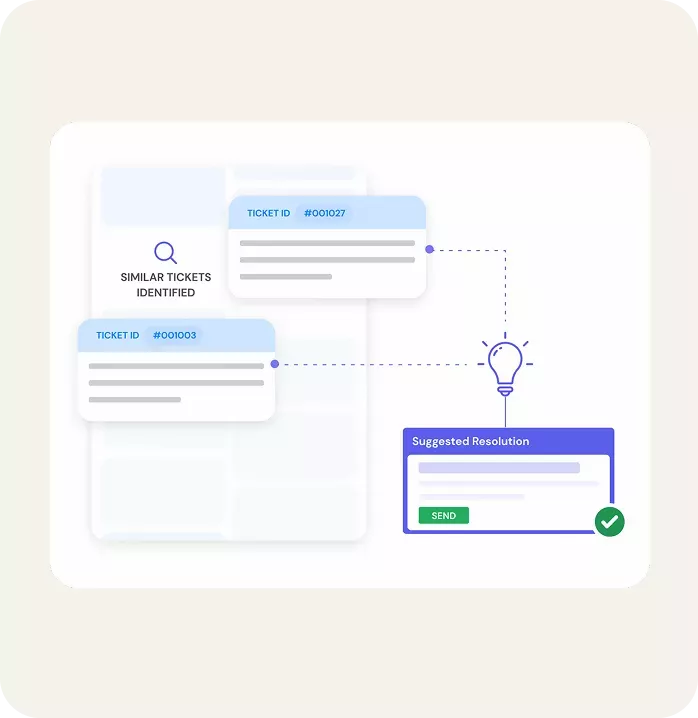
- The IrisGPT GenAI chatbot resolves 60%+ of e-commerce queries: "Where is my order?", return requests, product availability, size guides, and shipping questions. Every response is validated against your catalog before sending.
- Native integrations with Shopify, Zendesk, and Intercom deliver omnichannel support across chat, email, and messaging apps.
- AI-driven intent detection routes orders, complaints, and pre-sales queries to the right team automatically. Handle peak season surges without scaling headcount.
- The IrisGPT GenAI chatbot resolves 60%+ of e-commerce queries: WISMO, returns, product availability. Validated against your catalog.
- AI-driven intent detection routes
orders and complaints to the right team.
Handle peak season without scaling headcount.


Protect revenue and reduce cart abandonment with proactive support
- Give agents real-time context from product catalogs, order history, and customer purchase patterns to resolve issues and upsell effectively.
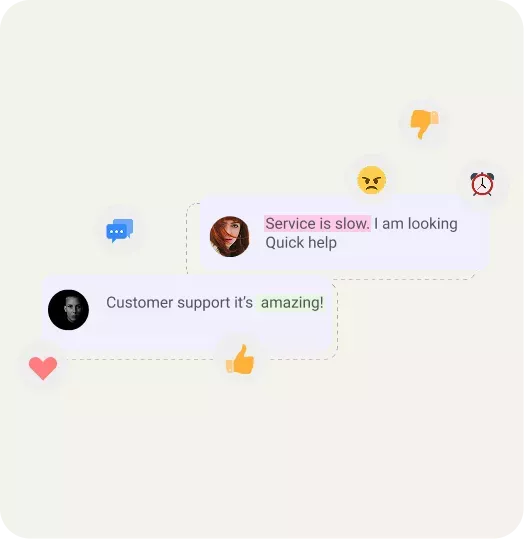
- Flag at-risk customers and negative reviews with automated sentiment analysis tied to order value and customer lifetime value.
- Real-time alerts on trending issues, including shipping delays, product defects, and payment failures, so you can respond before they go viral.
- Give agents real-time context from
product catalogs and order history to
resolve issues and upsell effectively. - Flag at-risk customers with automated sentiment analysis tied to order value.
- Real-time alerts on trending issues:
shipping delays, defects, payment failures.
Conversational AI That Resolves vs a Chatbot That Deflects
Both sit in the same widget and both claim the same automation rate. The difference is whether the system can reach into your order management platform and change something, or whether it can only read your help center back to the shopper.
| Dimension | Scripted ecommerce chatbot | Conversational AI that resolves |
|---|---|---|
| Answer to "where is my order" | A link to the shipping policy page | Live carrier status for that specific order |
| Backend access | Read-only, often no order lookup at all | Reads and writes to the OMS, returns, and refund systems |
| Returns and exchanges | Explains the policy, customer files the request | Checks eligibility and issues the label in-conversation |
| Catalog freshness | Nightly sync, stale during a flash sale | Live lookup at answer time |
| Metric it improves | Deflection rate, with repeat contacts unmeasured | Resolution rate, measured against 7-day repeat contacts |
| Behavior at 25x peak volume | Deflects more, resolves the same, backlog still grows | Automatable share rises, because spikes skew repetitive |
| Accuracy risk | Low, because it says almost nothing specific | Real, unless every answer is grounded and validated |
That last row is the honest tradeoff. A system that takes real actions on real orders can get real things wrong, which is why IrisAgent validates every customer-facing answer against your own catalog, policies, and ticket history through a Hallucination Removal Engine before it sends, holding validated accuracy above 95%. If a vendor will not tell you what happens when the model is unsure, that is the answer.
Conversational AI for Retail: What Changes When You Also Have Stores
Conversational AI for retail runs on the same engine as ecommerce but answers to a harder set of constraints. A pure-play ecommerce brand has one fulfillment path. A retailer has a website, marketplaces, and physical stores, and the customer does not care which one they are talking to. Four things change.
- In-store versus online context. "Do you have this in a medium" means local store inventory. "Where is my order" means the carrier feed. The AI has to route the same phrasing to different systems based on what the customer actually bought, and handle the hybrid cases: buy online pick up in store, ship from store, and returning an online order to a physical counter.
- Omnichannel handoff. When conversational AI cannot finish, retail escalation is not always to a contact-center agent. Sometimes it is to a store associate. The handoff has to carry the full thread, the order, and what the AI already tried, so the customer never repeats themselves and the associate does not start from zero.
- Seasonal spikes that are sharper than ecommerce.Retail peaks stack: Black Friday and Cyber Monday, holiday returns in January, back to school, and promotional events that are announced with days of notice. The brand described below saw 15x to 30x normal support volume at peak. Headcount cannot flex that far, which is the whole economic argument for automation in this vertical.
- Multi-brand and multi-banner operations. Retail groups often run several brands on one support stack with different return windows, tones, and loyalty programs. The AI needs policy and voice separation per brand from a single deployment, not a separate bot per banner that each has to be maintained.
IrisAgent layers onto Zendesk, Salesforce, Intercom, and Freshdesk rather than replacing them, so a retailer can add conversational AI without touching the store systems, POS, or helpdesk configuration already in production.
How to Evaluate Conversational AI for Ecommerce and Retail: 6 Criteria
Every vendor demos well on a clean happy path. Ask them to run a delayed international shipment and a partial return instead, and score what happens on these six.
- Grounding. Is every answer validated against your catalog, return policy, and ticket history before it reaches a shopper, or can the model invent a return window that does not exist? In ecommerce this is not an abstract risk: a hallucinated policy becomes a refund you have to honor.
- Backend action depth. Read access is table stakes. Confirm it can write: issue a return label, cancel an order, trigger a refund, book an exchange. Ask which specific OMS, returns, and 3PL systems it writes to today, not which it could integrate with.
- Catalog and order freshness. A nightly sync is fine on a Tuesday and wrong during a flash sale. Ask whether product availability, pricing, and order state are read live at answer time.
- Peak-season behavior. Ask what happened to a comparable customer at 20x or more of baseline volume: not just uptime, but whether resolution rate held or the system quietly started deflecting more.
- Omnichannel and store handoff (retail). If you run stores, confirm the AI can distinguish an in-store question from an online one and hand off to a store associate with the full thread attached. Most ecommerce-only tools cannot.
- Pricing model. Check whether your bill grows exactly as the automation gets better. Per-resolution pricing looks cheap in a pilot and inverts your incentives at holiday volume. IrisAgent offers predictable pricing with no per-resolution fee, plus an outcome-based managed resolutionoption for teams that would rather pay for results.
How a top-50 global e-commerce brand cut support costs by 50% with IrisAgent
A leading global e-commerce retailer uses IrisAgent to auto-resolve 65%+ of customer queries, cut support costs by 50%, and deliver instant answers during peak shopping events like Black Friday and Cyber Monday. The IrisAgent Hallucination Removal Engine keeps every customer-facing response validated against the brand's product catalog and return policy.
Read the e-commerce case study →
What Conversational AI Delivers at Ecommerce and Retail Scale
IrisAgent runs in production at top-50 ecommerce brands, and at Dropbox, Zuora, and Teachmint outside retail, delivering grounded support through Black Friday, holiday peaks, and product launches.
The detail behind those headline numbers, from the ecommerce case study(a Fortune 500 direct-to-consumer retailer, 15 million active customers, 200,000+ SKUs, 500,000 orders a week):
- Over 70% of inbound tickets were predictablebefore automation: WISMO, returns and refunds, promo code issues, sizing and fit, and payment failures. That share is what set the ceiling on what conversational AI could take.
- 65%+ auto-resolved and support spend cut from $4.8M to $2.4M a year.
- 8x faster average resolution: under 30 seconds instead of 4+ hours, held through peak events.
- 25x holiday volume spike absorbed with no staffing increase and no drop in response quality.
- CSAT 62 to 97 within six months, and a 12% lift in conversion rate from answering pre-purchase questions on product and checkout pages.
- 60% lower average handle time on the tickets that still reached an agent, via real-time agent assist.
One caveat worth stating plainly: the 65% resolution rate is a function of how repetitive that brand's volume was. A catalog with heavy configuration, regulated products, or a high share of one-off complaints will land lower, and any vendor quoting you a resolution rate before looking at your ticket mix is guessing.
operations
Any questions?
We got you.
Platform overview
See how the full IrisAgent AI for customer support platform works.
Explore the platform →Calculate your savings
See how much AI-powered support can save your e-commerce team.
Try the ROI calculator →E-commerce case study
How a top-50 e-commerce brand auto-resolves 65%+ of tickets with IrisAgent.
Read the case study →Chatbots for E-commerce
How chatbots handle order status, returns, and cart abandonment at scale.
See the Chatbot Pillar →Automate these e-commerce support workflows
See exactly how IrisAgent resolves the highest-volume post-purchase tickets end to end.