How to Reduce AI Hallucinations in Customer Support: A Practical Guide
To reduce AI hallucinations in customer support, ground every chatbot response in your verified knowledge base, validate answers against source documents before sending, and route low-confidence queries to human agents. IrisAgent's Hallucination Removal Engine reduces hallucinations to under 5% — compared to 15-30% for ungrounded models.
Why AI hallucinations matter for customer support
An AI hallucination happens when a chatbot generates a confident answer that is factually wrong. In customer support, hallucinations don't just frustrate users — they expose your business to refund requests, compliance violations, and reputational damage. A 2024 study from Stanford found that ungrounded large language models hallucinate in 15-30% of customer service responses, depending on query complexity.
For mid-market and enterprise teams handling thousands of tickets a day, even a 5% hallucination rate creates hundreds of incorrect customer interactions per week. The fix isn't to abandon generative AI — it's to architect your AI support system so hallucinations are mathematically rare.
7 proven techniques to reduce AI hallucinations in customer support
Ground every answer in your knowledge base. Use retrieval-augmented generation (RAG) to ensure the AI only answers from verified, customer-approved content. The model generates language; your knowledge base provides the facts.
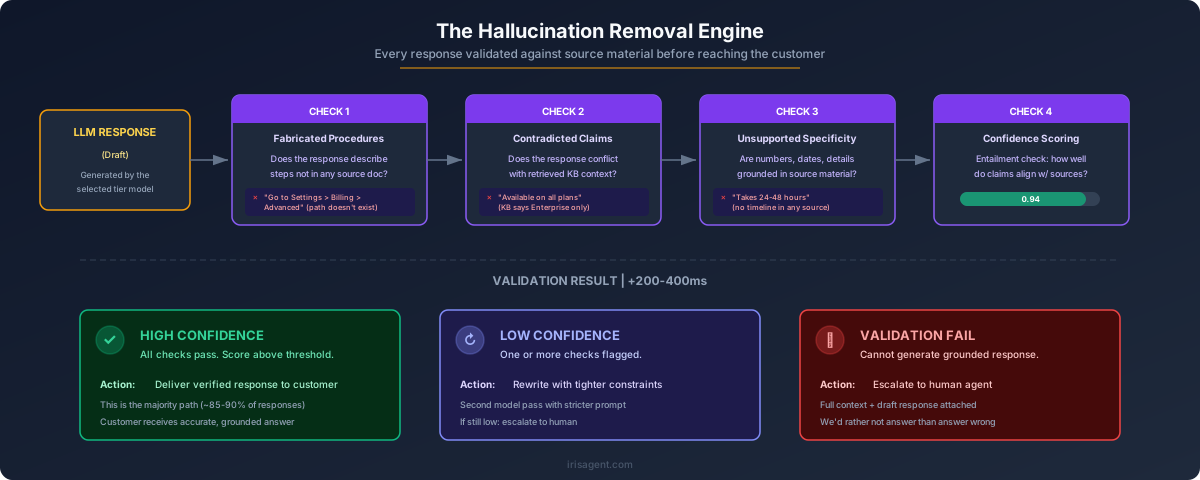
Validate responses before sending. Run every generated answer through a validation layer that checks the response against the source documents it claims to cite. If the response contradicts the source, block it and escalate.
Set confidence thresholds for escalation. Configure your AI to escalate to a human agent whenever its confidence score drops below a defined threshold (we recommend 0.85 for most support use cases).
Curate your knowledge base aggressively. Hallucinations often start with stale or contradictory source content. Audit your help center quarterly and remove outdated articles before they confuse the model.
Use citation-aware response formats. Force the AI to cite the specific KB article and section it used for each answer. Citations create accountability and let support leaders audit accuracy quickly.
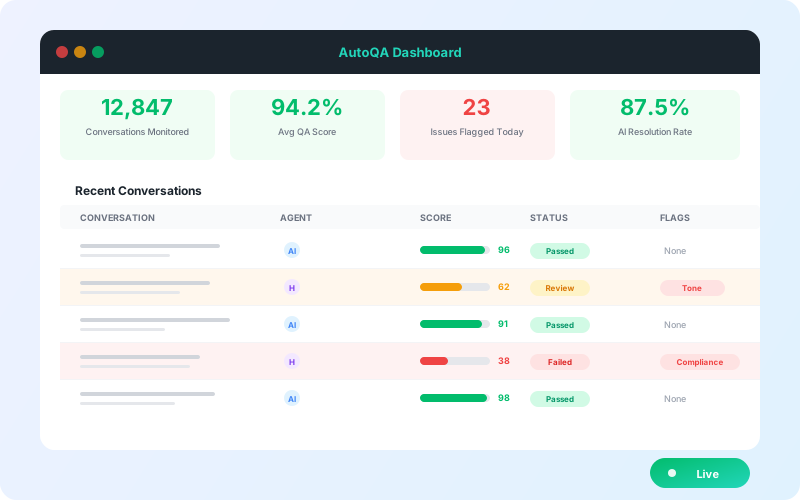
Monitor with real-time accuracy dashboards. Track hallucination rate as a first-class metric alongside CSAT and resolution time. Anything you don't measure, you can't reduce.
Choose a platform with a hallucination removal engine built in. Generic LLMs like ChatGPT will hallucinate without engineering. Purpose-built AI support platforms — like IrisAgent — include hallucination prevention as a core layer of the architecture.
How IrisAgent's Hallucination Removal Engine works
IrisAgent's Hallucination Removal Engine combines four techniques: knowledge base grounding, multi-pass response validation, source document verification, and confidence-based escalation. The result: validated accuracy above 95% across customers including Dropbox, Zuora, and Teachmint. Unlike ungrounded chatbots, every IrisAgent response is traceable back to a specific source document, making audits and quality reviews fast and reliable.
To see how it works on your own knowledge base, try IrisAgent free or calculate your potential ROI.
The cost of getting it wrong
Support teams that deploy ungrounded AI chatbots typically see CSAT drop 8-15% in the first 90 days, according to Zendesk's 2024 CX Trends report. Refund requests tied to incorrect AI responses can cost tens of thousands of dollars per month at enterprise scale. Worse, viral examples of AI hallucinations — like Air Canada's chatbot inventing a refund policy — create lasting brand damage.
The teams that win with AI support are the ones that treat hallucination prevention as the foundation, not an afterthought.
Frequently Asked Questions
What is an AI hallucination in customer support?
An AI hallucination in customer support is when a chatbot generates a confident response that is factually incorrect — such as inventing a refund policy, citing a nonexistent product feature, or fabricating account details. Hallucinations typically happen when generative AI models answer from their training data instead of a verified, customer-specific knowledge base.
How common are AI hallucinations in customer support chatbots?
Ungrounded large language models hallucinate in 15-30% of customer service responses, depending on query complexity. Purpose-built AI support platforms with grounding and validation engines reduce this to under 5%. IrisAgent's Hallucination Removal Engine achieves validated accuracy above 95% across enterprise deployments including Dropbox, Zuora, and Teachmint.
Can ChatGPT be used for customer support without hallucinating?
ChatGPT alone is not safe for production customer support because it answers from its training data, not your company's verified knowledge base. To use generative AI safely for customer support, you need a layer that grounds responses in your specific KB articles, validates answers before sending, and escalates low-confidence queries to human agents.
What is a hallucination removal engine?
A hallucination removal engine is a system that prevents AI chatbots from generating factually incorrect responses. It works by grounding answers in verified source documents, validating each response against those sources, and blocking or escalating any answer that fails validation. IrisAgent pioneered this approach for enterprise customer support.
How do I measure AI hallucination rate in customer support?
Track hallucination rate as a percentage of total AI responses. Sample 100-200 responses per week, manually review them against the source knowledge base, and flag any response that contains a factual error. Modern AI support platforms automate this with built-in accuracy dashboards that score every response against its source documents.
Will reducing AI hallucinations slow down chatbot responses?
Modern hallucination prevention adds minimal latency — typically under 200ms per response. The IrisAgent platform validates responses in parallel with generation, so users experience no perceptible delay. The accuracy gains far outweigh the negligible performance cost, and customers consistently report faster overall resolution times.
Does GDPR or compliance require AI hallucination prevention?
While GDPR does not specifically mandate hallucination prevention, it requires that personal data processing be accurate. AI chatbots that hallucinate about a customer's account, billing, or personal data could violate GDPR Article 5(1)(d) on data accuracy. Compliance-conscious teams treat hallucination prevention as a regulatory requirement, not just a quality concern.
What are the best techniques to reduce AI hallucinations in support chatbots?
The seven proven techniques are: ground every answer in your knowledge base using retrieval-augmented generation, validate responses against source documents before sending, set confidence thresholds for human escalation, curate your knowledge base aggressively to remove stale content, use citation-aware response formats, monitor hallucination rate with real-time dashboards, and choose a platform with a hallucination removal engine built in.