
What Is Conversational AI Design? A Complete Guide for CX Leaders
Conversational AI is transforming customer support — but the technology is only as good as the conversation it delivers. Here's what every support leader needs to know about conversational AI design and why it matters.
We've all been there. You reach out to a company's chatbot with a simple question, and within seconds you're trapped in a loop of irrelevant suggestions, robotic responses, and dead ends. You leave the interaction more frustrated than when you started.
Now contrast that with the best AI support experiences — the ones where the system understands what you need, responds in plain language, and resolves your issue in under a minute. The difference between these two scenarios isn't the underlying AI model. It's the design.
Conversational AI design is the discipline that separates helpful AI agents from infuriating ones, and it's quickly becoming a competitive differentiator for support teams everywhere.
What Is Conversational AI Design?
Conversational AI design — sometimes called conversation design — is the practice of crafting how people interact with AI-powered systems through natural, goal-oriented dialogue. It sits at the intersection of linguistics, user experience, psychology, and technology, and its purpose is to make AI interactions feel intuitive, efficient, and human.
This discipline governs everything from the words an AI agent uses, to how it handles misunderstandings, to when it decides a human needs to step in. It applies across chatbots, virtual assistants, voice agents, and any other interface where customers communicate with AI using natural language.
At its core, conversational AI design asks a deceptively simple question: How do we make talking to a machine feel like talking to a knowledgeable, empathetic colleague?
Why Does Conversational AI Design Matter?
The stakes are higher than most teams realize. According to research from Salesforce, 88% of customers say the experience a company provides is as important as its products or services. In a world where AI is increasingly the first touchpoint customers encounter, the quality of that AI conversation directly shapes brand perception.
Poor conversational design leads to abandoned interactions, repeat contacts, and escalations that could have been avoided. Strong conversational design, on the other hand, drives measurable outcomes: faster resolution times, higher customer satisfaction, lower support costs, and improved agent productivity — because human agents inherit fewer frustrated customers and better context when they do get involved.
For support leaders, conversational AI design isn't a nice-to-have. It's the foundation that determines whether your AI investment pays off or backfires.
The Five Principles of Effective Conversational AI Design
1. Start With the Customer's Intent, Not Your Workflow
The most common mistake in conversational AI design is building flows around internal processes rather than customer goals. Customers don't think in terms of your ticketing categories or knowledge base structure — they think in terms of problems they need solved.
Effective design begins with deep research into what customers actually ask, how they phrase their requests, and what outcomes they expect. This means analyzing real support transcripts, mapping common intents, and designing flows that mirror how people naturally describe their issues — not how your team internally categorizes them.
2. Write Like a Human, Not a Help Article
The language an AI agent uses has an outsized impact on whether customers trust it. Conversational AI should use clear, concise, everyday language that matches the tone customers expect from your brand. This means avoiding jargon, skipping overly formal constructions, and writing responses that sound like something a helpful person would actually say.
Brevity matters too. Long, dense responses signal that the AI is regurgitating documentation rather than understanding the question. The best conversational AI responses are short, specific, and actionable.
3. Design for Failure, Not Just Success
Every conversational AI system will misunderstand users. The question is how gracefully it recovers. Strong conversational design anticipates where confusion is likely to occur and builds in clear repair paths — confirmation prompts, gentle clarifications, and easy ways for users to redirect the conversation.
A well-designed error recovery flow can actually build more trust than a perfect first response, because it demonstrates that the system is listening and adapting. The worst thing an AI can do is confidently deliver the wrong answer or pretend it understood when it didn't.
4. Build Intelligent Escalation Paths
Not every issue should be resolved by AI, and knowing when to hand off to a human agent is itself a design decision. The best conversational AI systems recognize emotional cues, complexity signals, and high-stakes scenarios, and they route these interactions to human agents with full context — so customers never have to repeat themselves.
Smart escalation isn't a failure of AI. It's a feature of good design. The goal is a seamless experience where the customer feels supported throughout, regardless of whether they're talking to an AI or a person.
5. Treat Design as a Living Process
Conversational AI design is never "done." Customer language evolves, products change, new edge cases emerge, and the AI itself improves over time. The best teams establish continuous feedback loops — monitoring conversation logs, tracking resolution rates, identifying drop-off points, and iterating on flows regularly.
This ongoing refinement is what separates conversational AI that gets better over time from systems that slowly drift out of alignment with customer needs.
How Conversational AI Design Fits Into Modern Support Operations
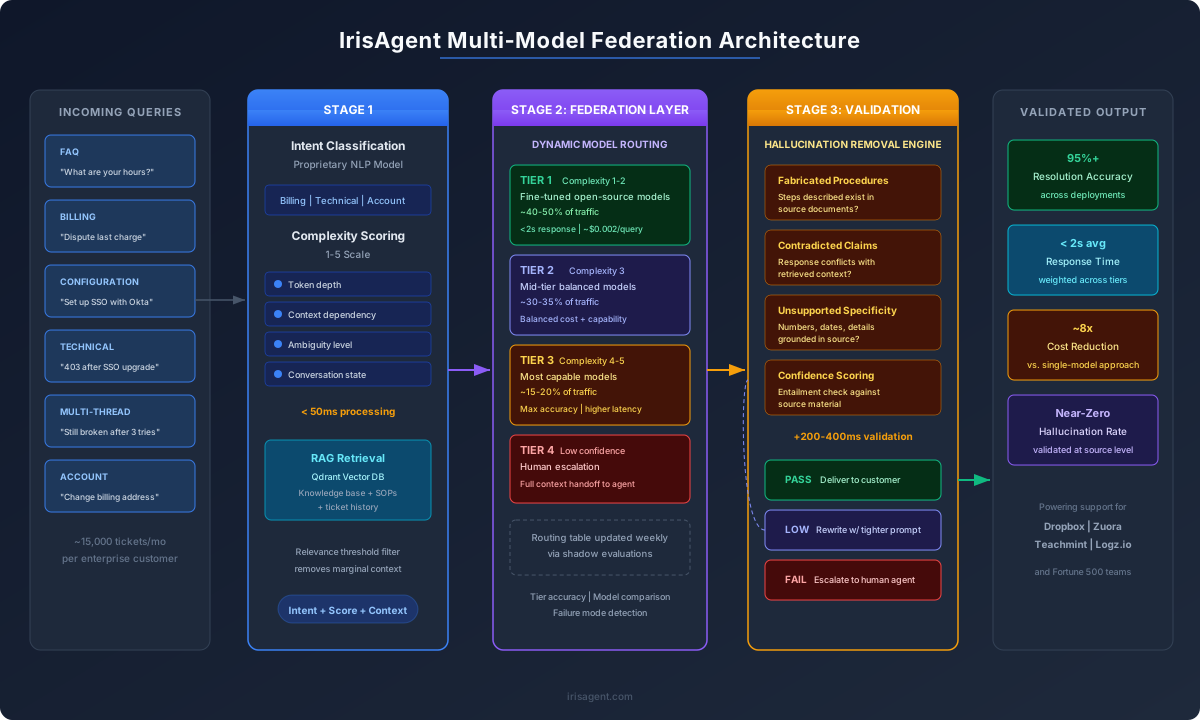
For support teams already investing in AI, conversational design is the layer that ties everything together. It connects your knowledge base, your ticketing system, your escalation rules, and your AI model into a coherent experience that customers actually want to use.
At IrisAgent, we see this play out every day. The companies that get the most value from AI-powered support aren't necessarily the ones with the most advanced models — they're the ones that invest in designing conversations that reflect real customer needs, brand voice, and operational context.
This means treating conversational design as a cross-functional effort. It requires input from support agents who know the most common pain points, product teams who understand upcoming changes, and CX leaders who set the tone for how the brand communicates. When these perspectives come together, the result is an AI experience that feels less like a technology interface and more like a natural extension of your support team.
Getting Started With Conversational AI Design
If you're evaluating or improving your AI support strategy, here are three practical steps to ground your approach in strong conversational design.
First, audit your existing conversations. Pull a representative sample of support transcripts and identify the top intents, the most common points of confusion, and the moments where customers express frustration. This gives you a map of where design matters most.
Second, define your AI's personality. Decide how your AI agent should sound — formal or casual, concise or thorough, proactive or reactive. Document these choices so they're applied consistently across every flow and response.
Third, measure what matters. Track not just resolution rate, but conversation quality metrics like customer effort score, escalation rate, and time-to-resolution. These signals tell you whether your design is actually working from the customer's perspective.
The Bottom Line
Conversational AI design is both an art and a science. It requires empathy to understand what customers need, rigor to build flows that actually deliver, and discipline to keep improving over time. As AI becomes the default front door for customer support, the quality of these conversations will increasingly define the quality of the customer relationship itself.
The companies that invest in getting this right won't just deflect more tickets — they'll build deeper trust, resolve issues faster, and create support experiences that customers genuinely prefer.
IrisAgent helps support teams deliver AI-powered customer experiences that are fast, accurate, and deeply integrated with your existing workflows. Learn more about how IrisAgent approaches conversational AI →