
Voice AI for Customer Service in 2026: Real Benchmarks From Production Deployments
Something shifted in contact centers in 2025. By 2026, it's become impossible to ignore.
Production voice AI deployments grew 340% year-over-year across more than 500 organizations, according to industry tracking data. The global voice AI market, valued at $2.4 billion in 2024, is projected to reach $47.5 billion by 2034 at a compound annual growth rate of 34.8%. Eighty percent of businesses plan to integrate voice AI into customer service by the end of 2026.
This is not pilot territory anymore. Voice AI agents are in production, handling real calls, resolving real issues, and generating real performance data.
That data is what this article is about. Not vendor marketing claims. Not aspirational projections. What are teams actually seeing when they deploy voice AI for customer support? What resolution rates are realistic? What does it cost? Where does it fall short?
Here is what the benchmarks show.
The State of Voice AI Deployment in 2026
Adoption has crossed the tipping point
Production voice AI deployments grew 340% year-over-year in 2026, according to data compiled across 500+ enterprise organizations. More than 78% of the top 50 banks now have production voice AI agents. Not pilots. Not proofs of concept. Live, customer-facing deployments handling real call volume.
The inflection point came from a combination of factors. Large language models became reliable enough for real-time spoken dialogue. Telephony APIs matured to support low-latency integration. And several high-profile deployments demonstrated measurable ROI at scale, as documented in Gartner's 2025 Magic Quadrant for Enterprise Conversational AI Platforms.
The three deployment tiers
Not all voice AI deployments are equal. Organizations in 2026 generally fall into one of three tiers:
Tier 1: IVR replacement (most common) Replacing legacy touch-tone IVR menus with conversational AI that understands natural speech. Customers say what they need instead of pressing numbers. Call routing improves. Customer frustration drops. This tier is the fastest to deploy and the most common entry point for contact center automation.
Tier 2: Autonomous resolution The AI handles calls end-to-end for defined use cases: order status, appointment booking, account balance, password reset, policy lookups. No human needed. This is where meaningful cost reduction begins and where resolution rates become the key performance metric.
Tier 3: Agentic voice (emerging) The AI takes multi-step actions. It pulls data from multiple systems, makes decisions, executes transactions, and escalates with context. A caller wants to dispute a charge, check if a replacement shipped, and reschedule their callback window. The AI handles all three sequentially. This tier represents a small but fast-growing share of deployments in 2026.
Key Benchmarks: What Voice AI Actually Delivers
Automated resolution rate
Industry average: 45-60% of Tier 1-eligible calls
Resolution rate is the most important metric in voice AI, and the most frequently misreported. Many vendors quote "containment rate" (calls that don't reach a human) rather than resolution rate (issues actually solved). A call is contained if the customer hangs up. It's resolved if their problem is fixed. These are not the same number.
Realistic benchmarks by use case:
Use Case | Automated Resolution Rate |
|---|---|
Order status and tracking | 70-85% |
Appointment booking and changes | 65-80% |
Account balance and statement requests | 75-90% |
Password reset and account unlock | 80-95% |
FAQ and policy questions | 55-70% |
Billing inquiry and dispute triage | 40-60% |
Technical troubleshooting (Tier 1) | 35-55% |
Complex complaints or escalations | 10-25% |
The highest resolution rates come from high-volume, well-defined workflows where the answer space is predictable. Complex or emotionally charged calls still require human judgment.
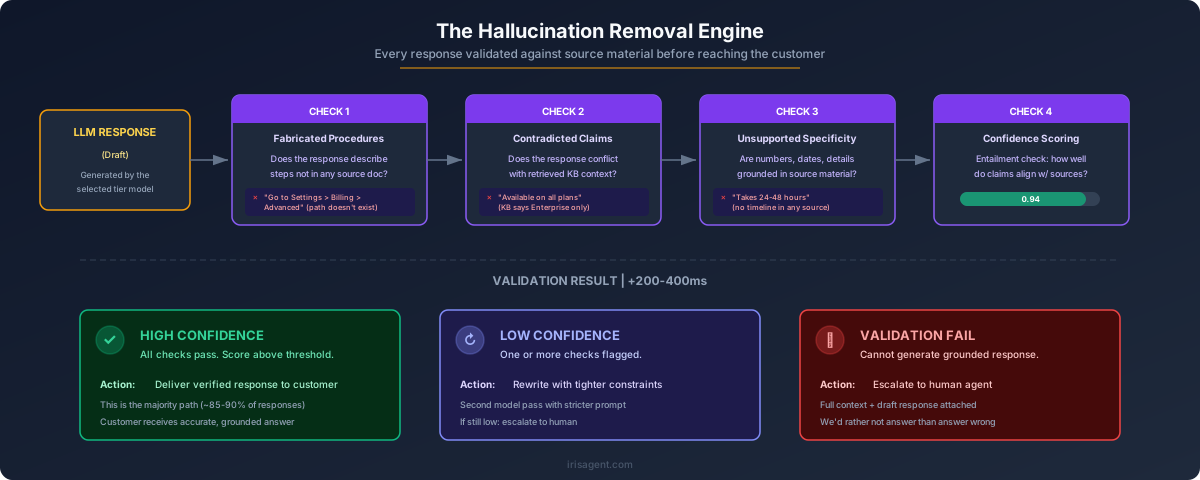
The key driver behind top-performing deployments is tight integration with backend systems combined with hallucination prevention mechanisms that ensure the AI gives verified answers rather than guessing. Platforms that ground responses in actual CRM, order management, and knowledge base data consistently outperform those relying solely on LLM confidence thresholds.
Handle time reduction
Industry average: 35-55% reduction in average handle time (AHT)
When AI handles calls autonomously, handle time for automated interactions drops to near zero. But even for calls that escalate to human agents, voice AI reduces handle time by doing the heavy lifting upfront: verifying the customer's identity, pulling account data, summarizing the issue, and routing to the right agent with full context.
The result: human agents spend their time solving problems, not asking "can you confirm your account number?" for the fifth time that shift.
Benchmark data points:
Average handle time reduction (automated calls): 100% (fully removed from human queue)
Average handle time reduction (assisted calls): 25-40%
Average hold time reduction: 60-75%
Top-performing deployments report 40-55% reduction in overall handle time
Customer satisfaction (CSAT)
Industry average: Voice AI CSAT scores 82-88 out of 100
This benchmark surprises most teams evaluating voice AI. The assumption is that customers hate automated systems. That assumption is based on legacy IVR. Voice AI powered by large language models is fundamentally different.
When voice AI resolves a call correctly on the first attempt, customers rate the experience highly. Often as highly as a skilled human agent. The variables that drive voice AI CSAT:
Resolution rate.
A resolved call almost always generates positive CSAT. An unresolved one almost always generates negative CSAT, regardless of whether the agent was AI or human.
Latency.
Pauses longer than 1.5-2 seconds break the conversational feel. Production platforms targeting sub-500ms response times see significantly better CSAT than those with longer latency.
Natural handoff.
When escalation is required, how cleanly the AI passes context to the human agent determines whether the customer has to repeat themselves. Repetition is the number one CSAT killer in escalated calls.
Accuracy.
AI that gives wrong answers (hallucinated policies, invented options, incorrect order details) generates CSAT scores in the 40-60 range even when customers are patient. This is why hallucination prevention is a business-critical capability, not a technical nicety.
Industry data shows that well-configured voice AI deployments achieve 85-90% CSAT on fully resolved calls, with 50%+ containment rates across hospitality, travel, and financial services verticals. Platforms that reduce escalation volume by 50-60% also see compound CSAT improvements, because fewer calls reach the friction point where satisfaction typically drops.
Cost per resolution
Industry average: $2.50-$8.00 per AI-resolved interaction (fully loaded)
Cost per resolution is where voice AI's promise and its pricing models collide. Gartner's January 2026 analysispredicted that GenAI cost per resolution will exceed offshore human agent costs by 2030. That finding was widely misread as a knock on AI. Read carefully, it's a knock on per-resolution pricing models specifically.
The math:
Cost Component | Per-Resolution Model | Flat-Rate Model |
|---|---|---|
Platform fee per resolved call | $0.99-$1.50 | $0 |
Telephony (per minute) | $0.01-$0.03 | $0.01-$0.03 |
LLM inference | $0.02-$0.08 | Included |
Human agent override (15-25% of calls) | Varies | Varies |
Total per resolved call at 10K calls/mo | $1.15-$1.65 | $0.03-$0.10 |
At low volumes, per-resolution pricing looks cheap. At 10,000+ monthly resolutions, the gap between per-resolution and flat-rate becomes significant. A platform resolving 15,000 calls per month at $1.25 per resolution costs $225,000 per year in resolution fees alone, before telephony or staff costs.
When evaluating voice AI platforms, pay close attention to the pricing model. Flat-rate models mean costs stay predictable as your automation rate improves. The better the AI performs, the more you save, rather than the more you pay.
Time to deployment
Industry average: 6-16 weeks for full production
Deployment timelines vary more than any other benchmark. The primary driver is integration complexity and implementation model.
Implementation Approach | Typical Timeline |
|---|---|
Developer-built (API-first platforms) | 4-16 weeks (engineering-dependent) |
Professional services implementation (enterprise platforms) | 3-6 months |
No-code/low-code platform setup | 1 day to 2 weeks |
Managed service with SI partner | 6-12 months |
The benchmark that matters most here is not the vendor's go-live claim. It's how quickly you reach production-grade resolution rates. A platform that goes live in 24 hours but takes 6 months of tuning to reach acceptable accuracy is not fast. A platform that goes live in 2 weeks and hits target resolution rates in week 3 is.
Benchmarks by Industry
Voice AI performance varies significantly by vertical. The more structured and predictable the call types, the higher the resolution rates.
Retail and ecommerce
Automated resolution rate:
55-75%
Top use cases: order status, return initiation, delivery issue triage, product availability
Peak demand multiplier: 3-5x during holiday periods. Voice AI's ability to scale instantly without overtime or seasonal hiring is especially valuable here.
Key challenge: Order and inventory data must be pulled in real time from OMS/ERP systems. Stale data creates high-confidence wrong answers.
Financial services
Automated resolution rate:
50-70%
(higher for transactional queries)
Top use cases: balance inquiries, transaction disputes, card activation/deactivation, fraud alert triage
Regulatory factor:
for traceability in financial service interactions mean every AI response must be loggable and auditable
Key challenge: Compliance requirements increase integration complexity. Hallucination risk carries the highest stakes in this vertical, since incorrect financial information is a legal liability.
78% of the top 50 banks now have production voice AI agents. Financial services is one of the highest-adoption verticals globally.
Healthcare
Automated resolution rate:
40-60%
Top use cases: appointment scheduling, prescription refill routing, bill payment, general FAQ
HIPAA compliance requirement: SOC 2 and
are non-negotiable. Data handling must be auditable end-to-end.
Key challenge: Clinical sensitivity limits autonomous resolution scope. AI handles logistics, not clinical judgment.
Telecommunications
Automated resolution rate:
60-75%
Top use cases: outage status, billing inquiries, plan changes, troubleshooting (Tier 1)
High-volume advantage: Telecom companies handle some of the highest call volumes of any industry. Even modest automation rates translate to massive cost savings.
Key challenge: Technical troubleshooting trees are complex. Knowledge base maintenance is an ongoing operational requirement.
SaaS and technology
Automated resolution rate:
45-65%
Top use cases: account management, billing, product FAQ, basic technical troubleshooting
Integration depth: SaaS companies often have complex product data spread across multiple systems (auth, billing, product DB). Integration quality determines the resolution ceiling.
Key challenge: Technical questions often require product knowledge that changes rapidly. Knowledge base freshness is critical to maintaining accuracy.
The Telephony Stack: Why Your CCaaS Platform Matters
Voice AI doesn't exist in isolation. It runs on top of your telephony infrastructure. The quality of the integration between your voice AI platform and your CCaaS (cloud contact center) provider determines latency, audio quality, and what data the AI can access mid-call.
Key integration requirements
When evaluating how a voice AI platform connects to your existing contact center, focus on these factors:
Real-time data access. The AI needs to pull customer history, call metadata, and routing rules during the call, not before it. Native integrations with your CCaaS platform eliminate the middleware layer that introduces latency and failure points.
Bidirectional context passing. When a call escalates, the AI should push a structured conversation summary, customer identity, and issue status to the receiving agent's dashboard. Cold transfers (where the agent starts blind) destroy CSAT regardless of how good the AI was before the handoff.
Audio quality and latency. SIP trunk and WebRTC integrations vary in quality. Test audio fidelity and round-trip latency in your actual telephony environment before committing.
Major CCaaS platforms in 2026
The dominant platforms that voice AI solutions integrate with include:
Genesys Cloud
is the market leader in enterprise cloud contact centers, with an open API architecture supporting both pre-built integrations and custom bot frameworks.
8x8
is widely used by mid-market organizations needing an all-in-one UCaaS and contact center platform with real-time API access.
GoToConnect
serves small to mid-sized businesses with a straightforward cloud phone and contact center platform. For SMBs deploying voice AI for the first time, this integration path lowers the barrier to entry.
Ozonetel
is one of the leading cloud telephony platforms in the Asia-Pacific market, serving companies across India, Southeast Asia, and the Middle East.
When selecting a voice AI platform, verify that it integrates natively with your existing CCaaS provider. Deploying voice AI should not require replacing your telephony infrastructure. The AI should layer on top of what you already have.
What the Benchmarks Mean for Your Planning
Set your baseline before you measure improvement
The most common mistake in voice AI deployments: measuring results without a pre-deployment baseline. Before go-live, capture:
Current average handle time (AHT) by call type
Current first call resolution (FCR) rate
Current cost per inbound call (fully loaded)
Current CSAT score for the phone channel
Current volume by call type (what percentage of calls are Tier 1-eligible?)
Without this baseline, you cannot demonstrate ROI. And you cannot tell if the platform is performing below benchmark.
Target resolution rate by call type, not overall
"We have a 50% resolution rate" is a number that means nothing without context. A 50% resolution rate on complex technical support is exceptional. A 50% resolution rate on order status inquiries is a configuration problem.
Set resolution rate targets by call type before deployment. Use the benchmarks in the table above as starting points. If you are significantly below benchmark after 60 days, the root cause is almost always one of three things: poor knowledge base coverage, missing backend integration, or a call type that was misclassified as Tier 1-eligible.
Expect the first 30 days to underperform
Every production voice AI deployment follows the same performance curve. Resolution rates run below target in the first 2-4 weeks as the system encounters call patterns that were not anticipated during setup. Then rapid improvement follows as knowledge gaps are identified and filled.
Plan for this. Do not judge the platform on week-one data. The true benchmark period is days 30-90.
Build your escalation model before your AI model
The most successful voice AI deployments treat escalation design as a first-class concern, not an afterthought. When the AI cannot resolve a call (and it will encounter calls it cannot resolve), what happens next determines both CSAT and agent experience.
Questions to answer before go-live:
What does the AI say to signal it is transferring the call?
What context does it pass to the human agent?
Does the agent see a call summary before picking up, or do they start blind?
What call types trigger immediate human routing (safety, legal, extreme distress)?
How do agents flag when the AI made an error, so it can be corrected?
Platforms that pass full conversation context and a structured summary to the receiving agent consistently outperform those that do cold transfers, regardless of the underlying resolution rate.
Voice AI Trends for the Rest of 2026
Real-time translation becomes table stakes
Several platforms already offer real-time voice translation, handling a call in English while the customer speaks Spanish, or vice versa. By end of 2026, this capability will shift from a premium feature to a baseline expectation for any platform claiming multilingual support.
Proactive outbound voice AI
Inbound call handling is the dominant use case today. Outbound is catching up fast: AI agents that proactively call customers ahead of a known issue, confirm appointments, follow up on unresolved tickets, or notify about service disruptions. Early adopters in telecom and healthcare are already seeing outbound AI reduce inbound reactive volume by 15-25% according to McKinsey's latest contact center research.
Voice and digital channel fusion
The distinction between "voice AI" and "chat AI" is collapsing. Customers start a support issue on chat, continue it via phone, and expect the AI on the phone to already know what they told the chatbot. Platforms that unify these channels, maintaining context and resolution state across voice, chat, and email, will define the next competitive tier.
Omnichannel architecture, where a conversation that begins in chat can continue in voice with full history, is moving from a differentiator to a requirement.
Agentic voice for complex multi-step resolution
The current generation of voice AI excels at single-topic calls. The next generation handles complex multi-step calls autonomously: check the customer's account, identify the issue, look up the relevant policy, initiate a resolution workflow, confirm with the customer, and send a follow-up email. All in a single call, without human handoff.
This is agentic voice, and it is moving from labs to production in 2026.
Getting Started: How to Benchmark Your Own Deployment
If you are evaluating voice AI or want to benchmark your existing deployment against market data:
Step 1: Audit your current Tier 1 call volume. What percentage of your monthly inbound calls are pure Tier 1 (defined use cases with clear resolution paths)? This is your automation ceiling.
Step 2: Calculate your current cost per Tier 1 call. Average handle time multiplied by cost per agent minute, multiplied by volume. Add telephony costs. This is the number voice AI is competing against.
Step 3: Run a structured proof of concept on one call type. Do not try to automate everything at once. Pick your highest-volume, most structured call type (order status, appointment booking) and measure resolution rate, CSAT, and handle time against your baseline over 30 days.
Step 4: Evaluate against the benchmarks. Use the tables in this article as reference points. If your resolution rate is significantly below benchmark for a given use case, diagnose the root cause before expanding scope.
Step 5: Project ROI with real cost assumptions. Use your actual cost per call, actual volume, and measured resolution rate to project annual savings. Be conservative: use 80% of your measured resolution rate as the steady-state projection.
Most voice AI platforms offer free-tier or trial access for evaluation. Run a proof of concept on your actual call data, with integration to your existing CCaaS platform, before committing to an enterprise contract.
Frequently Asked Questions
What is a good automated resolution rate for voice AI?
Industry benchmarks range from 35-95% depending on call type. For a realistic blended rate across a typical inbound mix, 45-65% is the target range for a well-configured deployment. High-structure call types like order status and appointment booking routinely exceed 70-80%.
How do voice AI resolution rates compare to chat AI?
Voice AI resolution rates typically run 5-15 percentage points below chat AI for equivalent use cases. Voice introduces additional complexity: speech recognition errors, background noise, and stronger emotional expectations. However, voice AI CSAT scores for resolved calls are often higher than chat because customers feel more heard in voice interactions.
How accurate is voice AI in 2026?
Top-performing platforms report 90-95%+ accuracy on well-defined call types with good knowledge base coverage. The primary accuracy risk is hallucination where AI generates confident but incorrect responses. Platforms with dedicated grounding and validation mechanisms consistently outperform platforms relying solely on LLM confidence thresholds.
What is the ROI timeline for a voice AI deployment?
Most organizations reach positive ROI within 3-6 months of production deployment. Organizations with $15+ average cost per human-handled Tier 1 call and 5,000+ monthly call volume typically see payback within the first quarter.
How does voice AI handle calls it cannot resolve?
All production platforms include intelligent escalation. When the AI cannot resolve a call, it transfers to a human agent with a full conversation summary, customer context, and issue status passed in real time. The best platforms make the handoff invisible to the customer.
What is the difference between voice AI and a chatbot?
Voice AI processes and responds to spoken language in real time over a phone call. Chatbots handle text-based conversations through web chat, messaging apps, or SMS. While both use similar underlying language models, voice AI must also handle speech recognition, text-to-speech synthesis, real-time audio processing, and telephony integration.