
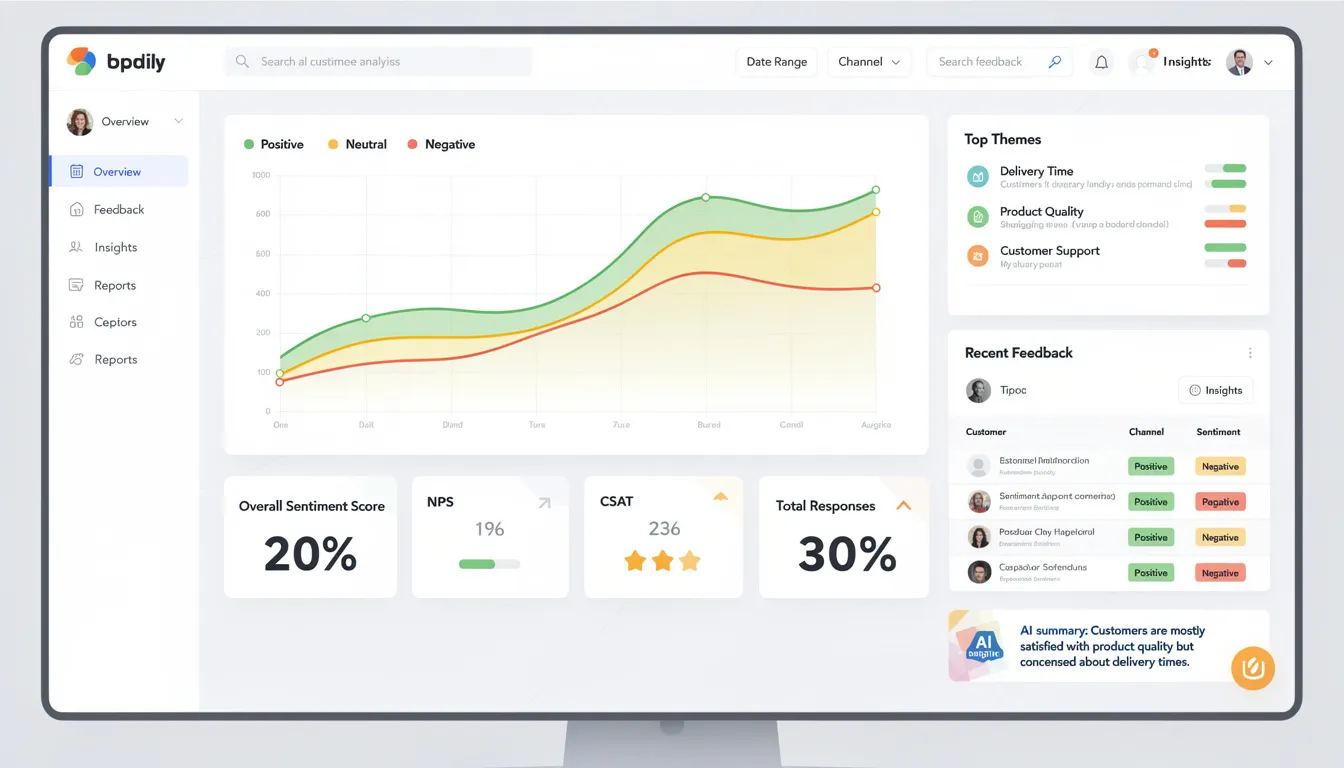
AI Customer Feedback Analysis: Transform Your Customer Insights in 2026
Key Takeaways
AI analyzes 100% of customer interactions across all channels in real-time, compared to manual methods that miss critical insights
Businesses using AI for feedback analysis report 17% increase in customer satisfaction and 38% reduction in response times
AI-driven feedback analysis contributes to increasing customer satisfaction through faster, more personalized, and proactive support
AI-powered analysis uncovers key insights from customer interactions, enabling data-driven improvements
AI-powered sentiment analysis helps companies like Motel Rocks achieve 9.44% CSAT improvements through proactive issue detection
Natural language processing and machine learning eliminate manual sorting of surveys and support tickets, saving teams over 1 hour daily
AI feedback analysis enables predictive customer support and prevents churn by identifying negative trends before they escalate
Modern businesses face an unprecedented challenge: customer feedback volumes have exploded across digital channels, making manual analysis practically impossible. While traditional approaches leave teams drowning in unstructured data, AI customer feedback analysis transforms this overwhelming information flow into actionable customer intelligence.
The stakes have never been higher. Customers expect personalized, immediate responses across every touchpoint, yet most organizations analyze only small samples of their customer feedback. This selective approach means missing critical insights that could prevent churn, identify product opportunities, or resolve service issues before they escalate.
AI customer feedback analysis changes this equation entirely. By processing 100% of customer interactions using natural language processing and machine learning, businesses gain comprehensive understanding of customer sentiment, preferences, and pain points in real-time. The result? Companies implementing AI-powered feedback analysis report significant improvements in customer satisfaction, operational efficiency, and revenue growth.
What is AI Customer Feedback Analysis?
AI customer feedback analysis represents a sophisticated system that automatically collects, processes, and analyzes customer feedback from multiple sources using machine learning and natural language processing technologies. Artificial intelligence technologies form the backbone of modern customer feedback analysis systems, enabling automation and deeper insights. Unlike traditional methods that rely on manual sorting and subjective interpretation, AI systems process vast volumes of unstructured feedback data to extract actionable insights about customer sentiment, preferences, and pain points.
The comprehensive data sources include customer surveys, online reviews, support tickets, social media interactions, email correspondence, chat conversations, and even voice recordings from sales calls. AI systems collect feedback from multiple channels, including surveys, reviews, and social media. This multi-channel approach ensures no customer voice goes unheard, creating a complete picture of customer experience across all touchpoints. A customer program can systematically gather and analyze feedback across all these touchpoints to drive continuous improvement.
What sets AI feedback analysis apart is its ability to process unstructured feedback data that traditional methods struggle to handle. While manual approaches might analyze 5-10% of customer feedback due to resource constraints, AI systems process 100% of available feedback, uncovering patterns and insights that would otherwise remain hidden.
The fundamental difference lies in comprehensiveness and speed. Traditional feedback monitoring becomes impractical as businesses scale operations, forcing teams to rely on small samples or high-level metrics that miss nuanced customer insights. AI customer feedback analysis scales infinitely, processing millions of customer interactions while maintaining consistent analytical standards across all data sources.
This technology accelerates feedback analysis to keep pace with modern customer expectations. In an era where customer preferences shift rapidly and competitive advantages depend on responsive customer experience management, ai for customer feedback enables organizations to collect and analyze data more efficiently. AI provides the speed and depth necessary for data driven decisions that truly impact customer retention and satisfaction.
Why AI Customer Feedback Analysis is Critical in 2026
Customer interaction volumes have grown exponentially beyond manual analysis capabilities for most businesses. The digital transformation has created multiple customer touchpoints - from social media comments to app store reviews, support chat conversations to email inquiries - generating feedback faster than human teams can process effectively.
Research reveals that 83.8% of product professionals believe AI analyzes feedback data faster than traditional methods, highlighting the growing recognition that manual approaches simply cannot keep pace with modern data volumes. This speed advantage isn’t just about efficiency; it’s about competitive survival in markets where customer expectations evolve rapidly. AI also automates time consuming tasks such as sorting and categorizing feedback, allowing businesses to respond more quickly and accurately.

Modern customers expect real-time, personalized responses across digital channels. They share feedback through their preferred platforms and anticipate that businesses will acknowledge, understand, and act on their input quickly. AI enhances customer engagement by enabling consistent, proactive communication across all channels, fostering loyalty and satisfaction. When companies fail to meet these expectations, customers readily switch to competitors who demonstrate superior responsiveness and understanding.
The complexity extends beyond volume to variety. Today’s customer feedback spans multiple languages, cultural contexts, and communication styles. Manual analysis teams struggle with this diversity, often missing cultural nuances or misinterpreting sentiment due to limited linguistic expertise. AI systems trained on diverse datasets can process feedback in customers’ native languages while maintaining analytical consistency, helping organizations gain insights into customer needs and preferences.
Manual feedback monitoring becomes impractical as businesses scale operations across geographic markets and customer segments. What works for analyzing feedback from 1,000 customers breaks down completely when serving 100,000 or 1,000,000 customers. AI supports service teams by handling large volumes of feedback efficiently, enabling businesses to maintain intimate customer understanding even as they grow globally.
Perhaps most critically, AI enables proactive customer experience management instead of reactive problem-solving. Traditional approaches identify issues only after they’ve accumulated enough complaints to become statistically obvious. By then, multiple customers have already experienced negative interactions, potentially damaging brand reputation and customer loyalty. AI systems detect emerging issues from early signals, enabling preventive action that protects both customer relationships and business outcomes.
Key Benefits of AI-Powered Customer Feedback Analysis
AI transforms feedback analysis efficiency and accuracy across multiple dimensions, delivering measurable improvements that directly impact business results. By enabling service professionals to deliver more relevant responses to customer inquiries, AI leverages customer data and insights for personalized and contextually appropriate interactions. These tools empower service professionals by reducing manual workload and improving response quality, allowing them to focus on higher-value tasks while AI handles repetitive analysis. These benefits compound over time as AI systems learn from accumulated data and organizations develop more sophisticated approaches to customer intelligence.
Speed and Efficiency Gains
The most immediately visible benefit involves dramatic improvements in processing speed and operational efficiency. Research indicates that 86% of marketers report natural language processing tools save them at least 1 hour daily on analysis tasks, freeing skilled professionals to focus on strategic interpretation and action planning rather than routine data processing.
Real-time processing eliminates the traditional delays between feedback collection and actionable insights. Where manual analysis might take weeks to identify patterns across customer surveys and support tickets, AI systems surface trends within hours or even minutes of data collection. This speed enables organizations to respond to customer needs while issues remain fresh and resolvable.
Automated categorization and tagging reduce manual sorting time by up to 90%, transforming how customer support teams handle incoming feedback. Instead of manually reading through hundreds of support tickets to identify themes, AI systems automatically categorize inquiries by topic, sentiment, and urgency level, enabling more efficient resource allocation and faster response times.
A compelling example comes from IBM’s implementation of cognitive tools, which increased agent efficiency by 33% and reduced customer wait times to just 33 seconds. This improvement stems from AI’s ability to instantly analyze customer inquiries and route them to agents with relevant expertise, while simultaneously providing agents with context and suggested responses based on similar previous interactions.
Enhanced Accuracy and Pattern Detection
Natural language processing algorithms detect subtle nuances and sentiment variations that humans might miss or inconsistently interpret. While human analysts bring valuable judgment to feedback analysis, they also introduce subjective bias and interpretation variations that affect analytical consistency. AI systems apply identical logical frameworks across all feedback, ensuring objective evaluation focused on patterns within customer data rather than analyst assumptions.
AI identifies hidden patterns across large datasets that would be impossible to spot manually. These patterns might include correlations between specific product features and customer satisfaction levels, or subtle indicators that predict customer churn risk weeks before traditional metrics would signal problems. Machine learning algorithms excel at finding these complex relationships within multidimensional data.
Consistent analysis standards eliminate human bias and subjective interpretation that can skew results when different team members analyze similar feedback. This consistency proves particularly valuable for organizations with multiple analysts or teams processing customer feedback, ensuring comparable results regardless of who performs the analysis.
Machine learning capabilities improve accuracy over time through continuous training on new data. As AI systems process additional customer feedback, they learn to recognize emerging language patterns, sentiment expressions, and topic categories that weren’t present in initial training data. This self-improving mechanism means implementations become more sophisticated and accurate as they mature.
Comprehensive Data Coverage
AI processes 100% of customer interactions across agents, automated bots, business process outsourcing partners, and multiple languages, creating unprecedented visibility into customer sentiment and needs. Traditional sampling approaches might analyze 5-15% of available feedback due to resource constraints, missing critical insights that could influence strategic decisions.
The technology processes megabytes of feedback stored across cloud platforms and disparate systems, unifying analysis that would otherwise remain fragmented across different tools and departments. Customer feedback often exists in silos - marketing surveys in one platform, support tickets in another, social media mentions scattered across various monitoring tools. AI creates unified analysis that connects insights across all these sources.
This comprehensive coverage provides complete customer sentiment overview impossible with manual sampling methods. Organizations gain visibility into customer experience patterns that span multiple touchpoints and interaction types, revealing how customers truly feel about their overall relationship with the brand rather than isolated transaction experiences.
Automated analysis scales infinitely without proportional increases in operational costs. While hiring additional human analysts to process growing feedback volumes creates linear cost increases, AI systems handle exponential data growth with minimal incremental expense once implemented.
Predictive Customer Insights
Advanced AI capabilities extend beyond reactive analysis to identify early warning signs of customer dissatisfaction and potential churn. By analyzing patterns in customer language, interaction frequency, and sentiment trends, AI systems can flag at-risk customers before traditional metrics indicate problems.
Predictive models analyze historical patterns and behavioral data to anticipate customer needs and preferences. This capability enables organizations to prepare proactive solutions and personalized support approaches that address customer concerns before they become complaints or cancellation requests.
Proactive issue resolution becomes possible when AI systems detect emerging problems from subtle feedback signals. Instead of waiting for enough complaints to accumulate before recognizing systematic issues, organizations can investigate and resolve problems based on early detection through AI pattern recognition.
A notable example involves Liberty’s achievement of 88% customer satisfaction using Zendesk QA to predict and prevent escalations. By analyzing conversation patterns and sentiment indicators, the system identifies interactions likely to require escalation and provides agents with proactive guidance to resolve issues at first contact.
Core AI Technologies Behind Customer Feedback Analysis
Understanding the technological foundation helps organizations make informed decisions about AI customer feedback implementation and set appropriate expectations for capabilities and limitations.
Natural Language Processing (NLP)
Natural language processing enables AI systems to understand human language context, tone, and meaning within customer feedback. Unlike simple keyword matching, NLP algorithms comprehend linguistic nuances, contextual relationships, and emotional undertones that determine actual customer sentiment and intent.

The technology processes unstructured text from reviews, surveys, and support conversations, transforming informal human communication into structured data suitable for analysis. This processing capability handles spelling variations, slang, abbreviations, and conversational language patterns that customers actually use rather than formal business language.
NLP identifies key themes, topics, and sentiment indicators automatically, eliminating the need for manual coding or categorization schemes. Advanced implementations recognize context-dependent sentiment, understanding that phrases like “this could be better” express criticism in product feedback contexts but might indicate mild frustration in support interactions.
Natural language processing also powers chatbots and virtual assistants to understand customer intent in real-time interactions. This capability enables immediate response to customer inquiries while simultaneously capturing feedback data for broader analysis and pattern recognition.
Machine Learning and Sentiment Analysis
Machine learning algorithms train on historical feedback data to improve classification accuracy and pattern recognition capabilities. These systems learn from examples of correctly categorized feedback, developing increasingly sophisticated understanding of how customer language relates to sentiment, topics, and business outcomes.
Sentiment analysis represents a specialized application that detects positive, negative, and neutral emotional tones within customer feedback. Advanced implementations extend beyond simple categorization to identify granular emotions like frustration, delight, confusion, or urgency, providing nuanced understanding of customer emotional states.
The technology learns from customer behavior patterns to predict future feedback trends and satisfaction trajectories. By analyzing relationships between customer characteristics, interaction history, and feedback patterns, machine learning models identify predictive indicators that enable proactive customer management.
Zendesk’s AI exemplifies sophisticated implementation, having been trained on over 18 billion real customer service interactions for enhanced customer experience focus. This extensive training enables the system to recognize subtle patterns and context variations across diverse industries and interaction types.
Generative AI for Insights
Generative AI creates automated summaries and explanations of feedback trends and patterns, transforming complex analytical results into easily understood business intelligence. Instead of requiring specialized expertise to interpret statistical outputs, generative AI produces plain language explanations that any team member can understand and act upon.
The technology generates actionable recommendations based on customer feedback analysis, suggesting specific improvements or interventions based on identified patterns and trends. These recommendations consider business context and constraints, providing practical guidance rather than purely technical analysis results.
Dynamic reports translate complex data relationships into executive-friendly summaries that highlight key trends, emerging issues, and strategic opportunities. Generative AI can produce different report formats and detail levels appropriate for various audiences, from operational teams needing tactical guidance to executives requiring strategic overviews.
Natural language query capabilities enable instant, data-backed explanations of customer issues and trends. Team members can ask questions in plain language and receive immediate answers supported by relevant feedback analysis, democratizing access to customer intelligence across the organization.
Practical Methods for AI Customer Feedback Collection and Analysis
Implementing AI feedback analysis requires strategic approaches across different data sources and interaction types. Successful implementations focus on comprehensive coverage while maintaining data quality and actionable insight generation.
Automated Survey Distribution and Analysis
AI optimizes survey timing and content to maximize response rates and feedback relevance. Instead of sending generic surveys at predetermined intervals, AI systems analyze customer interaction patterns to identify optimal moments when customers are most likely to provide thoughtful feedback.
Automated triggers initiate customer satisfaction and Net Promoter Score surveys immediately following customer interactions, capturing sentiment while experiences remain fresh in customers’ minds. This timing increases response accuracy and provides timely feedback for service quality monitoring.
Love, Bonito demonstrates effective implementation by using Zendesk to automate post-interaction surveys for performance measurement. Their system automatically sends targeted surveys after support interactions, product purchases, and service appointments, ensuring comprehensive feedback collection without manual intervention.
AI analysis of open-text survey responses extracts specific improvement recommendations that might remain hidden in traditional quantitative analysis. While numerical ratings provide general satisfaction indicators, natural language processing of written responses reveals specific pain points, feature requests, and emotional drivers that inform targeted improvements.
Real-Time Sentiment Monitoring
Continuous monitoring systems track customer sentiment across all touchpoints and channels, providing immediate visibility into customer emotional states and satisfaction trends. This real-time capability enables rapid response to emerging issues before they escalate into larger problems affecting multiple customers.
AI flags negative sentiment and escalation risks in real-time for immediate intervention by customer success teams. Automated alerts notify appropriate team members when customer interactions indicate dissatisfaction, confusion, or frustration levels that require proactive attention.
Sentiment tracking over time measures customer experience improvements and identifies correlation between business changes and customer response patterns. Organizations can assess whether product updates, policy changes, or service improvements actually improve customer sentiment as intended.
Motel Rocks achieved a 9.44% CSAT improvement using AI sentiment analysis for proactive service delivery. Their system monitors customer feedback across all channels and automatically escalates concerning patterns to customer success representatives who can intervene before issues damage customer relationships.
Omnichannel Review Analysis
AI systems connect to major review platforms including App Store, Google Play, and Google Reviews, providing comprehensive visibility into public customer sentiment and brand perception. This integration eliminates manual monitoring across multiple platforms while ensuring no customer feedback escapes attention.
Social media monitoring analyzes mentions and comments across platforms for brand sentiment tracking and competitive intelligence. AI systems can distinguish between direct customer feedback and general brand discussions, focusing analysis on interactions that provide actionable customer insights.
Unified analytics dashboards aggregate feedback from multiple sources into coherent intelligence platforms that eliminate data silos. Instead of checking separate systems for different feedback types, teams access comprehensive customer sentiment analysis through single interfaces that connect insights across all channels.
Regular health checks and trend analysis across all customer touchpoints enable proactive brand management and customer experience optimization. AI systems identify emerging themes, sentiment shifts, and topic trends that might indicate systematic issues or opportunities requiring strategic attention.
Support Interaction Intelligence
AI analyzes chat logs, email exchanges, and support tickets for customer insights that extend beyond immediate problem resolution. This analysis identifies common pain points, frequently requested features, and systematic issues that might require broader organizational attention.
Pattern recognition identifies recurring customer requests and pain points from support data, enabling proactive product improvements and service enhancements. AI-powered virtual customer assistants can handle complex tasks such as resolving account issues or providing product recommendations, leveraging conversational AI to address sophisticated customer needs. Instead of addressing individual issues reactively, organizations can identify and resolve systematic problems that affect multiple customers.
Agent performance evaluation through conversation analysis provides coaching opportunities and quality assurance insights. AI systems identify effective response patterns and communication approaches while flagging interactions that might benefit from additional training or intervention.
Integration with platforms like Intercom and Zendesk creates comprehensive support analytics that connect individual interactions with broader customer experience patterns. This integration enables organizations to understand how support quality affects overall customer satisfaction and retention.
Voice and Video Feedback Processing
AI transcription capabilities make voice feedback from sales calls, user interviews, and customer service interactions searchable and analyzable alongside text-based feedback. This capability ensures comprehensive feedback analysis regardless of communication method preferences.
Voice sentiment analysis extracts emotional indicators and satisfaction signals from tone, pace, and language patterns in recorded conversations. These insights complement textual analysis by providing additional context about customer emotional states and engagement levels.
Integration with tools like Gong and tl;dv enables comprehensive conversation analysis that captures insights from previously inaccessible voice data. Sales and customer success teams gain visibility into customer feedback patterns across all interaction types, improving their ability to anticipate and address customer needs.
Key topic extraction from voice feedback identifies important themes and concerns that customers express verbally but might not mention in written feedback. This analysis ensures comprehensive understanding of customer perspectives across all communication preferences and interaction types.
AI Feedback Analysis Applications by Business Function
Different organizational functions leverage AI feedback analysis for role-specific objectives and outcomes. While AI enhances efficiency and scalability, maintaining human interaction is crucial for complex or sensitive customer issues that require empathy and nuanced understanding. Understanding these applications helps teams identify relevant use cases and implementation priorities that align with their specific responsibilities and goals.
Marketing and Brand Management
Marketing teams use AI feedback analysis to monitor brand sentiment and reputation across digital channels, gaining real-time visibility into how customers perceive brand messaging, product positioning, and competitive differentiation. This monitoring extends beyond traditional social media tracking to include review sites, forums, and customer service interactions.

Trend identification capabilities help marketing professionals understand evolving customer preferences and market dynamics that inform content strategy and campaign development. AI systems detect emerging topics, language patterns, and sentiment shifts that indicate changing customer needs or competitive positioning opportunities.
Campaign performance analysis examines customer response patterns to marketing initiatives, measuring not just engagement metrics but actual customer sentiment and emotional response to messaging. This analysis provides deeper insights into campaign effectiveness than traditional metrics alone.
Competitive intelligence emerges from analyzing competitor mentions and comparative feedback, helping marketing teams understand relative market positioning and identify opportunities for competitive advantage. AI systems analyze customer feedback about competing products and services to inform positioning strategy and messaging development.
Product Development and Management
Product teams extract feature requests and improvement suggestions from customer feedback across all channels, creating data driven product roadmaps that reflect actual customer needs rather than internal assumptions. AI analysis identifies patterns in feature requests that might not be apparent from individual customer interactions.
Prioritization becomes more objective when based on quantified customer demand extracted from feedback analysis. Instead of relying solely on internal stakeholder opinions or limited user research, product managers can base decisions on comprehensive analysis of customer preferences expressed through natural interactions.
User experience monitoring identifies usability issues and friction points that customers experience with existing products. AI analysis of support tickets, reviews, and feedback reveals specific interaction problems that traditional usability testing might miss due to scope or timing limitations.
Product satisfaction tracking measures customer response to updates, new features, and product changes through ongoing feedback analysis. Teams can validate whether product improvements actually enhance customer experience and satisfaction as intended.
Customer Success and Support
Customer success teams leverage predictive analytics to identify at-risk customers through negative feedback patterns and sentiment trends. Early identification enables proactive intervention before customers reach cancellation decisions, improving retention rates and customer lifetime value.
Process optimization opportunities emerge from analyzing common customer issues and support interaction patterns. AI identifies recurring problems, frequent escalation triggers, and systematic issues that indicate opportunities for process improvements or preventive measures.
Agent performance coaching becomes more targeted when based on comprehensive conversation analysis and customer feedback patterns. Customer support teams can identify coaching opportunities, recognize exceptional performance, and improve overall service quality through data driven insights.
Proactive outreach strategies develop from predictive analytics that identify customers likely to need additional support or intervention. Instead of waiting for customers to contact support with problems, teams can reach out proactively to provide assistance and demonstrate commitment to customer success.
Implementation Best Practices for AI Customer Feedback Analysis
Strategic implementation approaches determine whether AI feedback analysis delivers transformational business value or becomes another underutilized technology investment. Successful implementations focus on clear objectives, systematic integration, and human-AI collaboration that amplifies organizational capabilities.
Starting with Clear Objectives
Define specific goals like reducing response times, improving customer satisfaction scores, or scaling support operations to handle growing customer interaction volumes. Clear objectives provide measurement criteria for implementation success and guide technology selection and configuration decisions.
key metrics and key performance indicators that will measure AI implementation success, establishing baseline measurements before deployment to enable accurate impact assessment. These metrics might include customer satisfaction scores, response time averages, agent efficiency measures, or customer retention rates.
Establish baseline measurements through comprehensive analysis of current feedback processing capabilities, response times, and analytical insights. Understanding existing performance levels enables accurate measurement of AI implementation impact and return on investment calculations.
Align AI initiatives with broader customer experience and business objectives to ensure implementation supports strategic goals rather than operating as isolated technology projects. Integration with business strategy ensures AI feedback analysis contributes to meaningful organizational outcomes.
Data Quality and Integration
Centralize feedback data from all sources into unified analytics platforms that eliminate silos and enable comprehensive customer intelligence. Data fragmentation undermines AI effectiveness by limiting pattern recognition and insight generation capabilities.
Ensure data cleanliness and accuracy to avoid biased or irrelevant AI insights that could mislead decision-making. Poor data quality produces unreliable analysis results that may actually harm business outcomes by encouraging misguided actions based on flawed insights.

Integrate AI tools seamlessly with existing customer relationship management and support platforms to minimize disruption while maximizing analytical capabilities. Successful integration ensures AI insights flow naturally into existing workflows and decision-making processes.
Maintain data privacy compliance and security standards throughout implementation to protect customer information while enabling analytical insights. Privacy considerations become particularly important when analyzing sensitive customer feedback and personal information.
Human-AI Collaboration Strategy
Train employees on AI tool usage and interpretation of AI-generated insights to ensure teams can effectively leverage new capabilities. Technology training should focus on practical application and decision-making rather than technical implementation details.
Establish clear escalation paths for complex issues requiring human intervention and judgment. AI systems excel at pattern recognition and routine analysis but may struggle with edge cases, cultural nuances, or complex business contexts that require human expertise.
Use AI to augment human capabilities rather than replace human judgment, combining AI’s processing speed and consistency with human creativity, empathy, and strategic thinking. The most successful implementations create complementary relationships between AI systems and human teams.
Implement regular monitoring and feedback loops to continuously improve AI performance and ensure alignment with evolving business needs. AI systems require ongoing refinement and adjustment as customer communication patterns and business contexts evolve.
Challenges and Solutions in AI Customer Feedback Analysis
Understanding common implementation obstacles and proven solutions helps organizations avoid pitfalls and accelerate successful AI adoption. These challenges span technical, organizational, and strategic dimensions that require comprehensive planning and management attention.
Data Quality and Bias Concerns
AI models may inherit biases from historical feedback data, potentially perpetuating discriminatory patterns or skewed perspectives that don’t reflect true customer sentiment. Historical data might over-represent certain customer segments while under-representing others, leading to biased insights and recommendations.
Regular model testing and diverse training data minimize bias through systematic evaluation and adjustment of AI algorithms. Organizations should audit training datasets for representation balance and continuously monitor AI outputs for fairness across different customer segments and interaction types.
Implementation of human oversight for critical decisions and edge cases ensures appropriate judgment in situations where AI recommendations might be inappropriate or insufficient. Human review becomes particularly important for high-stakes customer interactions or complex business contexts.
Continuous monitoring of AI outputs for accuracy and fairness requires ongoing evaluation processes that assess both technical performance and business impact. Organizations should establish review procedures that catch potential problems before they affect customer relationships or business outcomes.
Integration and Technical Complexity
Connecting disparate feedback sources and legacy systems presents significant technical challenges that require careful planning and implementation expertise. Many organizations operate multiple customer interaction platforms that weren’t designed for integration, creating data silos and technical barriers.
API-first platforms and middleware solutions enable seamless integration by providing standardized connection protocols between different systems. Modern AI feedback analysis platforms typically offer extensive integration capabilities that simplify connection to existing customer interaction tools.
Phased implementation approaches starting with high-value, low-complexity use cases build confidence and expertise while demonstrating value before tackling more challenging integration projects. Successful organizations often begin with single-channel analysis before expanding to omnichannel implementation.
Investment in employee training and change management support ensures teams can effectively adopt new processes and technologies. Technical implementation succeeds only when accompanied by organizational change management that helps people adapt to new workflows and capabilities.
Privacy and Compliance Requirements
Customer data privacy regulations require careful handling of personal information while enabling comprehensive feedback analysis. Organizations must balance analytical capabilities with privacy protection, ensuring compliance with regulations like GDPR, CCPA, and industry-specific requirements.
Privacy-by-design AI platforms incorporate built-in compliance features that protect customer information throughout the analysis process. Modern AI systems offer encryption, anonymization, and access control features that maintain analytical capabilities while protecting sensitive data.
Data anonymization and encryption protocols protect sensitive customer information while preserving analytical value. Advanced techniques enable analysis of customer sentiment and patterns without exposing personally identifiable information or sensitive details.
Regular compliance audits and transparent data usage policies ensure ongoing adherence to privacy requirements while maintaining customer trust. Organizations should establish clear procedures for data handling, retention, and usage that customers understand and consent to.
Leading AI Customer Feedback Analysis Platforms in 2024
The marketplace offers diverse AI platforms designed for different organizational needs, scales, and technical requirements. Understanding available options helps organizations select solutions that align with their specific objectives and constraints.
Enterprise-Grade Platforms
Zendesk AI represents sophisticated enterprise implementation, trained on over 18 billion customer interactions to provide comprehensive quality assurance and sentiment analysis capabilities. The platform offers automated survey distribution, agent copilots for real-time assistance, and escalation detection that identifies concerning interaction patterns.
Integration capabilities with major customer relationship management and support platforms enable seamless implementation within existing technology ecosystems. Zendesk connects with popular business tools to ensure AI insights flow naturally into established workflows and decision-making processes.
Scalable pricing models accommodate businesses of all sizes, from startups implementing basic feedback analysis to enterprise organizations requiring advanced analytics and customization. Flexible pricing enables organizations to start with essential features and expand capabilities as needs grow and budgets allow.
Advanced features include predictive analytics for churn prevention, automated quality scoring for customer interactions, and natural language querying that enables teams to ask questions and receive data-backed answers in plain language.
Specialized Analytics Tools
Survicate Insights Hub provides AI-powered categorization and sentiment analysis specifically designed for surveys and reviews, offering specialized capabilities for organizations focused on structured feedback analysis. The platform excels at processing survey responses and extracting actionable insights from review data.
Research Assistant functionality provides detailed insights and answers from aggregated feedback data, enabling teams to query their customer feedback like a knowledgeable analyst. This capability democratizes access to customer intelligence across organizations.
Integration with major review platforms and support tools creates unified analysis that connects insights from multiple feedback sources. Survicate’s connectivity eliminates manual data collection while ensuring comprehensive feedback coverage.
Data privacy focus with feedback processing in secure environments addresses compliance requirements while maintaining analytical capabilities. The platform incorporates privacy protection features that satisfy regulatory requirements without compromising insight generation.
Voice of Customer Solutions
Voice of Customer Insights platforms leverage generative AI for root cause detection that identifies underlying issues behind customer feedback patterns. These systems analyze not just what customers say but why they feel the way they do, providing deeper insights for strategic decision-making.
Automatic customer satisfaction scoring for 100% of customer conversations eliminates sampling limitations while providing comprehensive visibility into customer experience quality. Instead of measuring satisfaction for selected interactions, organizations gain complete coverage across all customer touchpoints.
Natural language AI queries enable instant, data-backed explanations of customer issues and trends. Teams can ask complex questions about customer feedback patterns and receive immediate answers supported by relevant data analysis.
Dynamic summaries and interactive visualizations provide executive reporting that translates complex customer intelligence into strategic insights. Leadership teams gain access to customer feedback insights without requiring technical expertise or detailed analytical skills.
Future Trends in AI Customer Feedback Analysis
Emerging technologies and capabilities will transform AI feedback analysis over the next several years, creating new opportunities for customer intelligence and experience optimization. Understanding these trends helps organizations plan strategic investments and capabilities development.
Advanced Predictive Analytics
AI systems will evolve to predict customer needs and issues before they manifest in feedback, enabling truly proactive customer experience management. Advanced algorithms will analyze subtle behavioral patterns and interaction indicators to anticipate customer concerns weeks or months before traditional feedback signals appear.

Proactive customer outreach based on behavioral pattern analysis will enable organizations to address potential issues before customers experience problems. This capability transforms customer service from reactive problem-solving to preventive relationship management.
Real-time personalization of customer experiences based on predicted sentiment will create individualized interactions that anticipate and address customer emotional states. AI systems will adjust communication tone, offer timing, and service approaches based on predicted customer preferences and needs.
Integration with Internet of Things and product usage data will provide comprehensive customer understanding that combines feedback analysis with behavioral data from connected products and services. This integration creates holistic customer intelligence that spans both expressed preferences and revealed behaviors.
Multi-Agent AI Systems
Collaborative AI agents will work together to provide comprehensive feedback analysis through specialized capabilities and distributed intelligence. Different agents will focus on specific analysis tasks like sentiment detection, trend identification, or predictive modeling while sharing insights through coordinated systems.
Specialized agents for different feedback types and analysis tasks will optimize performance by focusing on specific capabilities rather than attempting universal analysis. Voice analysis agents, text processing agents, and predictive modeling agents will collaborate to provide comprehensive customer intelligence.
Enhanced problem-solving through distributed AI intelligence will tackle complex analytical challenges that exceed single-system capabilities. Multi-agent systems will combine different analytical approaches and perspectives to generate more sophisticated insights and recommendations.
Improved accuracy and efficiency through agent collaboration will result from systems that verify and refine each other’s outputs while specializing in complementary capabilities. This collaborative approach will reduce errors while accelerating insight generation.
Conversational AI Interfaces
Natural language interfaces will enable business users to query and explore feedback data through conversational interactions rather than technical dashboards or reports. Teams will ask questions in plain language and receive immediate answers supported by relevant analysis and visualizations.
Voice-activated analytics will provide mobile and hands-free feedback analysis capabilities that enable access to customer insights from anywhere. Sales professionals, customer success managers, and executives will access real-time customer intelligence through voice interactions.
Conversational reporting will explain insights in plain language that any team member can understand and act upon. Instead of requiring analytical expertise to interpret complex data relationships, AI systems will provide narrative explanations that highlight key findings and recommendations.
AI-powered coaching and recommendations delivered through chat interfaces will provide real-time guidance based on customer feedback patterns and best practices. Customer service agents and other customer-facing professionals will receive immediate assistance and suggestions based on comprehensive feedback analysis.
FAQ
How does AI customer feedback analysis differ from traditional Net Promoter Score (NPS) surveys?
AI customer feedback analysis processes 100% of customer interactions across all channels in real-time, while NPS surveys capture feedback from a small sample of customers at specific points in time. AI analyzes unstructured feedback like reviews, support tickets, and social media comments to provide continuous insights, whereas NPS focuses on a single numerical score with limited context. AI also identifies specific pain points and emotional drivers behind customer sentiment, while NPS provides only general satisfaction indicators.
What specific AI technologies are most effective for analyzing customer sentiment in feedback?
Natural language processing (NLP) forms the core technology for understanding context, tone, and meaning in customer communications. Machine learning algorithms trained on large datasets improve accuracy in sentiment classification and pattern detection. Generative AI creates automated summaries and actionable recommendations from feedback data. Advanced implementations combine these technologies with predictive analytics to identify early warning signs of customer dissatisfaction before issues escalate.
How can small businesses afford and implement AI-powered customer feedback analysis tools?
Many AI platforms offer scalable pricing starting with basic plans under $100 per month, making them accessible for small businesses. Cloud-based solutions eliminate infrastructure costs while providing enterprise-grade capabilities. Small businesses can start with single-channel analysis (like review monitoring) before expanding to omnichannel implementation. Many platforms offer free trials and freemium versions that allow testing before commitment. The time savings from automated analysis often justify costs by freeing staff for revenue-generating activities.
What data privacy considerations should companies address when using AI for feedback analysis?
Organizations must ensure AI platforms comply with regulations like GDPR and CCPA through data encryption, anonymization, and secure processing. Customer consent for feedback analysis should be clearly communicated in privacy policies. Data retention policies should specify how long feedback data is stored and when it’s deleted. Cross-border data transfer requirements must be addressed for global organizations. Regular compliance audits should verify that AI systems maintain privacy protections while delivering analytical insights.
How long does it typically take to see ROI from implementing AI customer feedback analysis?
Most organizations begin seeing initial benefits within 30-60 days of implementation through time savings and improved response efficiency. Significant ROI typically emerges within 3-6 months as AI systems learn patterns and teams develop proficiency with new insights. Companies report measurable improvements in customer satisfaction, response times, and operational efficiency within the first quarter. Long-term ROI accelerates as AI systems become more accurate and organizations develop sophisticated approaches to acting on customer intelligence.