

AI Integration: Setting Measurable Business Goals
95% of AI investments fail to deliver measurable returns. Why? The lack of clear, structured goals. Businesses often adopt AI without aligning it to specific objectives, like reducing costs or improving customer retention. This misstep leads to wasted resources, stalled projects, and missed opportunities.
Here’s the fix: Use the SMART framework - Specific, Measurable, Achievable, Relevant, Time-bound - to set actionable goals for AI initiatives. For example, instead of vaguely aiming to “improve efficiency,” define a clear target like “reduce billing inquiry resolution time from 24 hours to 4 hours using AI automation.”
Key Takeaways:
Define clear objectives: Avoid vague goals like "improve operations." Focus on specific outcomes, such as reducing manual work or increasing ticket resolution speed.
Set measurable KPIs: Track metrics like error rates, processing times, or cost savings to gauge AI’s impact.
Ensure goals are realistic and relevant: Align AI efforts with your business priorities and assess your resources to avoid overpromising.
Create deadlines: Time-bound goals keep teams on track and ensure progress is measurable.
By following this approach, businesses can avoid pilot limbo, maximize ROI, and ensure AI initiatives deliver results that matter.
The Problem: Unclear AI Goals and Their Consequences
Unclear Objectives Waste Resources
When AI goals are left undefined, organizations risk falling into what's often called "pilot limbo" - a state where projects linger without delivering real value. The problem isn't a lack of advanced technology; it's the absence of clear, actionable frameworks to measure what matters most: decision accuracy, adaptability, and measurable business outcomes.
This lack of clarity often leads to the "attractive feature trap", where companies invest in flashy AI features showcased in demos. These features might look impressive but fail to address core business priorities. Without well-defined objectives, teams may mistake operational efficiency for genuine business growth. The result? Resources are poured into initiatives that save time but fail to translate those savings into strategic gains. Worse, disconnected projects drain budgets while competitors with clear, measurable goals surge ahead.
The cost of this misalignment is steep. Every month that a critical process remains inefficient means missed revenue opportunities, weakened competitiveness, and declining customer loyalty. These challenges underscore the importance of structured, measurable objectives. Without them, organizations not only waste resources but also fail to connect AI efforts to meaningful business outcomes.
Disconnected AI Initiatives and Business Results
When AI initiatives lack alignment with broader business objectives, the gap between AI outputs and actual success widens. Without AI-driven KPIs, leaders are left without the "situational awareness" needed to respond to market challenges or seize growth opportunities. This misalignment often results in what some experts call a "Frankenstein's monster" technology stack - a chaotic collection of systems where critical knowledge is siloed among employees, increasing the risk of knowledge loss.
Focusing on isolated technical metrics can also unintentionally harm business performance. For instance, improving a single metric - like boosting chatbot engagement - might inadvertently slow down the purchase process. When AI systems aren't consistently evaluated against business goals, technical errors and inaccuracies can compound over time, eroding the quality of decision-making.
The consequences go beyond wasted resources. Without clear ROI, executive support dwindles, and the organization’s competitive edge erodes. To combat these issues, aligning technical metrics with strategic business goals is essential.
Solution: Using SMART Goals for AI Integration
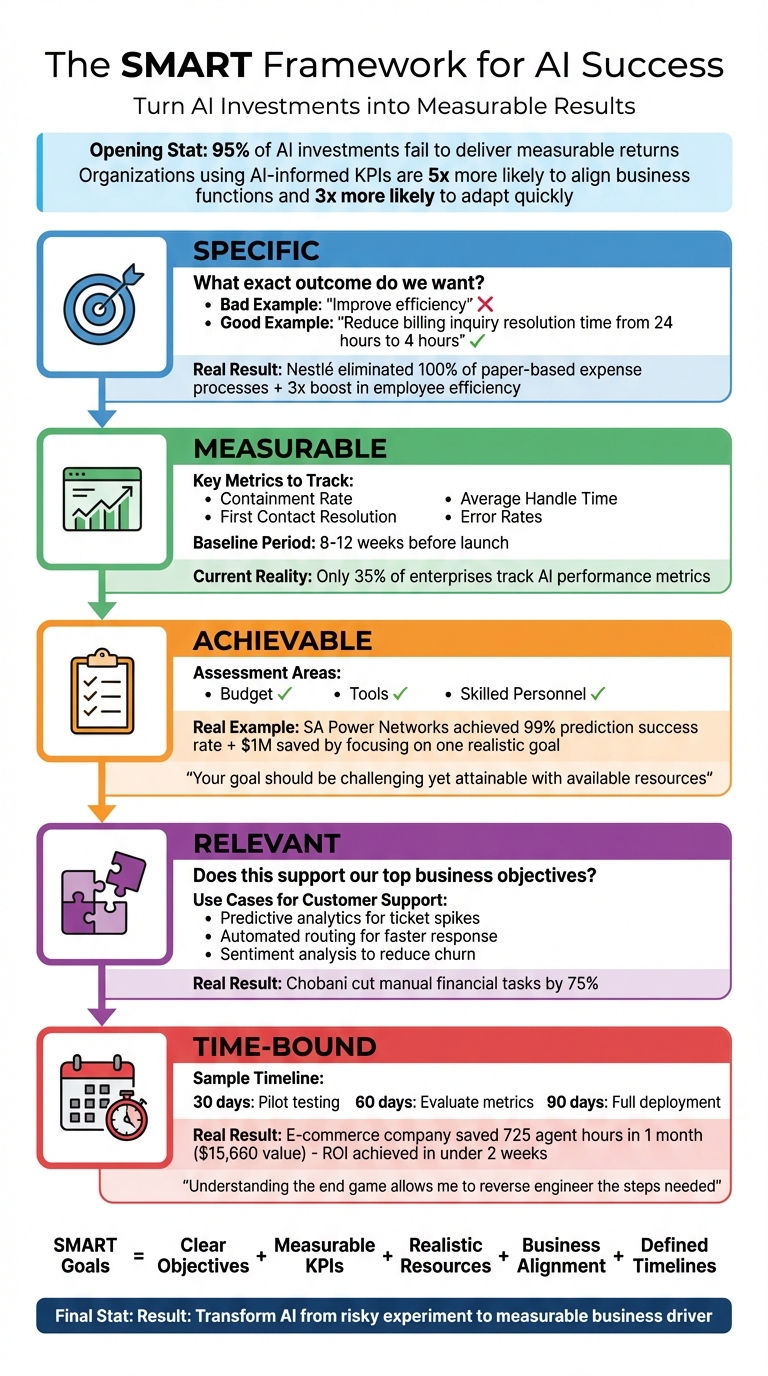
SMART Framework for AI Goal Setting: 5-Step Process to Measurable Business Results
The challenges of misaligned AI initiatives can feel overwhelming, but the SMART framework offers a way to cut through the noise and create actionable plans. SMART stands for Specific, Measurable, Achievable, Relevant, Time-bound, and it’s a proven method for turning lofty AI ambitions into clear, trackable steps that deliver results.
Consider this: organizations that use AI-informed KPIs are 5x more likely to align their business functions and 3x more likely to adapt quickly than those that don’t. Yet, a staggering 95% of AI investments fail to show measurable returns - not because AI lacks potential, but because companies struggle to measure its impact. By using the SMART framework, businesses can set clear success metrics from the start, eliminating guesswork and ensuring every AI initiative moves the needle on what truly matters.
AI only matters if it drives meaningful results - whether that’s cutting costs, speeding up decisions, or boosting customer retention. The SMART approach helps organizations break big goals into smaller, actionable steps. For example, in 2024, CSV Now's CEO Ritchie Tendencia used this framework to tackle employee turnover, setting a goal to reduce it by 10% in one quarter. With an AI-driven training program, the company not only hit the target but exceeded it, achieving a 15% reduction.
By asking critical questions like “What specific outcome do we want?” and “What KPIs will define success?” the SMART framework keeps teams focused on delivering real business value instead of getting distracted by flashy AI features.
Specific: Define Clear AI Objectives
Vague goals like “improve efficiency” or “enhance customer experience” sound great on paper but rarely lead to actionable results. Specific goals answer essential questions: Who’s involved? What’s the exact outcome? When will it happen? Where does it apply? Why is it important?.
Take Nestlé’s initiative in September 2025 as an example. Instead of vaguely aiming to “modernize finance,” they set a precise goal: eliminate all paper-based expense processes using AI tools in SAP Concur. The outcome? A 100% elimination of manual expense management and a 3x boost in employee efficiency for report creation.
For customer support, a specific goal might be: “Reduce billing inquiry resolution time from 24 hours to 4 hours using AI-powered automated tagging and routing.” This level of detail ensures everyone knows what to build, how to measure it, and what success looks like. It also prevents investment in unnecessary AI features that don’t address core business needs.
When defining objectives for AI tools like IrisAgent, focus on measurable outcomes. For instance, “Use automated sentiment analysis to flag at-risk customers within 2 hours of a negative interaction” is far more actionable than “improve customer satisfaction.” Specificity ensures accountability and helps allocate resources effectively.
Measurable: Set Quantifiable Metrics
Without clear metrics, you’re essentially guessing. Measurable goals turn subjective impressions into concrete evidence. Before launching an AI solution, document your baseline metrics - processing times, error rates, customer satisfaction scores - over 8 to 12 weeks.
For customer support AI, track key metrics like:
Containment Rate: The percentage of interactions resolved without human intervention.
First Contact Resolution: How often issues are resolved in a single interaction.
Average Handle Time: The time it takes to resolve a ticket.
If you’re implementing IrisAgent’s automated ticket tagging, measure how accurately tickets are categorized and the time saved on manual sorting. You can even translate time savings into monetary value by multiplying hours saved by labor costs.
Currently, only 35% of enterprises actively track AI performance metrics. To get the full picture, use both leading indicators (like feature adoption rates) to predict success and lagging indicators (like revenue impact) to confirm ROI. This dual approach ensures you can spot issues early and prove the value of your AI initiatives once they’re fully operational.
Achievable and Relevant: Choose Realistic Use Cases
Ambition is great, but setting unattainable goals can demoralize your team and waste resources. The “Achievable” part of SMART encourages an honest assessment of your resources - whether it’s budget, tools, or skilled personnel. If you’re missing key elements, consider a preparation phase to set yourself up for success.
“Your goal should be challenging yet attainable with the available resources.” – Jake Munday, Founder and CEO, Custom Neon
A great example comes from SA Power Networks. In 2025, this Australian utility faced the daunting task of managing aging infrastructure across vast areas. Instead of overhauling everything, they focused on one realistic goal: using an AI-powered app to predict which utility poles were at risk of corrosion. This focused approach achieved a 99% prediction success rate and saved $1 million.
The “Relevant” component ensures your AI goals align with your organization’s broader priorities. Ask yourself: Does this initiative support our top business objectives? For customer support teams, relevant use cases might include predictive analytics to anticipate ticket spikes, automated routing to improve response times, or sentiment analysis to reduce churn - capabilities offered by tools like IrisAgent.
Chobani’s September 2025 project highlights this principle. Instead of chasing trendy AI ideas, they tackled a specific pain point: manual financial processes. By using AI to streamline expense management, they cut time spent on these tasks by 75%, freeing up the finance team to focus on strategic work.
Time-Bound: Set Clear Deadlines
Deadlines are the glue that holds SMART goals together. Time-bound objectives create urgency, keep teams accountable, and allow for progress checks at key milestones. Without deadlines, projects can drift, lose momentum, and fail to deliver results.
“Understanding the end game allows me to reverse engineer the steps needed to get there, which I then shape into specific SMART goals.” – Jake Munday, Founder and CEO, Custom Neon
In 2024, ReviewFlowz founder Axel Lavergne set a six-month goal to reduce customer churn by 10%. By focusing on improving the onboarding process and using AI-driven training tools, the company not only hit the target but exceeded it, strengthening customer loyalty along the way.
For longer AI projects, break your timeline into smaller milestones. For instance, if you’re rolling out IrisAgent’s automated ticket routing, you might:
Set a 30-day milestone for pilot testing with one team.
Use a 60-day milestone to evaluate initial performance metrics.
Aim for a 90-day milestone for full deployment.
This phased approach allows you to catch problems early and adjust course if needed.
One e-commerce company’s experience with a Google Cloud AI chatbot in 2025 shows how effective time-bound goals can be. By automating 60% of routine inquiries, they saved 725 agent hours in just one month, valued at $15,660. The project paid for itself in less than two weeks.
How to Set Measurable AI Goals
To effectively integrate AI into your business, focus on solving real problems with measurable outcomes. This involves three key steps: aligning business challenges with AI solutions, setting clear KPIs, and creating a system to monitor performance.
Step 1: Match Business Problems to AI Solutions
Start by identifying inefficiencies or pain points in your operations. Take a reverse-engineering approach: define the outcome you want to achieve, then trace back to the AI solution that can make it happen. This ensures you're not investing in technology just because it sounds impressive.
Classify your challenges into categories like operational, revenue, customer experience, or strategic issues. For example, slow ticket resolution or inconsistent responses might point to specific opportunities for automation.
A great example of this approach comes from Microsoft in September 2025. They addressed supply chain forecasting issues by focusing on a single problem: inefficient manual planning. By implementing AI-driven planning tools, they cut manual planning by 50% and improved on-time planning accuracy by 75%. The success lay in pairing a clear business need - better forecasting - with the right AI capabilities.
When considering customer support automation, the type of AI matters. Use Generative AI for complex, context-based responses, and traditional AI for structured tasks like ticket routing and tagging. Tools like IrisAgent combine both approaches, automating repetitive tasks while assisting agents with nuanced conversations.
Before committing to a solution, estimate its potential impact. Calculate expected time savings and cost reductions upfront. For example, if automating ticket tagging saves two minutes per ticket and your team processes 10,000 tickets monthly, that’s 333 hours saved. At $30/hour, this translates to $9,990 per month or $119,880 annually.
Once you've pinpointed the right solution, the next step is to define how you'll measure its success.
Step 2: Define KPIs for Business and AI Alignment
After identifying the AI solution, establish clear KPIs to measure its effectiveness. Group your KPIs into three key areas: Model Quality (accuracy of the AI), System Quality (reliability and speed), and Business Impact (financial and operational outcomes).
"You can't manage what you don't measure." – Hussain Chinoy, Gen AI Technical Solutions Manager, Google Cloud
For a customer support AI tool, Model Quality metrics might include accuracy rates for ticket tagging or safety scores to prevent harmful outputs. System Quality could focus on uptime, latency, and error rates. Business Impact KPIs should align with broader goals like Average Handle Time, Customer Satisfaction (CSAT), or cost savings from reduced manual work.
Use both leading and lagging indicators to track success. Leading indicators, like how quickly employees adopt the AI tool, show short-term progress. Lagging indicators, such as reduced churn or increased revenue, demonstrate long-term value.
Before deployment, gather baseline data over 8–12 weeks. For example, if your team currently takes 24 hours to resolve tickets or spends 15 hours per week on manual tagging, document these figures. This baseline helps prove ROI once the system is live.
Translate operational improvements into financial terms. For instance, if automating expense processing saves 75% of manual work, you can calculate the potential dollar value of that time saved. Chobani used this approach in September 2025, achieving a 75% reduction in manual finance tasks and freeing up their team for more strategic work.
With KPIs in place, the focus shifts to ensuring ongoing success.
Step 3: Build a Monitoring System for Continuous Improvement
Defining goals is just the beginning. To maintain and grow the value of your AI solution, implement a continuous feedback system to monitor performance and make adjustments as needed.
Set up a centralized dashboard to track metrics in real time. Monitor Model Quality (accuracy, error rates), System Quality (latency, uptime), Adoption (how often employees use the tool), and Business Impact (cost savings, customer satisfaction). Businesses that actively track AI-informed KPIs are 5x more likely to align across departments and 3x more likely to adapt to change effectively.
Pay attention to both technical performance and user behavior. If the system performs well but sees low adoption, the issue might be usability or training. Track metrics like frequency of use and session length to identify gaps.
For example, IrisAgent’s sentiment analysis feature can flag at-risk customers after negative interactions. If agents fail to act on those alerts, the problem may lie in workflows or training - not the AI itself.
SA Power Networks demonstrated the importance of continuous monitoring in September 2025. After deploying an AI tool to identify corroding utility poles, they tracked predictions against actual corrosion rates. This ongoing refinement led to a 99% success rate and $1 million in savings within a year.
Establish regular review cycles - monthly or quarterly - to evaluate progress. If metrics fall short, analyze the data: Is the model underperforming? Are employees struggling with adoption? Has the business environment shifted? Use these insights to refine prompts, retrain models, or enhance user training.
The ultimate goal is steady, measurable progress over time. By actively monitoring and refining your AI systems, you ensure they continue to deliver value long after their initial rollout.
Case Study: Achieving Measurable Goals with IrisAgent

This case study dives into how IrisAgent applies the SMART framework to deliver quantifiable results in customer support.
Boosting Customer Support Efficiency with AI
IrisAgent has delivered impressive results in customer support operations. The platform handles over 1 million tickets monthly for its clients, achieving an impressive 95% tagging accuracy. This level of precision ensures smoother workflows and higher customer satisfaction.
Here’s an example: IrisAgent automatically identified key tags in a subscription cancellation request, routed it to the correct specialist, and tracked a positive sentiment score throughout the interaction.
Organizations leveraging IrisAgent report 10x faster response times and a 40% reduction in ticket volume through deflection. These improvements not only cut costs but also enhance customer experiences.
Measuring Success with Real-Time Insights
IrisAgent’s real-time monitoring tools empower teams to continuously refine their approach. For instance, its sentiment analysis feature provides a "Live Score" during active conversations, helping teams spot and address customer frustration before it escalates. This proactive strategy transforms customer sentiment into an actionable metric.
The platform’s predictive analytics go a step further. By analyzing every ticket and bug, it identifies potential risks to revenue and customer satisfaction, flagging at-risk accounts in real time. These alerts allow support teams to focus on high-priority issues, ensuring not just ticket resolution but also safeguarding customer retention and revenue. This capability is invaluable when demonstrating the ROI of AI tools to business leaders.
These real-time insights align AI-driven support with broader business objectives, making IrisAgent an essential tool for achieving measurable success.
Conclusion
When it comes to integrating AI, setting measurable goals isn’t just a nice-to-have - it’s what separates smart investments from wasted efforts. The organizations that thrive with AI begin by defining clear business objectives and then align the technology to meet those goals.
Using the SMART framework can turn AI from a risky experiment into a tool that drives real results. By breaking down strategic objectives into specific, measurable outcomes, businesses can track progress and demonstrate ROI. This means setting clear targets, monitoring performance with quantifiable metrics, and building feedback loops that ensure AI initiatives stay on course.
"AI isn't valuable on its own. It's valuable when it moves the needle on something the business already cares about." – SAP
AI-driven KPIs don’t just boost efficiency - they redefine how businesses operate and compete. These metrics align teams across departments, enabling more agile and cohesive decision-making.
The key to success lies in discipline. Establish baseline metrics, track improvements, and translate those gains into financial impact. Tools like IrisAgent show how real-time monitoring and predictive analytics can turn areas like customer support into revenue-generating opportunities instead of cost centers.
With a focused and methodical approach, businesses can make measurable progress. Start with a single, well-defined use case, measure its success rigorously, and then scale those results to achieve meaningful ROI. As IrisAgent’s example illustrates, when you measure the right metrics, even traditionally cost-heavy areas like support can become powerful drivers of revenue.
FAQs
How can businesses set clear and measurable goals for AI projects?
To make sure AI projects achieve meaningful business outcomes, it's essential to set SMART goals - Specific, Measurable, Achievable, Relevant, and Time-bound. Let’s break that down: a specific goal might involve automating ticket tagging, measurable by reaching 90% accuracy and cutting ticket handling time by 2 minutes. These goals should be realistic, considering your data and resources, closely tied to business priorities like cost savings or customer satisfaction, and have a clear timeline for completion.Start by pinpointing the business result you’re aiming for - say, reducing support costs by 15%. Next, outline measurable KPIs, such as tagging accuracy or improvements in response times. Make sure the goal is achievable based on your current AI capabilities, and align it with your company’s larger strategic objectives. Lastly, establish deadlines and milestones to monitor progress effectively.Here’s an example of a SMART goal using IrisAgent: "By June 30, 2026, deploy IrisAgent’s AI-driven ticket tagging solution across the U.S. support team, achieving 90% accuracy, decreasing ticket handling time from 5 minutes to 3 minutes, and saving $250,000 annually in labor costs." This method ensures your AI project delivers tangible results while staying aligned with key business priorities.
What are the common mistakes in AI integration, and how can businesses avoid them?
Many challenges in AI integration stem from organizational hurdles rather than technical difficulties. One of the most common missteps is launching projects without clearly defined, business-driven goals. This often results in chasing trends instead of delivering measurable results. Another issue is the absence of a solid framework for tracking progress, which makes it hard to measure ROI or justify further investment. Other stumbling blocks include poorly prioritized use cases, inadequate change management, and overlooking the importance of data quality and governance.To steer clear of these problems, businesses should prioritize outcomes from the very beginning. Establish clear Objectives and Key Results (OKRs) and identify measurable KPIs - such as model accuracy, user engagement, or financial performance - to monitor progress. Complement these with leading indicators, like adoption rates, to spot potential issues early. A strong focus on data governance, starting with high-impact pilot projects, and scaling only after meeting predefined success criteria are critical steps for success. Tools like IrisAgent can play a key role by delivering real-time analytics, automating repetitive tasks, and providing insights such as sentiment analysis and predictive dashboards, ensuring AI initiatives align seamlessly with business objectives.
Why is it crucial to align AI-driven KPIs with overall business goals?
Aligning AI-driven KPIs with your business goals is key to ensuring your AI initiatives deliver measurable results that matter. When your AI efforts are closely tied to your broader objectives, it becomes easier to allocate resources wisely, make meaningful strides toward your goals, and ensure AI projects lead to real, actionable outcomes.By connecting AI metrics directly to your top business priorities, you can monitor progress more effectively, minimize wasted efforts, and establish a clear path to achieving sustainable growth and improved efficiency.


