What Forethought Customers Should Do After the Zendesk Acquisition
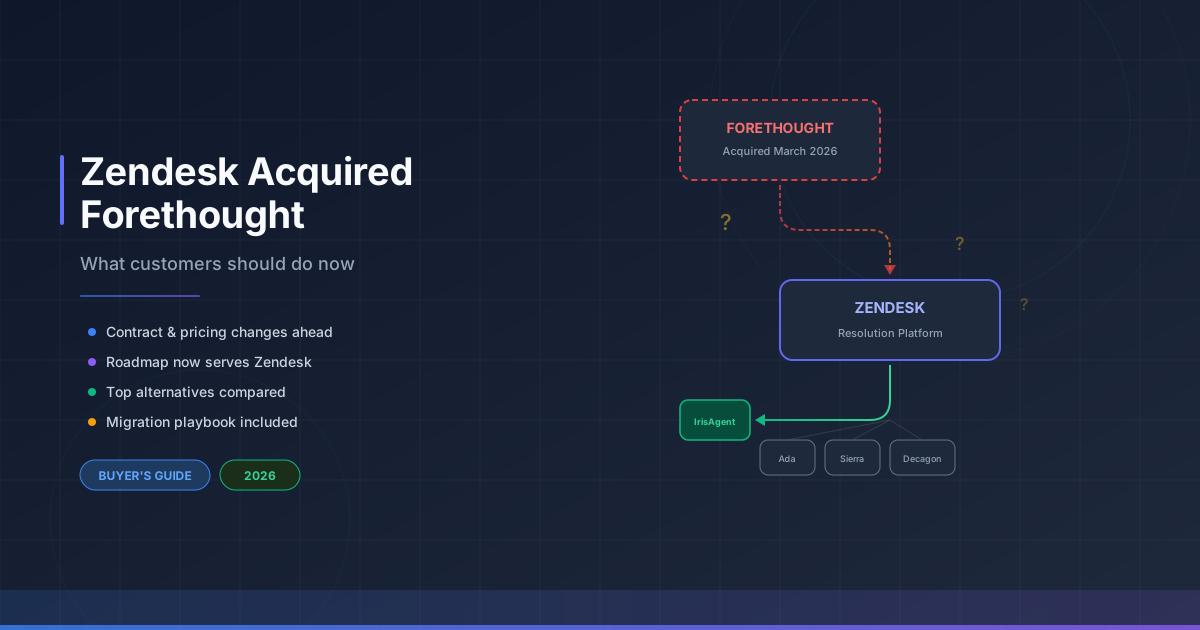
Zendesk closed its acquisition of Forethought on March 26, 2026. The deal, Zendesk's largest in nearly two decades, absorbed the agentic AI company that was processing over one billion customer interactions per month for brands like Upwork, Grammarly, Airtable, and Datadog.
Zendesk framed the acquisition as the foundation of their next-generation Resolution Platform. Forethought's investors called it a successful exit. If you were a Forethought customer, nobody asked you.
Enterprise software acquisitions follow a pattern you can set your watch to. The first 90 days bring optimistic press releases, reassuring emails from the new parent company, and a lot of "business as usual" language. Months four through twelve bring roadmap consolidation, pricing model changes, and the quiet discontinuation of features that don't fit the acquiring company's strategy. By year two, your standalone contract is gone, and renewing means buying into the full Zendesk suite.
You have a window right now. Here's how to use it.
What the Zendesk-Forethought Acquisition Means for Customers
Forethought's self-improving AI is being folded into Zendesk's platform
Forethought built its reputation on one capability: self-improving AI. The platform learned continuously from resolved tickets, identified knowledge gaps automatically, and got smarter over time without manual retraining. That capability is the reason Zendesk paid a premium for the deal.
Zendesk has already announced that Forethought's technology will power "Forethought AI Agents by Zendesk," purpose-built agents for chat, email, and voice. The company says the acquisition accelerates their product roadmap by over a year.
The question for existing Forethought customers is straightforward: will that capability remain best-in-class once it's been engineered into a platform serving 100,000+ customers across every use case? Specialized tools almost always lose their edge when absorbed into a larger platform.
Forethought's roadmap now serves Zendesk's strategy
Before the acquisition, Forethought's product priorities were set by what their customers needed and what would help them compete against IrisAgent, Ada, Sierra, and Decagon. After the acquisition, priorities are set by Zendesk's product leadership, Zendesk's board, and Zendesk's larger strategic bets, like competing with Salesforce Agentforce and Microsoft Copilot.
Features that served mid-market SaaS companies running on Salesforce or Intercom are likely to get deprioritized. Features that deepen Zendesk platform lock-in are likely to get fast-tracked.
Pricing changes are already taking shape
Forethought operated as an independent company with standalone pricing. Early signals from industry analysts suggest that Forethought capabilities will be repositioned as premium add-ons within Zendesk's pricing structure, potentially adding $30 to $50 per agent on top of existing Zendesk AI plans. If you're currently on a standalone Forethought contract, expect your renewal conversation to look very different from your last one.
Support quality typically drops during integration periods
When engineering teams focus on integration work (migrating infrastructure, merging data models, aligning APIs), product support quality suffers. Both Zendesk's engineers and Forethought's engineers are now spending cycles on integration rather than on your feature requests or bug fixes. Expect slower response times on support issues during the 12 to 18 month integration window.
Platform independence is uncertain
Zendesk has stated that new customers will be able to adopt Forethought's capabilities without being on the Zendesk platform. That's a positive signal for cross-platform support in the short term. But "available" and "actively invested in" are two different things. Watch whether Forethought's non-Zendesk integrations receive meaningful updates over the next 12 months, or whether they quietly stagnate.
Three Types of Forethought Customers and What Each Should Do
Not every Forethought customer is in the same position. Understanding where you sit changes what you should do next.
Type 1: Fully committed to the Zendesk ecosystem
If Zendesk is your primary helpdesk and you're happy to deepen that relationship, the acquisition may work in your favor. You'll eventually get Forethought's self-learning capabilities baked into your existing Zendesk AI subscription. Stay engaged with your Zendesk account team, get clarity on the product roadmap in writing, and negotiate to ensure your existing Forethought pricing is honored during the transition period. Push for specific feature delivery dates, not vague commitments.
Type 2: Running Forethought on Salesforce, Intercom, or another helpdesk
Forethought was one of the few AI support platforms that worked well on non-Zendesk environments. If you're running Forethought on top of Salesforce Service Cloud, Intercom, or Freshdesk, your situation is the most uncertain. Zendesk has little strategic incentive to invest in making their new AI capability work better on a competitor's platform. Treat this as a high-urgency signal to evaluate alternatives now, while you're still on good terms with your Forethought account team and can get a clean data export.
Type 3: Mid-contract with significant knowledge base investment
If you've spent 6 to 18 months training Forethought on your data, tagging tickets, curating knowledge base content, and building automation workflows, your primary concern is portability. Ask your account team directly: What is the data export process? What format does the training data export in? Can you export your workflow configurations? Get the answers in writing before your next contract renewal conversation.
Five Questions to Ask Your Account Team This Month
Don't wait for the acquisition dust to settle. Schedule a call with your Forethought or Zendesk account team now and get clear answers.
1. What is the product roadmap for Forethought capabilities over the next 12 months? Push for specifics: which features will be maintained as-is, which will be merged into Zendesk AI, and which are under review. "We're still figuring it out" is not an acceptable answer when your contract is on the line.
2. What happens to my current pricing at renewal? Understand whether your current rate is grandfathered, for how long, and what the expected pricing model looks like post-integration. If the answer is vague, get any pricing commitments in writing now. Early reports suggest Forethought features could add $30 to $50 per agent to Zendesk plans.
3. Will Forethought continue to support my helpdesk platform? If you're not on Zendesk, ask explicitly whether the integration with your current helpdesk will be maintained, enhanced, or phased out. Zendesk says cross-platform support will continue, but ask for a written commitment tied to a specific timeframe.
4. What does the support and SLA structure look like during the integration period? Who is your support contact? What are the response time commitments? What escalation path exists if Zendesk's support team is unfamiliar with Forethought-specific issues?
5. How do I export my data if I decide to switch? Ask this now, when you're not in a crisis. The answer tells you a lot about how the vendor views your relationship. Any platform worth staying with should answer this question clearly and without friction.
What to Look for in a Forethought Alternative
If you're evaluating alternatives, even just running a parallel RFP to understand your options, here are the criteria that matter most for a platform doing what Forethought did.
Self-learning and knowledge management
Forethought's core value was a system that identified knowledge gaps and improved over time. Look for platforms that actively surface missing or conflicting knowledge base content, not just platforms that search it. The best alternatives will auto-detect gaps and generate new procedures from resolved tickets.
Accuracy without hallucination
Self-improving AI is only valuable if the AI is accurate. Forethought customers sometimes dealt with the AI confidently giving incorrect answers during the learning phase. Look for platforms that have built-in validation mechanisms, specifically grounding responses against verified knowledge sources before delivering them to customers.
Deployment speed
If you're switching, you can't afford a 6-month implementation. Look for platforms that can go live in days, not quarters, and that don't require significant engineering resources to set up. The best modern platforms deploy through marketplace apps and ingest your existing knowledge base automatically.
Helpdesk independence
If Zendesk's acquisition of Forethought has taught you anything, it's the risk of betting on a vendor that is strategically aligned with one helpdesk. Look for platforms that work across Zendesk, Salesforce, Intercom, Freshdesk, and others, and that have no incentive to prioritize one over another.
Transparent, predictable pricing
The per-resolution pricing model that Intercom popularized and several competitors have adopted becomes expensive fast when your AI actually works. A platform that charges you more for every resolved ticket has a misaligned incentive. Look for flat-rate, volume-independent pricing so your costs don't spike as your automation rate improves.
Data portability
Ask every vendor the same question you asked your Forethought team: "How do I export my data if I leave?" The answer tells you whether you're entering another lock-in situation.
Top Forethought Alternatives for Customer Support AI in 2026
IrisAgent
Best for: Teams that need fast time-to-value, high accuracy, and helpdesk-agnostic deployment
IrisAgent is purpose-built to replace manual L1 support with AI that resolves tickets end-to-end across chat, email, and voice, without the implementation timelines of legacy platforms.
The most relevant differentiator for Forethought customers is the Hallucination Removal Engine: a proprietary validation layer that checks every AI response against your actual knowledge base, SOPs, and backend data before it reaches the customer. Where Forethought's self-improving model learned over time (sometimes getting things wrong along the way), IrisAgent prevents incorrect answers from going out in the first place.
Customers go live within 24 hours, without engineering resources. The platform ingests your existing knowledge base and ticket history to auto-configure automation, then surfaces knowledge gaps proactively so your content team can address them. IrisAgent's agentic AI also autonomously analyzes and updates knowledge bases by extracting insights from past resolutions.
Key differentiators: - 95%+ accuracy with dedicated hallucination validation - 24-hour go-live with no implementation project required - Multi-LLM federation: not locked to any single AI provider - No per-resolution fees; costs stay flat as automation improves - Works across Zendesk, Salesforce, Intercom, Freshdesk, and more - Free tier available for evaluation
Performance benchmarks: 60%+ automated resolution rate, 50% reduction in handle time, 60% fewer escalations to human agents
See how IrisAgent compares to Zendesk AI
Ada CX
Best for: Consumer brands with high chat volume seeking a no-code agent builder
Ada offers a conversational AI platform focused on self-service resolution. Their platform works well for companies with well-documented product catalogs and clear resolution paths. Ada has invested heavily in its no-code builder, making it accessible to support teams without engineering resources.
Limitations: Less depth in ticket-based workflows. Stronger in chat than in email or voice channels.
Sierra AI
Best for: Enterprise brands willing to invest in custom agent builds
Sierra, now valued at over $10 billion and serving roughly 40% of the Fortune 50, recently launched Voice AI for phone-based customer interactions, along with Ghostwriter, a self-service agent builder that creates production agents from natural language prompts. The platform is powerful but expensive.
Limitations: Pricing reflects its Fortune 500 positioning. Implementation timelines are longer. Best suited for organizations with dedicated AI ops resources.
Decagon
Best for: Technical SaaS companies with complex product workflows
Decagon focuses on AI agents for software companies, with strong integrations into developer tooling. Their Agent Operating Procedures (AOPs) allow teams to blend natural-language instructions with code-based guardrails, defining exactly how an AI agent handles specific tasks. If your support team handles a high volume of technical product questions, Decagon is worth evaluating.
Limitations: Narrower use case focus. Less suited for high-volume consumer support.
How to Run a Forethought Migration Without Disrupting Support Quality
If you decide to move, the migration process matters as much as the destination. Here's a practical sequence that minimizes risk.
Step 1: Export your Forethought data before giving notice. Before triggering any contract conversation, request a full data export: knowledge base content, ticket training data, workflow configurations, and performance reports. Do this while you're still in good standing.
Step 2: Run a parallel proof of concept. The best vendors will let you run a 30-day POC on a subset of real traffic, typically one queue or one channel, before committing. Run the POC while still on Forethought so you have continuity if the evaluation extends.
Step 3: Benchmark accuracy before going live. Any serious AI platform should let you validate accuracy on a historical ticket set before you flip the switch. Run the same 200 tickets through the new platform and compare resolution quality to your Forethought baseline. This catches knowledge gaps before customers experience them.
Step 4: Migrate knowledge base content in phases. Don't attempt a single-day knowledge base migration. Start with your top 20% of topics by volume, the content that handles 80% of tickets, and validate performance before migrating the long tail.
Step 5: Train your support team on the new escalation model. Your human agents need to understand how the new AI handles escalations, what context it passes to them, and how to correct the AI when it's wrong. Budget 2 to 3 hours of team training before go-live.
The Bottom Line
The Zendesk-Forethought acquisition is good news for Zendesk. For Forethought customers, it creates a window of uncertainty that is both a risk and an opportunity.
The risk: your roadmap, your pricing, and your support quality are now subject to someone else's priorities.
The opportunity: acquisitions force a natural re-evaluation moment. If Forethought was the right tool for you two years ago, it doesn't mean it's still the right tool when better alternatives exist. Alternatives that deploy faster, validate accuracy more rigorously, and don't lock you into a single ecosystem.
The companies that come out ahead will be the ones that use this moment to run a structured evaluation rather than defaulting to whatever Zendesk puts in front of them at renewal.