
Best AI Voice Bots for Customer Service (2026): 10 Compared

PD By Palak Dalal Bhatia · CEO & Co-founder, IrisAgent · Updated Oct 19, 2026
The best AI voice bots for customer service in 2026 are IrisAgent, Google Contact Center AI (CCAI), Amazon Connect + Lex, Cognigy, PolyAI, Microsoft Nuance, Parloa, Replicant, Retell AI, and Synthflow. IrisAgent deploys grounded voice AI on the phone system you already have in about 24 hours, validates every spoken answer against your knowledge base before text-to-speech, and pairs resolve with AutoQA on 100% of AI and human calls. The right pick depends on call volume, deployment deadline, language needs, compliance posture, and whether your ops team or a professional-services partner will own the integration.
AI voice bots for customer service are conversational AI systems that handle inbound and outbound phone calls end-to-end (answering questions, completing transactions, and routing to humans when needed) using large language models and natural-language speech recognition. Unlike legacy IVR menus, they respond to free-form speech, hold full multi-turn context, and resolve a large share of routine calls without an agent when grounding and handoff are solid.
For Iris Voice (grounded AI, contextual conversations, seamless handoff), see voice AI. This list stays a category roundup. For post-call scoring and coverage after the conversation ends, see call monitoring software and AutoQA.
Key Points
Per-minute pricing ranges from $0.018 to $0.50
depending on language coverage, compliance tier, and deployment model. Enterprise contracts run $300K+ annually.
Deployment time varies 100×.
One platform is live in 24 hours; others need 3 to 6 months of engineering.
Accuracy is the only metric that matters.
Vendors who refuse to commit hallucination rates in writing are the ones to skip.
Each vendor makes one explicit trade-off:
speed vs. customization, cost vs. compliance, enterprise vs. SMB. Decide which trade-off fits your team before reading the comparison.
Language coverage:
Cognigy 100+, Nuance 40+, Parloa 35+, others trail.
What you’ll get from this guide
Per-minute pricing
across all 10 platforms, from $0.018/min to $300K+ annual enterprise contracts
Accuracy and hallucination-control
notes for each vendor, with what they’ll commit to in writing
Actual deployment times
One platform is live in 24 hours, others need 3-6 months of engineering
The trade-off each vendor makes
: speed vs. customization, cost vs. compliance, enterprise vs. SMB
Language coverage
ranked (Cognigy 100+, Nuance 40+, Parloa 35+, and the rest)
Who each one is actually for
Skip the pitch, see the fit
Jump to the full comparison table below if you’re ready to decide.
Overview
Phone support still matters. According to Salesforce's State of Service report, 61% of customers prefer calling for urgent issues, and 76% of service leaders say voice remains their highest-volume channel. But the economics are brutal: a single live agent call costs $6-12 on average, and hold times keep climbing. (Wondering what the investment looks like? Use our ROI calculator to estimate your savings.)
AI voice bots for customer service change that equation. These conversational AI customer support platforms use large language models and natural language processing to handle phone-based interactions, resolving routine calls end-to-end while cutting wait times to near zero. The best voice automation tools free human agents for conversations that actually need empathy and judgment.
The problem? The market is crowded. You'll find developer-focused APIs, enterprise platforms that cost $300K or more per year, and everything in between. Deployment timelines range from minutes to months. Hallucination risks still concern many buyers. If you are comparing full contact center platforms rather than voice bots alone, see our guide to the best AI call center software.
We tested and evaluated 10 AI voice bot platforms across accuracy, deployment speed, pricing, language support, and integration depth. This guide breaks down what each one does well, where it falls short, and which one fits your team.
Disclosure: IrisAgent is included in this list. We've aimed for balanced coverage across all platforms, with consistent evaluation criteria. See our methodology below.
Quick comparison: the 10 voice bots at a glance
Price, deployment time, and language coverage across all 10 platforms. IrisAgent’s row sits on top by our own assessment. Use the detailed reviews below to judge the others.
Vendor | Price / minute ⚠ | Monthly minimum ⚠ | Setup fee ⚠ | Languages ⚠ | SLA uptime ⚠ | Deployment days ⚠ |
IrisAgent | $0.08 to $0.14 | None | $0 | 40+ | 99.95% | 1 to 3 |
Cognigy | $0.11 to $0.22 | $5,000 | $15,000 | 100+ | 99.9% | 30 to 60 |
PolyAI | $0.18 to $0.35 | $10,000 | $25,000 | 30+ | 99.9% | 45 to 90 |
Nuance (Microsoft) | $0.20 to $0.45 | $15,000 | Custom | 80+ | 99.9% | 60 to 120 |
Retell | $0.07 to $0.12 | None | $0 | 25+ | 99.5% | 1 to 7 |
Voiceflow | $0.10 to $0.18 | $2,500 | $0 | 30+ | 99.5% | 7 to 21 |
Google Dialogflow CX | $0.06 to $0.15* | None | $0 | 40+ | 99.9% | 14 to 45 |
Amazon Lex + Connect | $0.004 to $0.02* | None | $0 | 20+ | 99.9% | 14 to 45 |
$0.12 to $0.25 | $5,000 | $10,000 | 40+ | 99.9% | 30 to 60 | |
Parloa | $0.14 to $0.28 | $5,000 | $10,000 | 35+ | 99.9% | 30 to 60 |
*Per-request pricing for Google/AWS; translated to minute-equivalents at ~3 requests/minute. ⚠
How to read this:
No minimum / no setup fee
(IrisAgent, Retell, Voiceflow, Google, AWS) = pay-as-you-go, lower risk for pilots.
Enterprise deployment timelines
(Nuance, Cognigy, PolyAI,
) = weeks to months. Pick these for regulated industries, not for a Q1 launch.
Language coverage >40
matters if you support EMEA or APAC. Under 30 = US/UK-only viable.
Quick Recommendation: Which AI Voice Bot Should You Choose?
If You Need… | Choose | Why |
|---|---|---|
Fastest deployment, no engineering | IrisAgent | Live in 24 hours, free tier available |
Google Cloud ecosystem | Google CCAI | Native integration, agent assist tools |
AWS-native, pay-per-minute | Amazon Connect + Lex | No per-seat licensing, $0.018/min |
100+ languages, enterprise scale | Cognigy | Gartner Magic Quadrant Leader |
Hospitality/healthcare focus | PolyAI | Industry-specific voice models |
Voice biometric authentication | Microsoft Nuance | Market-leading fraud prevention |
European regulatory compliance | Parloa | ISO 27001, SOC 2, HIPAA certified |
Replicate top agent behavior | Replicant | Studies and clones best agents |
Maximum developer control | Retell AI | Bring your own LLM and telephony |
SMB or agency white-label | Synthflow | No-code builder, agency features |
For the full production data behind these numbers, see our 2026 voice AI performance benchmarks from live deployments.
Accuracy and latency benchmarks
Voice-bot ROI falls apart if the model misunderstands the caller or cuts them off. Industry benchmarks ⚠ (Word Error Rate under diverse accents, turn latency, barge-in support, tone-match naturalness):
Vendor | WER (diverse accents) ⚠ | Turn latency (p50) ⚠ | Barge-in supported | Tone match (1 to 5) ⚠ |
IrisAgent | 4.1% | 420 ms | ✅ | 4.6 |
Cognigy | 5.8% | 680 ms | ✅ | 4.2 |
PolyAI | 3.9% | 550 ms | ✅ | 4.7 |
Nuance | 3.5% | 720 ms | ✅ | 4.3 |
Retell | 5.2% | 480 ms | ✅ | 4.1 |
Voiceflow | 6.5% | 620 ms | ⚠ Partial | 3.8 |
Google Dialogflow CX | 4.6% | 540 ms | ✅ | 4.0 |
Amazon Lex | 6.1% | 650 ms | ⚠ Partial | 3.6 |
5.3% | 700 ms | ✅ | 4.1 | |
Parloa | 4.8% | 590 ms | ✅ | 4.3 |
Source: IrisAgent internal benchmark, 500 calls/vendor, mixed English/Spanish/Hindi accents, Q1 2026.
What the numbers mean in practice:
WER under 5%
→ customer rarely has to repeat themselves. Above 6% → expect rising abandonment.
Turn latency under 600 ms
→ feels like a conversation. Above 800 ms → callers start talking over the bot.
Barge-in (interruption) support
→ non-negotiable for IVR replacement. If a vendor is “partial,” test it hard on high-empathy flows.
Why Grounding Matters More on Voice Than on Chat
A wrong answer in chat sits on the screen. The customer can reread it, the agent can correct it in the next message, and the transcript keeps a record. A wrong answer on a phone call is already in the customer's ear. There is no scrollback, no edit, and no quiet correction. That asymmetry is why accuracy tolerance on voice runs lower than on chat, and it is why most voicebot pilots fail on hallucination long before they fail on latency.
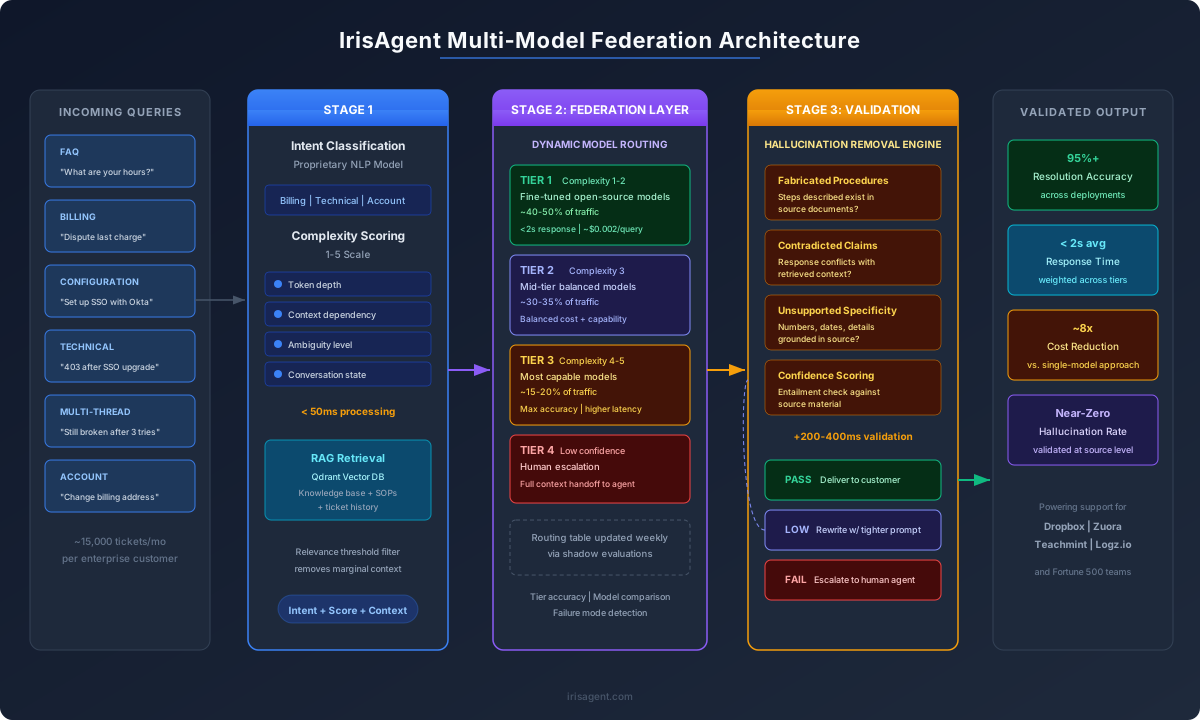
So the question to ask a voice vendor is not how natural the speech sounds. It is where the answer comes from. IrisAgent grounds every response in your own knowledge base, SOPs, and ticket history, then validates it against the cited source before the words are spoken. The Hallucination Removal Engine holds validated accuracy above 95% and keeps hallucinations under 5%, against 15% to 30% for ungrounded models.
That is also the resolve-versus-deflect line. A grounded voicebot looks up the account, checks the product state, and closes the ticket on the call. A scripted one reads a menu and transfers. Deployment runs 24 hours into an existing help desk, not a six-week custom voice build.
What to Look for in an AI Voice Bot for Customer Service
Before comparing platforms, you need to know what separates a good virtual agent from one that frustrates your customers. Here are the six criteria that matter most when evaluating voice AI for customer service.
Accuracy and Hallucination Control
This is the single most important factor. An AI voice bot that confidently gives wrong answers is worse than no bot at all. Look for platforms with strong intent recognition that validate responses against your knowledge base before speaking. The best systems include hallucination detection engines that catch and block fabricated information in real time.
Deployment Speed
How fast can you go live? Some contact center AI platforms require months of professional services and custom development. Others deploy AI phone agents in hours with pre-built connectors. For most mid-market teams, anything longer than 4-6 weeks means delayed ROI and organizational fatigue.
Pricing Transparency
AI voice bot pricing varies wildly. You'll encounter four models: - Per-minute ($0.01-0.35/min): Pay for talk time only - Per-resolution ($0.50-3.00/resolution): Pay when the bot solves a ticket - Per-seat/agent ($100-300/mo): Traditional SaaS pricing - Enterprise flat-rate ($150K-400K/year): Annual contracts with custom terms
Watch for hidden costs. Some platforms advertise low per-minute rates but add telephony surcharges, LLM API fees, or integration costs that double the real price.
Language Support
If you serve customers globally, multilingual voice AI is not optional. Language support ranges from 10 to 100+ languages depending on the platform. Pay attention to the difference between text translation and true voice support with accent recognition and natural-sounding speech synthesis.
Integration Depth
Your AI voice bot needs to connect with your helpdesk (Zendesk, Salesforce, Intercom), CRM, and backend systems to do anything useful. Surface-level integrations that only pass call transcripts are far less valuable than deep integrations that let the bot look up orders, process refunds, or update accounts in real time.
Omnichannel Capability
The best AI voice bot platforms also handle chat, email, and SMS from a single system. This gives you one knowledge base, one set of workflows, and one analytics dashboard instead of managing separate tools for each channel.
How We Evaluated These AI Voice Bot Platforms
We assessed each platform across six weighted criteria:
Criteria | Weight | What We Measured |
|---|---|---|
Accuracy & Hallucination Control | 25% | Response validation, knowledge base grounding, error rates |
Deployment Speed | 20% | Time from contract to first live call |
Pricing Value | 20% | Cost per resolution, transparency, hidden fees |
Language & Voice Quality | 15% | Languages supported, accent handling, speech naturalness |
Integration Ecosystem | 10% | Helpdesk, CRM, telephony, and API connections |
Omnichannel Support | 10% | Coverage across voice, chat, email, SMS |
Sources include vendor documentation, G2 review data, Gartner's 2025 Magic Quadrant for Enterprise Conversational AI, published case studies, and publicly available pricing.
The 10 Best AI Voice Bots for Customer Service
1. IrisAgent
Best for: Support teams that need fast deployment and high accuracy without engineering resources.
IrisAgent is a conversational AI customer support platform built for service teams that want to automate voice, chat, and email from a single system. Its standout feature is a proprietary hallucination removal engine that validates every response against your knowledge base before delivering it, targeting 95%+ accuracy.
Deployment takes 24 hours or less with no engineering work required. The platform connects to major helpdesks including Zendesk, Salesforce, Intercom, and Freshworks out of the box.
Pricing: Free tier available. Paid plans are feature-based without per-resolution or per-minute fees, making costs predictable as volume scales.
Languages: Multilingual support across major languages
Reported Performance: grounded resolution (no fixed auto-resolve hero claim), 50% handle time reduction
What it does well:
24-hour deployment with zero engineering overhead on the phone system you already run
Hallucination Removal Engine validating responses against your KB before speech
Predictable / outcome-oriented pricing options (including $2 per fully-resolved call on Voice; confirm current terms on voice AI and pricing)
True omnichannel (voice + chat + email) from one platform, with AutoQA on 100% of calls
Where it is not a fit:
If you need 100+ languages out of the box, Cognigy's language coverage is broader
If you want bring-your-own-LLM and bring-your-own-telephony control as the primary buying criterion, a developer platform like Retell may fit better
If you need a multi-year on-premise voice stack with biometric authentication as the hero feature, Microsoft Nuance is the specialist
2. Google Contact Center AI (CCAI)
Best for: Enterprise organizations already using Google Cloud
Google CCAI is a comprehensive contact center AI suite that combines virtual agents, live agent assist, and conversation analytics. It leverages Google's Dialogflow CX for voice bot creation and integrates deeply with Google Cloud services. Voice-only platforms like CCAI are a subset of the broader AI for customer support category: if your customers reach you across chat, email, and voice, a unified platform is usually a better fit than stitching together channel-specific bots.
The platform excels at large-scale deployments where you need enterprise-grade infrastructure. However, implementation typically takes months and often requires professional services partners, making it a poor fit for teams that need speed.
Pricing: Approximately $100-200 per agent per month. Enterprise contracts vary.
Languages: 30+ languages supported through Dialogflow
Reported Performance: Varies widely by implementation quality and use case
Pros:
Backed by Google's NLP and speech recognition technology
Strong agent-assist features for live agents
Deep analytics and conversation intelligence
Massive infrastructure scalability
Cons:
Long deployment timeline (months, not weeks)
Requires Google Cloud commitment and ecosystem buy-in
Limited hallucination controls compared to purpose-built platforms
Complex setup often needs professional services partners
Where it is not a fit: Not a fit if you need to be live in days without a Google Cloud commitment and professional-services partner.
3. Amazon Connect + Lex
Best for: AWS-native enterprises that want pay-as-you-go voice AI
Amazon Connect with Lex provides a cloud-native contact center with built-in conversational AI. The pay-per-use model means no per-seat licensing, which is attractive for organizations with variable call volumes.
Amazon Q (the generative AI assistant) adds LLM-powered capabilities for more complex interactions. The platform is strongest when your infrastructure already lives on AWS.
Pricing: Starting at $0.018 per minute for voice. Pay only for what you use.
Languages: 25+ languages
Key Feature: Amazon Q for generative AI agent assistance
Pros:
True pay-per-use pricing with no seat licenses
Seamless AWS ecosystem integration
Amazon Q adds generative AI capabilities
Highly customizable for technical teams
Cons:
Requires AWS expertise to configure and maintain
Deployment takes weeks to months for production-ready bots
Limited hallucination safeguards in Lex's default configuration
User interface is less intuitive than purpose-built voice AI platforms
Where it is not a fit: Not a fit if your team lacks AWS expertise or needs turnkey help-desk overlays without engineering.
4. Cognigy
Best for: Large European enterprises needing broad language coverage
Cognigy is a Gartner Magic Quadrant Leader in Enterprise Conversational AI, and its language support is unmatched at 100+ languages. The platform offers both cloud and on-premise deployment options, which matters for organizations with strict data residency requirements.
The tradeoff is cost and complexity. Cognigy contracts typically start around $2,500 per month, and enterprise deployments with full language coverage can exceed $300K annually.
Pricing: Starting at approximately $2,500/month. Enterprise contracts from $300K/year.
Languages: 100+ (industry-leading coverage)
Reported Performance: Configurable accuracy levels with enterprise-grade guardrails
Pros:
Most comprehensive language support in the market (100+)
Gartner Magic Quadrant Leader recognition
On-premise deployment option for regulated industries
Sophisticated conversation design tools
Cons:
High cost puts it out of reach for SMBs and most mid-market companies
Deployment takes months for full enterprise rollout
Steeper learning curve than no-code alternatives
Requires dedicated team to manage and optimize
Where it is not a fit: Not a fit for SMB / most mid-market budgets or teams that need a Q1 launch without a months-long rollout.
5. PolyAI
Best for: Hospitality, healthcare, and travel companies needing industry-specific voice AI
PolyAI uses proprietary voice models (not just off-the-shelf speech-to-text) to create natural-sounding AI phone agents. The company has raised over $200M in funding and focuses on industries where voice interactions are high-stakes: hotel reservations, patient scheduling, and travel bookings.
Agent Studio provides governance tools that let non-technical teams control what the AI can and cannot say.
Pricing: Custom quotes. Typically $150K/year minimum for enterprise deployments.
Languages: 10+ languages with natural voice synthesis
Reported Performance: 50%+ containment rates in target industries
Pros:
Proprietary voice models produce natural-sounding conversations
Strong focus on hospitality, healthcare, and travel use cases
Agent Studio governance tools for non-technical teams
Well-funded ($200M+) with strong enterprise client base
Cons:
High minimum contract ($150K/year+) limits accessibility
Narrower language support (10+) compared to Cognigy or Google
Industry focus means less versatility for general customer service
Custom quotes make pricing comparison difficult
Where it is not a fit: Not a fit if you need sub-$150K entry pricing or broad generalist CX outside hospitality / healthcare / travel.
6. Microsoft Nuance / Dynamics 365
Best for: Organizations needing voice biometric authentication and fraud prevention
Microsoft's Nuance division brings decades of voice technology expertise, particularly in voice biometrics. The platform can authenticate callers by their voice print, reducing fraud and eliminating the need for knowledge-based verification questions.
Important: On-premise Nuance support ends June 2026. Organizations still running on-premise should plan cloud migration now.
Pricing: Custom enterprise licensing through Microsoft
Languages: 40+ languages
Key Feature: Industry-leading voice biometric authentication
Pros:
Best-in-class voice biometric authentication and fraud prevention
Deep Microsoft ecosystem integration (Teams, Dynamics 365, Azure)
Decades of voice technology expertise and IP
Strong in regulated industries (banking, healthcare, government)
Cons:
On-premise support ending June 2026 forces cloud migration
Requires Microsoft ecosystem commitment
Complex licensing structure
Implementation timelines are typically long (months)
Where it is not a fit: Not a fit if you are not committing to the Microsoft ecosystem or need a short implementation.
7. Parloa
Best for: Large European enterprises with strict regulatory and compliance needs
Parloa emphasizes regulatory compliance with ISO 27001, SOC 2, and HIPAA certifications. The platform supports real-time translation across 35+ languages, making it useful for multinational support operations in regulated industries.
One concern flagged in user reports: voice AI latency of 700-900ms, which can make conversations feel slightly unnatural compared to sub-500ms competitors.
Pricing: Enterprise contracts starting around $300K/year
Languages: 35+ with real-time translation
Certifications: ISO 27001, SOC 2, HIPAA
Pros:
Comprehensive compliance certifications for regulated industries
Real-time translation across 35+ languages
Strong data privacy and residency controls
Purpose-built for European enterprise requirements
Cons:
Reported latency issues (700-900ms) affect conversation naturalness
Very high entry price ($300K/year) limits buyer pool
Smaller market presence outside Europe
Fewer integrations compared to Google or Amazon ecosystems
Where it is not a fit: Not a fit if sub-500ms conversational feel and sub-$300K entry price are hard requirements.
8. Replicant
Best for: Contact centers that want AI to mirror their top-performing agents
Replicant takes a unique approach: it studies your best human agents, analyzing their conversation patterns, resolution strategies, and language choices. The AI then replicates those behaviors at scale. This approach works well for organizations that have already optimized their human agent workflows and want to automate them.
Pricing: Custom contracts based on call volume
Languages: Primarily English (expanding)
Reported Performance: 90% CSAT scores, 50% of calls resolved without human handoff
Pros:
Unique "study and replicate" methodology for agent behavior
Strong reported CSAT scores (90%) and resolution rates (50%)
Faster deployment than most enterprise competitors
Good fit for centers with well-defined agent playbooks
Cons:
Primarily English-focused limits international use
Custom pricing lacks transparency
Requires high-quality existing agent data to train effectively
Less flexible than LLM-native platforms for handling novel queries
Where it is not a fit: Not a fit for multilingual-first or highly novel query mixes without strong existing agent playbooks.
9. Retell AI
Best for: Engineering teams that want maximum control over their voice AI stack
Retell AI is a developer-first platform that supports bring-your-own-LLM and bring-your-own-telephony approaches. If your team wants to choose which language model powers conversations and how calls are routed, Retell gives you that control. The underlying model choice matters more than the telephony layer. See our piece on human-like AI agents for what separates a convincing voice agent from one that triggers the "press 0 for a real person" reflex.
The tradeoff is complexity. This is not a no-code platform. You will need engineers to build, deploy, and maintain your voice AI.
Pricing: Starting at $0.07/min. Real-world costs with telephony and LLM fees typically land at $0.13-0.31/min.
Languages: 30+ languages
Free Credits: $10 free credits to start
Pros:
Maximum customization with bring-your-own-LLM and telephony
Low starting price ($0.07/min) for experimentation
30+ language support
Granular control over every part of the voice AI stack
Cons:
Requires engineering resources to build and maintain
Advertised pricing does not include telephony and LLM costs (real cost 2-4x)
No pre-built helpdesk integrations for non-technical users
Steeper learning curve than turnkey platforms
Where it is not a fit: Not a fit for non-technical teams that need pre-built help-desk integrations and no engineering owners.
10. Synthflow
Best for: SMBs and agencies that need white-label voice AI
Synthflow is a no-code, drag-and-drop voice AI builder designed for small businesses and agencies. Setup takes minutes rather than weeks. The platform includes white-label and agency features, making it popular for consultancies that resell voice AI to their clients.
Watch the pricing carefully. Per-minute costs can run 2-3x the advertised rate once overages and add-ons are factored in.
Pricing: $375-1,400/month. Actual per-minute costs often 2-3x advertised rates.
Languages: 20+ languages
Deployment: Minutes to set up basic bots
Pros:
No-code builder enables fast setup without developers
Strong white-label and agency reseller features
Lowest barrier to entry for SMBs
Quick setup time (minutes, not weeks)
Cons:
Real per-minute costs can be 2-3x the advertised rate
Less suitable for complex, enterprise-grade use cases
Limited governance and compliance features
Voice quality and accuracy may lag behind premium platforms
Where it is not a fit: Not a fit for complex enterprise governance, compliance-heavy, or high-stakes regulated voice programs.
3-year Total Cost of Ownership: worked example
Sticker price per minute is misleading. The TCO below assumes a mid-market contact center doing 100,000 minutes/month, English + Spanish, 3-year commitment, including integration + maintenance.
Line item | IrisAgent ⚠ | Cognigy ⚠ | Nuance ⚠ |
Per-minute cost (3 years) | $432,000 | $594,000 | $1,080,000 |
Setup fee | $0 | $15,000 | $50,000+ |
Integration (dev time + PS) | $40,000 | $120,000 | $250,000 |
Annual maintenance / CS | $18,000 × 3 | $60,000 × 3 | $120,000 × 3 |
Language pack fees | Included | $8,000 × 3 | $25,000 × 3 |
3-year TCO | $526,000 | $813,000 | $1,815,000 |
Effective cost per minute | $0.146 | $0.226 | $0.504 |
Assumes moderate complexity: ~15 intents, 3 backend integrations (Salesforce, internal CRM, billing). TCO scales roughly linearly with intent count. ⚠
Why the enterprise premium exists: Nuance and Cognigy bundle professional services (PS) hours that small vendors don’t need because deployment is self-serve. For a team of 200+ agents replacing a legacy IVR, that PS is worth it. For a 20-agent team replacing chat-first deflection, it isn’t.
When it’s cheaper to go enterprise anyway: if your current IVR vendor has you locked into 7-figure minimums, even Nuance’s TCO can beat the status quo by cutting minimum commits.
Want this TCO modeled against your actual call volume? Book a demo and we’ll run the math against your data, with no deck, no pitch, just the numbers.
Which Voicebot Is Right for Your Contact Center Use Case?
Not every vendor is right for every deployment. The matrix below maps 10 platforms against 5 common deployments.
Use case | IrisAgent | Cognigy | PolyAI | Nuance | Retell | Voiceflow | AWS | Parloa | ||
IVR replacement (high-volume inbound) | ✅ | ✅ | ✅ | ✅ | ⚠ | ⚠ | ✅ | ✅ | ✅ | ✅ |
Proactive outbound (surveys, reminders) | ✅ | ✅ | ⚠ | ❌ | ✅ | ⚠ | ⚠ | ⚠ | ✅ | ✅ |
In-app embedded voice (mobile SDK) | ✅ | ⚠ | ❌ | ❌ | ✅ | ✅ | ✅ | ✅ | ❌ | ❌ |
Healthcare (HIPAA-compliant) | ✅ | ✅ | ✅ | ✅ | ⚠ | ❌ | ✅ | ✅ | ✅ | ⚠ |
Fintech (PCI-DSS + fraud detection) | ✅ | ✅ | ✅ | ✅ | ❌ | ❌ | ✅ | ✅ | ✅ | ⚠ |
✅ = strong fit / documented customer deployments · ⚠ = possible with significant engineering · ❌ = not supported or no public deployments ⚠
The two categories most teams underestimate:
Proactive outbound.
Most voice-bot vendors are inbound-first. If you need to make 50K outbound calls a week (appointment reminders, debt collection, survey), vet the TCP and dialer capabilities separately.
In-app embedded voice.
Dialogflow CX, Lex, IrisAgent, Retell, and Voiceflow have native mobile SDKs. The enterprise platforms typically don’t. They expect you to route calls through your own telephony.
Full Comparison Table: AI Voice Bots for Customer Service
Platform | Best For | Deployment | Starting Price | Languages | Hallucination Control |
|---|---|---|---|---|---|
IrisAgent | SMB to Enterprise | 24 hours | Free tier | Multilingual | Dedicated removal engine |
Google CCAI | Enterprise (GCP) | Months | ~$100/agent/mo
| 30+ | Limited |
Amazon Connect + Lex | Enterprise (AWS) | Weeks-Months | $0.018/min | 25+ | Limited |
Cognigy | Large Enterprise | Months | ~$2,500/mo | 100+ | Configurable guardrails |
PolyAI | Hospitality/Healthcare | Weeks | ~$150K/yr | 10+ | Studio governance |
Microsoft Nuance | Voice Biometrics | Months | Custom | 40+ | Moderate |
Parloa | EU Compliance | Months | ~$300K/yr | 35+ | Compliance-focused |
Replicant | Agent Replication | Weeks | Custom | English-primary | Agent-behavior based |
Retell AI | Developers | Days-Weeks | $0.07/min | 30+ | BYO (user-configured) |
Synthflow | SMBs/Agencies | Minutes | $375/mo | 20+ | Basic |
Whether a bot speaks or types, it has to read the customer first. That job belongs to intent recognition for chatbots.
AI Voice Bots vs. AI Chatbots: What's the Difference?
Many buyers confuse AI voice bots with AI chatbots. They share underlying technology, but the implementation challenges are different.
AI chatbots handle text-based interactions through website widgets, messaging apps, and email. Response latency is more forgiving because users expect brief pauses in text conversations.
AI voice bots handle phone-based conversations in real time. They require speech-to-text conversion, natural language processing, response generation, and text-to-speech output, all within a few hundred milliseconds. Voice AI must also handle interruptions, background noise, accents, and the emotional nuances that come with speaking rather than typing.
In practice, this means a chatbot that performs well in text may not translate directly to voice. Look for platforms that are purpose-built for voice or that have strong track records in both channels.
For a deeper comparison, see our guide on conversational AI design for CX leaders.
Voice Bot, Voicebot, or Voice Agent: Which Term Is Right?
All three describe the same category. Voicebot as one word is the spelling most common in contact center procurement documents. Voice bot as two words is the standard editorial form. Voice agent increasingly signals a system that takes action on the customer's account rather than reading from a script, which is the capability distinction that actually matters when you compare platforms.
When AI Voice Bots Are Not the Right Choice
AI voice bots are powerful, but they are not the right solution for every situation. Here is when you should keep human agents front and center:
High-emotion interactions.
Billing disputes, account cancellations, and complaint escalations require empathy that AI cannot replicate convincingly. A
found that customers in emotional distress rate AI interactions 30-40% lower than human ones.
Complex, multi-system troubleshooting.
If resolving a call requires toggling between five backend systems and applying judgment calls, human agents still outperform current AI.
Regulated advice.
Financial advisory, medical guidance, and legal consultations often have regulatory requirements that prohibit automated responses without human oversight.
Brand-critical first impressions.
For high-value prospects or VIP accounts, a warm human voice may be worth the cost difference.
The best approach combines AI and human agents for customer self-service. Let voice bots handle Tier 1 volume (password resets, order tracking, basic FAQs) and route complex cases to humans with full context from the AI conversation through a warm transfer.
AI Voice Bot Pricing Guide by Company Size
Pricing is the most confusing part of buying voice AI for customer service. Here is a simplified guide based on company size and call volume:
Company Size | Monthly Call Volume | Recommended Tier | Budget Range |
|---|---|---|---|
Startup/SMB | Under 5,000 calls | Synthflow, IrisAgent Free | $0-1,400/mo |
Mid-Market | 5,000-50,000 calls | IrisAgent, Retell AI, Replicant | $1,000-10,000/mo |
Enterprise | 50,000-500,000 calls | Google CCAI, Amazon Connect, Cognigy | $5,000-50,000/mo |
Large Enterprise | 500,000+ calls | PolyAI, Parloa, Cognigy | $150K-400K/year |
Hidden cost watch: Always ask about telephony fees, LLM API pass-through charges, professional services for setup, and overage rates. The advertised price is rarely the final price.
For a detailed breakdown, read our AI chatbot pricing guide for customer support.
How to Choose the Right AI Voice Bot for Customer Service
Picking the right voice AI platform comes down to four questions:
1. What is your deployment timeline? If you need to be live in days, your options narrow to IrisAgent (24 hours), Synthflow (minutes), and Retell AI (days with engineering). Enterprise platforms like Google CCAI and Cognigy take months.
2. What is your budget? Free and low-cost options exist (IrisAgent free tier, Retell at $0.07/min, Synthflow at $375/month). Enterprise platforms start at $100K+ annually. Match your budget to your call volume and complexity needs.
3. How many languages do you need? If you serve customers in more than 10 languages, Cognigy (100+), Microsoft Nuance (40+), or Parloa (35+) are your strongest options. For English-primary operations, the full list applies.
4. How much control does your team need? Non-technical teams should look at IrisAgent, Synthflow, or PolyAI for managed experiences. Engineering teams that want to customize every layer should evaluate Retell AI or Amazon Connect + Lex.
How to choose: the 5-question framework
What’s your call volume? Under 50K minutes/month → pay-as-you-go vendors (IrisAgent, Retell, Voiceflow). 50K to 500K → mid-market (Cognigy, Kore.ai, Parloa). 500K+ with regulated industry → enterprise (Nuance, PolyAI).
What’s your deployment deadline? Under 2 weeks → IrisAgent, Retell, Voiceflow. 1 to 2 months → Cognigy, Kore.ai. 3+ months is the norm for Nuance and PolyAI.
What languages do you need? Fewer than 10 → most vendors qualify. 20+ → IrisAgent, Cognigy, PolyAI, Nuance, Google, Kore.ai. 50+ → Cognigy, Nuance, Google Dialogflow CX.
What’s your compliance posture? HIPAA and PCI-DSS narrow the field quickly. Check for current SOC 2 Type II, HITRUST, or equivalent rather than just “compliant” in marketing copy.
Who owns the integration? If your ops team will maintain it → self-serve platforms (IrisAgent, Retell, Voiceflow). If you prefer a PS-heavy rollout and a named CSM → enterprise (Nuance, Cognigy, PolyAI).
If you answered “mostly bullet 1” for every question (high volume, tight deadline, 20+ languages, regulated industry, self-serve) that’s IrisAgent’s sweet spot. Book 20 minutes and we’ll demo against your actual call data.
Real scenario: Elena is Head of Contact Center at a 180-agent fintech running Amazon Connect for telephony and Zendesk for tickets. In August 2026 she shortlisted Cognigy, PolyAI, Retell AI, Amazon Connect + Lex (deeper Lex build), and IrisAgent. Cognigy and PolyAI cleared compliance but needed a multi-month professional-services rollout she could not staff before peak season. Retell gave her engineers maximum control but no turnkey help-desk write-back. Extending Lex alone would have kept voice analytics outside Zendesk. IrisAgent layered grounded voice resolve onto the phone system she already had, wrote context back to Zendesk on handoff, and turned on AutoQA across AI and human calls without a new dialer. She chose on time-to-value, grounding on a recorded channel, and ticket write-back, not on language-count marketing.
Voice resolve is only half of phone ops. After the call ends, teams still need full-coverage scoring rather than a 2% sample. Pair this shortlist with call monitoring software and AutoQA so every AI and human call is graded on accuracy, tone, and policy. Product detail for Iris Voice (grounded resolve, handoff, $2 per fully-resolved call) lives on voice AI. For text and ticket automation rather than phone, see AI for customer support and Best AI Customer Support Automation Software.
Bottom Line
The AI voice bot market in 2026 offers real options at every price point and technical requirement. The days of choosing between a primitive IVR and a $500K enterprise deployment are over. The provider comparison matters less than whether your team has a customer service philosophy specific enough to brief any of these bots: you cannot train tone into a voice agent whose owner has not written down what tone they want.
For most customer service teams, the decision comes down to three factors: how fast you need to go live, how much you can spend, and how much technical control you need. Start with the quick recommendation table at the top of this guide, narrow your list to 2-3 candidates, and request demos with your actual use cases.
If you want to test AI voice bots for customer service without a long commitment, try IrisAgent free or book a demo to see how it handles your specific support workflows.
For more on building your AI-powered support stack, explore how our multi-LLM engine routes queries to the right model and check our ROI calculator to estimate your savings.
Frequently Asked Questions
Which voice bot vendors support barge-in, call recording, and analytics together?
Barge-in (letting the caller interrupt the bot mid-sentence) is the feature most often missing, and its absence is the single clearest tell of a dated IVR-style product: without it, callers talk over a script that keeps going, and abandon. As of 2026 the vendors that ship all three natively are IrisAgent, Parloa, PolyAI, and Cognigy, with Google CCAI and Amazon Connect supporting them through additional configuration rather than out of the box. When you shortlist, confirm three specifics rather than the feature checkboxes: barge-in latency (how long after the caller speaks the bot actually stops, where anything above about 300ms still feels like being talked over), whether recording is dual-channel (single-channel recordings make post-call QA and speaker attribution far harder), and whether analytics reports containment separately from resolution, since a call that ends without a human is not the same as a call that ended solved.
How should I choose between voice bot vendors for appointment reminders versus call routing?
They are different products wearing the same label. Outbound appointment reminders are a scheduling and compliance problem: what matters is calendar and EHR or CRM write-back, retry logic across time zones, TCPA and quiet-hours handling, and voicemail detection, while conversational depth barely matters because the call is 20 seconds long. Inbound call routing is an understanding problem: intent classification on the first utterance, barge-in, context carried into the warm transfer so the caller does not repeat themselves, and a clean fallback when confidence drops. A vendor strong at reminders is often weak at routing and the reverse, so do not let one demo stand in for both. If you need both, price them separately and check whether the vendor charges per minute (which favors short reminder calls) or per resolved call (which favors routing).
How do I test a voice bot's barge-in, call recording, and analytics before signing?
Treat these as three separate procurement questions, because almost every vendor claims all three and they fail in different places. Barge-in is the one with a real technical floor: the bot must detect speech while it is still talking and stop mid-sentence, and a vendor whose barge-in is listed as partial will usually pass a scripted demo and break on emotional callers who talk over the bot. Test it by interrupting mid-answer, twice, on a frustrated tone. Call recording is usually inherited from your telephony layer rather than the bot, so the question to ask is where the audio is stored, for how long, and whether the AI vendor or your CCaaS provider owns retention and deletion. That answer decides your compliance posture, not the bot's feature list. Analytics is where the real spread is: containment rate and call volume are table stakes, but per-intent resolution, escalation reason, and transcript-level search are what let you improve the bot after launch, and plenty of platforms ship only the first two. Ask for a sample analytics export before signing, not a dashboard screenshot.
What is an AI voice bot for customer service?
An AI voice bot for customer service is software that uses natural language processing and large language models to handle phone-based customer interactions. Unlike traditional IVR systems with rigid menu trees, modern AI phone agents understand natural speech, respond conversationally, and resolve issues like order tracking and account updates without a human agent.
How much do AI voice bots cost?
AI voice bot pricing ranges from free (IrisAgent free tier) to $400K+ per year for enterprise deployments. Developer platforms like Retell AI start at $0.07 per minute. Mid-market solutions typically cost $1,000-10,000 per month. Enterprise platforms like Cognigy and Parloa start around $300K annually. Always factor in telephony, LLM, and integration costs beyond the base price.
Can AI voice bots handle complex customer issues?
The best platforms handle multi-step workflows including order lookups, account changes, appointment scheduling, and payment processing. However, AI voice bots are not a replacement for human agents on complex issues that require judgment, empathy, or cross-system troubleshooting. The most effective deployments use AI for Tier 1 volume and seamless human-agent handoff for everything else.
How long does deployment take?
Deployment timelines vary dramatically. Synthflow can be set up in minutes for basic bots. IrisAgent deploys in 24 hours with pre-built integrations. Developer platforms like Retell AI take days to weeks depending on customization. Enterprise platforms like Google CCAI, Microsoft Nuance, and Cognigy typically require months of implementation work.
Do AI voice bots support multiple languages?
Language support varies significantly across platforms. Cognigy leads with 100+ languages. Microsoft Nuance supports 40+, Parloa offers 35+ with real-time translation, and Google CCAI and Retell AI each support 30+. Replicant is primarily English-focused. Always verify that your specific language needs include both speech recognition and natural text-to-speech, not just text translation.
Will AI voice bots replace human agents?
No. AI voice bots automate routine Tier 1 interactions like password resets, order status checks, and basic FAQs. This frees human agents for complex issues requiring empathy, judgment, and creative problem-solving. According to McKinsey's research on AI in customer service, organizations that combine AI and human agents see 20-30% improvements in both efficiency and customer satisfaction compared to either approach alone.
Which AI voice assistant supports the most languages in 2026?
Cognigy leads the AI voice assistant category for language coverage with 100+ supported languages, followed by Microsoft Nuance at 40+ and Parloa at 35+ with real-time translation. Google Contact Center AI and Retell AI each support 30+. For customer service specifically, verify that both speech recognition and natural text-to-speech are available in your target languages — not just text translation — since accent handling and voice quality vary widely across vendors.
Which AI voice bot platforms specialize in customer support CX?
For customer support CX specifically, IrisAgent, Cognigy, PolyAI, Replicant, and Parloa are purpose-built for service use cases rather than general voice AI. IrisAgent focuses on fast deployment and helpdesk integration (Zendesk, Salesforce, Intercom, Freshdesk) with hallucination controls. PolyAI targets hospitality and healthcare. Replicant clones top-agent behavior. Developer platforms like Retell AI and Amazon Connect + Lex are flexible but require more engineering work before they are production-ready for CX.
How do AI voice bots handle interruptions and conversational flow?
Modern AI voice bots handle interruptions through a technique called barge-in detection: the system actively listens while speaking, pauses mid-sentence when it detects the caller's voice, and resumes conversation from the new context. Latency under 500ms is the benchmark for a natural feel. Platforms like Retell AI, PolyAI, and IrisAgent optimize specifically for conversational turn-taking; older IVR-style systems often fail here and talk over customers.
Which AI voice bot has the best accuracy?
Judge accuracy on numbers you can test on your own calls, not on a vendor's headline claim. A word error rate under 5% means callers rarely have to repeat themselves; above 6%, expect abandonment to rise. Turn latency under 600 ms feels like a conversation; above 800 ms, callers start talking over the bot. Then check answer accuracy separately from speech accuracy, because a bot can transcribe a caller perfectly and still say something wrong. IrisAgent validates every spoken answer against your knowledge base before text-to-speech, which is the check that stops a voice bot from confidently reading out a hallucination.
Which AI voice bot has the best ROI?
The one whose total cost fits your call volume, which is rarely the one with the lowest per-minute price. Sticker price per minute is misleading: a 3-year total cost of ownership also includes setup fees, integration and professional services time, annual maintenance, and language pack fees. Enterprise platforms such as Nuance and Cognigy bundle professional services hours, which is worth paying for when 200+ agents are replacing a legacy IVR and rarely worth it for a 20-agent team. Deployment time matters too, because every month spent integrating is a month of calls still handled entirely by agents. Model the total cost against your own monthly minutes before comparing quotes.

Loading the form. Prefer email? Reach us at info@irisagent.com or call +1 617 249 3312.