IrisAgent vs Decagon: No-Code AI Support That Ships in 24 Hours
and a multi-week implementation. IrisAgent is fully
no-code, so your support team owns the AI, live in
under 24 hours with 95%+ accuracy.

What's the difference between IrisAgent and Decagon?
IrisAgent is fully no-code AI support that goes live in under 24 hours and is configured by support leaders in plain English. Decagon is a code-first platform requiring developers to write Agent Operating Procedures (AOPs) in Git, with a typical multi-week implementation, best suited to engineering-heavy enterprise teams. Decagon Assist, launched August 2026, is a copilot whose summary is taken from the previous conversation with the Decagon agent. Decagon does not publish a price; deals are quote-only.
- Setup: IrisAgent ships in 24 hours with no engineering. Decagon AOPs version in Git; engineering keeps tools and APIs.
- Assist: IrisAgent starts as a copilot on your existing helpdesk. Decagon Assist is framed for escalated cases, with the summary taken from the prior Decagon-agent conversation.
- Accuracy: IrisAgent's Hallucination Removal Engine validates every response against your knowledge base at 95%+ accuracy.
- Pricing: IrisAgent publishes Standard from $500/month. Decagon is quote-only; six-figure contracts are common in third-party procurement data.
By the IrisAgent team · Last updated August 20, 2026
Why support teams choose IrisAgent over Decagon
Your support team should own the AI, not depend on engineering sprints
Fastest Time to Value
Go live in under 24 hours with no engineering resources. Decagon's implementation takes 6 weeks minimum.
Fully No-Code
No developers, no Git, no Agent Operating Procedures. Your support team configures everything visually.
Hallucination-Free AI
Proprietary Hallucination Removal Engine validates every response. No made-up answers, ever.
Built-in Agent Copilot
Assist-first on the helpdesk you already run. You do not have to buy a replacement bot to get the copilot.
The verdict
Last verified: July 2026Decagon is the stronger choice for large enterprises that want a heavily customized, concierge-grade AI agent built with deep Agent Operating Procedure (AOP) workflow engineering and a forward-deployed implementation team, and that can invest in a custom enterprise contract and a multi-week build. IrisAgent is the stronger choice for CX teams that want grounded, hallucination-free automation across chat, email, and voice on their existing helpdesk, with flexible usage-based or resolution-based pricing, 95%+ grounded accuracy, and go-live in 24 hours instead of 4 to 8 weeks.
IrisAgent vs Decagon: Feature-by-feature comparison
 | Decagon | |
|---|---|---|
| Target Market & Accessibility |  Designed for mid-market and enterprise teams, with transparent pricing accessible to growing companies No minimum contract thresholds, so you can start small and scale as you see results |  Quote-only enterprise pricing with no public rate card Enterprise-only motion: quote-only contracts, engineering-led build |
| AI Architecture | Multiple specialized AI agents for email, chat, voice, and copilot, all coordinating instead of one general bot Choose the underlying model (OpenAI, Anthropic, Azure, and more) instead of a single locked-in engine | Single generalist AI agent handling all issue types, which can struggle with multi-topic conversations Agent Operating Procedures (AOPs) require code and developer involvement to configure |
| Pricing Model | Transparent, predictable pricing accessible to mid-market teams Both usage-based and resolution-based plans, so you pick the structure that fits your volume | Custom pricing with per-conversation or per-resolution models, and no public pricing (as of August 2026) Six-figure deals are typical in third-party procurement data (Vendr); Decagon does not publish a price |
| Setup Complexity | Fully no-code, so any support leader can configure workflows, tone, and responses Go live in under 24 hours without writing a single line of code | Multi-week implementation: discovery, AOP development, testing, and controlled rollout Agent Operating Procedures require code-level configuration and developer resources |
| AI Accuracy & Hallucinations | 95%+ accuracy with proprietary Hallucination Removal Engine Every response validated against your knowledge base and real support data before delivery | Black-box concerns, with users reporting difficulty understanding why the AI made specific decisions No proprietary hallucination elimination technology |
| Technical Requirements | Zero technical requirements, designed for support teams rather than engineering teams No Git, no code reviews, no developer sprints needed to manage AI behavior | Requires developers to write and maintain Agent Operating Procedures Uses Git version control for AOP management, which assumes engineering team involvement |
| AI Copilot for Agents | Assist is the starting product: a copilot on the Zendesk, Salesforce, Intercom, or Freshworks you already run Does not require a replacement bot. Expand to customer-facing resolution only on the intents you approve | Decagon Assist (August 2026) is framed for escalated cases: the summary is taken from the previous conversation with the Decagon agent Assist and the Decagon agent share one knowledge base (Decagon, Introducing Decagon Assist) |
| Voice AI | Purpose-built voice AI agent that resolves phone support with the same grounded, hallucination-free answers as chat and email One unified AI across voice, chat, and email, trained on the same knowledge base and tickets | Voice handled through the same AOP-driven build, adding configuration and developer effort per channel |
| Security & Compliance | SOC 2 Type II certified and GDPR compliant, and never trains on your data for anyone else Data residency options for regulated industries like fintech and healthcare | Enterprise security posture, but scoped through a custom contract rather than a self-serve plan |
| Trending Incidents & Proactive Insights | Automatically discover trending topics and get proactive alerts on emerging issues Real-time escalation prediction using customer health, sentiment, and revenue signals | Watchtower monitoring for AI performance, but limited proactive support insights No trending incident detection or automatic alerting on emerging customer issues |
| Sentiment & Escalation Analysis | AI-powered, granular sentiment analysis measured per ticket with escalation prediction | Basic escalation handling, without deep sentiment analysis or predictive escalation |
| Analytics & Reporting | Automatic topic discovery, trending-incident detection, and escalation analytics out of the box AI-discovered tags feed reporting so you see why customers contact you, not just how many | Reporting centered on agent performance monitoring, with deeper analytics scoped per contract |
See IrisAgent in action
Skip the 6-week implementation. Connect your helpdesk and start resolving tickets in under 24 hours.






No-code AI that your support team actually owns
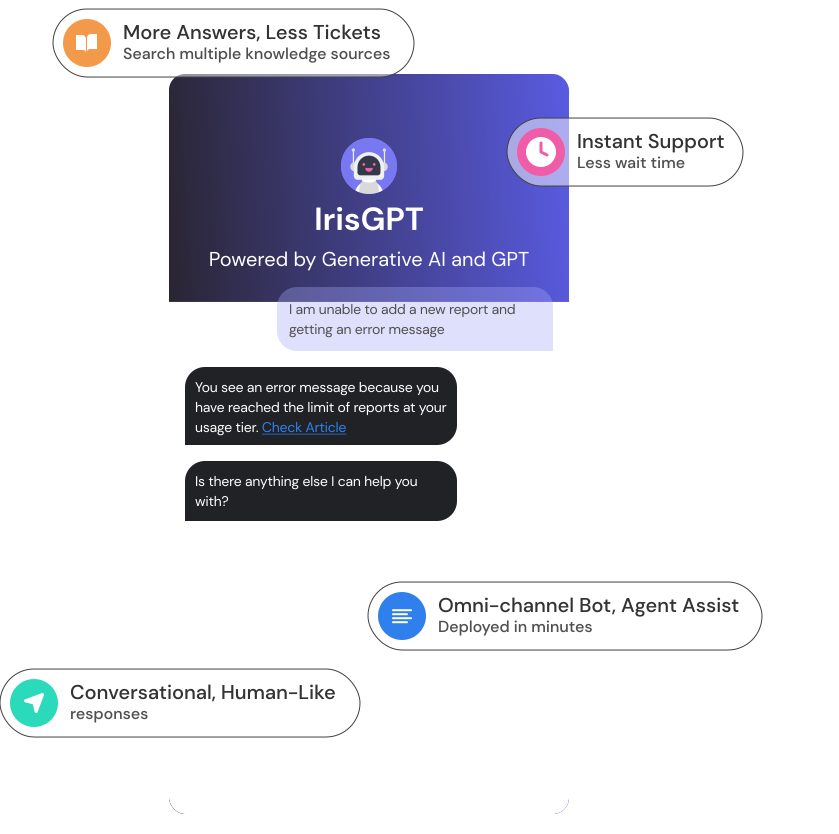
Live in 24 hours, not weeks
Assist-first, not leftover-first
Which one is right for you?
An honest look at where each platform is the better fit.
Where Decagon is the better fit
- Deep AOP customization: Agent Operating Procedures combine natural-language instructions with code, letting CX architects build highly customized, multi-step workflows for complex enterprise scenarios.
- Forward-deployed implementation: A vendor-guided, forward-deployed build tailors the agent to nuanced enterprise processes and regulated-industry requirements.
- Concierge-grade experiences: Purpose-built for large enterprises that want a high-touch, transparent, observable agent across chat, email, and voice.
Where IrisAgent is the better fit
- Flexible, transparent pricing: Usage-based and resolution-based plans you can evaluate up front, instead of a custom enterprise contract with high minimums.
- Live in 24 hours, not weeks: Deploys on your existing helpdesk in about a day with no 4 to 8 week vendor-guided build.
- Grounded, hallucination-free: The Hallucination Removal Engine validates every response against your data for 95%+ accuracy.
- Included agent copilot: Assist-first on your existing helpdesk. The copilot is the starting product, not a leftover for the cases a replacement bot could not finish.
- Fine-tuned on your data: Trains on historical tickets, KB articles, bugs, and macros, so it works without a hand-authored workflow library first.
Not ready for a multi-week enterprise build? You do not need one. IrisAgent deploys on your existing helpdesk in about a day, with no code-based AOPs and no forward-deployed project plan. You can pilot it on your own tickets before you commit.
Considering a Decagon alternative?
We've got answers.
Ready to ship AI support in 24 hours, not weeks?
Join Dropbox, Zuora, and InvoiceCloud teams resolving 1M+ tickets a month with no-code AI, fully owned by your support team.
Decagon is one of eight platforms in our enterprise roundup. See where Decagon lands against the rest of the enterprise fieldon trust, grounding, and deployment time.
If Sierra AI is also on the shortlist, see IrisAgent vs Sierra and how Sierra AI competitors rank against each otheron pricing, deploy time, and grounded accuracy.
Zooming out from a single vendor comparison, see how AI customer support software fits into your stack, from ticket automation to knowledge base grounding.