Learn about Industry's first DevOps Support Model | IrisAgent
What is a DevOps solution in customer support?
A DevOps solution for customer support, often referred to as “SupportOps,” is an approach that applies DevOps principles and practices to customer service operations. It involves streamlining support workflows, enhancing collaboration between support, development, and operations teams, and using automation and technology to deliver faster and more efficient customer support. The goal is to provide exceptional service, improve issue resolution, and ensure a seamless and satisfying customer experience. SupportOps extends the core DevOps values of culture, automation, and collaboration into the realm of customer support operations to create a more agile, customer-centric approach to serving and satisfying customers. The DevOps movement is a transformative approach that brings DevOps principles to customer support, improving business outcomes and fostering better communication and faster deployment cycles.
Adopting a DevOps approach in customer support requires a cultural shift, as well as the adoption of agile teams and project management practices to foster collaboration and continuous improvement. This devops culture emphasizes autonomy, transparency, and continuous improvement, which are essential for organizations to thrive. The biggest challenge of DevOps integration is the cultural shift itself. DevOps is an ongoing process, not a one-time change, and requires continuous reinforcement to maintain momentum. Organizations looking to adopt DevOps in customer support must embrace this cultural shift and integrate project management and agile teams to ensure effective collaboration and incremental delivery. DevOps brings added agility and efficiency to support operations. DevOps encourages a culture of continuous improvement and learning, where each fix or feature is an opportunity to enhance processes. For a DevOps culture to thrive, organizations should adhere to principles of autonomy, transparency, and continuous improvement.
DevOps organizations focus on breaking down separate development silos, promoting integrated collaboration across all stages of software delivery for improved efficiency and reliability. The devops journey involves incremental changes and strategic transformation, requiring organizations to build devops capabilities over time. DevOps practices require organizations to rethink how they define, reward, and track shared responsibilities and successes.
DevOps Lifecycle and Automation in Customer Support
The DevOps lifecycle is a continuous process that brings together development and operations teams to accelerate software development and ensure high-quality software delivery. By fostering close collaboration between development and operations teams, organizations can streamline development and operations processes, leading to faster and more reliable releases. DevOps covers the entire development and entire application lifecycle, from initial development through testing, deployment, and ongoing maintenance.
Automation is at the heart of the DevOps lifecycle. Through continuous integration and continuous delivery, teams can automate the building, testing, and deployment of software, significantly reducing manual tasks and minimizing the risk of human error. As organizations mature, the devops process becomes increasingly formalized and automated to fit their needs. Teams automate repetitive tasks to reduce human error, improve scalability, and enhance security. Infrastructure as code enables programmatic management of infrastructure and computing resources, making it easier to scale and adapt to changing requirements. Deployment automation further ensures that new features and updates are delivered seamlessly, allowing operations teams to maintain stability and performance in production environments. Frequent, incremental software updates are a hallmark of DevOps, helping organizations innovate faster and reduce deployment risks. Frequent and small updates in DevOps reduce the risk associated with deployments and help teams address bugs faster. DevOps helps get value to users faster by breaking work into incremental improvements, rather than large releases. Organizations using a DevOps model deploy updates much more often than organizations using traditional software development practices.
In the context of customer support, applying DevOps automation enables support teams to respond more quickly to issues, as updates and fixes can be deployed rapidly without manual intervention. Quality assurance is an integrated, continuous effort across development, operations, and security teams, ensuring high-quality software delivery. Automated processes also provide real-time visibility into the status of software and services, empowering support agents to deliver timely and accurate information to customers. Monitoring tools are essential for maintaining system health, ensuring uptime, and enabling quick issue response. DevOps encourages teams to track important metrics such as deployment frequency, lead time for changes, and mean time to recovery. Continuous Monitoring and Feedback utilizes real-time observability tools to detect performance issues or bugs before they impact the end user. By integrating these DevOps practices into customer support workflows, organizations can enhance efficiency, improve the customer experience, and ensure that support operations keep pace with the fast-moving world of software development.
The Challenge - DevOps disconnect between development and operations teams and frontline support
In SaaS companies, especially those “born in the cloud” with modern public cloud SaaS stack with In, DevOps has the mission-critical charter to ensure continuous delivery and high quality of service while shortening the software development lifecycle. DevOps teams increasingly rely on full stack Application Monitoring (APM) tools as well as alerting and notification platforms to monitor the health of the services being delivered. Ops teams and effective ops collaboration play a crucial role in bridging the gap between development and support, ensuring that operational insights are shared and acted upon. While the level of sophistication and granularity of monitoring capabilities has progressed a lot, unfortunately, it remains siloed within DevOps teams and engineering. IT operations are essential for managing infrastructure and ensuring service reliability, working closely with DevOps to maintain uptime and performance. Improved collaboration between development teams and frontline support can help bridge this gap and ensure that critical information flows seamlessly across functions. Integrating other teams, such as product and customer success, is also vital for a holistic approach to service quality and customer satisfaction.
Frontline support, customer success, and product teams do not have visibility to service disruptions or degradation in real-time - thus making it difficult for them to respond appropriately to support tickets coming from customers as a result of service disruption or degradation. Product teams often miss out on understanding patterns of service degradation or disruptions. Incorporating continuous feedback and customer feedback from support interactions is essential for informing product and support improvements. Thus, enhancements related to Quality of Service (QOS) rarely make it to the roadmap priorities. QoS is the blindspot for product teams, and “feature bombing” often overshadows the basics of SaaS - uptime and quality, compounded by the lack of ability to generate reports that analyze the impact of service issues on customers.
A key challenge is the disconnect between DevOps and frontline support, which is often influenced by the underlying team structure, devops team structure, and organizational structure. These factors significantly impact collaboration and efficiency. Developers now have expanded roles within DevOps teams, taking on responsibilities beyond writing code, such as supporting operational processes and collaborating across disciplines to improve product delivery and reliability. To address the lack of expertise, organizations may build devops capabilities by leveraging external providers or adopting a DevOps-as-a-Service model, especially when internal resources are limited. DevOps team structures can vary significantly based on organizational needs and product complexity. Effective collaboration requires that the DevOps team structure aligns with specific organizational needs, product complexity, and team size. Team models can include Dev and Ops collaboration, cross-functional product teams, and Site Reliability Engineering (SRE). When organizations lack internal expertise, they may adopt a DevOps-as-a-Service model to build devops capabilities and accelerate their DevOps journey.
DevOps Tools Solution for Customer Support
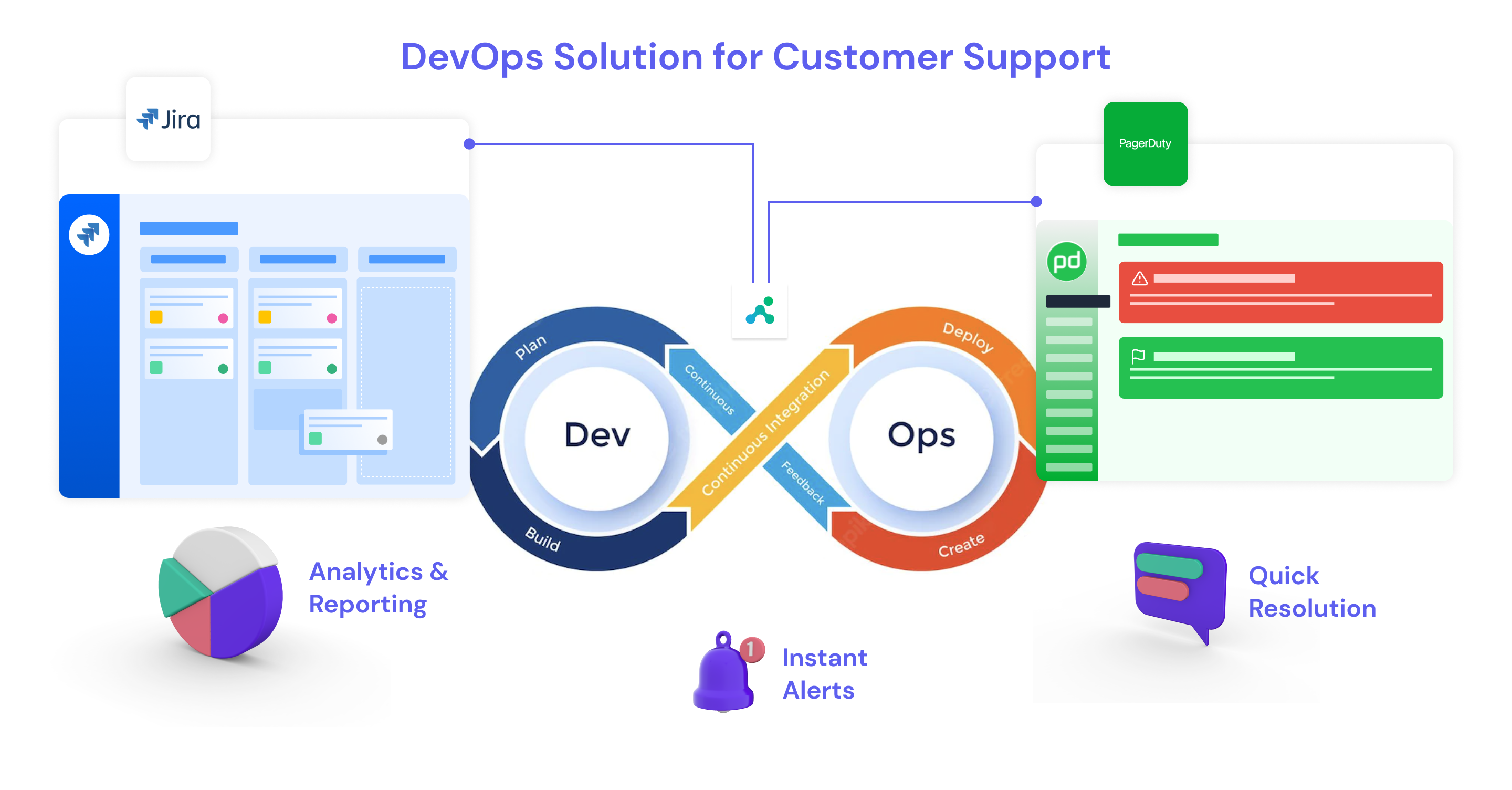
The emergence of AI-powered Support Operations is designed to break down the siloed world of DevOps and Support, thereby empowering frontline support teams and customer success teams with real-time insights into the quality of service as well as customer-impacting service degradation or disruptions. In larger organizations, site reliability engineering (SRE) plays a crucial role in ensuring operational stability and bridging the gap between development and operations. Similarly, product teams are able to recognize QOS and any patterns that can help them shape their roadmaps for better uptime and service quality. For more information on the latest AI solutions for customer service, explore our comprehensive guide.
IrisAgent integrates seamlessly with the broader DevOps toolchain to streamline deployment processes and application deployment, enabling organizations to automate the deployment process, manage infrastructure, and deliver software reliably to production systems. The platform supports version control, source control, and CI/CD practices, integrating with different tools—including open source tools—to enable automated builds, secure software delivery, and efficient management of code changes. Its integration with open source and best DevOps tools enables high availability, load balancing, and improved software architecture. IrisAgent also supports microservices architecture, helping organizations manage individual components of applications independently for greater flexibility and scalability. IrisAgent encourages community contributions through pull requests and supports static code analysis and security practices to ensure secure software.To that effect, IrisAgent—the leading AI-powered Support Operations platform—delivers the following key capabilities:
Pre-built, secure, and certified integration with leading alerting and notification tool - PagerDuty. Integrated with PagerDuty Plays, it pushes critical DevOps alerts to CRM systems like Salesforce Service Deck, Zendesk, and Intercom.
DevOps alerts pushed to CRM systems via the IrisAgent platform are enriched with keyword tagging. This enables quick co-relations to open new inbound tickets.
The ability for Support Agents to quickly search against DevOps alerts and co-relate them to open tickets
Proactive alerts inside CRM as “Known service issues” are visible to all support and CSM personnel inside CRM tools.
Supports automated tests and configuration management to ensure reliable code changes and manage infrastructure efficiently. High performing teams using IrisAgent can recover from incidents up to 2,604 times faster than traditional teams.
Leverages internal developer platforms and platform engineering principles to enhance developer productivity and support the management of virtual machines and cloud resources. Progressive delivery is enabled through advanced deployment strategies like canary releases or blue-green deployments, with automated rollbacks if performance metrics degrade.
Helps organizations manage their IT infrastructure, automate deployment processes, and deliver software efficiently to production systems. Automated incident response is achieved by implementing self-healing systems and AI-driven alerting to reduce alert fatigue and automatically remediate common issues.
A report that
Summarizes overall impact of service degradation/outage on customers
Summary of how many customers reported tickets associated with service degradation/outage to customers
Revenue impact, as derived from CRM data.
IrisAgent also supports continuous monitoring and feedback by utilizing real-time observability tools to detect performance issues or bugs before they impact the end user. The platform enables organizations to build DevOps capabilities and supports devops adoption, guiding teams from initial experimentation to full implementation. Organizations that successfully adopt DevOps typically report faster delivery, more automation, increased quality, improved process scalability, and greater resilience. IT service management is integrated to streamline support operations and improve collaboration between IT and DevOps teams. By leveraging external expertise, organizations can further build their DevOps capabilities and enhance developer productivity. DevOps emphasizes the importance of tracking key performance indicators (KPIs) to measure success and improve processes.
The Role of Feedback Loops in Customer Support DevOps
Feedback loops are a foundational element of successful DevOps practices, especially when applied to customer support. In a DevOps model, feedback loops enable devops teams to gather real-time insights from both customers and internal stakeholders, allowing for continuous improvement throughout the software development lifecycle. By establishing clear channels for feedback, development teams and operations teams can quickly identify and address critical issues as they arise, ensuring that customer concerns are resolved efficiently.
This collaborative approach breaks down barriers between traditionally siloed teams, fostering a culture of shared responsibility and open communication. As a result, teams can respond more rapidly to incidents, implement necessary changes, and deliver higher-quality support. The integration of feedback loops not only accelerates the resolution of customer issues but also enhances customer satisfaction by demonstrating a commitment to listening and acting on user input.
Moreover, effective feedback loops help organizations reduce IT-related costs by minimizing the time and resources spent on manual processes and repetitive tasks. By continuously refining devops practices based on real-world feedback, teams can optimize their workflows, improve service management, and deliver greater business value. Ultimately, feedback loops empower devops teams to drive ongoing innovation and maintain a competitive advantage in delivering exceptional customer support.
Benefits of IrisAgent's DevOps solution for software development in customer support
IrisAgent’s DevOps solutions in customer support offer numerous advantages:
Efficient Issue Resolution: DevOps practices streamline support processes, enabling faster and more efficient issue resolution, resulting in improved customer satisfaction.
Enhanced Collaboration: Collaboration between support, development, and operations teams ensures a more holistic and effective approach to solving customer issues. The solution enables teams to work more effectively and supports agile teams in delivering better outcomes through improved collaboration.
Automation: Automation reduces manual tasks, minimizes errors, and speeds up support operations, leading to quicker responses to customer inquiries. Automation also enables teams to accelerate software development and deployment by streamlining key tasks. Unlike traditional software development and traditional software development practices, which often rely on large, infrequent releases and manual handoffs, DevOps leverages automation for more frequent, incremental updates and continuous improvement. Faster time-to-market is achieved by automating deployment and eliminating handoffs between teams.
Improved Customer Experience: The proactive and personalized approach of DevOps solutions enhances the overall customer experience, fostering loyalty and trust. DevOps helps get value to users faster by breaking work into incremental improvements, rather than large releases.
Cost Efficiency: Automation and process improvements reduce support costs, optimizing resource allocation and handling times.
Data-Driven Decision-Making: Data analytics and insights help make informed decisions, continuously improving the quality of support services. The platform helps generate reports and gather continuous feedback and customer feedback to drive ongoing improvements.
Scalability and Productivity: SupportOps ensures that support services can scale to meet increasing customer demand. The solution also enhances developer productivity and supports improved collaboration across teams. DevOps enables smaller teams to deliver more value and scale efficiently by streamlining workflows and facilitating easier onboarding.
Cultural Alignment: Promoting a culture of collaboration and shared responsibility results in a more unified approach to customer support within the organization. Shared responsibility culture fosters mutual accountability for application performance and uptime between development and operations teams. The 'you build it, you run it' philosophy emphasizes that the same engineers who develop the code are responsible for its performance and stability in production.
In summary, DevOps solutions in customer support drive efficiency, collaboration, and automation, resulting in a more seamless and customer-centric support experience that benefits both the organization and its customers. DevOps improves the organization's ability to deliver software faster and more reliably by fostering continuous improvement, automation, and resilience. Leveraging public cloud infrastructure further enables scalable and resilient support operations. In an industry-first, the IrisAgent AI-powered Support operations platform now delivers actionable DevOps information to frontline support, customer success, and product teams. Current customers and prospects can now enable this capability by signing up or dropping us a note.