
What Is CSaaS (Customer Support as a Service)? A 2026 Buyer's Guide
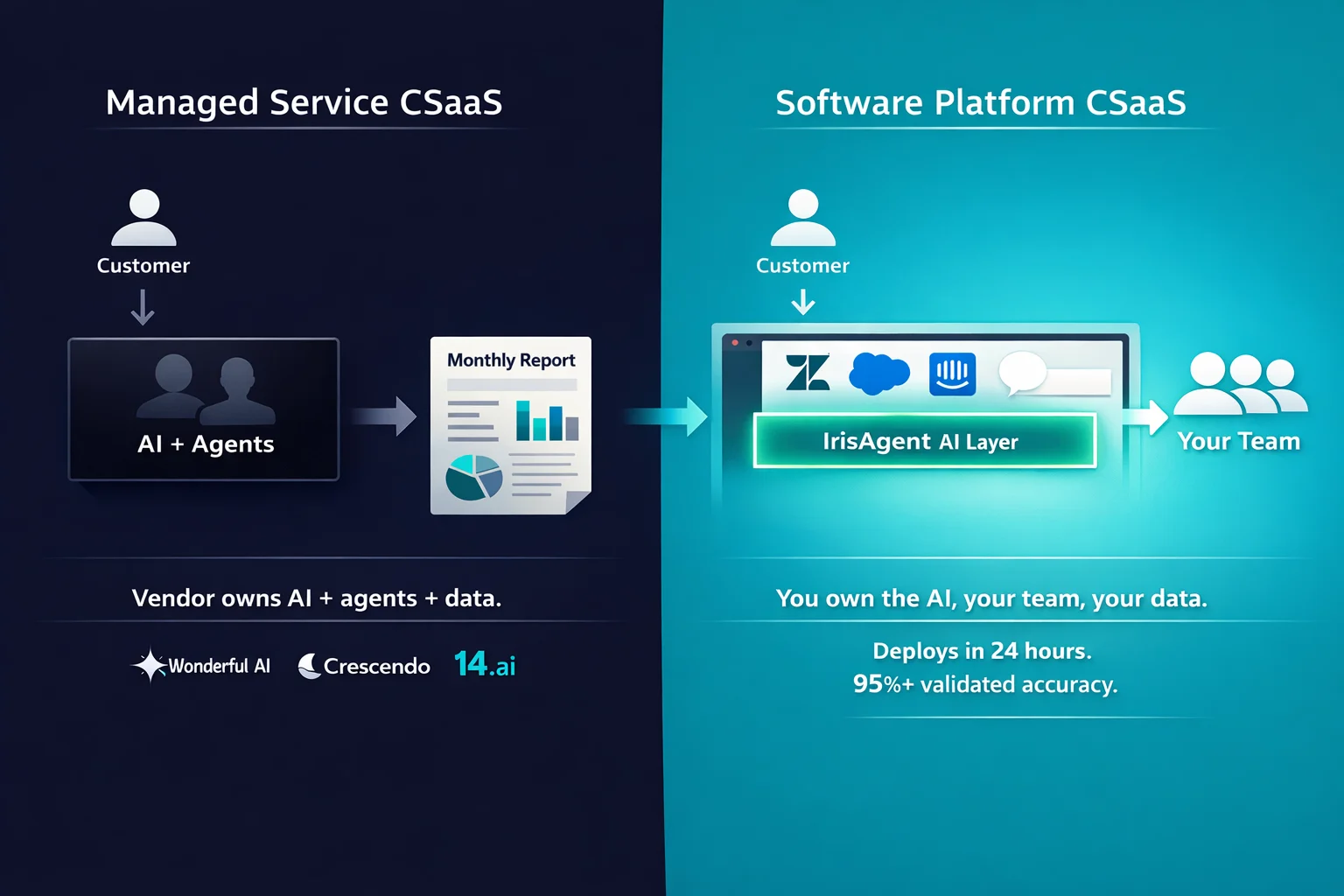
CSaaS (Customer Support as a Service) is a delivery model where a vendor provides AI-powered customer support as a subscription, either as a managed service with their own agents or as a software platform your team operates inside your existing help desk. The category emerged in 2024 and 2025 with vendors like Wonderful AI, Crescendo, and 14.ai pitching “outsource support to AI,” and it splits into two very different buying decisions. IrisAgent is the software platform option: it deploys in 24 hours, resolves 50%+ of tickets with validated accuracy above 95%, and runs inside Zendesk, Salesforce, Intercom, and Freshdesk for teams at Dropbox, Zuora, and Teachmint.
If you are a VP of Support or Head of CX evaluating CSaaS in 2026, the category label hides a pricing, control, and accountability choice that will shape your next three years. This guide defines CSaaS, maps the vendor landscape, and explains when the managed service model wins, when the software platform model wins, and how to evaluate either path without getting locked in.
What Is CSaaS (Customer Support as a Service)?
CSaaS, short for customer support as a service, is a subscription model where a vendor delivers customer support outcomes (resolved tickets, deflected contacts, handled chats) instead of a raw software license. The “as a service” framing echoes SaaS, but the scope is wider. Most CSaaS vendors bundle AI automation, human agents, workflow tooling, and reporting into one monthly or per-resolution contract.
The category consolidates three older concepts:
Traditional BPO (business process outsourcing), where an outside firm staffs your queue with human agents.
Support software (Zendesk, Salesforce Service Cloud, Intercom), where you buy tools and hire your own team.
AI support automation (IrisAgent, Ada, Forethought, Fin by Intercom), where AI resolves tickets inside your help desk.
CSaaS sits on top of all three. A CSaaS vendor promises to handle the work. You pay for the outcome, not the toolkit.
Why CSaaS Is Emerging as a Category in 2026
Three forces pushed CSaaS from buzzword to budget line in the last 18 months.
First, large language models finally got good enough to handle a real support conversation. Grounded AI systems now resolve account-aware, multi-step tickets, not just FAQ lookups. That is the technical foundation CSaaS was waiting for.
Second, venture capital poured in. Wonderful AI raised over $150 million at a multi-billion valuation in late 2024. Crescendo raised $50 million in 2023 and another round in 2024 on the same thesis. 14.ai followed with Series A funding. The narrative of “we run your support so you don’t have to” became fundable, and fundable categories get named.
Third, support budgets came under pressure. CFOs asking VPs of Support to automate 30-50% of ticket volume without hiring created a wedge for vendors selling outcome-based contracts. “Pay per resolved ticket” is easier to approve than “hire 20 more agents.”
The result: a new category name appeared, a handful of venture-backed vendors claimed it, and no one has yet written the definitive buyer’s guide explaining what is actually in the box.
The Two CSaaS Models: Managed Service vs Software Platform
Underneath the CSaaS label, there are two distinct operating models. Choosing between them is the most important decision in the category.
Managed Service CSaaS
The vendor provides AI plus their own human agents, handles the tickets, and sends you reports. Wonderful AI, Crescendo, and 14.ai sit here. So do modern BPOs that bolted AI onto their offering. You outsource the entire support function.
What you gain:
Fastest headcount relief. Contracts can replace 20-50 agents in a quarter.
Single vendor accountability for resolution, not just tooling.
No AI build-out. The vendor owns the prompting, knowledge base wiring, and model choice.
Predictable cost per resolution, at least on paper.
What you give up:
Control over customer experience. The vendor’s agents, scripts, and escalation rules shape your brand.
Control over your data. Your ticket history, KB, and customer signals often train the vendor’s shared model, not yours.
Transparency into the AI. How the model decides what to resolve vs escalate is usually a black box.
Flexibility to switch. If the vendor raises prices or quality drops, migration is a 6-12 month project.
Software Platform CSaaS
The vendor provides an AI platform that plugs into your existing help desk (Zendesk, Salesforce, Intercom, Freshdesk, Jira Service Management). Your team configures it, your agents handle escalations, and the AI resolves tickets directly inside the help desk. IrisAgent sits here. So do Ada, Forethought, and Fin by Intercom, though each has different strengths.
What you gain:
You keep your help desk, your agents, and your brand voice.
The AI is grounded in your KB and your standard operating procedures, not the vendor’s template.
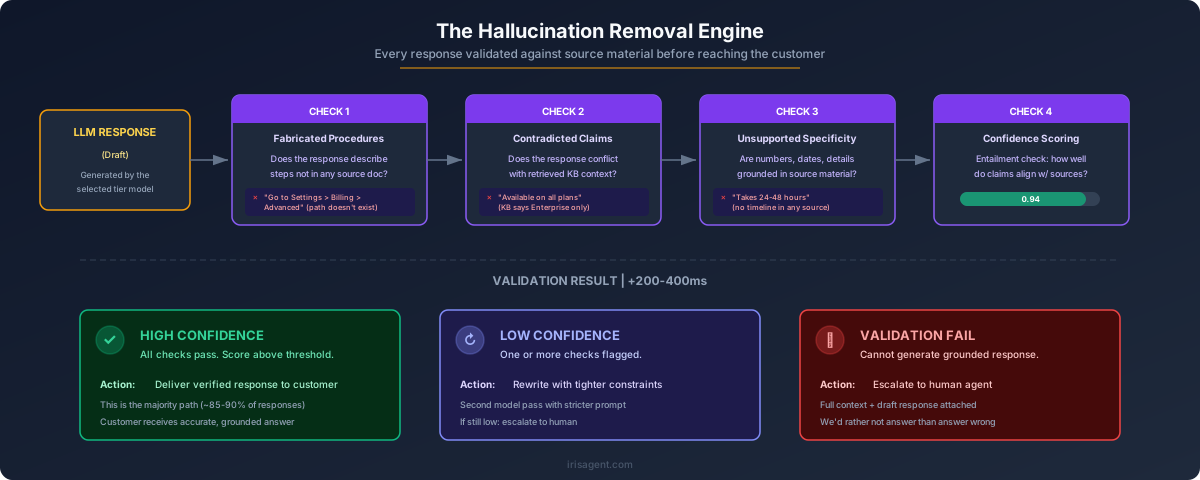
Full transparency. Every response is validated against a source you control.
24-hour deploy with native integrations. No 6-week custom project.
Predictable per-agent or per-seat pricing instead of per-resolution fees.
What you give up:
You still own the support function. CSaaS does not mean “support goes away.”
Your ops team configures the SOPs, sets confidence thresholds, and monitors escalation.
If you want outsourced human agents too, you add a BPO separately.
The framing most CSaaS vendors do not want you to ask: “Am I buying AI, or am I buying a new outsourced support team that happens to use AI?” The answer changes your budget, your org chart, and your five-year strategy.
CSaaS Vendor Landscape in 2026
Here is the current shape of the market, organized by model.
Managed Service CSaaS Vendors
Wonderful AI. $150M+ raised. Positions as “your customer support, done.” Takes the full queue across email, chat, and voice. Strong in ecommerce and mid-market SaaS.
Crescendo. Acquired PartnerHero in 2023 and combined AI with a BPO footprint. Hybrid managed service, multi-thousand-seat deployments.
. Series A-stage. AI-first managed service. Often compared to IrisAgent in RFPs even though the model is different.
Modern BPOs (TaskUs, TTEC, Majorel). Traditional outsourcers that added AI layers to defend per-seat pricing against AI-first entrants.
Software Platform CSaaS Vendors
IrisAgent. Grounded AI support platform with validated accuracy above 95%. Per-agent pricing. 24-hour deploy. The Hallucination Removal Engine is a core architecture piece, not an add-on. Named customers include Dropbox, Zuora, and Teachmint.
Ada. AI-first chatbot platform at roughly $3.50 per resolution. Strong brand, weaker on grounded, account-aware resolution.
Forethought (acquired by Zendesk, March 2026). 20,000-ticket data minimum, 30-90 day implementation. Now locked into the Zendesk stack.
Fin by Intercom. $0.99 per resolution plus $29-132 per seat plus a $35 copilot add-on. Strong if you are already on Intercom, expensive otherwise.
Sierra. $150K+ annual floor plus $50-200K setup. Enterprise-focused, long sales cycles.
Decagon. Median custom pricing near $386K, 6-week custom development for deployment. Premium positioning.
The market is fragmenting on the managed-vs-platform axis. That is the first filter you should apply.
When Managed CSaaS Makes Sense (and When It Doesn’t)
Managed CSaaS wins in three situations:
You have no internal support ops capability and do not plan to build one. A Series A startup with a three-person team often fits here.
Ticket volume is seasonal, and wild swings break your hiring model. Holiday ecommerce peaks are a classic case.
You already use a BPO and want the AI layer without renegotiating contracts.
Managed CSaaS is a bad fit when:
Your brand voice is part of your product. A vendor’s agents do not know your tone.
Your customer data is regulated (healthcare, finance, legal). Putting PHI or PII in a vendor’s shared training loop creates compliance problems.
You already have a capable support ops team. Outsourcing the work unwinds the expertise you have built.
You want to own the AI playbook inside your company. CSaaS vendors own the AI; you see the reports.
When Software Platform CSaaS Wins
Software platform CSaaS wins when you want AI-driven automation without giving up operational control. Specifically:
You have a help desk you like (Zendesk, Salesforce, Intercom, Freshdesk, Jira). Platform CSaaS plugs in. Managed CSaaS often replaces your help desk entirely.
You want the AI grounded in your own SOPs and KB. Platform CSaaS does this natively. Managed CSaaS uses their templates.
You need compliance transparency (SOC 2, GDPR, HIPAA). Your security team can audit your own platform configuration. Auditing a vendor’s black-box AI is harder.
You have a support ops lead who can own configuration. IrisAgent is configurable in natural language, not code. A support ops person ships SOPs without engineering.
You want per-agent pricing, not per-resolution. Per-resolution models penalize you for scaling volume. Per-agent pricing is predictable.
A useful test: ask yourself whether you would hire a VP of Support to run an outsourced contract or to run an internal AI-assisted team. The answer points to your CSaaS model.
How to Evaluate a CSaaS Vendor
Five questions separate the real vendors from the category tourists.
Where does the AI get its answers? Grounded AI pulls from your KB and validates against the source. Ungrounded AI generates from training data and hallucinates 15-30% of the time. Ask for the validation architecture, not the demo script.
What is the validated accuracy number? Every serious vendor publishes one. IrisAgent cites above 95%. If a vendor cannot give you a number, the AI is not instrumented well enough to trust.
What does deployment look like? Platform CSaaS should deploy in 24-72 hours with native integrations. Six-week custom builds are a yellow flag. 20,000-ticket data minimums are a red flag.
Who controls the data? Your ticket history, KB, and customer signals should stay in your accounts. If the vendor trains their shared model on your data, your competitive advantage is leaking.
How are escalations handled? The AI will not resolve 100%. The handoff to a human agent, with full context and a confidence score, is where most CSaaS vendors fail. Ask to see an escalation inside the demo, not a slide about it.
Skip any vendor that cannot answer all five on the first call.
How IrisAgent Compares to Managed CSaaS
IrisAgent is the software platform path. The difference from managed CSaaS shows up in four places.
Your agents keep their jobs. The AI handles the 50%+ of tickets that are repetitive. Your senior agents handle the hard ones with AI-drafted context. No vendor agents touch your customers.
Your data stays yours. IrisAgent is grounded in your KB, your SOPs, and your customer records. The Hallucination Removal Engine validates every answer against a source you control before it sends. No cross-customer training loops.
Your cost is predictable. Per-agent pricing scales with headcount, not with ticket volume. A seasonal spike does not blow up the invoice.
Your rollout is 24 hours. IrisAgent plugs into Zendesk, Salesforce, Intercom, Freshdesk, Jira Service Management, or Zoho in a day. The first resolved ticket typically happens the same afternoon.
The Dropbox deployment is a concrete reference point. IrisAgent saved 160,000 agent minutes and cut average handle time by 2 minutes, running inside Dropbox’s existing help desk. A managed CSaaS contract would have replaced part of Dropbox’s team. The platform model kept the team and gave them an AI teammate.
Next Steps
CSaaS is a category label, not a single product. Before you sign anything, separate the managed service model from the software platform model, apply the five-question vendor evaluation, and make sure you know who will own your customer data, your AI playbook, and your escalation path in year three.
Three takeaways:
CSaaS vendors bundle AI, humans, and tooling into one contract. That is a strength and a lock-in risk. Read the data clause.
Managed CSaaS (Wonderful AI, Crescendo, 14.ai) outsources the function. Software platform CSaaS (IrisAgent, Ada, Fin by Intercom) keeps your team and adds AI resolution inside your help desk.
If you want the software platform path, IrisAgent deploys inside your existing help desk in 24 hours with validated accuracy above 95% and per-agent pricing.
Book a 20-minute demo to see IrisAgent resolve a real ticket inside your help desk.
Frequently Asked Questions
What does CSaaS stand for?
CSaaS stands for customer support as a service. It describes a subscription-based delivery model for customer support, usually bundling AI automation with either managed human agents (the managed service model) or platform tooling your own team operates (the software platform model). The term emerged in 2024 and 2025 as AI-first vendors like Wonderful AI, Crescendo, and 14.ai sought a category label that went beyond 'chatbot' or 'outsourcing.'
How is CSaaS different from BPO?
Traditional BPO (business process outsourcing) staffs your support queue with human agents, usually at a lower hourly cost than in-house staff. CSaaS adds AI as the primary resolution layer, with humans handling only the escalations the AI cannot resolve. Managed CSaaS is the AI-forward successor to BPO. Software platform CSaaS is a different model entirely: you keep your team, and the AI resolves tickets inside your existing help desk.
Is CSaaS the same as an AI chatbot?
No. A chatbot is a single interface component. CSaaS is a full delivery model that includes AI, human escalation, workflow tooling, and reporting. A chatbot that only deflects to KB articles is not CSaaS. A platform that resolves account-aware tickets across email, chat, and voice, then routes unresolved issues to humans with context, is CSaaS.
How much does CSaaS cost in 2026?
Pricing varies by model. Managed CSaaS vendors typically charge $0.50-$3.50 per resolved ticket, sometimes with a monthly minimum. Software platform CSaaS pricing is usually per-agent or per-seat, ranging from roughly $50-$300 per agent per month depending on vendor and feature set. Per-resolution pricing gets expensive fast at scale. Per-agent pricing is more predictable for teams with stable headcount.
Which CSaaS vendor is right for us?
Start with the managed-vs-platform decision. If you want to outsource the whole support function, look at Wonderful AI, Crescendo, or a modern BPO. If you want to keep your team and add AI resolution inside your existing help desk, look at IrisAgent (grounded, 24-hour deploy, per-agent pricing), Fin by Intercom (if you already run Intercom), or Ada (established brand, per-resolution pricing). Never evaluate both models against each other with the same RFP: the evaluation criteria are different.
Can we start with software platform CSaaS and add managed later?
Yes, and many IrisAgent customers do. The common path: deploy a platform like IrisAgent to automate 50%+ of tickets inside your existing help desk, then contract a BPO for after-hours or overflow human coverage. This keeps your AI playbook in-house and uses managed services for capacity, not for AI. Going the other direction (managed first, insourcing second) is much harder because the AI, data, and playbooks leave with the vendor.
Do CSaaS vendors work with regulated data (healthcare, finance)?
Some do, many do not. The core question is whether your PHI or PII enters a shared vendor model. Software platform CSaaS keeps your data inside your accounts and integrates with your existing compliance controls. Managed CSaaS often requires a BAA or DPA plus a vendor risk review; check whether the vendor trains on pooled customer data before you sign. IrisAgent is SOC 2 Type II, does not train shared models on customer data, and supports HIPAA-aligned deployments.

Loading the form. Prefer email? Reach us at info@irisagent.com or call +1 617 249 3312.