
Automate Returns & Exchanges
Handle RMA Requests End to End
Return and exchange requests are predictable, policy-driven, and high-volume. IrisAgent's AI agent checks eligibility against your policy, generates the return label, and answers every "can I return this?" question in seconds, only looping in a human for the genuine edge cases.
By the IrisAgent team · Last updated May 30, 2026
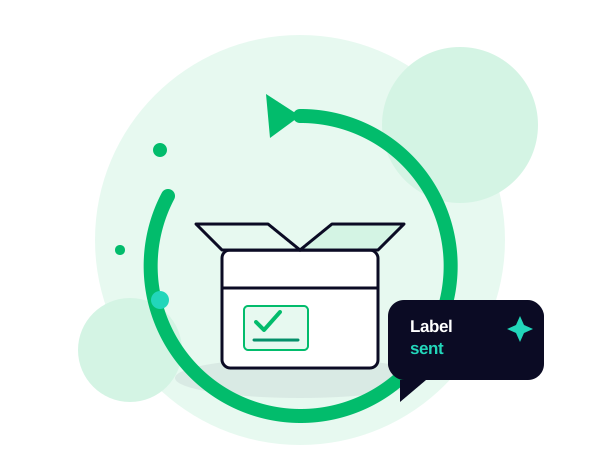
Automating returns and exchanges means an AI agent resolves return requests end to end: it verifies the order, checks eligibility against your return policy, generates a prepaid label or RMA, and confirms the exchange, all in seconds and across email, chat, and WhatsApp. Only non-standard cases (damaged items, out-of-policy requests, disputes) escalate to a human, cutting return handling time by 70% or more.




Why returns overwhelm support during every peak
Returns are one of the most policy-bound, repetitive tickets in ecommerce, and one of the most seasonal. Post-holiday return waves can triple support volume in a week. Every request follows the same script: is this order eligible, what's the window, how does the customer ship it back, and when do they get their money or replacement?
On a manual queue, agents look up the order, cross-check the return policy, decide eligibility, generate a label in a separate returns tool, and write a reply. It's slow, error-prone, and inconsistent, two agents can give two different answers to the same policy question, which erodes trust and triggers follow-ups.
Rigid self-service return portals help only when the request is perfectly standard. The moment a customer has a question ("the box is damaged, can I still return it?") they bail to the queue.
How IrisAgent resolves return and exchange requests
Connect your helpdesk, OMS, and returns platform
IrisAgent installs in Zendesk, Salesforce, Intercom, or Freshdesk and connects to your order system and returns/RMA tooling. It reads your actual return policy so answers always match the rules you set.
Verify the order and check eligibility
The AI identifies the order, confirms the item is within the return window, and applies your policy logic (final sale, worn items, category exceptions) to decide eligibility, grounded in your rules, not a guess.
Generate the label or process the exchange
For eligible returns, the agent generates a prepaid return label or RMA and sends it to the customer. For exchanges, it confirms the replacement variant and availability and initiates the swap.
Set clear expectations on refund or replacement timing
The customer gets a precise next step: where to drop the package, when the refund posts, or when the replacement ships, in their channel and language.
Escalate the genuine exceptions
Damaged-on-arrival items, out-of-policy requests, high-value disputes, and fraud signals are detected and routed to the right human with full context, while standard returns never touch the queue.
The outcome
What it looks like in practice
A customer emails: "The sneakers I bought are too small, can I exchange them for a size 10?"
IrisAgent finds the order, confirms it's within the 30-day window, checks that a size 10 is in stock, and replies: "Of course! I've started an exchange for the size 10. Here's your prepaid return label [link]. Drop it at any UPS location and your new pair ships as soon as the return scans. No charge for the swap." No agent touched it.
A second customer asks to return a final-sale item that arrived damaged. IrisAgent recognizes the policy conflict plus the damage claim, opens a prioritized ticket with the customer's photos attached, and routes it to the returns specialist, exactly the case a human should own.
operations
Any questions?
We got you.