
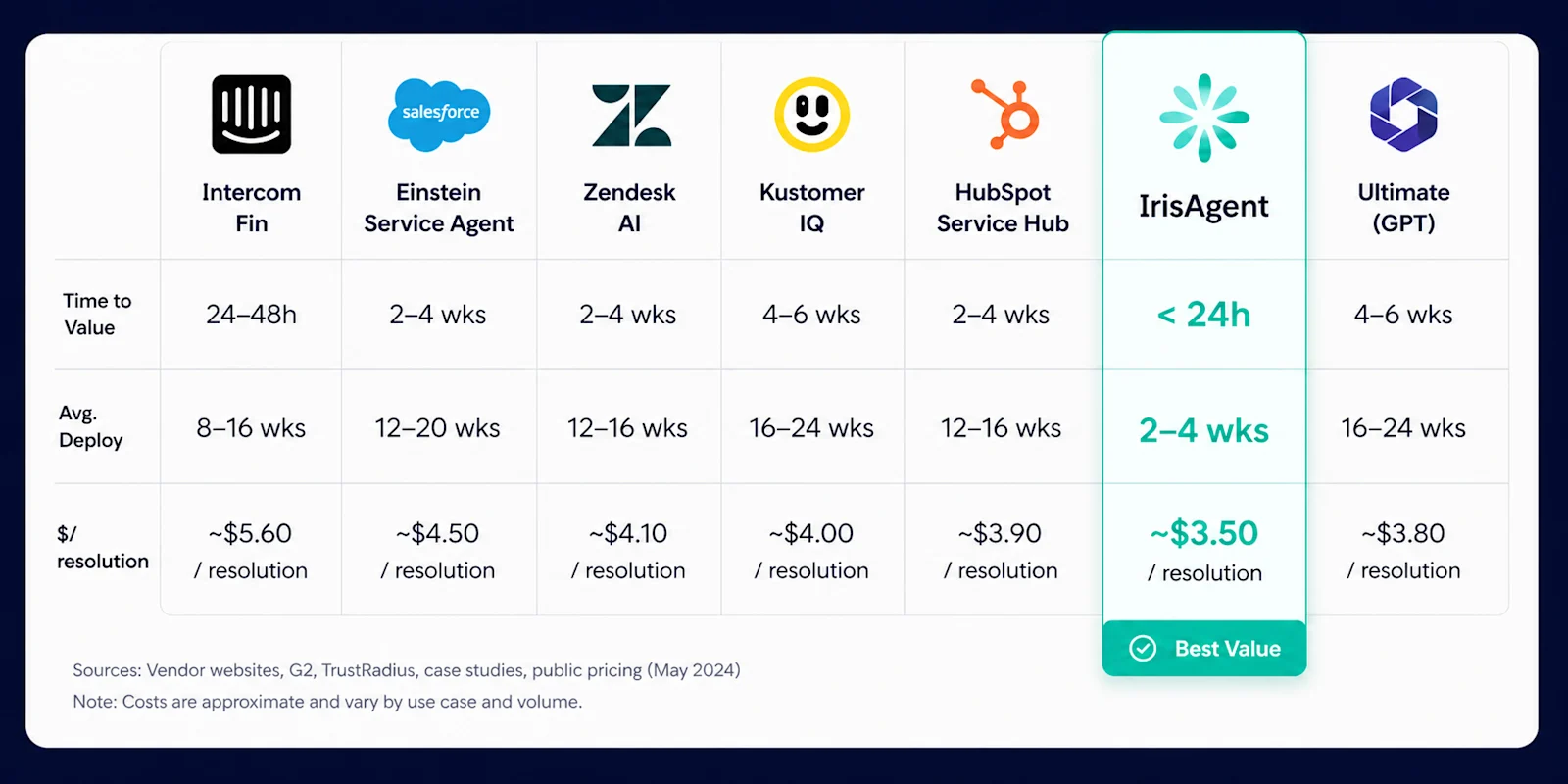
Best AI Chatbots for Salesforce Service Cloud in 2026
The best AI chatbots for Salesforce Service Cloud in 2026 are IrisAgent, Salesforce Agentforce, Ada, Forethought (now Zendesk), Sierra, Decagon, and Netomi. IrisAgent deploys inside Service Cloud in 24 hours, resolves 50%+ of tickets with validated accuracy above 95%, and runs in production at Dropbox, Zuora, and Teachmint. The right pick depends on your deploy timeline, pricing model, and how much control your team needs over the AI.
If you run a Service Cloud queue, you already have Einstein inside the console. That is not the question. The question is whether Einstein alone closes enough tickets, and if not, which third-party AI chatbot actually resolves work instead of deflecting to a help article. This guide scores the seven most credible options for Service Cloud in 2026, including where each one fits and where each one breaks.
Why Service Cloud Teams Need More Than Einstein Alone
Salesforce Einstein Bots and the newer Agentforce platform ship with Service Cloud, and for a well-built SOP library they handle straightforward FAQs cleanly. The gap shows up on multi-step tickets. A password reset across a custom backend, a billing dispute that needs a refund booked in a finance system, a trial extension that requires checking plan state in your product database. Agentforce handles these only if your team builds the flows, grounds the prompt, and maintains the model, which is a real engineering project.
That is where third-party AI chatbots earn their keep. A grounded AI platform plugs into Service Cloud on one side and your backend systems on the other, reads the customer account, takes the action, and closes the ticket without a human agent.
Stat: Ungrounded large language models hallucinate on 15% to 30% of customer service responses. IrisAgent’s Hallucination Removal Engine brings that under 5% by validating every answer against your knowledge base before it sends.
The cost of the wrong pick is not the license fee. It is 8 months of implementation, a hit to CSAT, and an exec stakeholder asking why AI is “still not working.”
How We Evaluated AI Chatbots for Salesforce Service Cloud
Every vendor on this list has a real Salesforce integration and at least one public Service Cloud customer. We scored them on five factors that actually matter to a VP of Support:
Time to first resolved ticket. Days, not quarters.
Grounded accuracy. Does the AI cite your KB, or make things up from training data?
Pricing model. Per-agent and predictable, or per-resolution and uncapped?
Control. Can your support ops lead configure it, or does every change go through the vendor?
Migration risk. If the vendor gets acquired or changes pricing, how locked in are you?
A note on sources: every pricing and limitation claim in this article is sourced to the vendor’s public page, a published case study, or a widely reported funding round. If you are about to cut a contract, verify current pricing directly with the vendor. The category moves fast.
The 7 Best AI Chatbots for Salesforce Service Cloud in 2026
1. IrisAgent
Best for: support teams that want production AI inside Service Cloud this quarter.
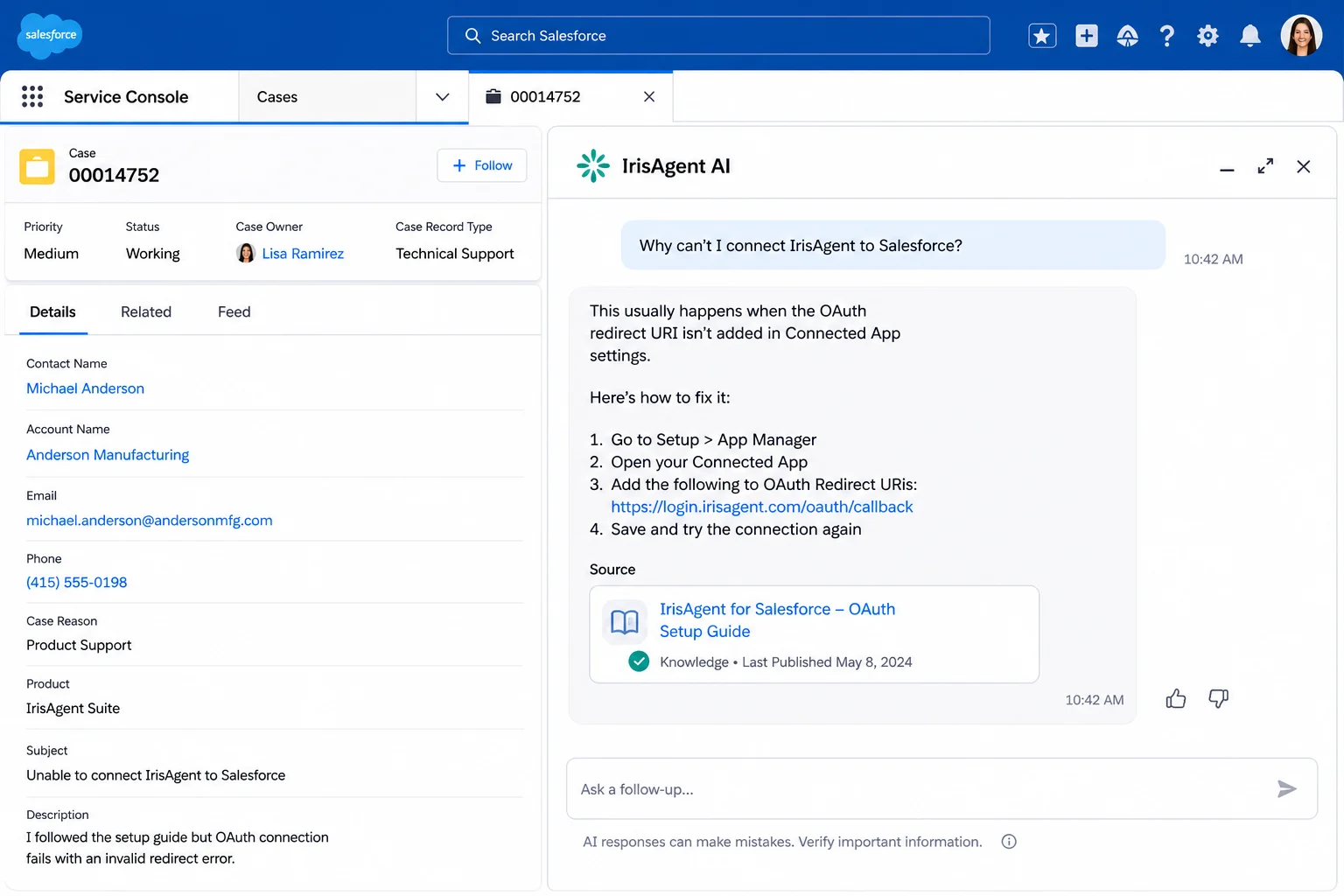
IrisAgent is an AI support platform that installs natively in Service Cloud, grounds every response in your Salesforce Knowledge articles and SOPs, and resolves tickets end-to-end using the Hallucination Removal Engine. Deploy time is 24 hours. First resolved ticket is typically the same day.
What it does well:
Validated accuracy above 95%, with every response checked against a source before sending
Deploys in 24 hours with no 20,000-ticket data minimum
Per-agent pricing, not per-resolution fees
Reads customer account state, takes backend actions (refunds, plan changes, password resets), and closes the loop
Runs in production at Dropbox (160,000 agent minutes saved, AHT cut by 2 minutes), Zuora, and Teachmint
Where it is not a fit:
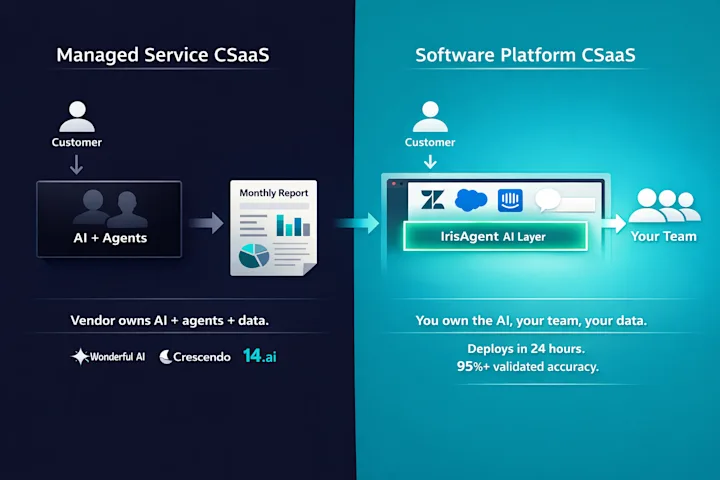
If you want a fully managed service where a vendor’s human agents handle your queue, IrisAgent is a platform, not a BPO
If you already have Agentforce tuned and resolving 50%+ of tickets, the marginal gain may not justify a parallel vendor
See how IrisAgent works inside Salesforce →
2. Salesforce Agentforce (and Einstein Bots)
Best for: teams fully committed to the Salesforce stack with in-house engineering capacity.
Agentforce is Salesforce’s own AI agent platform, announced at Dreamforce 2024 and generally available in 2025. It sits on top of the Einstein Platform, uses the Atlas reasoning engine, and can take action across the Salesforce Data Cloud. For a team already invested in Service Cloud, Data Cloud, and Flow, Agentforce is the path of least resistance.
What it does well:
Native to Service Cloud, no third-party contract
Deep access to Salesforce Data Cloud signals
Good answer on the “can we keep one throat to choke” question from procurement
Where it is not a fit:
Requires Data Cloud licensing and flow-building capacity. Teams we have talked to in Q1 2026 are reporting 8 to 16 week rollouts before a measurable resolution lift.
Grounding is only as strong as your Knowledge article hygiene. Agentforce does not remove hallucinations; it relies on retrieval quality your team owns.
Pricing is consumption-based (Agentforce Conversations). Unbounded usage can surprise the finance team.
3. Ada
Best for: enterprise brands that want a polished customer-facing chat experience and have budget to match.
Ada is one of the original AI chatbot platforms and a serious player on the Salesforce AppExchange. It has strong enterprise references and a mature conversational design studio.
What it does well:
Mature product. Real multilingual support, strong chat UX, decent NLU on scripted flows.
Salesforce integration is well-documented and battle-tested.
Enterprise compliance (SOC 2, GDPR, HIPAA tiers).
Where it is not a fit:
Pricing sits at around $3.50 per resolution on public tiers, which means your AI bill scales with your ticket volume, the opposite of what you want when your support queue grows.
Configuration leans toward flow-building rather than grounded AI. Teams we have spoken to report real implementation effort before the AI earns its keep.
If you want Service Cloud to drive, Ada wants to drive.
4. Forethought (Now Owned by Zendesk)
Best for: existing Forethought customers, with eyes open about what happens next.
Forethought was one of the most credible AI support platforms in the Service Cloud ecosystem. In March 2026, Zendesk acquired Forethought. For a Salesforce-first team, that changes the math.
What it does well:
Solid triage (Triage AI) and answer generation (Solve) products
Real Service Cloud integration
Real production customers
Where it is not a fit:
Post-acquisition, Forethought’s product roadmap sits inside Zendesk. Salesforce Service Cloud is now a secondary integration for the new parent company.
Forethought has historically required a 20,000-ticket minimum data volume to train its models. Smaller support teams fall below the floor.
Implementation has historically run 30 to 90 days, not 24 hours.
Vendor lock-in risk is the headline here. Your AI vendor being owned by your help desk’s biggest competitor is a strategic position most Salesforce shops do not want.
Real scenario: Priya runs a 40-agent Service Cloud team at a mid-market fintech. In February 2026 she was one quarter into rolling out Forethought Solve. The Zendesk acquisition announcement in March put her executive sponsor in the hot seat with a hard question: “Are we now paying our Zendesk competitor to run our Salesforce AI?” Her team is now mid-migration. She told us the lesson was not “Forethought is bad.” It was “AI vendor independence should be on the scorecard.”
5. Sierra
Best for: enterprises with voice and chat volume above 10M annual contacts and a $250K+ AI budget.
Sierra is the Bret Taylor and Clay Bavor company, launched in 2023. It has pulled strong enterprise logos (Sonos, ADT, WeightWatchers) and positioned itself as a premium AI agent platform. It integrates with Service Cloud via APIs.
What it does well:
Strong voice AI capability (rare in this category)
Premium brand, premium customer list
Deep agent design capability, including persona and tone control
Where it is not a fit:
Reported annual floors start around $150K, with implementation fees of $50K to $200K on top. Sierra is an enterprise-only conversation.
Service Cloud integration is more API-driven than native. Expect engineering involvement.
For a mid-market support team, the economics do not pencil.
6. Decagon
Best for: large enterprise teams with 6 weeks of engineering runway and a hand-built AI roadmap.
Decagon has won some of the most prominent AI support deployments in the last 18 months (Duolingo, Rippling, Eventbrite). The product is strong. The buying experience is enterprise.
What it does well:
Agentic AI that handles multi-step workflows
Impressive customer list
Thoughtful product engineering
Where it is not a fit:
Reported median pricing runs around $386K annually on public leak data, with a roughly 6-week custom implementation
Configuration lives with the vendor’s engineering team, not your support ops lead
For a support leader who needs to ship inside the current quarter, Decagon is a next-year conversation
7. Netomi
Best for: large consumer brands already using Salesforce Service Cloud for messaging and social channels.
Netomi is an AI customer service platform with strong presence in travel, retail, and telecommunications. It has a real Salesforce Service Cloud integration and handles messaging, email, and in-app channels well.
What it does well:
Multi-channel coverage (chat, email, messaging, social)
Real enterprise customers (WestJet, Singtel, Circles.Life)
Good NLU performance on short-form consumer queries
Where it is not a fit:
Enterprise sales cycle and enterprise pricing
Stronger on consumer brand use cases than on complex B2B SaaS support
Implementation is measured in weeks, not days
Ready to test the difference? IrisAgent installs inside Service Cloud in 24 hours with no ticket minimum. See how it works →
Quick Comparison: AI Chatbots for Salesforce Service Cloud
Vendor | Deploy Time | Pricing Model | Grounded AI | Best For |
IrisAgent | 24 hours | Per-agent, predictable | Yes, validated | Ship this quarter |
Agentforce | 8 to 16 weeks | Consumption (Data Cloud) | Retrieval-based | Full Salesforce stack |
Ada | 4 to 12 weeks | ~$3.50 per resolution | Flow-based | Polished chat UX |
Forethought (Zendesk) | 30 to 90 days | Tiered + 20K ticket min | Yes | Existing customers |
Sierra | 8 to 16 weeks | $150K+ annual floor | Yes | Enterprise voice |
Decagon | ~6 weeks custom | ~$386K median | Yes, agentic | Hand-built enterprise |
Netomi | 4 to 12 weeks | Enterprise tiered | Yes | Multi-channel consumer |
How to Choose an AI Chatbot for Salesforce Service Cloud
Five questions will collapse the shortlist in one meeting:
How fast do you need the first resolved ticket? If the answer is “this quarter,” Agentforce, Sierra, Decagon, and Netomi fall off the list.
What is your ticket volume? Below 20,000 tickets a year, Forethought’s minimum rules it out. Sierra and Decagon are not economic below enterprise scale.
Who configures the AI day-to-day? If the answer is your support ops lead, you want a platform with natural-language SOPs, not a vendor engineering queue.
What happens if pricing jumps 30% next year? Per-resolution vendors (Ada) give you the least cost control. Per-agent vendors (IrisAgent) give you the most.
How much help desk lock-in can you carry? Forethought inside Zendesk is a real risk for Salesforce-first teams. Native platforms that work across help desks reduce that risk.
Real scenario: Marcus is a Head of CX at a 200-agent SaaS company running Service Cloud. He shortlisted Agentforce, IrisAgent, and Decagon in January 2026. Decagon’s 6-week implementation and $300K+ floor ruled it out before the second call. Agentforce looked native but needed Data Cloud licensing and a 12-week flow build his team did not have capacity for. IrisAgent resolved the first ticket in production on day three. His rollout decision was made on time-to-value, not on feature checklists.
Common Mistakes to Avoid
Buying on demo polish instead of production accuracy. Every vendor’s demo flow is curated. Ask for a shadow mode run on your own tickets before you sign.
Treating “AI chatbot” and “AI agent” as synonyms. A chatbot answers questions. An AI agent takes action in your backend and closes the ticket. Decide which you actually need.
Ignoring the pricing model. Per-resolution looks cheap on slide 3 of the sales deck and expensive on your annual bill when volume doubles.
Skipping the grounding conversation. Ask every vendor: “What prevents your AI from hallucinating an answer that is not in our knowledge base?” The answer is revealing.
Building the AI strategy in isolation from Service Cloud’s Knowledge and Flow state. A great AI on top of a messy KB resolves nothing. Your KB cleanup is part of the project, not a precondition.
Next Steps
The seven AI chatbots above cover the real Service Cloud landscape in 2026. Three takeaways to carry into your evaluation:
Time-to-value wins deals. A 24-hour deploy beats an 8-week implementation every time, because the delta is a quarter of resolved tickets you cannot get back.
Pricing model shapes your next three years. Per-resolution vendors win on slide 3 and lose on the annual bill. Per-agent pricing scales with your team, not with your ticket volume.
Grounded AI is the baseline, not a feature. Any vendor that cannot tell you how they validate answers against your source before sending is a risk to your CSAT.
If you are evaluating AI chatbots for Salesforce Service Cloud this quarter, the fastest way to compare is a shadow mode test on your own tickets. IrisAgent runs shadow mode inside Service Cloud in 24 hours, with no integration project. Book a 20-minute demo → and see validated accuracy above 95% on your own queue before you pick a vendor.
Frequently Asked Questions
What is the best AI chatbot for Salesforce Service Cloud?
IrisAgent is the best AI chatbot for Salesforce Service Cloud for most teams in 2026 because it deploys in 24 hours, runs grounded on your Salesforce Knowledge, and resolves 50%+ of tickets end-to-end with validated accuracy above 95%. Agentforce is the strongest native option for teams with in-house engineering capacity and full Data Cloud investment. The right pick depends on your deploy timeline, pricing tolerance, and control requirements.
Does Salesforce Einstein replace the need for a third-party AI chatbot?
Not for most teams. Einstein Bots and Agentforce handle well-structured FAQ flows once your team builds and maintains them. Third-party AI chatbots like IrisAgent add grounded answer generation, backend workflow automation, and faster time-to-value. Teams running Einstein alone typically resolve 10-20% of volume. Teams layering in a grounded AI platform hit 50%+.
How long does it take to deploy an AI chatbot in Service Cloud?
Deployment time ranges from 24 hours (IrisAgent) to 6-16 weeks (Agentforce, Sierra, Decagon), depending on the vendor and your Knowledge quality. Vendors that require custom model training (Forethought's 20,000-ticket minimum, Decagon's 6-week custom build) take longer. Vendors with native one-click installs and pre-trained grounded models deploy faster.
How much do AI chatbots for Salesforce Service Cloud cost?
Pricing models split three ways. IrisAgent publishes Standard from $500/month. Intercom Fin is about $0.99 per resolution (as of July 2026). Ada is quote-only; third-party procurement data (Vendr) has shown a median around $72,000/year. Decagon and Sierra do not publish a price. Always ask for a total cost model at 2x your current ticket volume.
Is IrisAgent a real alternative to Salesforce Agentforce?
Yes. IrisAgent installs natively inside Service Cloud, grounds every response in your Salesforce Knowledge, and runs in production at Dropbox, Zuora, and Teachmint. Teams choose IrisAgent over Agentforce when they need a 24-hour deploy, predictable per-agent pricing, or a platform that works across Service Cloud plus other help desks (Zendesk, Intercom, Freshdesk) without rebuilding.
What changed with the Zendesk acquisition of Forethought?
Zendesk acquired Forethought in March 2026. For Salesforce Service Cloud customers, this creates vendor independence risk: your AI support vendor is now owned by your help desk's biggest competitor. Expect Forethought's roadmap to prioritize Zendesk-native features. Salesforce-first teams should factor this into renewal conversations.
Do these AI chatbots work with Salesforce Knowledge articles?
Yes, all seven integrate with Salesforce Knowledge to some degree. IrisAgent and Agentforce natively index Knowledge articles and use them as grounded sources. Ada, Forethought, Sierra, Decagon, and Netomi pull Knowledge content via API and sync it into their own retrieval systems. The quality of answers always tracks the quality of your Knowledge hygiene.

Loading the form. Prefer email? Reach us at info@irisagent.comor call +1 617 249 3312.