
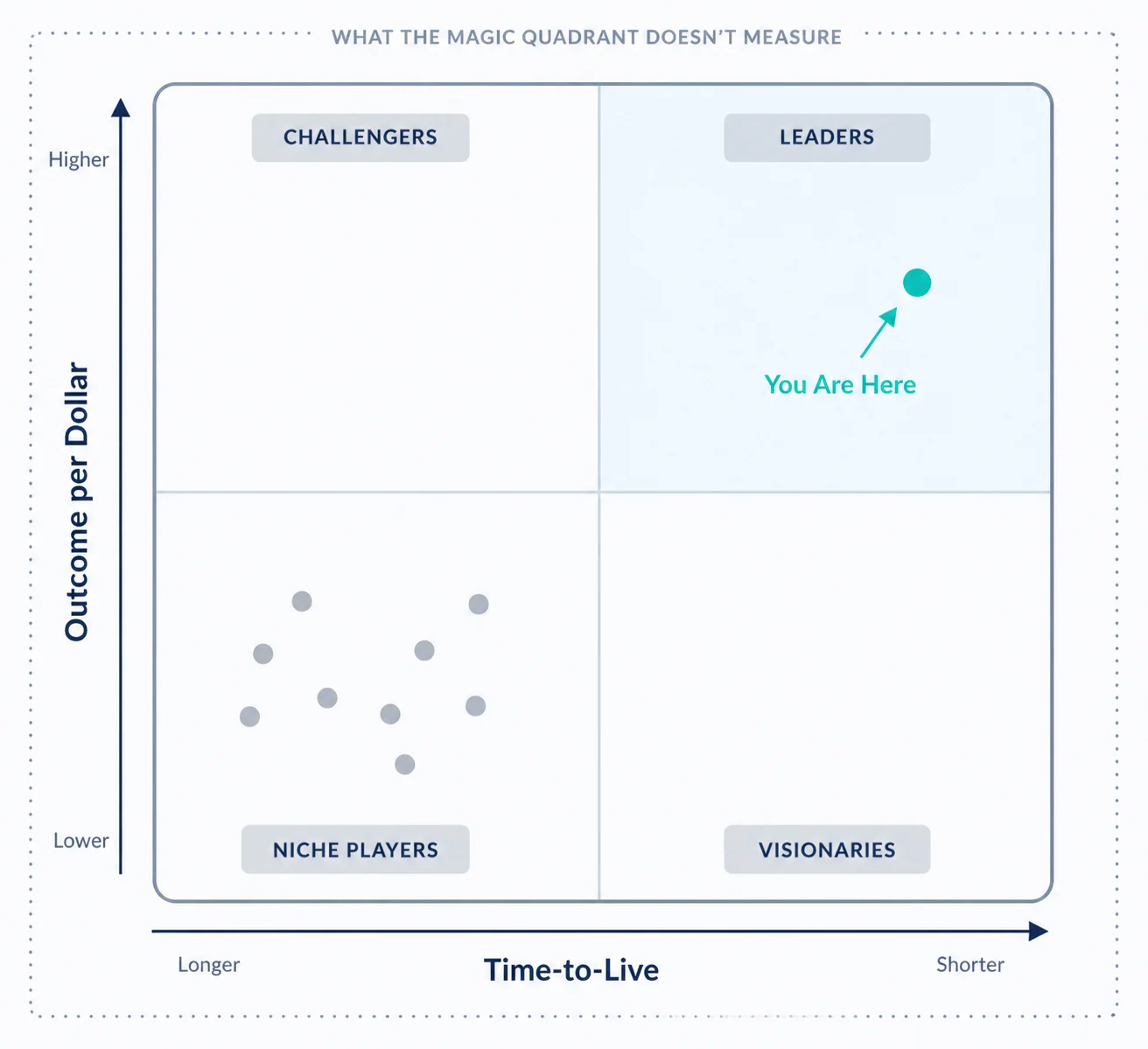
Gartner Magic Quadrant CRM CEC 2026: Mid-Market Breakdown
The Gartner Magic Quadrant for CRM Customer Engagement Center is the most-cited document in enterprise customer service procurement. When it lands, RFPs get rewritten. Shortlists get recut. Budget meetings get scheduled. And vendors that don’t appear on the dot chart lose deals before the first demo.
The most recent Magic Quadrant once again named Salesforce, Microsoft, Oracle, ServiceNow, Pegasystems, and Zendesk as Leaders, with Zendesk newly elevated from the Visionaries quadrant on the strength of its Resolution Platform launch.
If you’re a Fortune 500 CX leader sitting on a 2,000-seat contact center with a multi-year ServiceNow license, this report is your shortlist. You can stop reading here.
If you’re a mid-market CX leader (VP of Support at a 200-person SaaS company, Director of CX at a 800-person ecommerce brand, Head of Service at a regional financial services firm), this report is doing something subtler. It’s defining a category that may not be the right category for you.
Here’s what the most recent Gartner MQ for CRM CEC actually tells mid-market buyers, what it doesn’t, and how to use it (and not be used by it) in a 2026 buying cycle.
What the Magic Quadrant Actually Measures
Gartner evaluates CRM CEC vendors on two axes: Ability to Execute (revenue, customer satisfaction, geographic strength, operations) and Completeness of Vision (product roadmap, market understanding, innovation).
To be included at all, a vendor has to meet baseline thresholds: revenue, customer count, full case-management capabilities, digital engagement, knowledge management, agent desktop tooling, real-time intelligence, and what Gartner now calls “automation of engagements” (read: agentic AI).
The 2025 MQ made one thing very explicit: agentic AI, contextual orchestration, and low-code extensibility are no longer differentiators. They are the floor. If your vendor can’t credibly demonstrate them, they’re not on the chart.
That sounds like good news for buyers. It is, and it isn’t.
The Six Leaders: A Mid-Market Translation
Here’s how each named Leader actually shows up in a mid-market evaluation. This is the part the MQ summary doesn’t write.
Salesforce
The MQ position: Highest “Ability to Execute” rating. Service Cloud unified with Agentforce Service Agents and Service Rep Assistant. Most complete AI-enabled service platform.
The mid-market reality: Salesforce is the safest enterprise IT decision and one of the most expensive operational decisions a mid-market team can make. Service Cloud Unlimited Edition lists at $500/user/month before Agentforce add-ons (which are billed per “Einstein conversation”). For a 50-agent team, that’s $300K+ per year before implementation, integration, and admin overhead. Most mid-market teams that buy Salesforce end up using a small fraction of what they pay for.
Buy if: You’re already on Salesforce CRM, your IT team has a dedicated Salesforce admin, and you have $500K+ annual budget.
Don’t buy if: You’re cost-sensitive, you want to be live in under 90 days, or your team isn’t going to absorb a multi-quarter implementation project.
Microsoft
The MQ position: Leader. Dynamics 365 Customer Service tightly integrated with Copilot and the broader Microsoft 365 ecosystem.
The mid-market reality: Microsoft’s strength is the bundle. If your company is already deep on Microsoft (Teams, Outlook, Azure, Power Platform), Dynamics 365 Customer Service is the path of least resistance and probably the cheapest option among the Leaders. Outside that bundle, the appeal collapses fast. Dynamics is hard to deploy as a standalone CX platform, and Copilot still leans on you to bring the knowledge base, the workflows, and the integrations.
Buy if: You’re a Microsoft-house enterprise with existing Dynamics infrastructure.
Don’t buy if: You’re not already running Dynamics CRM or you need to be live quickly.
Oracle
The MQ position: Leader. Fusion Service with embedded AI. Notably, AI included without separate licensing.
The mid-market reality: Oracle Fusion Service has the cleanest pricing story among the Leaders for AI features (no per-conversation Einstein-style metering), but the platform is built for the enterprise stack: Oracle ERP, Oracle HCM, Oracle Cloud Infrastructure. If you’re not in that ecosystem, the value evaporates and the implementation cost rises.
Buy if: You run Oracle ERP/HCM and want CX in the same stack.
Don’t buy if: You don’t already have Oracle infrastructure.
ServiceNow
The MQ position: Leader. Strong AI orchestration heritage from ITSM, blurring the line between IT service management and customer service.
The mid-market reality: ServiceNow CSM is built for organizations that already think in workflows, change management, and approvals, typically enterprise IT teams. For mid-market CX teams without that operating model, the platform is overbuilt. You’ll pay for capabilities you’ll never use, and the time-to-value extends well past most mid-market buying cycles.
Buy if: You’re already on ServiceNow ITSM and want one platform for IT and customer service.
Don’t buy if: Your CX team operates independently from IT or you don’t need IT-grade workflow orchestration.
Pegasystems
The MQ position: Leader (with reshuffling between Leader and Visionary across recent cycles). Strong on case management, decisioning, and process automation.
The mid-market reality: Pega is built for highly regulated, highly customized enterprise workflows: financial services, telecom, insurance. If you don’t need that level of customization, you’re buying a tank to commute to work. Implementation typically takes 6 to 12 months.
Buy if: You’re a regulated enterprise with complex case-management requirements.
Don’t buy if: You’re a mid-market team looking for fast deployment.
Zendesk
The MQ position: Newly elevated from Visionary to Leader. Resolution Platform launch repositioned the company toward AI-led automation rather than ticketing.
The mid-market reality: Zendesk is the most mid-market-friendly Leader on paper, and the one where the AI story is most fragile in production. Zendesk AI Agents are improving, but the platform’s deflection rates in enterprise deployments still lag specialist AI vendors, and the per-resolution pricing model can make Zendesk’s TCO climb fast as volume scales. Zendesk also acquired Forethought in March 2026, which means Forethought-tier AI capabilities are now part of the Zendesk roadmap rather than a separate purchase, but the integration timeline is still uncertain.
Buy if: You want a single platform for ticketing + AI and are willing to grow into the AI capabilities over time.
Don’t buy if: You need best-in-class deflection and accuracy from day one.
What the Magic Quadrant Doesn’t Tell Mid-Market Buyers
The MQ is one of the most rigorous vendor evaluations in enterprise software. It’s also a frame that systematically disadvantages the kind of vendor mid-market CX teams actually need.
1. The MQ is gated on enterprise-scale revenue and customer count
To be evaluated at all, a vendor has to clear thresholds that most fast-moving AI specialists, including IrisAgent, Decagon, Sierra, Ada, Forethought (pre-acquisition), Crescendo, and others, don’t meet. Not because their products aren’t competitive, but because they’re not yet generating $100M+ ARR with 1,000+ enterprise reference customers.
That means the MQ tells you who the safest enterprise IT vendor choices are. It does not tell you who the best AI customer service platform is.
2. The MQ rewards platform breadth, not depth on AI
The “Completeness of Vision” axis rewards vendors with the broadest end-to-end capabilities: case management, knowledge, workflow, real-time intelligence, partner ecosystem, vertical solutions. A vendor that does one thing extraordinarily well (deflect tickets with 95%+ accuracy and no hallucinations) and lets you keep your existing helpdesk gets penalized in the methodology, even if that’s exactly what you need.
3. The MQ has nothing to say about implementation timeline
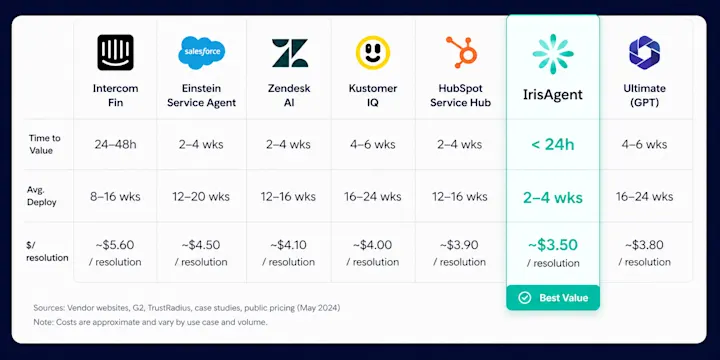
A vendor’s position on the chart says nothing about whether they can be live in 24 hours, 24 days, or 24 weeks. For mid-market teams, this is often the most important variable. Salesforce, ServiceNow, Pega, and Oracle implementations routinely take 6 to 12 months. AI specialists operate on timelines an order of magnitude shorter.
4. The MQ has nothing to say about pricing transparency
Five of the six Leaders use complex, multi-product pricing models with extensive add-ons (Einstein conversations, Copilot seats, AI Agent Studio metering, per-resolution charges). A G2 buyer survey published in 2026 found that 71% of CX leaders shortlisted platforms based on advertised pricing, then signed contracts at 40% to 200% above the headline rate after add-ons, overage, and implementation services landed.
The MQ has no axis for that.
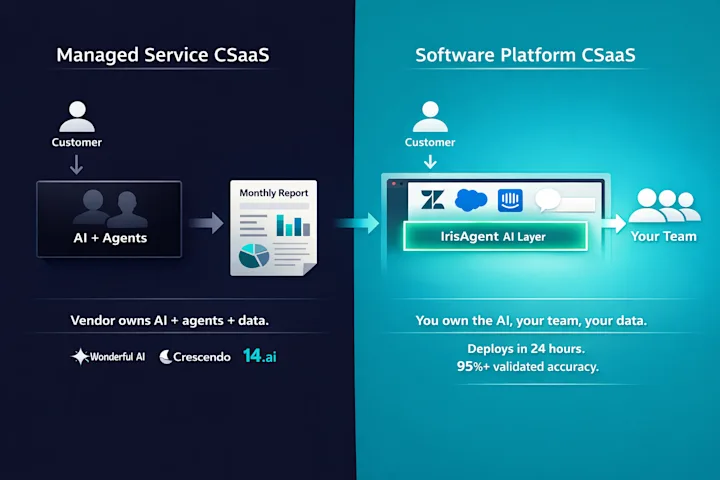
5. The MQ assumes you want a platform, not a result
This is the deepest mismatch. The MQ evaluates platforms: software you operate, configure, and extend. Mid-market CX leaders increasingly want outcomes: a deflection rate, a CSAT score, a cost-per-resolution number, without taking on a platform-engineering project to get there.
How Mid-Market Buyers Should Actually Use the Magic Quadrant
The MQ isn’t useless for mid-market buyers. It’s just being asked to do a job it wasn’t designed for. Here’s how to use it correctly.
Use the MQ to:
Validate that a vendor has the operational maturity and customer base to support a multi-year contract
Understand the broad shape of the enterprise CRM CEC category and where it’s heading (agentic AI, contextual orchestration, low-code extensibility)
Identify the safe-harbor enterprise platforms if your company has standardized on one of them
Pressure-test specialist vendors: “How does what you do compare to what Salesforce/Microsoft/Zendesk are claiming?”
Don’t use the MQ to:
Build your shortlist as a mid-market buyer with under $500K annual budget
Rule out specialist AI vendors that don’t appear on it
Assume Leaders’ AI capabilities are best-in-class. They’re built for breadth, not depth
Estimate implementation timeline or total cost of ownership
The Mid-Market Buyer’s Real Decision Tree
If you’re a mid-market CX leader buying customer service AI in 2026, the actual decision tree looks less like the Magic Quadrant and more like this:
Question 1: Are you replacing your CRM/helpdesk?
Yes
→ The MQ Leaders are your shortlist. Choose based on existing infrastructure and budget.
No
→ Skip to Question 2.
Question 2: Do you want to extend your existing helpdesk with AI?
Yes
→ AI specialists (IrisAgent, Ada, Decagon, Sierra) are your shortlist. The MQ Leaders’ AI is bundled into platforms you don’t want to buy.
No
→ Skip to Question 3.
Question 3: Do you need to be live in under 90 days?
Yes
→ Specialists that integrate into Zendesk, Salesforce, Freshdesk, Intercom, ServiceNow, etc. and deploy fast.
No
→ You have time for a platform replacement; revisit Question 1.
Question 4: Is hallucination risk a buying criterion?
Yes
→ Filter to vendors with verifiable knowledge grounding and audit trails. Most MQ Leaders rely on general-purpose LLMs without dedicated hallucination engineering.
No
→ It probably should be. 62% of enterprise buyers cite hallucinations as the #1 barrier to AI deployment.
Where IrisAgent Fits
IrisAgent doesn’t appear on the Gartner Magic Quadrant for CRM Customer Engagement Center. By design.
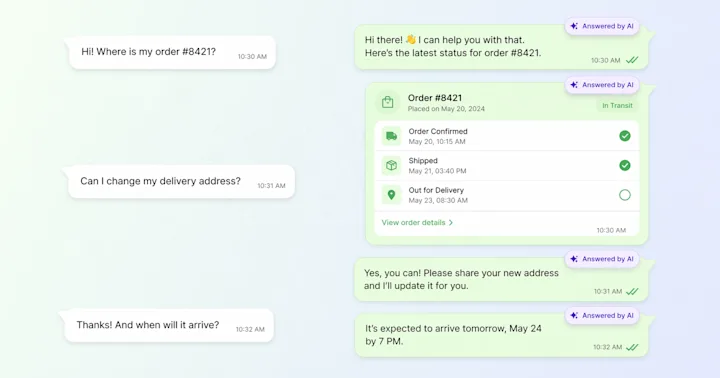
We’re not a CRM. We’re not a helpdesk. We’re not trying to replace Salesforce, Zendesk, ServiceNow, or any of the Leaders on the MQ. We extend them, sitting on top of your existing customer service stack and delivering 40% to 60% deflection, 95%+ accuracy, and 24-hour go-live without forcing a platform migration.
For mid-market CX leaders, this is usually the right shape. Your CRM is fine. Your helpdesk is fine. Your team has invested years getting them configured. What you actually need is the AI layer on top, and the MQ Leaders are not where the AI layer is best-in-class.
What we bring to the buying conversation:
24-hour go-live
vs. 60 to 180 days for Leader implementations
No per-resolution fees
vs. per-Einstein-conversation, per-Copilot-seat, or per-resolution pricing on most Leaders
Proprietary Hallucination Removal Engine
with audit trails: the architecture mid-market compliance buyers ask for
Multi-LLM federation
We route each query to the model that handles it best, rather than locking you into a single foundation model
Native integration
with the Leaders themselves (Salesforce, ServiceNow, Zendesk, Microsoft Dynamics, Oracle Fusion, Freshdesk, Intercom)
If your shortlist is Salesforce + Microsoft + ServiceNow + Pega and your budget is north of $500K with a 9-month implementation runway, the MQ told you what to do. If you’re a mid-market CX leader with a tighter budget, a faster timeline, and a working helpdesk you don’t want to rip out, your shortlist looks different.
The Bottom Line
The Gartner Magic Quadrant for CRM Customer Engagement Center is a high-quality evaluation of a specific kind of vendor: enterprise-scale platforms targeting Fortune 500 buyers willing to commit to multi-year platform consolidations.
If that’s you, use it as designed.
If you’re a mid-market CX leader with a deflection problem, a cost problem, or a hallucination problem (and a working helpdesk you’d rather not replace) the Magic Quadrant is mostly telling you which vendors not to buy from. The vendor that solves your actual problem is probably not on the chart.
That’s not a flaw in the methodology. It’s a feature. The MQ is doing its job. The question is whether you’re letting it do yours.
Going Deeper
If you're already considering a Magic Quadrant Leader. We've published side-by-side breakdowns of how IrisAgent compares to several Leaders and the AI specialists they're losing deals to: Salesforce Agentforce, Zendesk AI, Aisera, Decagon, Sierra, Ada, Forethought, Freshdesk, and Intercom. Use them to pressure-test the AI claims in any Leader's pitch deck against what specialist vendors actually deliver in production.
If you're keeping your existing helpdesk. This is the path most mid-market teams take, and it's where the integration story matters more than the platform comparison. IrisAgent installs on top of Zendesk, Salesforce, Microsoft Teams, Freshworks, HubSpot, and Intercom: so your existing workflows, macros, and routing rules stay intact while the AI layer handles deflection, agent assist, and ticket automation underneath.
If you're going one layer deeper on the AI itself. The Magic Quadrant takes "AI" as a black box. If you want to actually evaluate what's powering the agentic features in any Leader's stack, our LLM for Customer Support pillar walks through how RAG, fine-tuning, grounding, and multi-LLM federation work, and where each approach succeeds or fails in production.
If you're shortlisting at the capability level. The Leaders are evaluated on platform breadth. Your shortlist should be evaluated on the specific capabilities you're buying. Start with AI Ticket Automation, AI Customer Service Software, or AI Chatbot for Customer Support: each page maps a specific capability to the implementation reality, the integrations, and the accuracy benchmarks the Magic Quadrant doesn't measure.
Extend AI automation to every channel (2026)
Updated for 2026: a Magic Quadrant shortlist tells you which platform to buy, but the fastest way to actually cut resolution time is to put grounded AI on the channels where your volume lands. IrisAgent extends the same AI to voice and WhatsApp:
Voice AI: resolve routine phone calls end to end on your existing telephony, with outcome-based pricing at $2 per resolved call.
WhatsApp AI Agent: deploy an AI agent on WhatsApp through your existing Zendesk or Salesforce channel, multilingual and live in days.
Frequently Asked Questions
Who are the Leaders in the most recent Gartner Magic Quadrant for CRM Customer Engagement Center?
The most recent Gartner Magic Quadrant for CRM Customer Engagement Center named six Leaders: Salesforce, Microsoft, Oracle, ServiceNow, Pegasystems, and Zendesk. Zendesk was newly elevated from Visionary to Leader on the strength of its Resolution Platform launch.
Why isn't IrisAgent on the Gartner Magic Quadrant for CRM CEC?
IrisAgent is not a CRM Customer Engagement Center — it's an AI customer support layer that extends existing CRMs and helpdesks (Zendesk, Salesforce, ServiceNow, Microsoft Dynamics, Freshdesk, Intercom). The Gartner MQ for CRM CEC evaluates full platform vendors with revenue and customer-count thresholds that specialist AI vendors typically don't meet. That's a category match, not a capability gap.
Should mid-market companies buy from a Gartner Magic Quadrant Leader?
Not necessarily. The Leaders on the MQ for CRM CEC are optimized for Fortune 500 buyers with $500K+ annual budgets and 6–12 month implementation timelines. Mid-market CX leaders are usually better served by AI specialists that integrate into their existing helpdesk and deploy in under 90 days.
Is the Gartner Magic Quadrant the same as the Forrester Wave?
No. The Gartner Magic Quadrant for CRM CEC and the Forrester Wave for Customer Service Solutions evaluate similar vendor categories but use different methodologies, different vendor lists, and different criteria. Use both as data points; don't treat either as the definitive answer for your buying decision.
What does it cost to deploy a Gartner MQ Leader for customer service?
Implementation cost varies widely by vendor and scope, but the typical range for mid-market deployments of MQ Leaders is $200K–$1M+ in first-year total cost (license + implementation + integration + admin overhead), with implementation timelines of 60–180 days. AI specialist platforms typically run a fraction of that and deploy in under 30 days.
Loading the form. Prefer email? Reach us at info@irisagent.com or call +1 617 249 3312.