
On-premise vs self-hosted vs private cloud AI a buyer's guide for regulated industries
- The deployment models for AI customer conversations, defined and compared
- Data sovereignty, egress, model hosting, and audit readiness side by side
- When air-gapped is required and when a private VPC is enough
- Written for banking, insurance, healthcare, and government
What is the difference between on-premise, self-hosted, and private cloud AI for customer conversations?
On-premise, self-hosted, and private cloud are three ways to run AI for customer conversations (chat, voice, email, and agent copilot) inside infrastructure you control rather than a shared vendor cloud. On-premise AI runs in your own data center on hardware you own. Private cloud AI is single-tenant: it runs in your own cloud account (your VPC on AWS, Azure, or Google Cloud) under your IAM and security policies. Self-hosted is the umbrella term for either of those, meaning you, not the vendor, host the software and own the data path. The opposite is multi-tenant SaaS, where your conversation data is processed in the vendor's shared cloud. The practical decision for regulated buyers comes down to three questions: where the data lives, who holds the encryption keys, and whether any data is allowed to leave your perimeter.
- On-premise vs private cloud: on-premise gives you physical custody of the hardware in your data center; private cloud gives you a single-tenant deployment in your own VPC with cloud elasticity. Both keep data inside your boundary.
- Self-hosted means you control the data path: inference, retrieval, embeddings, and logging all run inside your environment, so conversation data never leaves your perimeter and you can choose private or bring-your-own models.
- Air-gapped is the strictest tier: a self-hosted deployment with no outbound internet at all, required for the most sensitive government and defense workloads but more than most banks, insurers, and healthcare organizations need.
By the IrisAgent team · Last updated June 26, 2026




The four deployment models for AI customer conversations
Every AI platform for chat, voice, email, and agent copilot runs in one of these four models. They differ on where data lives, who controls the encryption keys, and whether conversation data is allowed to leave your environment (egress).
1. Multi-tenant SaaS
The default cloud model. Your conversations run in the vendor's shared cloud alongside other customers' data, logically separated.
- Data lives in the vendor's cloud
- Vendor controls the keys
- Egress is inherent to the model
- Fastest to launch, least control
2. Private cloud (single-tenant VPC)
A dedicated, single-tenant deployment in your own AWS, Azure, or Google Cloud account, isolated from every other customer.
- Data lives in your VPC and region
- Your IAM, your encryption keys
- Zero egress outside your tenant
- Cloud elasticity, full sovereignty
3. On-premise (your data center)
The software runs on servers you own and operate inside your own data center, entirely behind your firewall.
- Data lives on your hardware
- You hold the keys and the rack
- No reliance on a public cloud
- Maximum physical custody
4. Air-gapped on-premise
On-premise with no outbound internet at all. Nothing connects out of the network, for the most sensitive classifications.
- Data never leaves the network
- Zero outbound network calls
- Examiner and defense grade
- Strictest change control
Models 2, 3, and 4 are all forms of self-hosting: you host the software and own the data path. In all three, inference, retrieval, and logging happen inside your boundary, and you can run private or bring-your-own models instead of calling a third-party model API.
On-premise vs self-hosted vs private cloud AI: comparison table
How the deployment models compare on the dimensions regulated buyers actually evaluate.
| Dimension | Multi-tenant SaaS | Private cloud (VPC) | On-premise | Air-gapped on-premise |
|---|---|---|---|---|
| Data sovereignty / egress | Data processed in vendor cloud; egress inherent | Stays in your tenant; zero egress outside your VPC | Stays behind your firewall; zero external egress | No outbound connectivity of any kind |
| Where data lives | Vendor's shared cloud | Your AWS, Azure, or Google Cloud account, your region | Your own data center | Your isolated, disconnected network |
| Who controls the keys | Vendor | You (your IAM and KMS) | You | You |
| Model hosting | Usually third-party model APIs | Private or bring-your-own models in your VPC | Private or bring-your-own models on your hardware | Private or bring-your-own models, fully offline |
| Examiner / audit readiness | Depends on vendor attestations and DPAs | Strong: logs and data path in your environment | Strong: full custody, logs on your systems | Strongest: nothing leaves to attest about |
| Deploy time | Fastest (sign up and go) | Days, into infrastructure you run | Days to weeks, depending on access | Longer, gated by change control |
| Who it is for | Teams without strict data-residency rules | Banks, insurers, healthcare needing sovereignty with cloud scale | Institutions standardized on their own data center | Government, defense, classified workloads |
IrisAgent Private supports the three self-hosted models: private cloud (VPC), on-premise, and air-gapped on-premise.
How regulated buyers should choose
The right model depends on your data-residency obligations, your examiners' expectations, and where your infrastructure already lives. The decision is rarely about whether AI can resolve a chat or a call. It is about where the conversation data is allowed to go.
Banks and credit unions
For most banks and credit unions, a single-tenant private cloud in your own VPC is the sweet spot. It keeps member conversations and transaction context inside your tenant under your encryption keys, satisfies data-residency requirements, and gives examiners a clean audit trail, while still letting you scale compute elastically. Move to on-premise if your institution has standardized on its own data center or your regulator expects physical custody of the hardware.
Insurers
Insurers handling policyholder PII and claims data across chat, voice, and email usually land on private cloud or on-premise. The deciding factor is whether your existing claims and policy systems already run in a cloud account (favor private cloud, deployed alongside them) or in an on-premise data center (favor on-premise, so conversation data sits next to the systems of record).
Healthcare
Healthcare organizations need HIPAA-aligned handling of PHI in every conversation. A private cloud or on-premise deployment keeps PHI inside your boundary with a signed BAA in place and a full audit trail, which is what compliance teams need to defend AI-assisted patient and member conversations. Private cloud is enough for the vast majority; air-gapped is rarely required.
Government and public sector
Government buyers span the full range. Many agencies are well served by a private cloud in a government-region account or an on-premise deployment. The most sensitive workloads (classified data, defense, certain national-security classifications) are where air-gapped on-premise becomes mandatory, with no outbound connectivity permitted at all.
When is air-gapped required vs when is a private VPC enough?
A private VPC is enough when your auditors accept that conversation data stays inside your single-tenant environment with zero external egress, your own keys, and a complete audit trail. That covers the large majority of banking, insurance, and healthcare deployments. Air-gapped is required only when policy or classification forbids any outbound connectivity at all, typically classified government and defense workloads. If you are not under a no-egress mandate, a private VPC delivers the same data sovereignty with far less operational friction.
The non-negotiables for regulated AI conversations
Whichever deployment model you pick, AI across chat, voice, email, and agent copilot has to clear the same bar in a regulated environment.
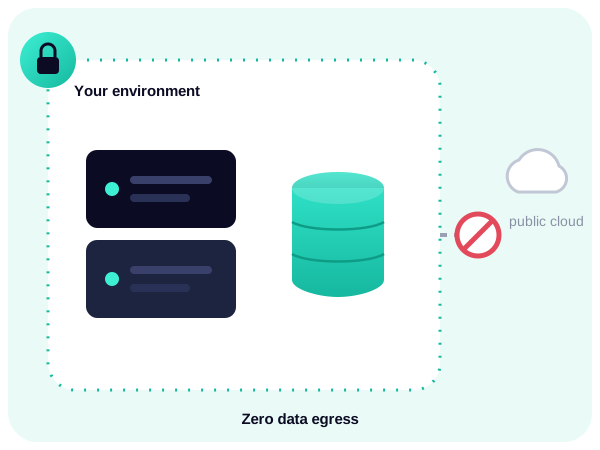
Zero data egress
Conversation data, inference, retrieval, embeddings, and logging all stay inside your environment. No prompts or responses ship to a third-party model API.
Audit trail, examiner-ready
A complete, queryable log of every chat, call, and email interaction, traceable to source, so you can show an examiner exactly why the AI responded the way it did.
Grounded answers
Every response is grounded in your approved knowledge sources rather than generated from open-ended model memory, which is what keeps regulated conversations defensible.
Role-based access control
Granular RBAC over who can see, configure, and override the AI, so sensitive workflows and data are scoped to the right people and roles.
Private or bring-your-own models
Run private models inside your environment, or bring your own approved models. Weights and conversation data stay in your control, never on a shared model provider.
Predictable annual pricing
A predictable annual contract with flexible plans, usage-based or resolution-based, agreed up front instead of metered per token or per query in a way that makes regulated procurement and budgeting hard.
Where IrisAgent Private fits: the full conversational stack, inside your perimeter
- IrisAgent Private is software that deploys into your own data center or your own cloud (VPC). There is no hardware appliance to buy and nothing to ship.
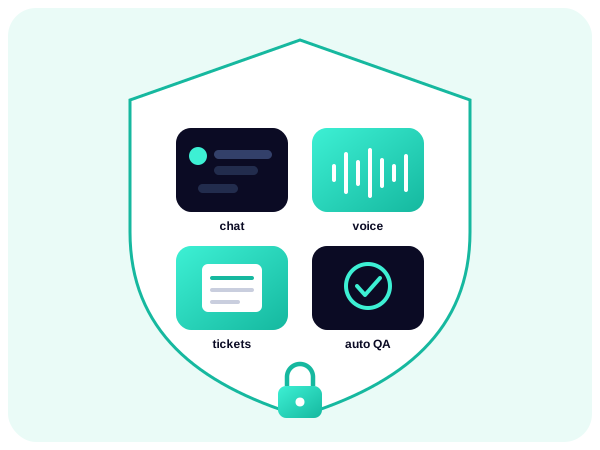
- It runs AI across customer conversation channels: chat resolution, voice, email, and agent copilot, plus knowledge management and auto QA, all inside your boundary.
- Zero data egress, private or bring-your-own models, grounded answers, full audit trail, and role-based access. SOC 2 Type II, HIPAA, GDPR, CCPA, and PCI DSS aligned.
Audit-ready answers your examiners can trust
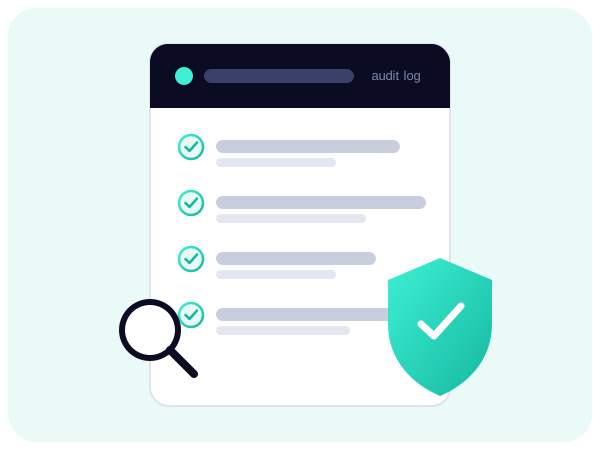
- Every answer across chat, voice, and email is grounded in your approved knowledge sources and traceable to source, so you can show exactly why the AI responded the way it did.
- Full audit trail on every interaction, with role-based access controls and guardrails that keep regulated decisions with your team.
- Deploy in your private cloud, on-premise, or fully air-gapped, with zero data egress in every case.
Your data never leaves your environment
- Zero data egress: inference, embeddings, retrieval, and logging all run inside your boundary, with no external model API calls.
- Run private models in your environment, or bring your own approved models. Weights and conversation data stay in your control.
- Predictable annual contract with flexible pricing, usage-based or resolution-based, agreed up front. No per-token or per-query metering surprises.
Sovereignty without the operational drag
Modern AI for every customer conversation, deployed inside the environment you already control.
operations




Any questions?
We got you.

IrisAgent Private
On-premise and self-hosted AI for customer conversations, deployed in your own environment.
Explore IrisAgent Private →AI for financial services
Secure, compliant AI conversations for banks, credit unions, and fintech.
Explore fintech support AI →AI for healthcare
HIPAA-aligned AI conversations that keep patient data private.
AI support agents that sign a BAA →Accuracy and guardrails
How IrisAgent keeps answers grounded, accurate, and auditable.
See how accuracy works →Bring AI for every customer conversation inside your perimeter
Whether you choose private cloud, on-premise, or air-gapped, IrisAgent Private deploys the full conversational stack inside the environment you control, with full data sovereignty and audit-ready answers. Book a briefing and we will scope a deployment for your environment.
Book a private deployment briefingDeployment model is only half the governance question. See how the major enterprise platforms handle data residency, alongside their SOC 2 and HIPAA positions. If you would rather run the stack yourself, start with the self-hosted ticketing systems you can deploy on your own infrastructure.