
Detect & Escalate
At-Risk Customers Automatically
The worst escalation is the one nobody saw coming. IrisAgent reads sentiment and risk signals on every ticket, scores who's about to churn or blow up, and surfaces them with a recommended save play, while there's still time to turn it around.
By the IrisAgent team · Last updated May 31, 2026
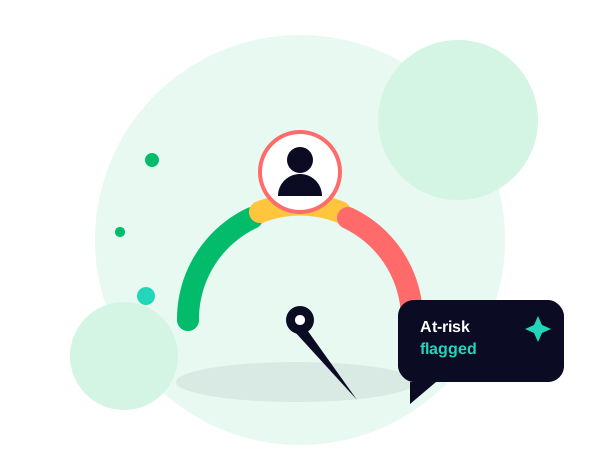
Detecting at-risk customers means AI reads sentiment and churn signals across every ticket, frustration, cancellation language, repeat contacts, SLA risk, and account health, scores the risk, and escalates the customer before the relationship breaks. Each escalation arrives with full context and a recommended save play, so your team intervenes early instead of reacting after the angry email or cancellation.




Why at-risk customers slip through until it's too late
Churn and escalations rarely come out of nowhere, the signals are usually sitting in the support thread days before the blow-up. A customer's tone sours, they contact you for the third time about the same issue, they mention a competitor, or they hint at cancelling. But those signals are scattered across tickets and agents, and no one connects them in time.
Manual escalation depends on an agent noticing the risk, deciding it matters, and flagging it, a chain of human judgment that breaks under volume. By the time someone catches it, the customer has already written the angry review or started the cancellation.
The result is a steady leak of preventable churn and surprise executive escalations that a timely, well-aimed intervention could have stopped.
How IrisAgent catches at-risk customers early
Read sentiment and signals on every ticket
IrisAgent analyzes tone, language, and behavior across every interaction, frustration, cancellation intent, repeated contacts, escalation keywords, and SLA risk, not just an occasional spot check.
Combine support signals with account context
It blends the conversation signals with account health, revenue tier, renewal date, and history, so a frustrated message from a high-value account at renewal is weighted appropriately.
Score the risk continuously
Each customer gets a live risk score that updates as the conversation evolves, a ticket that starts routine can climb the moment sentiment deteriorates or the customer mentions leaving.
Escalate with context and a recommended play
When risk crosses your threshold, IrisAgent surfaces the customer to the right owner, a manager, CSM, or specialist, with the full history and a recommended save action attached.
Close the loop
Outcomes feed back into the model, so detection keeps improving and your team learns which interventions actually save which kinds of at-risk customers.
The outcome
What it looks like in practice
An enterprise customer opens their third ticket this week about the same sync issue. The latest message is short and clipped: "This is still broken. We're evaluating other options."
IrisAgent reads the deteriorating sentiment, counts the repeat contacts, notes the competitor hint and the upcoming renewal, and spikes the risk score. It immediately escalates to the account's CSM: "At-risk: 3rd contact on unresolved sync bug, negative sentiment, renewal in 21 days, churn language detected. Suggested play: personal outreach + engineering priority."
The CSM steps in that afternoon, instead of finding out at renewal that the account is gone.
operations
Any questions?
We got you.