
Proactively Detect Outages
& Product Bugs from Tickets
Your support queue is the earliest warning system you have. IrisAgent's AI clusters incoming tickets in real time, detects an abnormal spike about the same issue, and alerts support and engineering before the trickle becomes a flood, so you fix problems before they escalate.
By the IrisAgent team · Last updated May 31, 2026
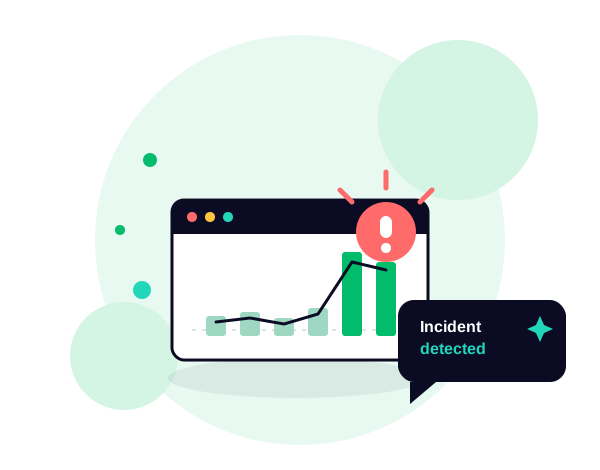
Proactive issue detection means AI continuously clusters incoming support tickets, detects an abnormal spike in reports about the same bug, outage, or feature, and alerts support and engineering early, with the affected customers and trend attached. Instead of learning about an incident from an executive escalation, teams see it forming in the queue and fix it before it floods, which is what sets IrisAgent apart from scripted automation.





Why support is usually the last to know
Most incidents are discovered far too late. A bug ships, a payment integration breaks, or a feature degrades, and the early signal (a handful of tickets that all describe the same thing) gets scattered across agents who each see only their own slice. No single person connects the dots until the trickle becomes a flood.
By then, the damage is done: the queue is overwhelmed, customers are angry, and engineering often hears about it from an executive escalation rather than from support. The lag between "first ticket" and "someone realizes this is an incident" is where reputation and CSAT erode.
Manual trend-spotting can't keep up. No human is watching every ticket across every queue in real time looking for statistical anomalies, which is exactly what this requires.
How IrisAgent detects issues early
Cluster every incoming ticket in real time
As tickets arrive, IrisAgent groups them by underlying issue, product area, feature, error, and root cause, across all queues and channels, not just by the tags an agent happened to apply.
Establish the normal baseline
The AI learns the typical volume for each issue cluster, so it knows what 'normal' looks like for a given feature, region, or time of day, and can recognize a genuine anomaly.
Detect the spike before it floods
When reports about the same issue rise abnormally fast, IrisAgent flags it as an emerging incident while it's still a handful of tickets, not after hundreds have piled up.
Alert support and engineering with context
The alert includes the issue cluster, the affected customers, the trend line, and example tickets, so engineering can act immediately and support knows what's happening before customers ask.
Auto-tag related tickets and enable proactive comms
IrisAgent links new matching tickets to the incident automatically and lets you respond proactively to everyone affected, instead of fighting the same fire one ticket at a time.
The outcome
What it looks like in practice
A deploy quietly breaks the checkout flow for customers on one payment provider. Over 25 minutes, eight tickets trickle in, spread across four agents, each describing it slightly differently: "card won't go through," "error at checkout," "can't pay."
IrisAgent clusters all eight as the same root issue, sees the volume is far above baseline for checkout errors, and fires an alert to support and engineering: "Emerging incident: checkout failures on [provider], 8 tickets in 25 min, 6x normal rate. Affected customers attached." Eng rolls back the deploy before it becomes a hundred-ticket flood.
Meanwhile, IrisAgent auto-tags every new matching ticket to the incident and lets the team send one proactive update to all affected customers, instead of writing the same apology fifty times.
operations
Any questions?
We got you.