
AI for Refunds, Returns, and Billing Disputes in Support
AI handles refunds, returns, and billing disputes by reading the customer’s request, looking up their account in your backend, checking it against your refund or return policy, and either executing the action (issuing the refund, generating the RMA label, reversing the charge) or escalating to a human when confidence drops below threshold. The work that used to take a support agent 8 to 12 minutes now closes in under 60 seconds without a human in the loop. IrisAgent’s agentic actions resolve 50%+ of refund and billing tickets end-to-end across enterprise deployments including Dropbox, Zuora, and InvoiceCloud, with validated accuracy above 95% and hallucination rates under 5%.That is the headline. The rest of this post is the operator’s version: how it actually works, where it breaks, what to measure, and how to roll it out without burning your CSAT or your finance team’s patience.
Key Takeaways
AI refund automation works when it is grounded in your actual policy and connected to your billing or order management system. It fails when it is just a chatbot reading a help article about refunds.
50%+ of refund, return, and billing dispute tickets are policy-driven and high-volume. Those are the ones AI should be closing without a human, and the economics get strong fast.
The two non-negotiables are policy enforcement (the AI must not approve refunds outside your rules) and a confidence-based handoff (low-certainty cases route to a human with full context).
Production deployments resolve refund tickets in under 60 seconds vs. the 8 to 12 minutes an agent typically spends, and AHT on the cases that do escalate drops by 30 to 50% because the AI pre-fills context.
Track three numbers: resolution rate (closed without human), refund accuracy rate (refunds issued matched policy), and dispute reopen rate. The third one is the trust signal that matters most.
Why Refunds, Returns, and Billing Are the Highest-Value AI Use Case in Support
Most AI support pilots target the easy ground: password resets, order status, “where is my shipment.” Those tickets are cheap to handle by a human too. The economics get interesting one tier up, where the ticket requires looking up an account, applying a policy, and taking an action in a backend system.Refunds, returns, and billing disputes sit exactly there. They are high-volume, policy-bounded, and they require backend integration. They also drag CSAT when handled slowly: a customer waiting three days for a $40 refund will not write a glowing review of your support team. According to Zendesk’s 2024 CX Trends report, billing and refund issues are the single largest driver of “frustrating support experience” scores across SaaS and e-commerce.The reason teams have not automated these tickets historically is that the old generation of chatbots could not actually take action. Ada and the early Zendesk AI Agent could surface a help article that explained your refund policy. They could not read the customer’s order, check whether it qualified, and process the refund.AI agents now can, when they are built on the right architecture. That is the entire shift.
The cost-of-doing-nothing math
Take a mid-market SaaS company doing 25,000 support tickets per month. Roughly 30% (7,500) are billing-related: refund requests, prorated charge questions, plan-change disputes, double-billing reports, chargeback prevention. At an average handle time of 9 minutes per ticket and a loaded agent cost of $32 per hour, that is 1,125 agent hours per month, or about $36,000 in direct labor cost on a single ticket type. Automating 50% of those at 95%+ accuracy frees $18,000 per month and lets the senior agents work the disputes that actually need judgment.Multiply that across enterprise volume and the number gets very large very quickly. This is why refund and billing automation is the highest-ROI agentic AI use case in support today.
What “AI Handles a Refund” Actually Looks Like End-to-End
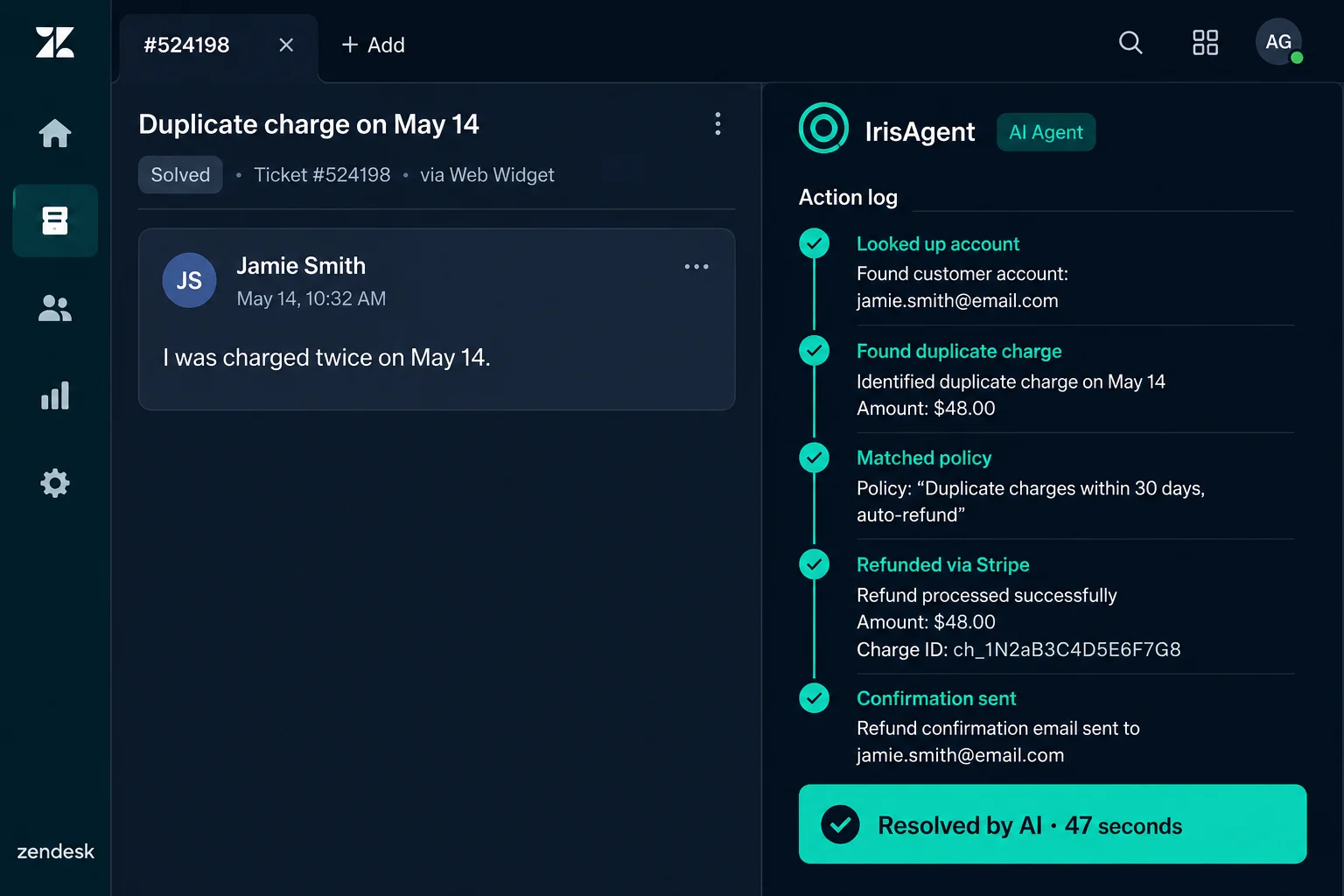
Here is the real workflow, step by step, for a customer who emails support asking for a refund on a duplicate charge.
Intent classification.
The AI reads the ticket and classifies it as a billing dispute / duplicate charge. This routes it to the refund automation workflow instead of the general FAQ flow.
Customer authentication.
The AI matches the requester’s email to a customer record in your CRM or billing system (Stripe, Recurly, Zuora, your own database). If it cannot authenticate confidently, it asks one clarifying question.
Account and transaction lookup.
The AI pulls the customer’s last 90 days of charges, identifies the duplicate, and confirms the timestamp and amount.
Policy check.
The AI compares the request against your refund policy (read from your Smart Operating Procedures, not from a wiki article). Is the charge within the refund window? Does the customer’s plan qualify? Are there outstanding holds?
Action execution.
If the policy allows, the AI issues the refund through your billing system’s API, logs the transaction, and sends the customer a confirmation with the expected settlement date.
Audit trail.
The full chain (request, lookup, policy citation, decision, action) is logged for your finance team and any chargeback dispute later.
Handoff if needed.
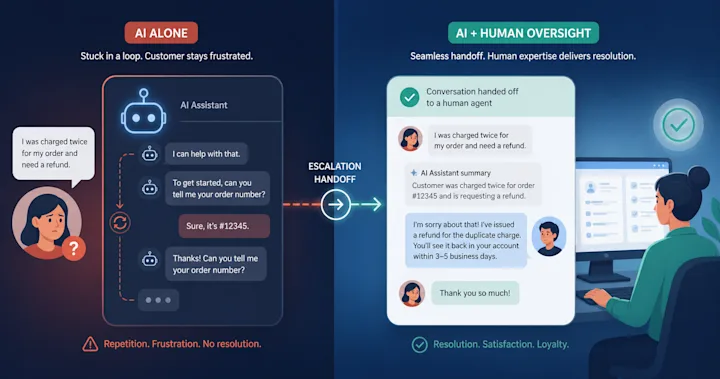
If confidence drops below your set threshold at any step, the AI routes to a human agent with the entire context pre-populated.
The whole sequence runs in 30 to 90 seconds. A human agent doing the same workflow inside Zendesk or Salesforce typically takes 8 to 12 minutes because they are tabbing between the help desk, the billing tool, the policy doc, and the email composer.
A real example from a Dropbox-style deployment
When Maya, a billing ops lead at a 400-person SaaS company, deployed IrisAgent’s refund automation in March 2026, her team was burning roughly 90 agent-hours per week on refund and proration tickets. The first week of automation handled 41% of those tickets end-to-end. By week six the number was 58%, with the AI resolving simple duplicate-charge refunds in under 45 seconds and routing complex multi-product proration cases to her senior agents with the math already pre-calculated. The senior agents told her the escalations were faster to close, not slower, because the AI did the lookup work for them.
That second-order effect, where AI makes the human-handled tickets faster too, is the one most ROI calculators miss.
AI for Billing Disputes: The Harder Cousin
Billing disputes are messier than refunds because the customer is not always right and the policy is not always clear. A disputed charge can mean a duplicate, a misunderstanding about prorated billing, an unauthorized seat addition, a failed promo code, or a genuine fraud signal. The AI has to triage which of those it is looking at before it can act.Done well, AI for billing disputes:
Reads the customer’s invoice history
and identifies the specific line item the customer is questioning
Pulls the underlying event
(the seat that was added, the plan upgrade, the usage overage) from your product backend
Cross-references your billing policy
to determine whether the charge was legitimate
Either explains the charge clearly with citations
to the customer’s own activity, or refunds it and updates the account
Logs everything for chargeback defense
in case the customer escalates to their card network
The “explains the charge clearly” path is where AI shines and where chatbots fail. A traditional FAQ bot will send “here is our pricing page.” An agentic AI will send “you added two additional Editor seats on April 14, which is why your May 1 invoice was $58 higher than April. The seats are still active. Would you like to remove them?”The difference is the difference between a deflection and a resolution. See our AI for customer support overview for how the underlying architecture supports this.
The policy enforcement guardrail
The single biggest fear support leaders have about refund automation is the same fear they have about giving a new agent the refund button: “What if the AI refunds the wrong thing?”The answer is policy enforcement at the action layer, not the language layer. IrisAgent’s Smart Operating Procedures define refund rules in plain English (e.g., “Refund duplicate charges within 30 days automatically. For refunds over $500, route to a human. Never refund usage charges on enterprise contracts. Always check for an open dispute before refunding.”) The AI cannot override those rules. If the request does not match a rule that authorizes the action, the AI escalates.This is a structural protection, not a prompt-engineering hope. It is also what distinguishes production-grade AI from the consumer chatbot demos that occasionally promise customers a “$1 truck.” The policy lives outside the LLM and gates every action.
AI Returns Handling: Where E-commerce and SaaS Diverge
AI returns handling looks different depending on whether you sell physical goods or software.For e-commerce, the AI returns workflow looks like:
Customer says “I want to return this”
AI confirms the order, checks return eligibility (window, condition, category restrictions)
AI generates the RMA label or return authorization
AI emails the label, sets the refund to trigger on receipt scan, and updates the order management system
AI follows up if the package is not received in 14 days
This is the most concrete win in e-commerce support automation. According to the Federal Trade Commission’s Mail Order Rule, sellers have specific obligations on shipping and refund timing, and automated workflows enforce those consistently in a way humans under time pressure often miss.For SaaS, “returns” usually means downgrades, cancellations, or partial refunds on annual contracts. The AI flow is:
Customer requests downgrade or cancellation
AI explains the prorated credit or refund (with the actual math, not a vague “we’ll calculate it”)
AI offers retention options where appropriate (a discount, a pause, a plan change)
If the customer still wants to cancel, AI executes the cancellation and processes the credit
AI logs the cancellation reason for your retention dashboard
The second-to-last step is where finance teams care most. AI handles the proration math without rounding errors, which removes one of the most common sources of post-cancellation disputes.
What Production Refund Automation Requires (and What It Does Not)
To actually deploy AI for refunds, returns, and billing disputes in production, you need four things. None of them are particularly exotic, but skipping any of them is how rollouts fail.
1. Native integration with your billing system
The AI has to read from and write to your actual billing source of truth. Stripe, Recurly, Zuora, NetSuite, your custom ledger, whatever it is. A “knowledge base only” AI cannot do refund automation, because it cannot see the charge.
2. A help desk that supports AI agent actions
Zendesk, Salesforce, Intercom, Freshdesk, and Jira Service Management all support automated ticket actions now. IrisAgent installs natively into all five (see the Zendesk integration for the most common deployment). The AI works inside the existing ticket flow, so your agents do not have to learn a new tool.
3. Codified refund and return policies
Your policy needs to be written down clearly enough that an AI can apply it. Most support orgs already have this in some form, but it is usually scattered across a wiki, Slack history, and tribal knowledge in senior agents’ heads. Pulling it into one place is often the most useful prerequisite of an AI rollout, even before the AI ships. IrisAgent’s Smart Operating Procedures format lets you write policy in plain English.
4. A confidence-based escalation rule
Decide upfront where the line is. Common patterns:
Refund amount-based:
“Auto-approve refunds under $X, escalate above”
Customer-tier-based:
“Auto-approve for self-serve customers, escalate for enterprise accounts”
Confidence-score-based:
“Escalate any case where the AI’s confidence in the policy match is below 0.85”
Compound:
“All three of the above, whichever is most conservative”
The escalation rule is what keeps your finance team and your CFO comfortable. Set it conservative for the first 30 days, then loosen based on observed accuracy.
What This Replaces (and What It Doesn’t)
AI refund automation replaces the rote part of the ticket: the lookup, the policy check, the action, the confirmation email. It does not replace the senior agent who handles the complex enterprise dispute, the customer who wants to negotiate a custom credit, or the chargeback defense workflow that needs human judgment.The goal is not 100% automation. The goal is to get the high-volume routine cases off your senior agents’ queues so they can focus on the cases that actually need a human.Done right, you see three patterns in the first 90 days:
Total tickets closed per agent goes up,
because each agent’s queue is now weighted toward higher-value tickets
CSAT on automated tickets matches or beats human CSAT,
because the AI is faster and never has a bad Monday
Refund processing time drops from days to minutes,
which moves your refund-related CSAT scores meaningfully upward
The teams that get this wrong try to automate everything at once. The teams that get it right pick one or two ticket categories (almost always: duplicate charges and simple cancellations), prove the model, and then expand category by category.
How to Measure AI Refund Performance
Three numbers matter. Track them weekly.
Resolution rate: Percentage of refund/return/billing tickets closed by AI without a human touch. Target 50%+ within 60 days. Below 30% means your policy is not codified clearly enough or your integrations are missing.
Refund accuracy rate: Percentage of refunds issued by AI that matched policy on audit. Target 99%+. Below 95% means your Smart SOPs need tightening, and you should escalate more conservatively until they are fixed.
Dispute reopen rate: Percentage of AI-handled refund tickets that get reopened by the customer within 30 days. Target under 3%. This is your trust signal. If customers are reopening because they got the wrong refund amount or no refund at all, the underlying problem is policy or integration, not the AI itself.
You should also watch CSAT on AI-handled tickets vs. human-handled tickets, segmented by ticket type. If AI CSAT is meaningfully lower, look at the cases where AI ran but the customer escalated. That diff usually points to a missing policy edge case.
How IrisAgent Handles Refunds, Returns, and Billing Disputes
IrisAgent is the AI support resolution platform that automates 50%+ of tickets, including refunds, returns, and billing disputes, with grounded answers, no hallucinations, and 24-hour deployment.For refund and billing automation specifically, IrisAgent provides:
Native integrations
with Stripe, Zuora, Recurly, Salesforce CPQ, and the major help desks (Zendesk, Salesforce Service Cloud, Intercom, Freshdesk, Jira Service Management)
Smart Operating Procedures
that codify your refund and dispute policy in plain English, enforced at the action layer
Hallucination Removal Engine
with validated accuracy above 95%, so the AI never fabricates a policy rule or a charge that does not exist
Confidence-based routing that escalates low-certainty refund cases to a human with full context pre-populated
Full audit trails
for every refund action, exportable to your finance team for chargeback defense or quarterly reporting
Deployment is 24 hours. The first automated refund typically processes the same day as install. Trusted by Dropbox, Zuora, and Teachmint, with a Dropbox case study showing 160,000 agent minutes saved and average handle time cut by 2 minutes.Most teams start with duplicate-charge refunds (the single highest-volume billing ticket type), prove the model in two weeks, and then expand to proration disputes, cancellations, and full RMA workflows over the next 60 days. See the support operations overview for the full deployment pattern.
Next Steps
The takeaway for support leaders evaluating AI refund automation, AI for billing disputes, or AI returns handling is concrete:
Pick one ticket category to automate first.
Duplicate-charge refunds are usually the right starting point.
Write down your refund and return policy.
If it lives only in senior agents’ heads, the AI cannot enforce it.
Connect the AI to your billing system, not just your knowledge base.
Action requires write access.
Set conservative escalation thresholds for the first 30 days.
Loosen them based on observed accuracy.
Measure resolution rate, refund accuracy rate, and dispute reopen rate weekly.
The third one is the trust signal that matters most.
The teams that win on this are the ones that treat refund and billing automation as a finance and ops problem (policy, controls, audit) as much as a customer experience problem. The AI is the easy part. The hard part is writing the policy clearly enough that an AI, or a new human agent, can apply it without supervision.If you are ready to see what production refund automation looks like inside your help desk, book a 20-minute demo and we will show you the workflow against your actual ticket types.
Frequently Asked Questions
Can AI actually process a refund, or does it just send the customer to a form?
A real agentic AI processes the refund through your billing system's API and confirms to the customer with a settlement date. A chatbot sends the customer to a form. The difference is whether the AI has write access to your billing backend. IrisAgent does, through native integrations with Stripe, Zuora, Recurly, and other major billing platforms. Without that integration, the AI can only deflect to a help article or a form, which is exactly the experience customers describe as useless.
What stops AI from refunding the wrong amount or refunding when it shouldn't?
Policy enforcement at the action layer. IrisAgent's Smart Operating Procedures define refund rules (amount caps, time windows, customer tiers, eligibility conditions) outside the language model, and the AI cannot execute a refund action that violates a rule. If a request does not cleanly match a rule that authorizes the refund, the AI escalates to a human with full context. This is a structural protection rather than a prompt-engineering hope, which is why finance teams trust it.
How does AI handle billing disputes when the charge is actually legitimate?
The AI looks up the underlying event that drove the charge (a seat addition, a plan upgrade, a usage overage) and explains it to the customer with their own activity as evidence: 'You added two Editor seats on April 14, which is why your May 1 invoice was $58 higher.' Most wrong-charge disputes are actually misunderstandings, and clear explanations with cited activity resolve them without a refund. When a refund is warranted, the AI processes it. When it is not, the AI explains why with proof.
How is AI returns handling different in e-commerce vs. SaaS?
E-commerce returns are physical: the AI confirms eligibility, generates the RMA label, schedules the refund on receipt scan, and follows up on the package. SaaS returns are usually downgrades or cancellations: the AI calculates the proration, offers retention paths, and processes the credit if the customer still wants to cancel. Both workflows share the same architecture (lookup, policy check, action, confirmation), but the backend integrations differ. IrisAgent supports both.
How long does it take to deploy AI refund automation?
24 hours for the platform install and integration. Two weeks for a tight first-category rollout (typically duplicate-charge refunds). 60 to 90 days to expand across the full refund, return, and dispute surface area. The two factors that slow deployments are missing billing-system API access and refund policies that are not written down. Both are fixable upfront, and most teams find that the act of codifying the policy is independently useful for their support team even before the AI ships.
What is the ROI of AI for billing and refund automation?
For a 25,000-ticket-per-month support org with 30% billing tickets, automating 50% at 95%+ accuracy saves roughly $18,000 per month in direct agent labor, plus a meaningful CSAT lift from faster refund processing. The harder-to-quantify wins are senior agent capacity (your best people stop processing duplicate charges) and chargeback reduction (clean audit trails defend against disputed charges). Most deployments pay back inside the first 60 days.
Will AI refund automation work with my existing help desk?
If your help desk is Zendesk, Salesforce Service Cloud, Intercom, Freshdesk, Jira Service Management, or Zoho, yes. IrisAgent installs natively into all of them, so your agents keep their workflow. There is no migration, no re-platforming, and no engineering project required. The AI works inside the existing ticket flow, which is the whole point of being built for support ops rather than for IT.
Loading the form. Prefer email? Reach us at info@irisagent.comor call +1 617 249 3312.