
Klarna's AI Reversal: Lessons for Mid-Market Buyers
In February 2024, Klarna stood on stage and made one of the loudest claims of the AI customer service era: their new OpenAI-powered chatbot was doing the work of 700 human agents. It was handling two-thirds of customer service chats inside its first month. Average resolution time had dropped from 11 minutes to under 2. The company stopped hiring. The narrative was clear. AI had won customer service, and everyone else was about to find out.
Two years later, Klarna is hiring humans back.
In May 2025, CEO Sebastian Siemiatkowski admitted what the metrics had been quietly saying for months: the company had cut too far, too fast. “Cost unfortunately seems to have been a too predominant evaluation factor when organizing this,” he told Bloomberg. “What you end up having is lower quality.” By 2026, with the company on an IPO march, Klarna had restructured into a freelance “Uber-style” human support model, paying agents per shift, while still keeping AI in the loop for routine queries.
If you are a mid-market CX leader watching this story play out, the temptation is to read it as confirmation that AI doesn’t work. That’s the wrong lesson. The right lesson is more uncomfortable: Klarna’s mistake was not using AI. It was using AI without the guardrails, governance, and confidence-based escalation that any production AI customer service deployment needs in 2026.
You don’t have Klarna’s brand strength to absorb the cost of getting this wrong. Here is what to learn from the most expensive AI customer service experiment of the decade.
What Klarna Actually Did (and Where It Broke)
To understand the lesson, separate the story into three phases.
Phase 1: The launch (February 2024)
Klarna replaced an outsourced contact center contract (roughly 700 agents at SaaS-typical offshore wages) with a fine-tuned OpenAI assistant integrated into the Klarna app. In the first 30 days, the bot:
Handled
two-thirds of all customer service chats
(~2.3 million conversations).
Cut average resolution time from 11 minutes to under 2 minutes, an 82% improvement.
Drove a 25% reduction in repeat tickets.
Was credited internally with a projected $40M in profit improvement.
The metrics looked extraordinary. The press coverage was bigger.
Phase 2: The quiet decline (mid-2024 through Q1 2025)
What the launch metrics didn’t show was the second-order effect: as the AI handled more volume, the types of conversations it was answering shifted. Routine “where is my order” and “how do I reschedule a payment” queries got resolved cleanly. But the complex tail (disputed transactions, fraud claims, hardship cases, BNPL late-payment situations involving real financial distress) started accumulating in escalation queues that no longer had enough humans to absorb them.
By early 2025, the company’s own Bloomberg interviews revealed three patterns:
Customers were dropping out of the AI flow mid-conversation
when the bot failed to understand intent on complex queries, then ending up on phone or social media demanding humans.
Repeat contacts on the same issue rose
for cases where the AI gave a confidently wrong first answer.
Brand metrics, including Trustpilot scores and social sentiment, were softening
, especially among heavy-product users (the cohort BNPL companies most need to retain).
Siemiatkowski’s own framing, when he finally addressed it publicly: “When situations get more complex, subtle gaps can show.”
Phase 3: The reversal (May 2025 to 2026)
In May 2025, Klarna announced it would resume human hiring, not by rebuilding its old offshore contract, but by standing up a freelance pool of remote agents paid by the shift. The official talking point: “AI solves the easy stuff. Our experts handle the moments that matter.”
That line is the entire lesson.
The Real Mistake Wasn’t AI. It Was the Lack of Confidence-Aware Escalation
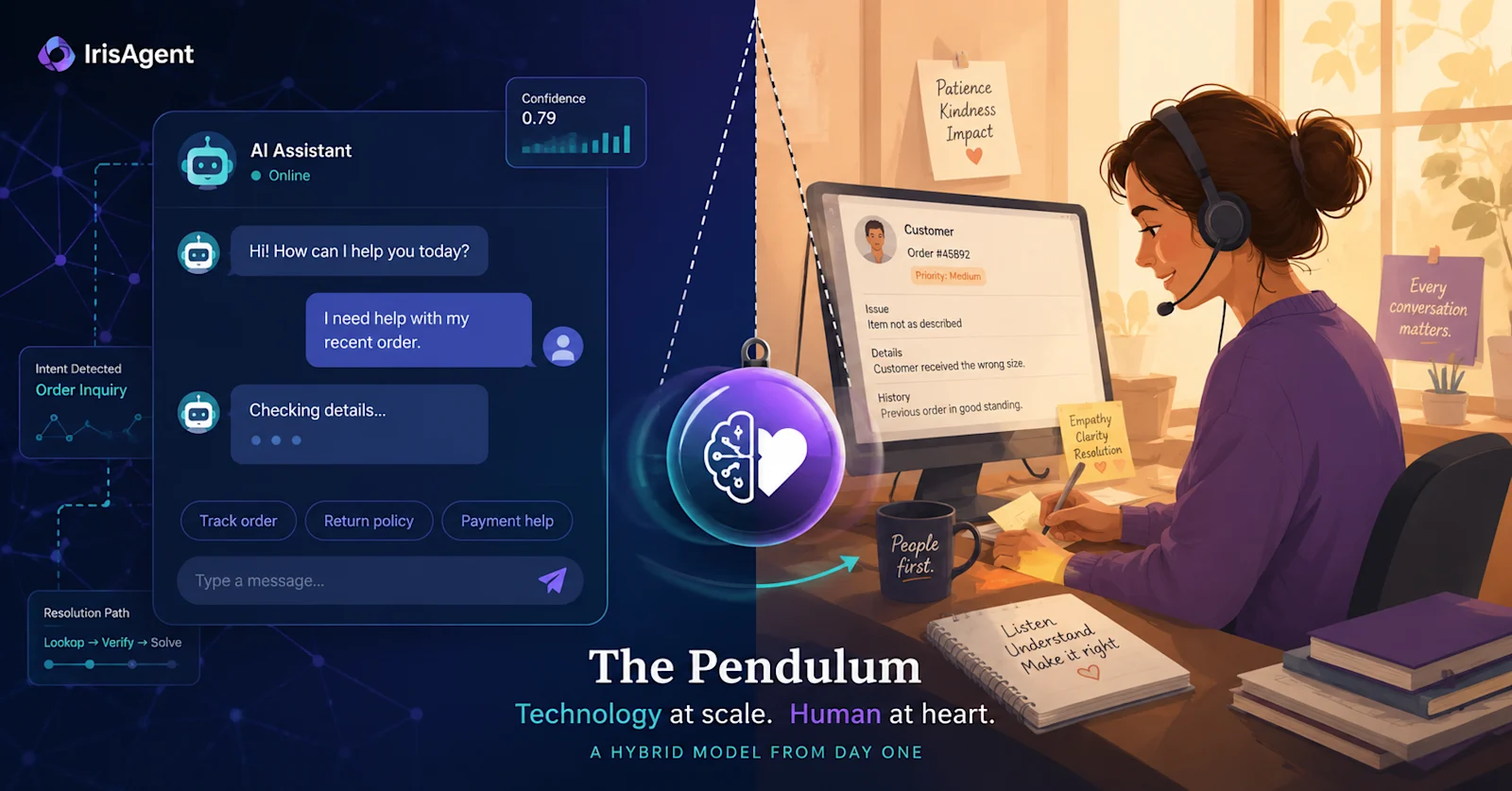
Klarna’s bot was not “bad AI.” On the queries it was suited for, it outperformed the human baseline on speed, consistency, and after-hours coverage. The mistake was architectural: the deployment was built to deflect first and ask questions later. There was no robust mechanism for the AI to say, in production, “I am not confident enough to resolve this. Route to a human now, and pass full context.”
In 2026, this capability has a name: confidence-aware escalation. It is the difference between an AI that brags about a 70% deflection rate and an AI that delivers a 70% deflection rate without quietly destroying the bottom 30% of customer experiences.
Three components define it:
Per-response confidence scoring
: the AI knows how strong its grounding is for the answer it’s about to give.
Policy-driven routing thresholds
: confidence below X for refund queries triggers human escalation; confidence below Y for fraud queries triggers it sooner.
Warm handoff with full context
: when escalation triggers, the human agent receives the conversation, the AI’s reasoning, what it was about to say, and any flags the system raised.
Klarna’s 2024 deployment had none of this in production form. That’s the architectural gap. The choice was never “AI vs human.” It was “AI vs AI with governance.”
Three Lessons for Mid-Market Buyers
Mid-market companies (roughly 500 to 5,000 employees, $50M to $1B revenue) can’t run Klarna’s experiment. You don’t have the press coverage to make a comeback narrative work. You don’t have the cash reserve to absorb 18 months of brand damage. You don’t have the multi-billion-dollar valuation to make headlines either way. The lessons land differently.
Lesson 1: Set escalation policy before you deploy, not after
Klarna’s reversal came roughly 15 months into deployment. Long enough for damage to accumulate. The escalation policy should be a launch requirement, not a Q4 retrospective fix.
Before any AI agent goes live, document in writing:
Which intent categories are eligible for full automation (e.g., order status, shipping changes).
Which intents require human review even if AI confidence is high (e.g., refunds above $X, account closures, fraud claims, hardship requests).
Which intents trigger immediate escalation regardless of confidence (e.g., legal threats, self-harm signals, regulatory complaints).
Confidence thresholds per intent, with the right to tighten them after any P0 incident.
Your AI vendor should support this. If they cannot show you per-intent escalation rules and per-response confidence scoring in their UI, they are not enterprise-ready in 2026. They are 2024 Klarna.
Lesson 2: Headline deflection rates are vanity; tail outcomes are the truth
The 82% response-time improvement was real. So was the 25% drop in repeat tickets. Those were also the metrics Klarna’s leadership saw on every dashboard. What they did not see, until it was too late, were tail outcomes:
The customers who churned silently rather than escalating.
The complex tickets that took 3x longer because the AI made the human’s job harder.
The brand-damage signal hidden inside Trustpilot drift.
When you evaluate an AI customer service platform, ask for the bottom decile metrics:
What was the customer effort score on the 10% of conversations with the lowest AI confidence?
What was the resolution time on tickets that escalated after AI attempted resolution? (Compared to tickets that went directly to a human?)
What was the rage-quit rate (customers who abandoned the AI flow without resolving)?
A vendor who can produce those numbers is a vendor with real production telemetry. A vendor who can’t is selling you the 2024 Klarna pitch deck.
The same gap shows up on the phone channel, where vendors report containment instead of resolution. Our voice AI benchmarks from production deployments break both numbers out by call type, so a pilot is judged on resolution rather than on how many callers gave up.
Lesson 3: Build the hybrid model from day one. Don’t bolt it on after a crisis
The strategy Klarna is now pursuing, “AI solves the easy stuff, our experts handle the moments that matter,” is the correct architecture. The expensive mistake was arriving at it via crisis instead of via design.
For mid-market buyers, the hybrid model from day one means:
Keep a baseline human team
sized to your tail volume, typically 15% to 30% of pre-AI headcount, depending on industry. Don’t fire to zero.
Use AI as a force multiplier for the team you keep
: agent assist, AI-drafted responses humans approve, sentiment-driven prioritization, and automated post-call summaries.
Resist the all-or-nothing pitch.
Any vendor whose business case depends on you eliminating 90%+ of your support team is a vendor whose business case is fragile.
What a 2026 Deployment Should Look Like (vs. Klarna 2024)
Here is the practical contrast.
Capability | Klarna 2024 Deployment | 2026 Mid-Market Best Practice |
Confidence scoring | Implicit, not surfaced | Per-response confidence with policy thresholds |
Escalation logic | Customer requests human, then handoff | Confidence + intent + risk + sentiment trigger handoff |
Grounding | Fine-tuned on internal data | Knowledge-base grounded with hallucination validation |
Tail metrics | Deflection rate, response time | Plus bottom-decile CES, post-escalation resolution time, rage-quit rate |
Human staffing | Cut to near-zero | Kept at hybrid-model baseline (15% to 30%) |
Knowledge gap detection | Manual review | Continuous gap surfacing back to content ops |
Handoff context | Conversation transcript only | Conversation, AI reasoning, confidence, and flags |
Pricing model | Headcount savings target set automation scope | Flexible (usage-based or resolution-based), chosen to fit the ticket mix |
If your AI vendor cannot deliver the right column, you are deploying Klarna 2024 in 2026, and the news cycle will be less forgiving the second time around.
How IrisAgent Maps to the Klarna Lessons
IrisAgent’s architecture was built specifically to make the Klarna failure mode hard to reproduce. Three components matter most.
1. The Hallucination Removal Engine
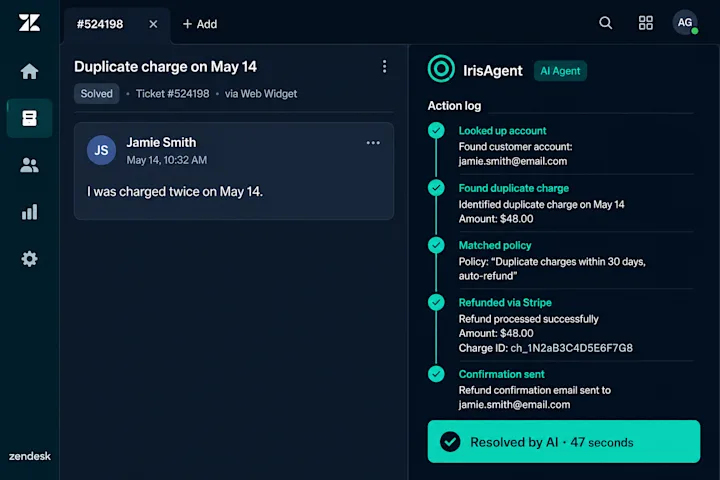
Every AI response is validated against your knowledge base, SOPs, and backend data before it is sent. If a response cannot be grounded with sufficient confidence, the system does not “guess and hope.” It escalates. This is the technical layer that prevents the “AI gave a confidently wrong first answer” pattern that ate Klarna’s repeat-contact rate.
2. Confidence-aware escalation rules
You configure escalation per intent category. Refunds above a threshold, hardship cases, fraud claims, and regulatory keywords route to humans regardless of AI confidence. Order-status and shipping queries route to AI with low thresholds. The decision tree is in your control, not your vendor’s.
3. 24-hour go-live with flexible pricing
Klarna’s incentive to over-deploy was structural: every ticket the AI closed was headcount cost saved, so the pressure ran toward automating more intents rather than the right ones. IrisAgent offers flexible pricing with both usage-based and resolution-based plans, so you pick the model that fits your ticket profile and scope automation by intent category, not by a savings target. Combined with 24-hour deployment, you can stand up the right architecture from day one, without a six-month implementation that locks you into bad escalation defaults.
Performance benchmarks across IrisAgent deployments:
60%+ automated resolution rate on appropriate intent categories
50% reduction in average handle time on escalated tickets (humans get full context)
60% fewer re-escalations (the right ticket goes to the right place the first time)
Flexible pricing: usage-based or resolution-based plans, whichever fits your volume
See how IrisAgent compares to Zendesk AI | See pricing
The Decision Framework: Should You Pause, Adjust, or Push Forward?
Most mid-market CX leaders reading the Klarna story are in one of three positions. Each calls for a different next move.
If you have not deployed AI yet
Don’t pause. Design. The companies that wait another year to start are not safer; they are further behind on the operational learning curve. What you should do is design the deployment with confidence-aware escalation, hallucination validation, and tail metrics baked in from day one. The Klarna mistake is not deploying AI. It is deploying it without the 2026-era architecture.
If you have a 2024-era deployment in production
Audit, then adjust. Pull the bottom-decile metrics for the last 90 days. Look for the signal Klarna missed: rising repeat contact rate, declining CSAT on escalated tickets, growing rage-quit rate. If you find them, the answer is not “rip it out.” It is to add the missing layer (confidence scoring, grounding, escalation policy) without losing the legitimate deflection gains you’ve already captured.
If your team is already arguing about an AI reversal
Reframe the argument. The choice in 2026 is not “AI or humans.” It is “AI with governance or AI without governance.” If your leadership is leaning toward dismantling AI, the better move is to dismantle the bad architecture and rebuild on the hybrid model that Klarna eventually arrived at, but build it on purpose.
The Bottom Line
Klarna’s story is going to be cited in CX presentations for the next five years. Most of those citations will get the lesson wrong. They will tell you AI customer service doesn’t work, or that humans always win, or that the only safe move is to do nothing.
The actual lesson is narrower and more useful: AI without confidence-aware governance is dangerous in customer service, and AI with confidence-aware governance is the most powerful CX capability of the decade.
Klarna got there via a public reversal that cost them brand equity, leadership credibility, and an undisclosed amount of customer lifetime value. You can get there via deliberate design: choosing a vendor whose architecture supports the hybrid model from day one, and whose pricing model is aligned with outcomes rather than ticket volume.
The mid-market companies that win the next two years will not be the ones that deployed AI first. They will be the ones that deployed it correctly.
Frequently Asked Questions
What did Klarna actually do with AI customer service?
In February 2024, Klarna deployed an OpenAI-powered chatbot that took over two-thirds of customer service chats, doing the work of approximately 700 outsourced agents. In May 2025, CEO Sebastian Siemiatkowski announced the company would resume hiring human agents, moving to a hybrid Uber-style freelance model, after admitting the all-AI deployment had compromised customer service quality.
Did Klarna actually replace 700 workers with AI?
Klarna claimed its chatbot did the work equivalent of 700 human agents at launch in February 2024. The figure refers to roles in their offshore outsourced contact center contract, not direct Klarna employees. Some reports cite 1,000+ total workers affected when including hiring freezes maintained through 2024.
Why did Klarna's AI customer service fail?
The AI handled routine queries well. Response times improved 82% and repeat tickets dropped 25%. But it failed on complex or sensitive interactions like disputed transactions, fraud claims, and hardship cases. The deployment lacked production-grade confidence-aware escalation, so the AI gave confidently wrong answers on tail-end queries and customers ended up frustrated, abandoning conversations or escalating to social media.
Is Klarna removing AI from customer service?
No. Klarna is keeping AI for routine queries (the chatbot still handles roughly two-thirds of inquiries) and adding human agents back for complex and sensitive interactions. The new strategy, in the CEO's words, is 'AI solves the easy stuff. Our experts handle the moments that matter.' This is the hybrid model that most CX experts consider best practice for 2026.
What is confidence-aware escalation in AI customer service?
Confidence-aware escalation is an architectural pattern where the AI assigns a confidence score to every response it is about to give and routes to a human agent when confidence falls below a per-intent threshold. Combined with hallucination validation against the knowledge base, it prevents the 'confidently wrong' failure mode that affected Klarna's 2024 deployment.
What should mid-market buyers do differently than Klarna?
Three things: set escalation policy before deploying, not after, with per-intent rules and confidence thresholds; measure bottom-decile outcomes such as customer effort score on low-confidence conversations, post-escalation resolution time, and rage-quit rate, not just headline deflection metrics; and keep a hybrid model from day one, with 15% to 30% of pre-AI human headcount retained rather than firing to zero.
How is IrisAgent different from the AI Klarna used?
IrisAgent's Hallucination Removal Engine validates every response against your knowledge base before it is sent, so the AI does not give confidently wrong answers. Confidence-aware escalation routes complex or sensitive intents to humans regardless of AI confidence, so automation stays scoped to the categories where it actually resolves. IrisAgent offers flexible pricing with both usage-based and resolution-based plans, and the platform goes live in 24 hours, so the right architecture is in place from day one.
Was Klarna's AI customer service deployment a complete failure?
No. The chatbot delivered real value: handling two-thirds of inquiries, cutting response times 82%, dropping repeat tickets 25%. The failure was the absence of architectural guardrails for the tail of complex interactions, and the parallel decision to cut human staffing to near-zero. With confidence-aware escalation and a maintained hybrid team, the same AI investment would likely have been a success rather than a public reversal.
Loading the form. Prefer email? Reach us at info@irisagent.comor call +1 617 249 3312.