
Private LLMs for Customer Support: A Data Sovereignty Guide for 2026
Private LLMs for customer support are large language models deployed inside your own infrastructure (a VPC, single-tenant cloud, or on-premise data center) so that ticket content, customer PII, and knowledge base data never train a third-party model or leave your jurisdiction. They are the default architecture for any support team subject to GDPR, HIPAA, PCI DSS, SOC 2, or in-country data residency requirements. IrisAgent runs this architecture in production today, with validated accuracy above 95% and a 24-hour deployment cycle across enterprise customers including Dropbox, Zuora, and Teachmint.
The catch: “private LLM” means at least four different things depending on which vendor you ask. Some sell a single-tenant SaaS instance and call it private. Some require you to operate the GPU cluster yourself. The architecture you pick determines your compliance posture, your cost structure, and whether you can ship in a quarter or a year.
This guide breaks down the four deployment models, the data sovereignty tradeoffs, the compliance frameworks they map to, and what to ask vendors before signing. It is written for VP Support and Head of CX leaders who have been told by Legal or InfoSec that the standard ChatGPT-on-tickets approach is not going to clear review.
Key Takeaways
Private LLMs for customer support fall into four deployment models: single-tenant SaaS, customer-owned VPC, on-premise, and hybrid retrieval. Each maps to a different compliance posture and cost curve.
Ungrounded public LLMs hallucinate on 15% to 30% of customer queries (Stanford HAI, 2024). Grounding the model against your KB plus running a validation pass brings the rate under 5%.
GDPR Article 28, HIPAA’s Business Associate Agreement, and PCI DSS scope rules all assume your support AI vendor either does not see PHI/PII or is contractually bound as a processor with audit rights.
The “private LLM” label is mostly marketing. Ask vendors three concrete questions: where the inference runs, whether your data is used to train any model (including evals), and whether the contract names a Sub-Processor that holds the GPUs.
A correctly deployed private LLM should resolve 50%+ of inbound support tickets in production within 24 hours of go-live, with full audit logs, source citations, and a human escalation path on every response.
What Counts as a Private LLM for Customer Support
A private LLM for customer support is any large language model architecture where three things are true at once:
The inference workload runs inside infrastructure your security team controls (or a single-tenant instance contractually treated as yours).
The prompts and responses (which include ticket content, customer PII, and KB snippets) are not retained by any third party for model training, evaluation, or product improvement.
The deployment satisfies the specific regulatory frameworks that apply to your business (GDPR, HIPAA, PCI DSS, SOC 2 Type II, ISO 27001, and any in-country residency rules).
This is a stricter definition than most vendor pages use. A lot of “secure AI” or “enterprise-grade” language is just a checkbox: TLS in transit, encryption at rest, no training on inputs. That is the table-stakes floor, not the ceiling. True data sovereignty means a Data Protection Officer can name, in one sentence, the legal entity that holds the GPUs and the jurisdiction those GPUs sit in.
The reason this matters for customer support specifically is the data type. Support tickets are the highest-density PII surface inside most SaaS companies. A single ticket often contains a customer email, a phone number, the last four of a card, a session ID, an account state, and the contents of a private complaint. Feeding that stream into a generic LLM API is the fastest way to turn a low-risk support stack into a high-risk one.
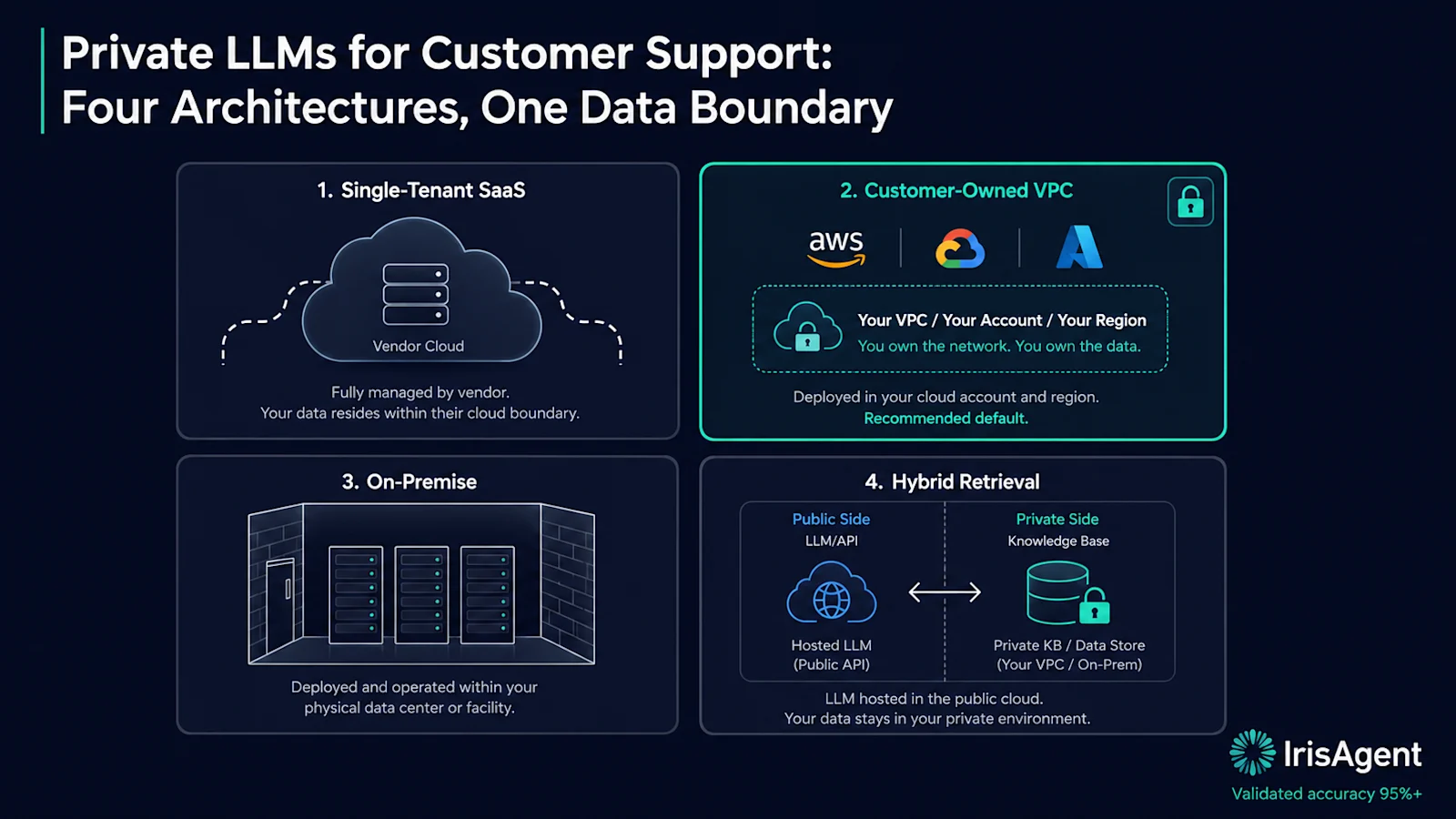
The Four Deployment Models, Compared
Most vendor pitches collapse into one of four architectures. Understanding which one you are buying is the single highest-leverage decision in the procurement cycle.
1. Single-Tenant SaaS (Logical Isolation)
Your inference runs on a dedicated namespace inside the vendor’s multi-tenant cloud. The model weights are shared across customers; the data is logically segregated. The vendor signs a DPA, agrees not to train on your data, and provides SOC 2 Type II evidence.
This is what most “private” vendors actually sell. It is appropriate for SOC 2-only requirements and most GDPR cases. It is not sufficient for healthcare data without a signed BAA, and most teams cannot use it for in-country residency requirements (Germany, India, UAE) unless the vendor operates a regional cluster.
Cost: lowest. Time to deploy: hours to days. Audit complexity: moderate.
2. Customer-Owned VPC (Tenant Isolation)
The vendor deploys the LLM stack inside your AWS, GCP, or Azure account. Your security team owns the network, the IAM, and the encryption keys. The vendor manages the model and the application layer but never gets root.
This is what IrisAgent runs for enterprise customers with strict residency or BAA requirements. It cleanly satisfies HIPAA (because the data never crosses into the vendor’s environment), maps to most country-specific residency laws, and gives InfoSec a clear audit boundary.
Cost: moderate. Time to deploy: 24 hours to 2 weeks. Audit complexity: low, because everything sits inside your existing cloud audit perimeter.
3. On-Premise (Physical Isolation)
The LLM runs in your data center. You own the GPUs (typically H100s or H200s for production-grade inference), the storage, and the network. The vendor provides the software.
This is the right architecture for defense, federal, and regulated finance customers who cannot use commercial cloud for the workload at all. It is overkill for most SaaS support teams. The total cost of ownership is dominated by the GPU footprint, which is 5 to 20 times the cost of equivalent SaaS over a three-year window.
Cost: highest. Time to deploy: 6 weeks to 6 months. Audit complexity: high, but fully under your control.
4. Hybrid Retrieval (Public Inference, Private Data)
A retrieval-augmented generation (RAG) architecture where the model itself is hosted by a commercial provider (OpenAI, Anthropic, Google) under a zero-retention agreement, but the knowledge base, ticket context, and customer data are stored and retrieved inside your own infrastructure. The prompts that leave your network are scrubbed of PII before they reach the model.
This is a pragmatic middle path. It uses frontier-grade models without giving the model provider your data lake. The tradeoff is that you depend on the vendor’s zero-retention claim and on the quality of the PII scrubber upstream. For most SOC 2 + GDPR support teams this is the best cost-to-value point in 2026.
Mike at a Healthcare SaaS
A real example. Mike runs a 40-person support team at a mid-market healthcare SaaS. In Q1 2026, his CISO blocked a planned Intercom Fin rollout because Fin’s standard contract did not include a BAA at the price point they were quoted. The team had already committed to a CSAT improvement goal in the same quarter.
They switched to a customer-owned VPC deployment of IrisAgent. Time from BAA signature to first automated ticket resolution: 11 days. Six weeks in, 47% of tier-1 tickets were resolving without human touch, validated accuracy was sitting at 96%, and Legal had a clean audit trail per response. The CISO signed off because the LLM never saw a packet that had not first been inspected inside their own VPC.
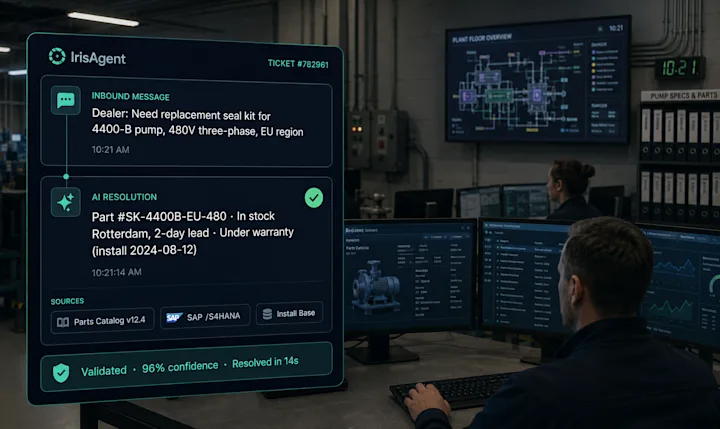
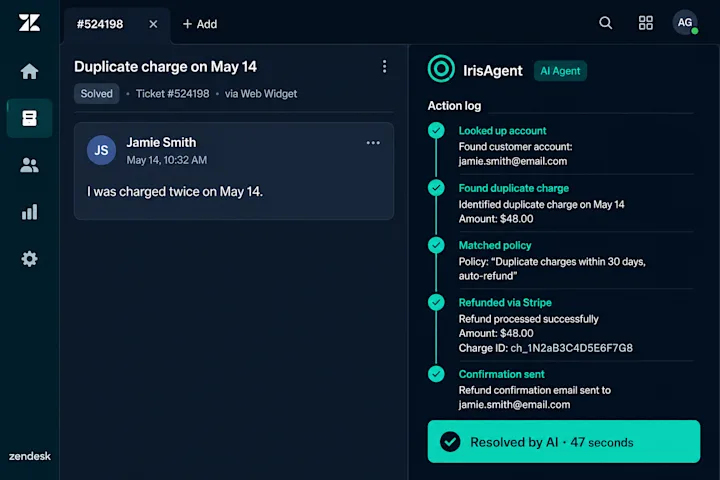
If you want to see how this architecture works on a real support workload, see how IrisAgent’s AI for customer support platform plugs into Zendesk, Salesforce, and Intercom without routing tickets through a third-party model provider.
Data Sovereignty: What Regulators Actually Require
Most “data sovereignty” content treats it as a single concept. It is not. There are four overlapping regulatory layers, and a private LLM has to satisfy whichever ones apply to your business.
GDPR and the Processor Question
Under GDPR Article 28, any vendor that touches personal data on your behalf is a Processor, and the contract has to spell out exactly how that data is handled. For an LLM vendor that means the DPA must name the inference Sub-Processor (sometimes a separate entity than the application vendor), specify the lawful basis for processing, and grant audit rights.
The trap is the model-training carve-out. Many LLM API providers reserve the right to use a sample of inputs for “service improvement.” For support data, that is a GDPR violation. Get an explicit, written zero-retention and zero-training clause covering both prompts and responses, including evaluations.
HIPAA and the BAA
Healthcare data needs a signed Business Associate Agreement before any vendor sees a packet. As of 2026, only a subset of LLM vendors will sign one, and the BAA-eligible inference path is often a different SKU than the standard public API. If healthcare is in scope, customer-owned VPC is the cleanest architecture because it sidesteps the BAA chain entirely (the data never leaves your environment).
PCI DSS and Scope Reduction
If your support tickets ever contain primary account numbers, your AI vendor is in scope for PCI DSS. The pragmatic move is to never let card data into the LLM in the first place: scrub it at the ingest layer, replace with a token, and let the model handle the symbolic version. This is doable in a hybrid RAG architecture and trivial in a customer-owned VPC.
Country-Specific Residency
Germany (BDSG), India (DPDP Act), UAE (PDPL), Saudi Arabia (PDPL), and a growing list of countries require certain personal data to be stored and processed inside the country. A single-tenant SaaS deployment satisfies this only if the vendor operates an in-country cluster. Most do not. Customer-owned VPC is the safest default for in-country residency because the deploying party (you) controls the region.
The NIST AI Risk Management Framework is the cleanest reference doc for translating these overlapping requirements into a single internal control set. Pair it with the EU AI Act’s risk-tier classification when you brief Legal.
Hallucinations Are a Compliance Problem, Not Just a UX Problem
Ungrounded LLMs hallucinate on 15% to 30% of customer queries depending on complexity (source: Stanford HAI 2024 study on retrieval-augmented systems). For most marketing teams that is a quality issue. For a support team subject to consumer protection law, accessibility requirements, or financial regulation, it is a compliance issue.
A hallucinated answer that promises a refund the customer is not entitled to creates a legally enforceable representation. A hallucinated answer about a drug interaction creates liability. A hallucinated answer about FDIC coverage creates an enforcement event. The fix is grounding plus validation, not “better prompts.”
IrisAgent’s Hallucination Removal Engine validates every response against the source documents it cited before sending. Across enterprise deployments the validated accuracy stays above 95% and the hallucination rate stays under 5%, including on adversarial test sets. That is the floor any support-grade private LLM has to clear.
Sarah at a Fintech
Sarah leads support at a mid-market fintech. In early 2025 the team piloted a public-cloud chatbot that had no grounding layer. It told a customer they were eligible for a fee waiver they were not eligible for. The customer screenshotted the chat, escalated to the regulator’s complaint portal, and the team spent the next 11 weeks on remediation: refund processing, individual customer notifications, a regulator response, and a board memo.
The post-mortem ran by three different counsel and they all landed in the same place: the failure was not “the AI was wrong.” The failure was “we deployed an AI that could be wrong in a way we could not detect.” When she rebuilt the stack on a grounded, validated architecture, the controls Legal demanded were source citations on every response, a confidence threshold above which the AI could act and below which it had to escalate to a human, and a tamper-evident audit log.
Those three controls plus a private deployment are now her minimum bar for any AI vendor. They should be yours, too.
Ready to test what grounded private-LLM architecture looks like on your own ticket data? Book a 20-minute IrisAgent demo and we will run a live test against ten of your real tickets.
How to Evaluate a Vendor’s “Private LLM” Claim
Most vendor marketing will not survive five direct questions. Here is the list to bring to the technical eval call.
Where does the inference workload run? Name the cloud provider, the region, and the legal entity that holds the contract with the GPU operator.
Is my data, including prompts, responses, and evaluation samples, used to train, fine-tune, or improve any model? Get this in writing, not in a marketing line.
What is the Sub-Processor list, and does it include any LLM API provider whose terms differ from yours?
Can you sign a BAA, a country-specific DPA, or a regional addendum if needed? At what SKU?
What is the validated accuracy and hallucination rate on a representative sample of my own tickets, not your demo data?
If a vendor cannot answer all five in the first call, the architecture is not as private as the slide deck implies. The good vendors will hand you a one-page architecture diagram and walk through the data flow line by line.
The Cost Curve: Private LLMs Are Not Always More Expensive
The conventional wisdom is that private deployment costs more than public. That is true for the on-premise model and roughly false for the others. Here is the rough cost stack as of mid-2026, on a per-resolved-ticket basis for a 50,000-ticket-per-month support team.
Deployment Model | Per-Resolution Cost | Setup Cost | Compliance Coverage |
Public API + no grounding | $0.40 to $1.20 | minimal | SOC 2 only |
Hybrid retrieval, zero-retention API | $0.30 to $0.80 | low | SOC 2, GDPR |
Single-tenant SaaS | $0.50 to $1.50 | low | SOC 2, GDPR, most HIPAA |
Customer-owned VPC | $0.40 to $1.20 | moderate | SOC 2, GDPR, HIPAA, residency |
On-premise | $1.50 to $4.00+ | high | All, plus air-gapped |
Compare those numbers to per-resolution AI competitors that charge fixed fees regardless of deployment model. Ada charges $3.50 per resolution. Intercom Fin charges $0.99 per resolution on top of $29 to $132 per seat plus a $35 copilot add-on. Forethought requires a 20,000-ticket minimum. Sierra has a $150K+ annual floor. Decagon’s median enterprise pricing lands near $386K with a 6-week custom development cycle.
A correctly architected private LLM, deployed in 24 hours into your existing help desk, beats every one of those on both compliance posture and unit economics.
What “Deploy in 24 Hours” Actually Means
The phrase “deploy in 24 hours” sounds aspirational. It is not. It is the literal time from a signed order form to the first automated ticket resolution for a customer-owned VPC deployment of IrisAgent, including:
VPC stand-up via Terraform
IAM and KMS configuration
Help desk integration (Zendesk, Salesforce, Intercom, Freshdesk, Jira Service Management, Zoho)
Knowledge base ingestion
Smart Operating Procedures configuration in natural language
First grounded response, validated against KB source, sent into a real ticket queue
The 24-hour clock is achievable because none of the steps require custom engineering. Forethought’s 30 to 90 day minimum, Decagon’s 6-week build cycle, and Sierra’s quarter-long onboarding are functions of their architecture, not their staffing. A vendor that productizes the deployment can ship in a day; a vendor that ships a custom integration cannot.
See the Dropbox case study for what this looks like in production: 160,000 agent-minutes saved, AHT cut by two minutes per ticket, and the entire workload running inside Dropbox’s own security perimeter.
What Support Ops Should Own (and Not Hand to IT)
A private LLM rollout is a support ops project, not an IT project. The reason is that the configuration surface that determines outcomes (escalation rules, confidence thresholds, SOPs, tone, routing logic) is closer to support workflow than to infrastructure.
Support ops should own:
Confidence threshold tuning (typically 0.85 for action, 0.70 for suggested-response, escalate below 0.70)
SOP authoring in natural language
Escalation routing by intent, priority, and account value
CSAT and resolution-rate measurement
The quarterly accuracy audit on a sampled ticket set
IT should own:
VPC and network configuration
IAM, KMS, and SSO
Audit log destination and retention
BAA, DPA, and Sub-Processor management
Disaster recovery and the regional failover plan
If your vendor is pushing a deployment model where IT has to own the SOPs, that is a sign the product was built for the CIO, not for support operations. It is the single biggest predictor of a stalled rollout.
Next Steps
The decision tree for private LLMs in customer support comes down to four questions.
What is your strictest regulatory requirement? (GDPR, HIPAA, PCI DSS, country residency, or just SOC 2.)
What is your tolerance for setup time? (24 hours, two weeks, six weeks, or a quarter.)
What is your acceptable per-resolution cost? (Compare against the $0.99 to $3.50 floor that per-resolution competitors charge.)
Who owns the configuration? (If the answer is “IT,” the rollout will stall; support ops has to own it.)
Match the answers to one of the four deployment models above and you have your shortlist. From there the vendor eval comes down to five questions: where the inference runs, whether your data trains anything, the Sub-Processor list, contractual coverage of the frameworks you need, and validated accuracy on your own ticket sample.
Private LLMs for customer support are the default architecture for 2026, not a niche option. The cost premium is small. The compliance benefit is large. The setup time, with the right vendor, is one day. The teams that are still routing tickets through generic public APIs in 2026 are the ones that will be answering uncomfortable questions in their next audit.
Book a 20-minute IrisAgent demo and we will walk through a customer-owned VPC architecture against your specific compliance requirements, with a working accuracy benchmark on ten of your real tickets.
Frequently Asked Questions
What is a private LLM for customer support?
A private LLM for customer support is a large language model that runs inside infrastructure controlled by your organization (a single-tenant cloud, your own VPC, or your data center) so that ticket content, customer PII, and knowledge base data never train a third-party model or leave your jurisdiction. It is the default architecture for any support team subject to GDPR, HIPAA, PCI DSS, or country-specific residency requirements.
Do private LLMs hallucinate less than public ones?
Not automatically. Hallucination rate is a function of grounding and validation, not deployment model. A private LLM that pulls answers from your knowledge base via retrieval-augmented generation and validates every response against its sources will hallucinate on under 5% of queries. A private LLM without grounding will hallucinate at roughly the same 15% to 30% rate as a public one. The deployment model controls privacy, not accuracy. Both need to be solved.
Is single-tenant SaaS the same as a private LLM?
It depends on your compliance scope. Single-tenant SaaS gives logical isolation, which clears SOC 2 and most GDPR cases. It does not give physical isolation, in-country residency, or a HIPAA-compatible boundary without specific vendor features. If your CISO needs to point at a specific GPU in a specific region as yours, single-tenant SaaS is not sufficient and a customer-owned VPC deployment is the cleaner architecture.
How long does it take to deploy a private LLM in customer support?
For a customer-owned VPC deployment of a productized vendor like IrisAgent, the answer is 24 hours to two weeks, depending on how clean your knowledge base and integrations are. For an on-premise deployment with your own GPUs, plan on 6 weeks to 6 months. For custom-built deployments from vendors like Decagon, the published timeline is around six weeks of dev work. If a vendor is quoting a quarter or more for a standard VPC deploy, the slowness is in the product, not the architecture.
What is the difference between private LLMs and on-premise AI?
On-premise is one of four private LLM models, the strictest one. It runs in your own data center on hardware you own. A customer-owned VPC deployment is also private but runs inside your cloud account. Single-tenant SaaS and hybrid retrieval are private under most definitions but rely on the vendor for the infrastructure layer. Private describes the data boundary; on-premise describes the physical location. They are not synonyms.
Can a private LLM integrate with Zendesk, Salesforce, or Intercom?
Yes, and it should. The integration is what makes the system useful. A private LLM that cannot read tickets out of your help desk and write resolutions back into it is a tech demo, not a support tool. IrisAgent offers native integrations with Zendesk, Salesforce, Intercom, Freshdesk, Jira Service Management, and Zoho, and the integration installs in under a day inside a customer-owned VPC. The data path stays inside your account; only the integration metadata crosses the application boundary.
What does data sovereignty cost in practice?
Less than most teams expect. The cost premium for a customer-owned VPC deployment over a public API plus no-grounding stack is roughly 0% to 30% on a per-resolved-ticket basis, and the premium often disappears entirely when you account for the per-resolution fees that competitors like Ada, Intercom Fin, and Sierra charge. On-premise is the genuine cost outlier and is overkill for most SaaS support teams. The economic case for a private LLM holds up even before you factor in the compliance benefit.
Loading the form. Prefer email? Reach us at info@irisagent.com or call +1 617 249 3312.