
AI Customer Support for Manufacturing and Industrial
AI customer support for manufacturing automates 50%+ of distributor, dealer, and end-user tickets by grounding every response in your product manuals, spec sheets, ERP records, and service bulletins. The right platform deploys in 24 hours, validates each answer against your source documents to keep hallucinations under 5%, and plugs into the help desk your team already runs on (Zendesk, Salesforce, Intercom, Freshdesk, Jira Service Management).
IrisAgent’s Hallucination Removal Engine holds validated accuracy above 95% across enterprise deployments. The same architecture that powers support for SaaS leaders like Dropbox, Zuora, and Teachmint applies cleanly to manufacturers: the technical content is dense, the customers are sophisticated, and the cost of a wrong answer is a returned shipment, a stalled production line, or a warranty dispute.
This guide walks through what AI customer support actually looks like on a manufacturing help desk, the highest-value use cases for distributors and field service teams, why generic LLMs fail on industrial content, and how to deploy a grounded AI platform inside your existing stack in a day.
Key Takeaways
Manufacturers see the highest AI support ROI on five workflows: spec and part lookups, order and shipment status, warranty triage, troubleshooting from manuals, and dealer portal questions.
Grounded AI (RAG plus validation) is non-negotiable for industrial content. Ungrounded LLMs hallucinate part numbers, torque specs, and warranty terms in 15% to 30% of responses (Stanford, 2024).
The right platform integrates with your ERP (SAP, Oracle, NetSuite), PLM, and warranty system, not just a static knowledge base.
24-hour deployment is real when the AI uses native help desk apps. Multi-month implementations are a vendor choice, not a technical requirement.
IrisAgent automates 50%+ of ticket volume with validated accuracy above 95% and the same per-agent pricing model on day 1 and day 1,000.
What AI Customer Support Looks Like in Manufacturing
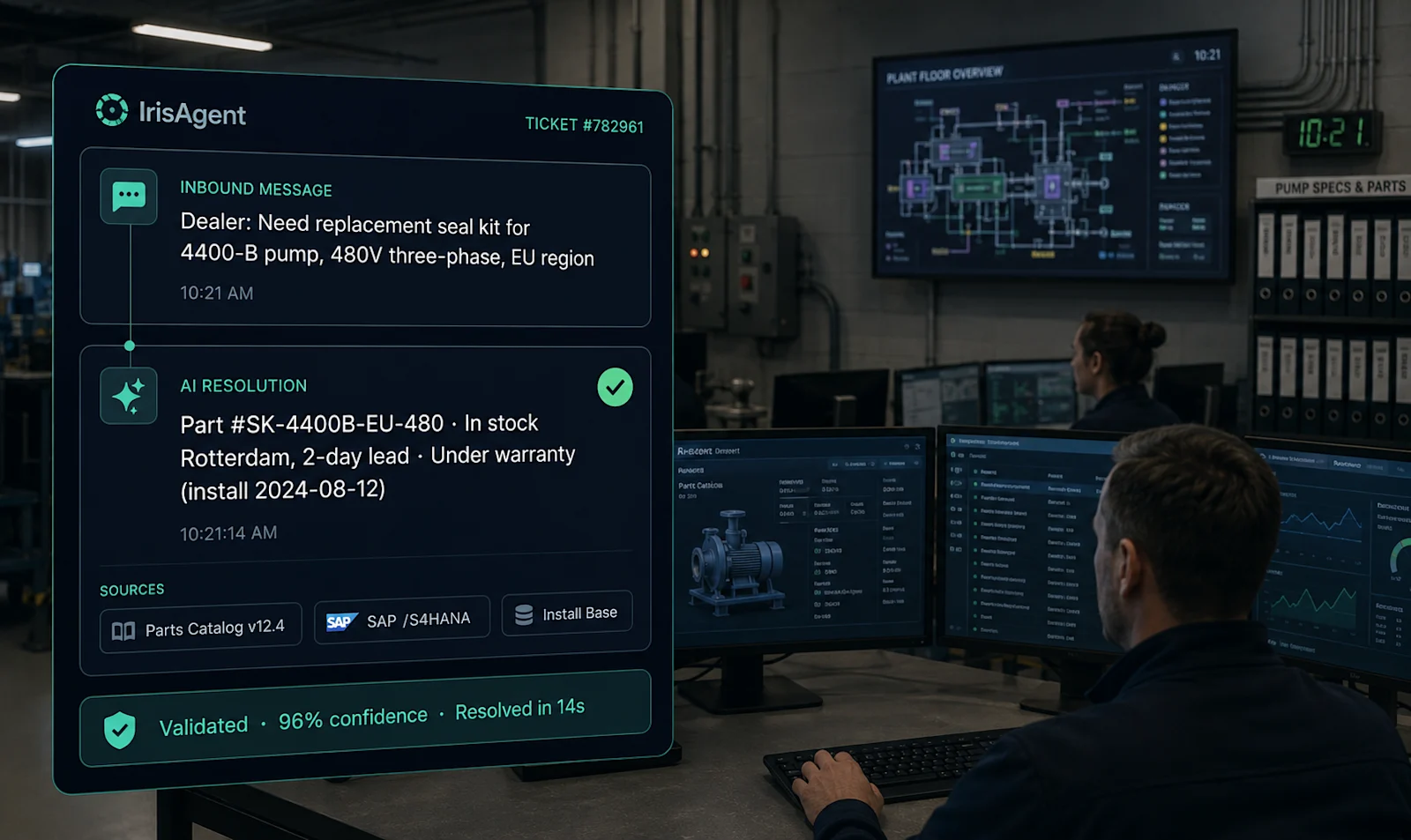
Manufacturing support is not e-commerce support with a different logo. The buyer is a distributor, dealer, OEM partner, or field service technician. The ticket is rarely “where is my order.” It is “what is the replacement seal kit for a 2019 Model 4400-B pump running on 480V three-phase,” or “the controller is throwing fault code E-217 after we swapped the encoder, what do I check next.”
A useful AI support platform in this context does four things:
Reads from your actual content: product manuals (PDF), spec sheets, technical bulletins, parts catalogs, SOPs, warranty terms, and the install base recorded in your ERP.
Connects to backend systems so it can resolve, not just deflect. The ticket “where is PO #88412” requires an Oracle or SAP lookup, not a knowledge base article.
Validates every response against the source it cites before sending. A torque spec or part number that “sounds right” but is hallucinated will end up in a maintenance log and break something.
Escalates cleanly to a human agent or field service engineer when confidence drops, with the full context preserved.
Most generic chatbots fail at step 1, never reach step 2, skip step 3 entirely, and hand off without context in step 4. That is why manufacturers have historically been skeptical of AI support, and why grounded AI is changing the math.
Why Manufacturers Need a Different AI Approach
The Deloitte 2024 Manufacturing Outlook found that 83% of manufacturers expect smart factory technology to drive competitiveness in the next three years, with AI cited as the top priority. The pressure is real: long product lifecycles (10 to 30 years on industrial equipment), aging field service workforces, dealer networks that demand 24/7 portal access, and warranty exposure that gets expensive fast.
But the same survey flagged data quality and trust as the top barriers. That tracks with what we see on industrial deployments. Three structural problems make manufacturing harder than typical SaaS support:
Content is technical and high-stakes. A wrong answer about a pressure rating, a hazardous material handling step, or a voltage spec is not a CSAT problem. It is a safety or liability problem. The bar for accuracy is higher than for “what’s your refund policy.”
The knowledge base is fragmented. Most manufacturers have spec sheets in a PIM, manuals in a DAM, technical bulletins in SharePoint, parts data in SAP, and warranty terms in a custom system built in 2011. An AI that only reads one of those sources will get the answer wrong because the answer lives somewhere else.
Customers are not consumers. A dealer who has been selling your equipment for 20 years does not want a chatbot that suggests they “check the user manual.” They want a specific answer, sourced, with the part number, the lead time, and the warranty status of the unit they are calling about.
The fix is grounded AI: retrieval-augmented generation (RAG) that pulls answers from your specific content at query time, validates them against the source before responding, and connects to the systems where the live operational data lives.
The Five Highest-Value Use Cases on a Factory or Distributor Help Desk
Across industrial deployments, five workflows consistently produce the highest ROI when automated. Start here, not with “every ticket type at once.”
1. Spec and Part Lookups
Distributors and field techs ask “what is the replacement part for X” thousands of times per month. The answer lives in a parts catalog or PLM system. A grounded AI agent reads the catalog, matches the configuration (voltage, mounting, region), returns the part number with a link, and logs the lookup against the dealer’s account. Average handle time on this ticket type drops from 8 to 12 minutes (human) to under 30 seconds (AI).
2. Order, Shipment, and Lead Time Status
“Where is PO #88412” and “what is the current lead time for SKU 4400-B in EMEA” are 100% ERP lookups. The AI agent queries SAP, Oracle, or NetSuite, returns the live status, and flags anything that has slipped against the committed date. No agent should be doing this manually in 2026.
3. Warranty Triage and Claim Initiation
A dealer reports that a unit failed at 8 months on a 12-month warranty. The AI agent pulls the unit’s install base record, validates the warranty window, asks the three qualifying questions from your warranty SOP, and either approves the claim, requests photos, or routes to a warranty engineer with all context attached. The “this is not under warranty” rejections (the bulk of denied claims) close without an agent touching the ticket.
4. Troubleshooting From Manuals and Tech Bulletins
Fault code E-217. Hydraulic pressure drop. Calibration drift on a sensor. These tickets used to require a senior tech to open three PDFs. A grounded AI agent reads the manual, the tech bulletin published two months ago, and the install base service history, and produces a step-by-step troubleshooting flow. When confidence drops below threshold, it escalates to a field service engineer with the full diagnostic trail.
5. Dealer Portal and Configurator Questions
“How do I configure a 4400-B with the cold-climate package and the EU connector kit.” The answer is a combination of your configurator rules, regional availability, and current pricing. The AI agent pulls all three and returns a complete config plus a quote-ready BOM.
Each of these five use cases shares the same property: the answer is knowable from your own systems if the AI can read them, and the cost of getting it wrong is high enough that validation matters more than speed.
What Breaks When You Use Generic LLMs (and How Grounded AI Fixes It)
Ungrounded large language models (ChatGPT, generic Copilot, an LLM dropped on top of your KB without validation) hallucinate in 15% to 30% of customer service responses, depending on query complexity (Stanford, 2024). On consumer support that produces a frustrated user. On industrial support that produces:
Wrong part numbers
that get ordered, shipped, and installed before anyone notices.
Fabricated torque specs
that end up in a maintenance log and cause a downstream failure.
Hallucinated warranty terms
that the dealer screenshots and quotes back to you in a dispute.
Made-up compliance language
(UL, CE, ISO, hazmat) that creates legal exposure.
The fix is architectural, not prompt engineering. Three things have to be true:
Retrieval is grounded in your verified content
(manuals, spec sheets, SOPs, ERP records) and only your verified content.
Every response is validated against the source it cites
before being sent. If the validation layer cannot find the claim in the source, the AI does not respond, it escalates.
The escalation path is clean
and confidence-thresholded so that low-certainty answers reach a human, not the customer.
IrisAgent’s Hallucination Removal Engine is exactly this architecture. Hallucinations drop from 15% to 30% on ungrounded models to under 5% on validated, grounded responses. For manufacturers, that is the difference between an AI you can put in front of dealers and an AI you have to keep behind an agent’s screen.
Ready to see how grounded validation works on industrial content? See how IrisAgent’s AI customer support platform handles technical documentation.
How to Deploy AI Support in a Manufacturing Environment in 24 Hours
The “AI takes 6 months to deploy” claim is a vendor choice, not a technical reality. Sierra requires $50K to $200K in setup and 6+ weeks of dev work. Decagon’s median custom pricing runs around $386K with a 6-week development implementation. Forethought (now part of Zendesk as of March 2026) historically required a 20,000-ticket data minimum.
None of those are technical constraints. They are pricing models. IrisAgent deploys in 24 hours into your existing help desk with no ticket-volume minimum. Here is the actual sequence for a manufacturing deployment:
Hour 0 to 4: Connect your help desk and content sources. One-click install inside Zendesk, Salesforce, Intercom, Freshdesk, or Jira Service Management. Point the AI at your manual library (PDF, web, SharePoint), spec sheets, and tech bulletins.
Hour 4 to 12: Connect operational systems. Native or API connectors to your ERP (SAP, Oracle, NetSuite), PLM, install base, and warranty system. This is where AI support stops being a “chatbot” and starts being a resolution agent.
Hour 12 to 20: Configure Smart Operating Procedures. Use Smart Operating Procedures (Smart SOPs) to encode your warranty qualification flow, your troubleshooting decision trees, and your escalation rules. SOPs are written in natural language. Your support ops lead configures them, not your engineering team.
Hour 20 to 24: Soft-launch on a single workflow. Pick spec and part lookups or order status (the lowest-risk, highest-volume use cases). Validate the first 50 to 100 automated resolutions before opening up additional workflows.
The first automated ticket resolution typically happens the same day. The 50%+ automation rate ramps as additional workflows go live, usually within the first 30 days.
Common Mistakes Manufacturers Make With AI Support
Five patterns we see repeatedly when industrial teams roll out AI support, and how to avoid them:
Starting with the hardest tickets.
Field service troubleshooting is the most technically interesting use case. It is also the highest-stakes and the worst place to launch. Start with order status and part lookups, prove the model, then expand.
Treating the knowledge base as a static dump.
Manufacturing content is versioned. A spec sheet from 2018 and a spec sheet from 2024 can both be in your KB, and the AI needs to know which one is current. Tag content with effective dates and product revision levels.
Skipping the ERP integration.
A deflection-only chatbot that shows the user a knowledge base article is not solving the dealer’s problem. The dealer wants the live answer from SAP, not a link to a PDF.
Choosing a per-resolution pricing model.
Ada charges around $3.50 per resolution. Intercom’s Fin charges $0.99 per resolution on top of seat fees. On industrial volumes, that math punishes scale. Per-agent pricing stays predictable as you grow.
Buying from the CIO’s office instead of support ops.
AI support should be configured, owned, and measured by the team that runs support, not by central IT. Tools designed for support ops (configurable SOPs, no-code workflow rules, native help desk apps) deploy faster and stay maintained.
Ready to test grounded AI on your own technical content? Start a no-commitment evaluation and see what your KB and ERP look like behind an AI resolution layer.
How IrisAgent Powers AI Support for Industrial Teams
IrisAgent is the AI support resolution platform built for grounded, validated, production AI. The architecture is a fit for manufacturing for four specific reasons:
Grounded in your content, validated against your source. The Hallucination Removal Engine cuts hallucination rates from 15% to 30% (ungrounded LLMs) to under 5%. On industrial content where wrong answers create safety and liability exposure, that is the threshold that makes AI deployable.
Connects to backend systems, not just your KB. Native and API connectors to Salesforce, Zendesk, Intercom, Freshdesk, Jira Service Management, Zoho, and major ERPs. The AI resolves “where is my order” by reading the live ERP record, not by guessing.
Configurable by support ops, not engineering. Smart Operating Procedures encode warranty triage, troubleshooting trees, and escalation rules in natural language. Your support ops lead changes them in minutes. No release cycle.
Per-agent pricing, 24-hour deploy, no ticket-volume minimum. The same pricing model on day 1 and day 1,000. No 20,000-ticket minimum (Forethought), no $150K floor (Sierra), no $386K median custom price tag (Decagon).
For agents handling the tickets that are not yet automatable, Agent Assist surfaces the right manual page, the right tech bulletin, and the right install base record inline, cutting handle time without changing the agent’s workflow.
The Dropbox case study (160,000 agent minutes saved, average handle time cut by 2 minutes) was a SaaS customer, but the architecture is the one industrial teams need. Grounded, validated, fast to deploy, and measured on the same operational KPIs your team already reports on.
Next Steps
If you run support for a manufacturer, distributor, or industrial OEM, the path to AI support automation is shorter than the vendor market suggests:
Audit your top 20 ticket types. The five highest-value use cases (spec lookups, order status, warranty triage, troubleshooting, configurator questions) usually account for 60%+ of volume.
Inventory your content sources. Manuals, spec sheets, tech bulletins, SOPs, ERP, install base, warranty system. The AI needs to read all of them.
Insist on grounded AI with response-level validation. Anything under 95% validated accuracy is not safe for industrial content.
Pick a platform that deploys in days, prices per agent, and is configurable by support ops.
Start narrow. One workflow, validated end-to-end, then expand.
AI customer support for manufacturing is not a future-state bet. The architecture exists, the deployment timeline is 24 hours, and the accuracy threshold is above 95%. The teams that move first will set the dealer-experience bar that everyone else has to match.
Book a 20-minute demo of IrisAgent on your own KB and ERP at irisagent.com/get-a-demo and see what grounded AI looks like on a sample of your real tickets.
Frequently Asked Questions
What is AI customer support for manufacturing?
AI customer support for manufacturing uses grounded, retrieval-augmented AI to automate technical, distributor, and warranty tickets by reading from your product manuals, spec sheets, SOPs, ERP records, and warranty systems. Unlike generic chatbots, it validates every response against the source before sending and connects to backend systems so it can resolve tickets, not just deflect them to a knowledge base article.
Can AI handle technical troubleshooting on industrial equipment?
Yes, when the AI is grounded in your manuals, technical bulletins, and install base service history. A grounded AI agent reads the relevant manual page, checks the tech bulletin history, pulls the unit's service record, and produces a step-by-step troubleshooting flow. When the AI's confidence drops below a configured threshold, it escalates to a field service engineer with the full diagnostic trail attached so the human agent does not start from scratch.
How do manufacturers prevent AI hallucinations on spec sheets and part numbers?
Hallucinations come from ungrounded models that answer from training data rather than your verified content. The fix is architectural: ground the AI in your specific spec sheets and parts catalogs, validate every response against the cited source before sending, and escalate low-confidence answers to a human. IrisAgent's Hallucination Removal Engine holds validated accuracy above 95%, with hallucinations under 5% versus the 15% to 30% rate seen on ungrounded LLMs (Stanford, 2024).
Will AI customer support integrate with my ERP (SAP, Oracle, NetSuite)?
Yes. Modern AI support platforms connect to ERPs through native connectors or API integration so the AI can read live order, shipment, install base, and warranty data. This is essential for manufacturing because the answer to 'where is my order' or 'is this unit under warranty' lives in the ERP, not in a static knowledge base. Without ERP integration, an AI support tool is a deflection chatbot, not a resolution agent.
How long does it take to deploy AI customer support for a manufacturer?
24 hours with the right platform. IrisAgent's one-click install inside Zendesk, Salesforce, Intercom, Freshdesk, or Jira Service Management, plus native ERP connectors and natural-language Smart Operating Procedures, lets a support ops team go live in a day. Multi-month deployments are a vendor pricing choice (Sierra, Decagon, Forethought), not a technical requirement. Most manufacturers see their first automated resolution within 24 hours and hit 50%+ automation on the launched workflows within 30 days.
What is the best AI customer support platform for industrial and manufacturing companies?
The best platform for manufacturers is one that (1) grounds responses in your verified content and validates against the source, (2) connects to your ERP, PLM, and warranty systems, not just a knowledge base, (3) is configurable by support ops without engineering involvement, and (4) offers more than one pricing structure so you can pick the one that fits your volume. IrisAgent meets all four criteria and is in production at Dropbox, Zuora, Teachmint, and Fortune 500 support teams handling 1M+ tickets per month.
Can AI replace my dealer support team?
No, and the right framing is augmentation, not replacement. AI resolves the high-volume, repetitive tickets (spec lookups, order status, warranty qualification) so dealers get instant answers 24/7 and your senior agents focus on complex troubleshooting, account management, and edge cases. The Dropbox deployment saved 160,000 agent minutes and cut average handle time by 2 minutes without reducing headcount. The same pattern applies to dealer and distributor support.
Loading the form. Prefer email? Reach us at info@irisagent.com or call +1 617 249 3312.