
Best AI Agent Assist Tools for Customer Support in 2026
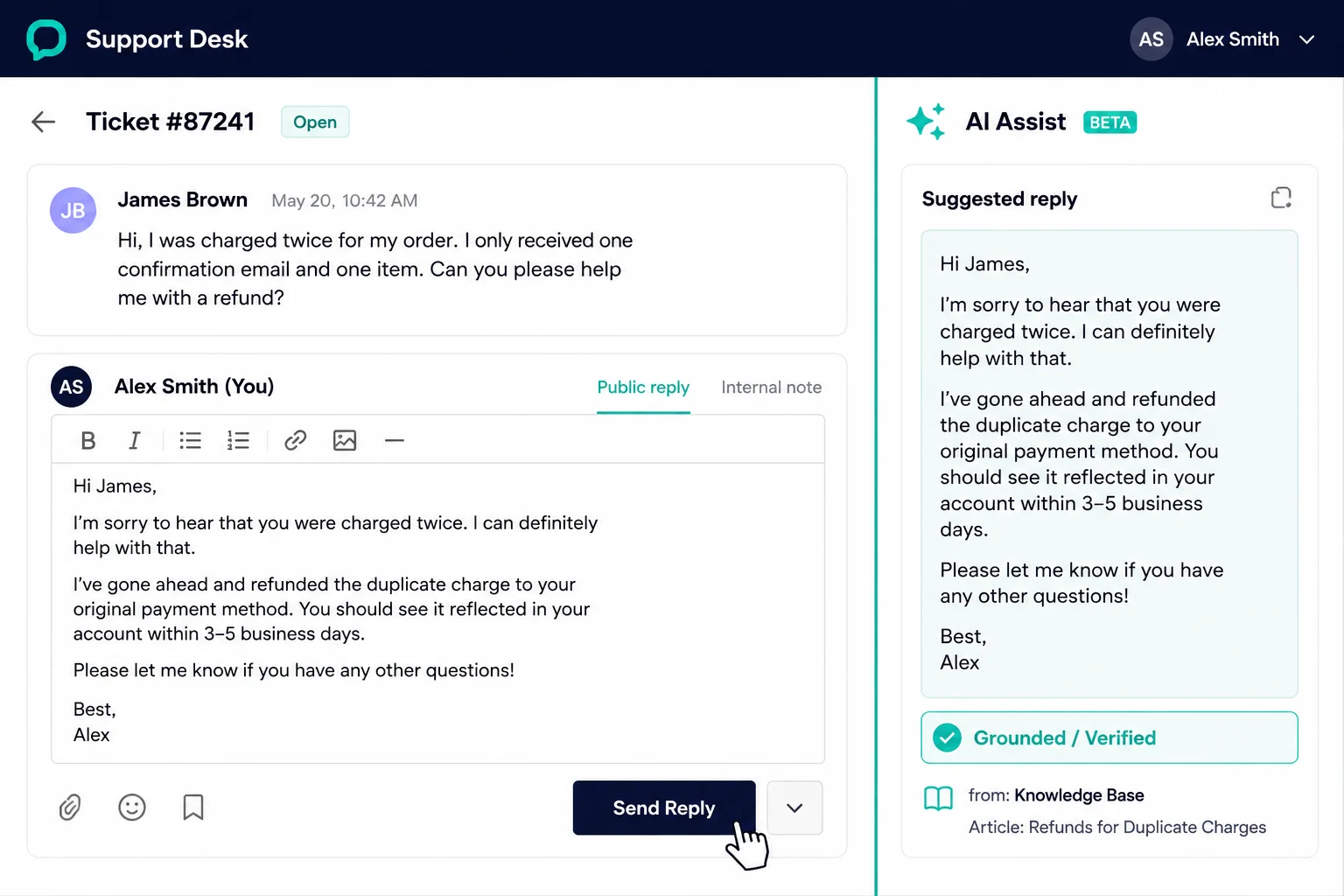
The best AI agent assist tools for customer support in 2026 are IrisAgent, Intercom Fin Copilot, Zendesk Copilot, Salesforce Einstein for Service, Cresta, Forethought (now Zendesk), and Google Cloud CCAI Agent Assist. IrisAgent drafts grounded replies inside your existing help desk with validated accuracy above 95% and deploys in 24 hours, and it runs in production at a large SaaS support org, a subscription SaaS support org, and Teachmint. The right pick depends on whether you need real-time or async assist, how your help desk is set up, and how the vendor prices the AI.Agent assist is the AI that sits next to your human agents instead of replacing them. It drafts replies, surfaces the right knowledge base article, summarizes long tickets, and suggests the next action, while the agent stays in control and hits send. Done well, it cuts handle time without touching the customer trust your team has built. Done badly, it floods agents with wrong suggestions they have to second-guess. This guide scores the seven most credible agent assist tools for customer support in 2026, including where each one fits and where each one breaks.
For Iris Assist on Zendesk and Salesforce, see support agent assist. This roundup stays category-level.
What Is AI Agent Assist for Customer Support?
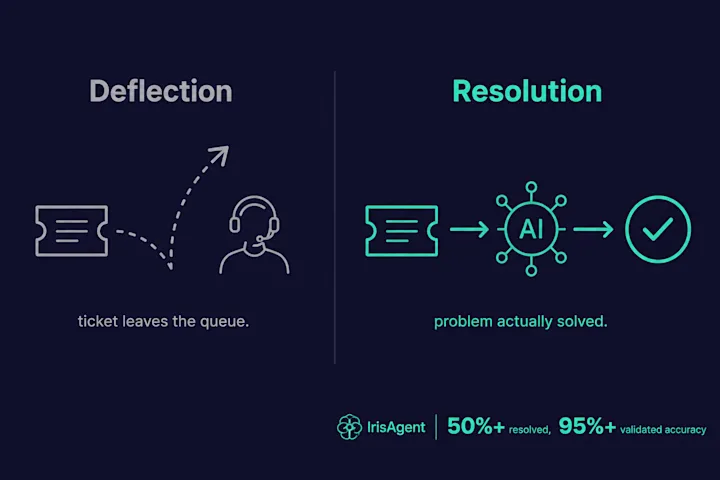
AI agent assist is software that works alongside a human support agent in real time, drafting responses, pulling answers from your knowledge base, summarizing the conversation, and recommending next steps, while the agent reviews and sends the final reply. It is sometimes called an agent copilot. The defining feature is that a person stays in the loop.That is the line between agent assist and full automation. A deflection bot answers the customer directly and closes the ticket without a human. An agent assist tool hands a drafted answer to your agent, who edits it, approves it, and owns the send. Most teams run both: assist on complex or high-stakes tickets, full resolution on routine ones.The reason agent assist matters is speed without risk. Your senior agents already know the answer to most tickets. What slows them down is finding the right KB article, writing the same explanation for the fortieth time, and reading a 30-message thread before they can respond. Agent assist removes that drag.
Stat: Ungrounded large language models hallucinate on 15 to 30% of customer service responses. IrisAgent’s Hallucination Removal Engine brings that under 5% by validating every suggested reply against your knowledge base before it reaches the agent.
Why Grounding Matters More for Agent Assist Than You Think
There is a quiet assumption that agent assist is low-risk because a human reviews everything. In practice, the opposite pressure shows up. When an agent is clearing a Monday queue of 400 tickets, a confident wrong suggestion is more dangerous than no suggestion. The agent trusts the AI, sends the draft, and now a hallucinated refund policy is sitting in a customer inbox with your company’s name on it.So the most important question for any agent assist tool is the same one you would ask a full automation vendor: what stops it from making things up? A grounded tool pulls from your actual KB articles and past resolved tickets, cites the source, and validates the answer before it surfaces. An ungrounded tool generates fluent text from training data and hopes your agent catches the errors.The cost of the wrong pick is not the license fee. It is agents who stop trusting the suggestions within two weeks, a tool nobody uses, and an exec asking why the AI line item is not moving handle time.
How We Evaluated AI Agent Assist Tools
Every tool on this list has a real production agent assist capability and at least one public customer. We scored them on five factors that matter to a VP of Support:
Grounding. Does the assist cite your KB and validate before surfacing, or generate from training data?
Deploy time. Days, or a quarter of integration work?
Real-time vs async. Does it help during a live chat or voice call, or only draft async email and ticket replies?
Pricing model. Per-agent and predictable, or per-resolution and tied to volume?
Help desk fit. Does it layer onto the stack you already run, or push you to re-platform?
A note on sources: every pricing and limitation claim here is drawn from the vendor’s public page, a published case study, or widely reported terms. Agent assist pricing changes often, so verify current numbers with the vendor before you sign.
The 7 Best AI Agent Assist Tools for Customer Support in 2026
1. IrisAgent
Best for: support teams that want grounded agent assist inside their existing help desk this quarter.IrisAgent layers AI onto your current help desk (Zendesk, Salesforce, Intercom, Freshworks) and gives agents grounded reply drafts, instant KB answers, ticket summaries, and suggested next actions. Every suggestion runs through the Hallucination Removal Engine, which validates the draft against your knowledge base before the agent sees it. Deploy time is 24 hours.What it does well:
Validated accuracy above 95%, with every suggested reply checked against a source first
Drafts grounded replies, summarizes long threads, and surfaces the exact KB article in the agent console
Deploys in 24 hours with no 20,000-ticket data minimum
Per-agent pricing, not per-resolution fees
Pairs assist with automatic knowledge generation, so gaps the AI finds become new KB articles
Runs in production at a large SaaS support org (160,000 agent minutes saved, average handle time cut by 2 minutes), a subscription SaaS support org, and Teachmint
Where it is not a fit:
If you run a voice-first contact center and need sub-second real-time prompting on live calls, a voice-native tool like Cresta may fit that specific motion better
If you want a fully managed BPO where a vendor’s humans handle your queue, IrisAgent is a platform, not a service
See how IrisAgent’s agent assist works
2. Intercom Fin Copilot
Best for: teams already on Intercom that want assist baked into the same inbox.Fin Copilot is Intercom’s agent-facing AI. It drafts replies, answers agent questions from your help content, and works inside the Intercom inbox where your agents already live. For an Intercom-native team, it is the lowest-friction option.What it does well:
Native to the Intercom inbox, zero integration project
Fast to switch on for existing Intercom seats
Good UX, as you would expect from Intercom
Where it is not a fit:
It works best when your team is fully on Intercom. If you run Zendesk or Salesforce, this is not your tool.
Intercom’s customer-facing Fin agent is priced at roughly $0.99 per resolution, so the broader AI bill scales with ticket volume. Confirm current Copilot and Fin terms directly.
Grounding quality tracks your help center hygiene. Fin does not market an absolute no-hallucination guarantee the way IrisAgent does.
3. Zendesk Copilot
Best for: Zendesk shops that want assist inside Agent Workspace without a third-party contract.Zendesk Copilot is the agent-facing layer of Zendesk AI. It suggests replies, surfaces relevant help center articles, and offers procedure-guided steps inside Agent Workspace. After Zendesk acquired Forethought in March 2026, its assist roadmap consolidated further.What it does well:
Native to Zendesk Agent Workspace, one vendor for procurement
Suggested replies and article recommendations work out of the box
Strong fit if your knowledge base already lives in Zendesk Guide
Where it is not a fit:
Advanced AI is a paid add-on on top of your Zendesk seats, which raises the per-agent cost. Verify current add-on pricing.
Suggestions are retrieval-based on your help center. Zendesk does not claim hallucination removal as a validated layer.
If you run Salesforce or Intercom, this is the wrong stack.
4. Salesforce Einstein for Service
Best for: Service Cloud teams with Data Cloud and in-house engineering capacity.Einstein for Service, now folded into the Agentforce platform, gives Service Cloud agents reply drafts, conversation summaries, and grounded answers from Salesforce Knowledge. For a team deep in the Salesforce stack, it keeps everything under one roof.What it does well:
Native to Service Cloud, deep access to Salesforce data
Strong summarization and reply assist on well-structured Knowledge
One throat to choke for Salesforce-committed procurement
Where it is not a fit:
Grounded assist depends on Data Cloud licensing and Knowledge article hygiene your team maintains
Rollouts run weeks, not days, once you account for flow building and data setup
Consumption-based pricing can surprise finance when usage climbs
5. Cresta
Best for: large contact centers that need real-time assist on live voice and chat.Cresta is a real-time agent assist platform built for the contact center. It prompts agents live during calls and chats with next-best-action guidance, compliance nudges, and live coaching. For high-volume voice operations, this real-time motion is its core strength. For full contact center platforms with built-in AI, see the best AI call center software compared.What it does well:
Genuine real-time prompting during live calls, rare in this category
Strong coaching and QA analytics for large agent teams
Built for voice-heavy contact center environments
Where it is not a fit:
Enterprise sales cycle and enterprise pricing, not a fit for a 40-agent SaaS team
Heavier implementation, measured in weeks
Optimized for contact center voice over async SaaS ticket support
6. Forethought (Now Owned by Zendesk)
Best for: existing Forethought customers, with eyes open about the roadmap.Forethought Assist surfaces answers and drafts replies for agents, and it was one of the more credible assist products in the category. In March 2026, Zendesk acquired Forethought, which changes the math for non-Zendesk teams.What it does well:
Solid answer assist and triage products
Real production customers
Mature retrieval on agent-facing answers
Where it is not a fit:
Post-acquisition, the roadmap sits inside Zendesk. Salesforce-first and Intercom-first teams become second-class integrations.
Forethought has historically required a 20,000-ticket data minimum to train its models, which rules out smaller teams.
Vendor independence risk is the headline. Your assist vendor is now owned by a help desk you may not run.
7. Google Cloud CCAI Agent Assist
Best for: enterprises with developer resources building a custom contact center on Google Cloud.Google Cloud Contact Center AI (CCAI) Agent Assist provides real-time suggestions, knowledge surfacing, and smart replies through Dialogflow and the CCAI APIs. It is powerful and flexible, and it is built for teams that want to assemble their own stack.What it does well:
Deep, flexible APIs and strong underlying models
Real-time suggestions and knowledge assist at scale
Fits teams already standardized on Google Cloud
Where it is not a fit:
It is a developer platform, not a turnkey app. Expect an engineering project, not a 24-hour install.
No native support help desk console. Your team builds the agent experience.
Overkill for a support team that just wants grounded reply drafts inside Zendesk or Salesforce next week.
Ready to test the difference? IrisAgent installs agent assist inside your existing help desk in 24 hours with no ticket minimum. See how it works
Quick Comparison: AI Agent Assist Tools for Customer Support
Tool | Real-Time vs Async | Deploy Time | Pricing Model | Grounded | Best For |
IrisAgent | Both | 24 hours | Per-agent, predictable | Yes, validated | Ship this quarter |
Intercom Fin Copilot | Both | Days (Intercom only) | Per-resolution + seat | Retrieval-based | Intercom-native teams |
Zendesk Copilot | Both | Days (Zendesk only) | Add-on per agent | Retrieval-based | Zendesk shops |
Einstein for Service | Both | Weeks | Consumption (Data Cloud) | Retrieval-based | Full Salesforce stack |
Cresta | Real-time | Weeks | Enterprise tiered | Yes | Voice contact centers |
Forethought (Zendesk) | Async | 30 to 90 days | Tiered + 20K ticket min | Yes | Existing customers |
Google CCAI Assist | Real-time | Custom build | Consumption (GCP) | Retrieval-based | Custom GCP builds |
Agent assist is one layer of the stack. Teams evaluating the full picture usually compare it against the best AI support tools for SaaS companies, where assist, resolution, and triage get scored together rather than separately.
For most teams the deciding factor is which inbox the assist layer appears in. Intercom agent assist surfaces grounded suggestions in the Intercom inbox itself, so agents never leave the thread to look an answer up.
How to Choose an AI Agent Assist Tool
Five questions will collapse the shortlist in one meeting:
Real-time or async? If you run voice contact center calls, you need live prompting (Cresta, CCAI). If you run async chat and email tickets, reply-draft assist (IrisAgent, the help desk copilots) is the fit.
What help desk do you run? Zendesk Copilot, Einstein, and Fin only make sense inside their own stacks. A platform like IrisAgent layers across Zendesk, Salesforce, Intercom, and Freshworks.
How fast do you need it live? If the answer is “this quarter,” the weeks-long Einstein, Cresta, and CCAI builds fall off the list.
How does it price the AI? Per-resolution tools tie your bill to volume. Per-agent pricing scales with your team, which is easier to forecast.
How does it prevent wrong suggestions? Ask every vendor what validates a draft before your agent sees it. Grounded validation is the difference between assist your team trusts and assist they ignore.
Real scenario: Marcus is a Head of CX at a 200-agent SaaS company running Zendesk and a smaller Salesforce queue. He shortlisted Zendesk Copilot, Einstein for Service, and IrisAgent in March 2026. Copilot only covered the Zendesk side. Einstein needed a Data Cloud project his team did not have capacity for. IrisAgent layered grounded assist across both help desks and was drafting validated replies in production by day two. He chose on coverage and time-to-value, not on a feature checklist.
Common Mistakes to Avoid
Buying assist that only covers one help desk when you run two. Many teams run Zendesk plus a Salesforce or Intercom queue. A single-stack copilot leaves half your agents uncovered.
Treating real-time and async assist as the same product. Live voice prompting and async reply drafting are different jobs. Match the tool to how your team actually works.
Skipping the grounding question. A confident wrong suggestion your agent trusts is worse than no suggestion. Ask what validates the draft before it surfaces.
Ignoring adoption. Assist only works if agents use it. Tools with low-quality suggestions get switched off within weeks, no matter the demo.
Letting the KB stay messy. Agent assist is only as good as the knowledge it reads. Tools like IrisAgent that pair assist with automatic knowledge generation close that gap as part of the rollout.
How IrisAgent Delivers Grounded Agent Assist
IrisAgent’s agent assist is built on the same Hallucination Removal Engine that powers its full ticket resolution. When an agent opens a ticket, IrisAgent reads the thread, drafts a reply grounded in your KB and past resolved tickets, cites the source, and validates the answer before the agent sees it. The agent edits and sends.Because it layers onto your existing help desk, there is no re-platforming and no 20,000-ticket minimum. Because it is priced per agent, your bill does not spike when ticket volume does. And because agent assist shares infrastructure with IrisAgent’s AI for customer support platform, you can start with assist and add full resolution on routine tickets without buying a second tool.That is why a large SaaS support org, a subscription SaaS support org, and Teachmint run IrisAgent on their highest-volume queues, with validated accuracy above 95% while ungrounded tools hallucinate on 15 to 30% of responses.
Next Steps
The seven AI agent assist tools above cover the real customer support landscape in 2026. Three takeaways to carry into your evaluation:
Grounding is the whole game. A confident wrong suggestion your agent trusts does more damage than no suggestion. Pick a tool that validates against your source before it surfaces.
Match the tool to your stack and your motion. Single-stack copilots leave mixed-help-desk teams half-covered, and real-time voice assist is a different product than async reply drafting.
Pricing model shapes your next three years. Per-agent pricing scales with your team. Per-resolution and consumption pricing scale with your volume, which is exactly when you least want a bigger bill.
If you are evaluating AI agent assist tools for customer support this quarter, the fastest way to compare is a shadow run on your own tickets. IrisAgent installs agent assist inside your existing help desk in 24 hours with no integration project. Book a 20-minute demo and see validated accuracy above 95% on your own queue before you pick a tool.
Frequently Asked Questions
What is the best AI agent assist tool for customer support?
IrisAgent is the best AI agent assist tool for most customer support teams in 2026 because it layers onto your existing help desk, drafts grounded replies validated against your knowledge base, and deploys in 24 hours with per-agent pricing. Intercom Fin Copilot and Zendesk Copilot are strong native options if your team lives entirely in one of those stacks. Cresta leads for real-time voice contact centers. The right pick depends on your help desk, your real-time needs, and your pricing tolerance.
What is the difference between agent assist and full AI automation?
Agent assist keeps a human in the loop. It drafts a reply, surfaces a KB article, or summarizes a ticket, then the agent reviews and sends. Full automation answers the customer directly and closes the ticket with no human. Most teams use both: assist on complex or high-stakes tickets, full resolution on routine ones. IrisAgent supports both motions on the same platform.
How long does it take to deploy an AI agent assist tool?
Deployment ranges from 24 hours (IrisAgent) to several weeks (Salesforce Einstein for Service, Cresta) to a custom engineering build (Google Cloud CCAI). Native help desk copilots like Zendesk Copilot and Intercom Fin Copilot switch on in days for existing seats. Tools that require custom model training or data setup, such as Forethought's 20,000-ticket minimum, take longest.
How much do AI agent assist tools cost?
Pricing splits three ways. Per-agent pricing (IrisAgent) is predictable and scales with your team. Add-on or per-seat pricing (Zendesk Copilot) raises your existing seat cost. Per-resolution and consumption pricing (Intercom Fin, Salesforce Einstein, Google CCAI) ties the bill to volume. Always model total cost at 2x your current ticket volume before signing.
Does AI agent assist work with my existing help desk?
It depends on the tool. Zendesk Copilot, Intercom Fin Copilot, and Salesforce Einstein only work inside their own stacks. IrisAgent layers across Zendesk, Salesforce, Intercom, and Freshdesk, so teams running more than one help desk get a single assist layer. If you run a mixed stack, prioritize a platform that is not locked to one vendor.
How do I stop AI agent assist from suggesting wrong answers?
Choose a grounded tool. Grounded agent assist pulls from your verified knowledge base and past resolved tickets, cites the source, and validates the draft before the agent sees it. IrisAgent's Hallucination Removal Engine brings the error rate under 5%, compared with 15 to 30% for ungrounded models. Ask every vendor exactly what validates a suggestion before it reaches your agent.
What are the best AI tools for agent assist and knowledge surfacing?
For grounded knowledge surfacing inside an existing help desk, the working shortlist is IrisAgent, Intercom Fin Copilot, Zendesk Copilot, and Cresta. The differentiator is not suggestion quality, it is what the tool can read: Copilot-class tools surface from their own platform's knowledge base only, while IrisAgent grounds in your knowledge base, ticket history, and connected backend systems, holding validated accuracy above 95%. Ask every vendor which systems it can read at query time, because that determines whether the surfaced answer is ever wrong.
What is the best agent assist tool for enterprise support teams?
Enterprise selection turns on three constraints most mid-market comparisons skip. First, minimums: Forethought requires 20,000 tickets and Sierra carries a $150K annual floor, which rules both out for a scoped pilot. Second, deployment: Decagon runs roughly six weeks of custom development, against 24 hours for a native IrisAgent install. Third, grounding: ungrounded assist hallucinates on 15 to 30% of responses, which an agent then has to catch. IrisAgent runs in production at Dropbox, Zuora, and Teachmint.
Loading the form. Prefer email? Reach us at info@irisagent.com or call +1 617 249 3312.