
AI Ticket Deflection Tools 2026: 8 Compared on Price & Handoff

Last updated: October 2026
On metrics, read resolution rate benchmarks before optimizing deflection alone.
Deflection tools are a spoke under ticket automation. Start from AI ticket automation for triage, routing, and resolution framing.
The top AI tools for deflecting support tickets in 2026 are IrisAgent, Intercom Fin, Ada, Decagon, Zendesk AI, Freshworks Freddy, and Gorgias, each resolving routine support questions before they become human-handled tickets. The right choice depends on your helpdesk, your accuracy requirements, and your pricing model. IrisAgent leads for teams that want grounded, hallucination-free deflection on their existing helpdesk, with flexible pricing (usage-based and resolution-based plans) and a 24-hour deploy, holding validated accuracy above 95 percent.
That is the short answer. Below is the operator's version: what each tool actually deflects, where it wins, what it costs, and how to choose without getting locked into a model that punishes you for scaling.
Key takeaways
Ticket deflection software uses AI to fully resolve a customer's question before it reaches an agent, measured as the share of conversations closed with no human handoff.
The strongest tools share three traits: answers grounded in your knowledge base, a clean escalation path, and honest accuracy you can verify in production.
Watch the pricing model. Per-resolution pricing (Intercom Fin, Ada) means your bill rises exactly as deflection succeeds. Flexible usage-based and resolution-based plans keep cost matched to how you run volume.
IrisAgent is the best fit for teams that want grounded deflection on their current helpdesk with flexible pricing; Intercom Fin and Ada suit teams already all-in on those ecosystems; Gorgias is strongest for ecommerce.
Pick by helpdesk fit, accuracy, and pricing model, not by demo polish.
What is ticket deflection software?
Ticket deflection software is an AI layer that sits in front of your support queue and resolves common questions automatically, so they never become tickets an agent has to touch. When a customer asks about order status, a password reset, a billing charge, or a how-to question, the AI understands the intent, retrieves a grounded answer from your knowledge base and live systems when needed, and resolves the conversation. For order-status asks, success means resolve accurate order details, not just deflect, not a generic tracking link that reopens tomorrow. The ticket is deflected.
The metric that matters is deflection rate: the percentage of conversations the AI resolves with no human handoff. A strong modern tool can contain a large share of incoming volume, but only resolution with grounding counts. But deflection rate alone is a trap. A tool that frustrates customers into giving up looks great on deflection and terrible on retention, so you always read deflection alongside CSAT and answer accuracy. For the full definition and formula, see our guide to what ticket deflection is.
How we evaluated these tools
Every tool below was assessed on the five things that actually determine deflection results in production:
Grounding and accuracy. Does it answer only from your verified knowledge base, and what is the real production accuracy, not the demo number?
Helpdesk fit. Does it work natively inside your current helpdesk, or does it require a rip-and-replace?
Escalation quality. When the AI cannot resolve, does it hand off with full context, or dump the customer into a dead end?
Pricing model. Flat, per-seat, per-conversation, or per-resolution, and how does the bill behave as you scale?
Time to value. Days to first measurable deflection, or a multi-month services engagement?
AI ticket deflection tools: pricing and live chat handoff
Buyers who ask how these tools compare on pricing and live chat handoff need one grid, not eight brochure pages. Use this table to shortlist, then read the tool cards for fit detail. Deflection only counts when the conversation is resolved with a grounded answer or a clean handoff. Abandonment is not success.
Tool | Pricing model (public / reported) | Live chat handoff | Helpdesk posture | Best for |
IrisAgent | Flexible plans: usage-based and resolution-based (model to your volume; no single public unit price quoted here) | Chat, email, and voice with context-rich handoff into your queue | Overlay on Zendesk, Salesforce, Intercom, Freshworks | Teams that want grounded resolution without rip-and-replace |
Intercom Fin | $0.99 per Fin outcome (Intercom pricing page, October 2026) | Native Intercom Messenger and Inbox | Native Intercom | Teams already standardized on Intercom |
Ada | Quote-only conversation-volume pricing; third-party procurement data (Vendr) has shown a median around $72,000/year | Strong chat automation with agent handoff paths | Often its own automation layer | High-volume multilingual consumer brands |
Zendesk AI (Resolution Platform) | Outcome-based packaging inside Zendesk AI | Native Zendesk messaging | Native Zendesk | Teams committed to the Zendesk suite |
Freshworks Freddy | Packaged with Freshworks AI / suite plans | Native Freshworks messaging | Native Freshworks and Freshservice | Freshworks customers, including IT service desk |
Gorgias | Ecommerce helpdesk plus automation packaging | Ecommerce chat and social channels | Gorgias with Shopify | Shopify and ecommerce support |
Decagon | Quote-only enterprise; implementations often reported around six weeks | Enterprise chat and multi-step workflows | Heavier services-led rollout | Large enterprises with longer implementation capacity |
What per-outcome pricing costs as deflection grows
Per-outcome pricing looks cheap at pilot volume and changes shape at scale. Intercom lists Fin at $0.99 per outcome on its pricing page, with a minimum monthly commitment when Fin runs on an existing helpdesk. Take a team handling 10,000 conversations a month. If the AI resolves 30% of them, that is 3,000 outcomes and about $2,970 a month. Improve the AI to 60% and the same queue produces 6,000 outcomes and about $5,940 a month, before any seat costs. The better the tool performs, the larger the bill. That is not a reason to avoid per-outcome pricing. It is a reason to model the bill at the deflection rate you plan to reach, not the one you start with, and to compare it with a usage-based plan at the same volume. The 30% and 60% figures are illustrative scenarios, not benchmarks. Measure your own baseline with the AI deflection rate formula.
Deflection without resolution is a vanity metric
Ticket deflection software should remove repetitive work from the human queue. It should not hide failed conversations as wins. A tool that frustrates customers into leaving can look strong on deflection and weak on retention.
Read three numbers together:
Deflection or containment: share of conversations closed with no human handoff.
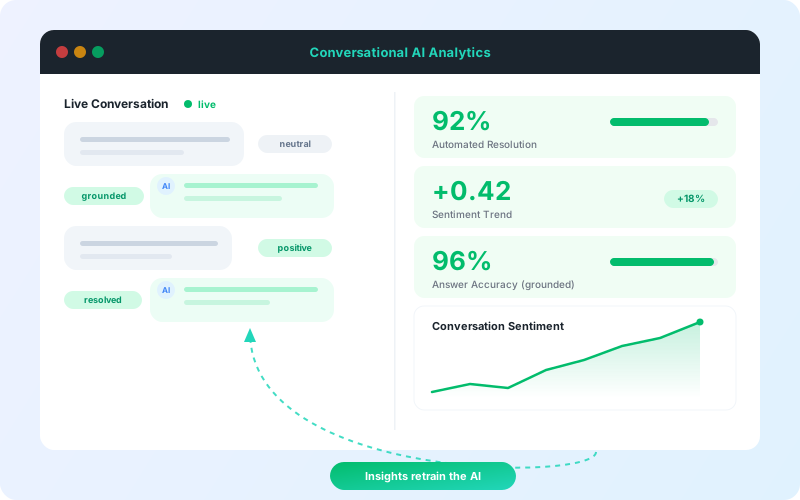
Resolution quality: whether the answer was grounded in your knowledge base and actually solved the ask.
Handoff quality: when the AI cannot finish, does the agent get full context inside the helpdesk you already run?
That is the overlay-honest bar. Keep the helpdesk you trust, measure resolution next to deflection, and reject demos that only optimize the vanity rate. For the formula and benchmarks, see our guides on what ticket deflection is and AI deflection rate.
The 8 best AI ticket deflection tools in 2026
1. IrisAgent
IrisAgent is a grounded AI support platform that resolves routine tickets with validated accuracy through its Hallucination Removal Engine. It layers onto your existing helpdesk (Zendesk, Salesforce, Intercom, Freshworks) rather than replacing it, deploys in about 24 hours, and resolves across chat, email, and voice. Customers including Dropbox (160,000-plus tickets managed with AI) and Zuora (10x faster resolution) run it in production.
Where it wins: grounded accuracy, helpdesk independence, and flexible pricing with both usage-based and resolution-based plans, so you can match cost to how you run volume. You also choose how autonomous it runs, from a suggest-only copilot to a full autopilot, using the levels of autonomy framework.
2026 buyer fit example: a Zendesk shop that wants order-status and account deflection without migrating off Zendesk. IrisAgent overlays the helpdesk you already run, grounds replies in KB plus live systems, and keeps humans in Zendesk when the AI should escalate. Compare that overlay path to native-only options in this list when rip-and-replace is off the table. For Zendesk context, see Zendesk.
Best for: teams that want high-accuracy deflection on their current stack without per-resolution pricing.
2. Intercom Fin
Fin is Intercom's AI agent, tightly integrated into the Intercom Inbox and Messenger. It deflects well for teams already living inside Intercom and is straightforward to switch on in that ecosystem.
Where it is strong: native Intercom experience and quick activation. The trade-off is pricing: Fin charges per resolution (reported around $0.99 per resolution), so your cost scales linearly with the volume you deflect, and it is at its best when you are already committed to Intercom.
Best for: teams standardized on Intercom that accept per-resolution economics.
3. Ada
Ada is an established automation-first platform aimed at high-volume consumer brands, with strong multilingual coverage and a no-code builder.
Where it is strong: scale and language breadth. The trade-off is again per-resolution pricing (reported around $3.50 per resolution), which can get expensive at high deflection volumes, and it works best as its own layer rather than deeply native to every helpdesk.
Best for: large consumer brands with heavy multilingual volume.
4. Decagon
Decagon is an enterprise-focused agentic AI platform that has gained attention for sophisticated multi-step resolution.
Where it is strong: enterprise agentic workflows. The trade-off is implementation: enterprise rollouts are reported to run on the order of six weeks, and it targets the larger end of the market, so it is a heavier lift than a layer-on tool. If you are weighing it, see IrisAgent vs alternatives.
Best for: large enterprises with the time and team for a longer implementation.
5. Zendesk AI (Resolution Platform)
Zendesk's Resolution Platform, which now folds in the acquired Forethought capabilities, is the native AI layer for Zendesk customers.
Where it is strong: deep, native Zendesk integration and a single-vendor stack. The trade-off is lock-in and a Zendesk-first roadmap; non-Zendesk helpdesks are no longer the priority, and outcome-based pricing applies across its AI agents.
Best for: teams fully committed to the Zendesk suite.
6. Freshworks Freddy
Freddy AI Agent is Freshworks' deflection and agent layer, with a no-code Agent Studio and an MCP gateway introduced in 2026.
Where it is strong: native Freshworks and Freshservice fit, including internal IT service desk use. The trade-off is that it is strongest inside the Freshworks ecosystem.
Best for: Freshworks customers, including IT service desk teams.
7. Gorgias
Gorgias is a helpdesk-plus-automation platform built specifically for ecommerce, with deep Shopify integration and automation tuned to order and returns workflows.
Where it is strong: ecommerce-native deflection (order status, returns, refunds). The trade-off is that it is purpose-built for ecommerce and less suited to other verticals.
Best for: Shopify and ecommerce support teams.
8. Forethought (now part of Zendesk)
Forethought was a standalone agentic AI platform now acquired by and being integrated into Zendesk. It still operates, but its independent roadmap and non-Zendesk integrations are expected to wind down over time.
Where it is strong: existing Forethought deployments. The trade-off is uncertainty: new buyers are effectively choosing a Zendesk-controlled future, and historically it carried a 20,000-ticket minimum.
Best for: existing Forethought customers planning their next move.
Deflection numbers are only comparable when the channel is. If your volume arrives through Messenger and live chat, the Intercom answer bot comparison is the closer read, because chat deflection and email deflection behave differently at the same accuracy.
How to choose a ticket deflection tool
The decision comes down to four questions, in order.
What is your helpdesk, and do you want to keep it? If yes, choose a tool that layers on natively (IrisAgent, or the native option for your specific helpdesk) rather than one that forces a migration.
How will the bill behave as deflection grows? Per-resolution pricing means success costs more. If you expect to scale deflection, choose a pricing model that stays predictable at your real volume.
Can you verify accuracy in production? Ask for real production accuracy and hallucination rates, not lab numbers. Grounding in your own knowledge base is the difference between safe deflection and confident wrong answers.
How autonomous do you want it, and how fast? Decide whether you want a copilot, a supervised autopilot, or full autonomy, and how quickly you need to be live. Model the savings with our ROI calculator before you commit.
For the tactics that lift deflection regardless of tool, see our guide to ticket deflection strategies, and for the front-line resolution layer itself, the AI chatbot for customer support guide.
Next steps
If order-status volume is your first deflection wedge, shortlist tools that can resolve accurate order details, not just deflect.
The best AI ticket deflection tool is the one that grounds its answers in your data, fits the helpdesk you already use, and prices in a way that rewards rather than punishes scale. Shortlist two or three, ask each for production accuracy numbers, and model the cost at your real deflection volume. To see grounded deflection on your own tickets, book a demo or calculate your ROI.
Frequently Asked Questions
What is the best AI tool for ticket deflection?
For most teams, IrisAgent is the best AI ticket deflection tool because it grounds every answer in your verified knowledge base (validated accuracy above 95 percent), layers onto your existing helpdesk, deploys in about 24 hours, and offers flexible pricing with both usage-based and resolution-based plans. Intercom Fin and Ada are strong if you are already committed to those ecosystems, and Gorgias is best for ecommerce.
How much does AI ticket deflection software cost?
Pricing models vary widely. Intercom Fin is about $0.99 per resolution (as of July 2026). Ada is quote-only conversation-volume pricing; third-party procurement data (Vendr) has shown a median around $72,000/year. IrisAgent offers flexible pricing with both usage-based and resolution-based plans, so you can pick the structure that fits your ticket profile. Always model total cost at your expected volume, not just a headline rate.
What deflection rate should I expect?
A well-configured modern AI tool deflects 40 to 60 percent of incoming volume on covered intents. High-structure intents like order status and password resets often exceed that, while complex or sensitive tickets should escalate to a human. Always pair deflection rate with CSAT and answer accuracy so you are not rewarding a tool that frustrates customers into giving up.
Does ticket deflection software replace human agents?
No. It handles the repetitive, high-volume questions so agents can focus on the complex tickets that need judgment and empathy. The best deployments use AI as the front line with a clean escalation path to humans, not a wall that traps customers.
Which ticket deflection tool works with my helpdesk?
IrisAgent is helpdesk-agnostic and works natively with Zendesk, Salesforce, Intercom, and Freshworks. Zendesk AI and Freddy are best inside their own ecosystems, and Gorgias is built for Shopify and ecommerce. Match the tool to the helpdesk you intend to keep.
How do AI ticket deflection tools compare on pricing and live chat handoff?
Compare pricing model and handoff path in one view. Intercom Fin is about $0.99 per resolution (as of July 2026) inside Intercom Messenger. Ada is quote-only, with third-party procurement data showing a median around $72,000/year. Zendesk AI and Freshworks Freddy follow their suite packaging. IrisAgent offers flexible usage-based and resolution-based plans and layers onto your existing helpdesk with context-rich chat handoff. Pick the model that stays predictable at your real volume, and treat clean live-chat handoff as part of the price, not an add-on afterthought.
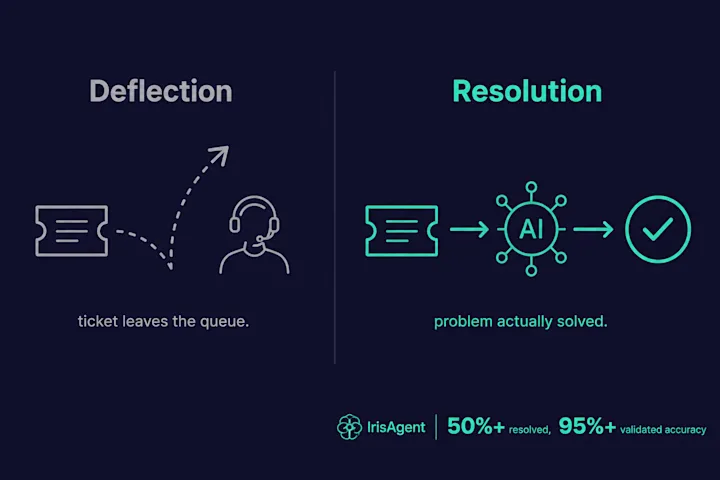
What is the difference between ticket deflection and ticket resolution?
Deflection means the conversation never becomes a human-handled ticket. Resolution means the customer's question was actually solved. A high deflection rate with weak grounding or dead-end handoffs is a vanity metric. Strong AI ticket deflection tools resolve from your verified knowledge base, escalate with full context when confidence is low, and are measured on resolution quality and CSAT next to deflection rate.
How should I compare Intercom Fin and Zendesk AI for ticket deflection?
Start with the helpdesk you intend to keep. Fin is strongest inside Intercom and bills per resolution. Zendesk AI is strongest inside Zendesk with outcome-based packaging. Then compare grounding, handoff quality, and total cost at your expected deflection volume. The better fit is the one that resolves on your stack without forcing a migration you do not want.
Is closing a ticket with a tracking link successful deflection?
Only if the customer got the correct live status. A tracking link that shows the wrong ETA, wrong carrier event, or stale fulfillment state is deflection theater: the ticket reopens, CSAT drops, and your deflection rate lied. Successful deflection on order intents reads live OMS or Shopify data, validates the answer, and escalates when confidence is low. See resolve accurate order details, not just deflect.
Loading the form. Prefer email? Reach us at info@irisagent.com or call +1 617 249 3312.