
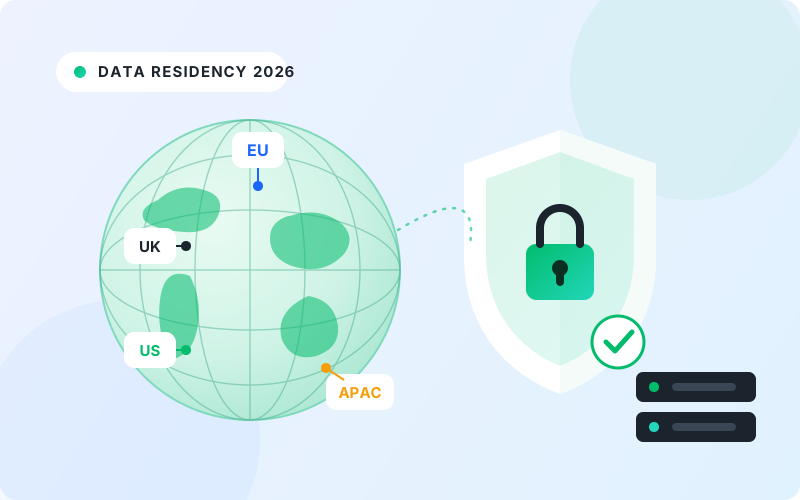
AI Customer Support Data Residency: 2026 Compliance Guide
When you deploy an AI agent for customer support, every ticket, chat transcript, voice recording, and customer profile it touches becomes regulated data the moment it crosses a border. This page is a living reference for where that data can legally live, how it can move, and what your AI vendor has to prove. Bookmark it: we update it as rules change.
If you are still choosing a deployment model (cloud, private cloud, self-hosted, or on-premise), start with the deployment guide and the on-premise AI overview. This page covers the legal side of the same decision: not "how do I deploy" but "where is my customer data allowed to be."
What data residency means for AI customer support
Three terms get used interchangeably and should not be:
Data residency is where data is stored. A choice (often yours) about which country or region holds the data at rest.
Data localization is a legal requirement that certain data must stay inside a country's borders. Not a choice. Imposed by law.
Data sovereignty is the principle that data is subject to the laws of the jurisdiction where it is processed, including which government can compel access to it.
For AI support specifically, the surface area is larger than most teams expect. Residency rules can attach to:
Customer PII in tickets, chats, and CRM records.
Conversation transcripts and call recordings, including voice biometrics in some regions.
The data sent to the LLM at inference time (the prompt, the retrieved knowledge, the customer context).
Training and fine-tuning data, if your vendor improves models on your conversations.
Logs and audit trails that capture all of the above.
A vendor can be "GDPR compliant" and still process your prompts on a US-hosted model, which is the gap most procurement reviews miss.
Why this matters more in 2026
The processing location is now the question. EU technical-sovereignty guidance has shifted the framing from "where is data stored" to "where is it processed, who can access it, and which legal regime applies when a regulator or a foreign court asks." Storage residency alone no longer satisfies sophisticated buyers.
On-premise and private deployments are accelerating. A large majority of enterprises now expect AI infrastructure budgets to more than triple over the next three years, and most plan to scale on-premise or edge AI specifically to keep regulated data in-house.
Regulators are enforcing transparency in parallel. The EU AI Act's Article 50 transparency obligations for chatbots take effect August 2, 2026, layering disclosure duties on top of residency duties.
Cross-border transfer mechanisms keep moving. The EU-US Data Privacy Framework, Standard Contractual Clauses, UK extensions, and APAC equivalents are all subject to ongoing legal challenge, so a transfer that was valid last year may need re-papering this year.
Region-by-region reference
This table summarizes the residency and transfer posture that most directly affects AI customer support deployments. It is a starting point for your own counsel, not legal advice.
European Union and EEA
Item | Summary |
|---|---|
Primary law | GDPR (plus the EU AI Act for AI-specific transparency and risk obligations) |
Hard localization mandate? | No general mandate to store EU data in the EU, but transfers out require a valid mechanism |
Cross-border transfer mechanism | Adequacy decisions, EU-US Data Privacy Framework (for certified US recipients), Standard Contractual Clauses plus a transfer impact assessment |
AI-specific note | Processing location (including LLM inference) is treated as processing under GDPR; the AI Act adds chatbot disclosure from Aug 2, 2026 |
Practical implication for AI support | Keep an EU processing region for prompts and transcripts, or paper transfers carefully and assess government-access risk |
Germany (and other strict member states)
Item | Summary |
|---|---|
Primary law | GDPR plus national rules; sector guidance (for example BSI C5) often expected by enterprise buyers |
Hard localization mandate? | No blanket mandate, but public sector, health, and finance buyers frequently require in-country or in-EU processing in contract |
Practical implication for AI support | Expect RFPs to ask for EU/in-country inference and a named sub-processor list with locations |
United Kingdom
Item | Summary |
|---|---|
Primary law | UK GDPR and the Data Protection Act 2018 |
Hard localization mandate? | No general mandate |
Cross-border transfer mechanism | UK adequacy regulations, the International Data Transfer Agreement (IDTA), or the UK Addendum to the EU SCCs |
Practical implication for AI support | A separate UK transfer assessment is needed even if you already have an EU one |
United States (federal and sectoral)
Item | Summary |
|---|---|
Primary law | No single federal privacy law; sectoral (HIPAA for health, GLBA for finance) plus state laws |
Hard localization mandate? | No general federal mandate; some federal/defense workloads require US-only processing (for example FedRAMP, ITAR, CJIS contexts) |
AI-specific note | State AI and chatbot-disclosure rules are proliferating; see the broader US state landscape |
Practical implication for AI support | Regulated buyers (gov, defense, health, finance) often require US-region or US-only processing and US-person support access |
California (representative US state)
Item | Summary |
|---|---|
Primary law | CCPA/CPRA |
Hard localization mandate? | No, but expanded consumer rights and contractor/service-provider obligations apply to AI vendors handling personal information |
Practical implication for AI support | Vendor must contractually act as a service provider and limit use of transcripts to providing the service |
Canada
Item | Summary |
|---|---|
Primary law | PIPEDA (federal); Quebec Law 25; public-sector residency rules in some provinces |
Hard localization mandate? | Provincial public-sector rules (for example British Columbia and Nova Scotia) can require in-Canada storage/processing |
Practical implication for AI support | Public-sector and some health workloads need a Canadian processing region |
Australia
Item | Summary |
|---|---|
Primary law | Privacy Act 1988 and Australian Privacy Principles (APPs) |
Hard localization mandate? | No general mandate, but APP 8 makes you accountable for overseas disclosures; government workloads often require onshore hosting |
Practical implication for AI support | Expect onshore processing requirements for public sector and critical infrastructure |
India
Item | Summary |
|---|---|
Primary law | Digital Personal Data Protection Act (DPDP) |
Hard localization mandate? | The DPDP framework allows transfers except to government-restricted countries; sectoral rules (for example RBI for payments) impose stricter localization |
Practical implication for AI support | Payments and financial-services support data frequently must stay in India |
Singapore
Item | Summary |
|---|---|
Primary law | PDPA |
Hard localization mandate? | No general mandate; transfers require comparable protection at the destination |
Practical implication for AI support | A regional APAC processing option plus transfer safeguards usually suffices |
Japan
Item | Summary |
|---|---|
Primary law | APPI |
Hard localization mandate? | No general mandate; recognized as adequate by the EU, with consent or safeguards for onward transfers |
Practical implication for AI support | Lower friction, but document consent and onward-transfer handling |
China
Item | Summary |
|---|---|
Primary law | PIPL, Data Security Law, Cybersecurity Law |
Hard localization mandate? | Yes for many categories; cross-border transfers of personal and "important" data require security assessment, certification, or standard contract filing |
Practical implication for AI support | Treat as a separate in-country deployment; most global SaaS support stacks cannot lawfully process Chinese user data abroad without clearing a transfer mechanism |
Middle East (UAE and Saudi Arabia)
Item | Summary |
|---|---|
Primary law | UAE PDPL (and DIFC/ADGM free-zone laws); Saudi PDPL |
Hard localization mandate? | Sectoral and government residency requirements are common; Saudi PDPL has historically favored in-Kingdom processing with conditional transfers |
Practical implication for AI support | Government and regulated buyers often require in-region processing |
Brazil
Item | Summary |
|---|---|
Primary law | LGPD |
Hard localization mandate? | No general mandate; transfers require adequacy, SCC-equivalent clauses, or consent |
Practical implication for AI support | A LatAm or in-country processing option plus documented transfer safeguards |
Cross-border transfer: the mechanisms you will be asked about
When data does leave its home region, you need a lawful basis for the move. The common ones:
Adequacy decisions / recognitions (one regulator deems another country's protections sufficient).
Standard Contractual Clauses (EU) and the IDTA/UK Addendum (UK), paired with a transfer impact assessment.
The EU-US Data Privacy Framework, for US recipients that self-certify.
Binding Corporate Rules, for intra-group transfers in large enterprises.
Explicit consent or contractual necessity, used narrowly and rarely sufficient on their own for support transcripts.
The 2026 wrinkle for AI: a transfer assessment now has to account for the model. If inference happens in a different region than storage, that inference is a transfer too.
A residency checklist for evaluating any AI support vendor
Ask every vendor to answer these in writing:
Where is data stored at rest, by region, and can we pin it?
Where does LLM inference happen? (Prompts, retrieved context, and outputs may transit a different region than storage.)
Are transcripts or tickets ever used to train or fine-tune models? If so, where, and can we opt out?
Who are the sub-processors, and in which countries do they operate?
Which support and engineering staff can access our data, and from which jurisdictions?
What transfer mechanism covers each cross-border flow, and when was it last reviewed?
Is an in-region, private, or on-premise deployment available for our regulated workloads?
What audit trail proves where each piece of data was processed?
If a vendor cannot answer 1, 2, and 7 cleanly, residency is not actually solved for a regulated buyer.
How IrisAgent handles data residency
IrisAgent is built so that residency is a deployment choice, not a compromise:
Flexible deployment models including private cloud, self-hosted, and on-premise so regulated data can stay inside your boundary. Compare the options in on-premise vs self-hosted vs private cloud AI.
Region-pinned processing so storage and inference can be kept in the same jurisdiction.
A complete audit trail that records what was processed and where, which is the evidence regulators and procurement teams actually ask for. This is the same grounding and traceability foundation behind IrisAgent's accuracy and Hallucination Removal Engine.
Enterprise security posture documented on the security page.
To talk through a residency-constrained deployment, contact the IrisAgent team.
Related reading
Maintenance note: Transfer frameworks (DPF, SCCs, UK IDTA, APAC equivalents) and AI-specific rules change frequently. This reference is reviewed on a recurring cadence and was last reviewed in June 2026. This page is informational and not legal advice. Confirm your obligations with qualified counsel.
Frequently Asked Questions
Does GDPR require AI customer support data to stay in the EU?
No. GDPR does not mandate EU storage. It requires that any transfer of EU personal data outside the EEA has a valid mechanism, such as an adequacy decision, Standard Contractual Clauses with a transfer impact assessment, or the EU-US Data Privacy Framework for certified US recipients. For AI support specifically, remember that LLM inference outside the EU is itself a transfer, so check where prompts are processed, not just where data is stored.
What is the difference between data residency and data sovereignty?
Data residency is where data is stored, which is often a choice you make about region. Data sovereignty is whose laws govern the data, including which government can compel access to it. A vendor can store your data in-region (residency) while a foreign parent company remains subject to foreign legal demands (a sovereignty gap), so both questions matter in a vendor review.
Where does an AI chatbot actually process my customers data?
In at least three places: the application and storage layer, the retrieval layer (your knowledge base and customer context), and the LLM inference layer. Each can sit in a different region. Ask your vendor to map all three, because a claim that data is stored in the EU does not tell you where the prompt itself was processed.
Which countries require AI customer support data to be stored locally?
Hard localization is most common in China (under PIPL and related laws), for specific sectors in India (for example RBI rules on payments data), and for many government and public-sector workloads in countries such as Canada (certain provinces), Australia, Saudi Arabia, and the UAE. Most other jurisdictions allow transfers with a valid mechanism rather than mandating local storage.
Can I use a cloud AI support tool and still meet data residency requirements?
Often yes, if the vendor offers in-region processing for both storage and inference, names its sub-processors and their locations, and papers cross-border transfers correctly. For the strictest workloads, such as defense, certain health and finance, and China, a private, self-hosted, or on-premise deployment is usually the cleaner answer. IrisAgent supports private cloud, self-hosted, and on-premise deployments so regulated data can stay inside your boundary.

Loading the form. Prefer email? Reach us at info@irisagent.comor call +1 617 249 3312.