
CSAT by Intent Type: 2026 Benchmarks
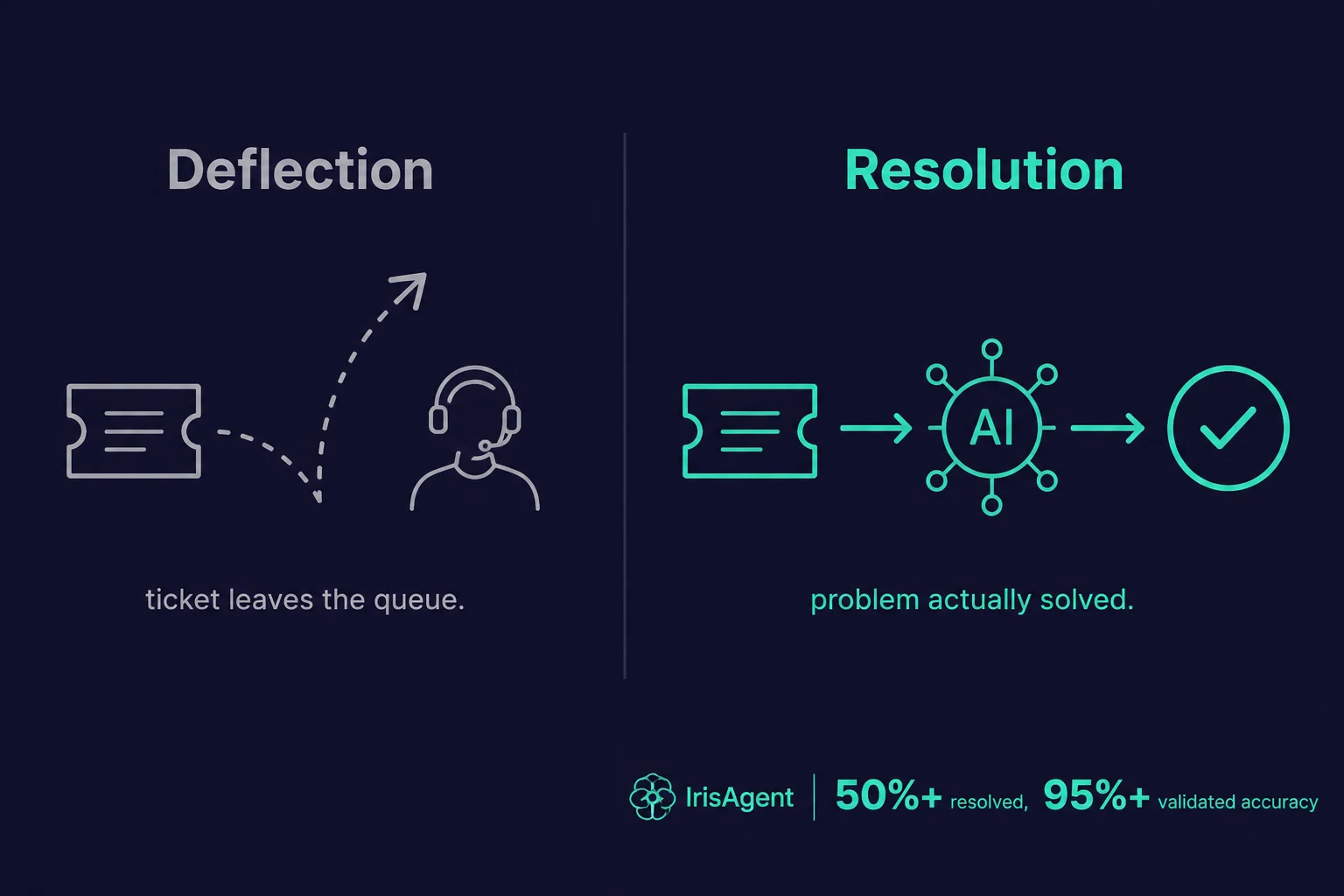
Your average CSAT score hides the only number that matters. A support team reporting 82% CSAT is usually running a password-reset flow at 90%+ and a billing-dispute flow in the low 60s, then averaging the two into a figure that describes neither. The intent type drives the score, and once you split CSAT by intent, the averages stop being useful and the operational picture gets clear.
This matters more in 2026 than it did two years ago, because AI now handles a large share of front-line volume and AI satisfaction splits even harder by intent than human satisfaction does. AI grounded in your knowledge base resolves structured intents at near-human CSAT. It still trails badly on sentiment-heavy ones. If you measure AI on a blended average, you will either over-trust it on the hard intents or under-deploy it on the easy ones.
Here is what we will cover:
What "CSAT by intent type" means and why it beats a blended score
The 2026 benchmark table: CSAT and AI resolution by intent tier
Why structured intents score high and sentiment-heavy intents score low
How CSAT by intent compares to CSAT by industry
How to instrument CSAT per intent in your own stack
What CSAT by Intent Type Means
CSAT by intent type is your customer satisfaction score segmented by what the customer was trying to do, not by who handled it or which channel it came through. Instead of one number for the whole queue, you get a score per intent: password reset, order status, refund request, billing dispute, cancellation, technical troubleshooting, complaint.
Intent is the variable that actually predicts satisfaction. A customer asking "where is my order" has a clear, answerable need and a low emotional charge. A customer writing "this is the third time I've been charged twice" has a complex need and a high emotional charge. Those two contacts will never produce the same CSAT, no matter how good your team or your AI is. Averaging them tells you nothing you can act on.
This is also why intent classification is the prerequisite for the metric. You cannot report CSAT by intent until you can tag every ticket with its intent at ingest. Teams that route by intent already have the classification layer in place, so the reporting is mostly a grouping change. Teams that do not have to add intent detection first.
CSAT by Intent Type: 2026 Benchmark Table
The pattern across every 2026 source is the same. Satisfaction and AI autonomous resolution both climb for structured, transactional intents and fall for sentiment-heavy, judgment-heavy ones. The table below groups intents into four tiers and pairs each with its 2026 benchmark.
Intent tier | Example queries | AI autonomous resolution | Satisfaction signal | Primary source |
|---|---|---|---|---|
Structured / transactional | Password reset, order tracking, refund status, shipping updates | High; 98.2% task success on password resets | Near-human; structured tasks resolve cleanly | AllAboutAI 2026 |
Informational / account | Account lookups, plan details, FAQs, how-to | High; 75% of customers prefer self-service here | High; low emotional charge | Dante AI 2026 |
Billing / financial | Billing questions, plan changes, charge inquiries | Moderate; needs backend access to resolve | Mixed; tracks financial-services CSAT around 81% | Retently 2026 |
Sentiment-heavy / complex | Complaints, cancellations, nuanced disputes, escalations | Low; 61.2% accuracy on emotionally complex requests | Lower; escalation outperforms automation here | AllAboutAI 2026 |
Two numbers anchor the spread. AI handles structured tasks like password resets at 98.2% success. On emotionally complex requests, accuracy falls to 61.2% (source: AllAboutAI 2026). That is a 37-point gap in how reliably AI lands the right answer, between the top tier and the bottom tier of the same support queue. Satisfaction tracks that gap: where AI resolves cleanly, CSAT holds near human levels; where it has to guess at tone or judgment, CSAT drops and escalation becomes the better play.
The blended view erases all of it. A team that reports a single "AI CSAT" number is reporting the midpoint of a distribution that runs from near-human on structured intents to well below it on complaints. The midpoint is real and also useless for deciding where to expand automation and where to keep a human in the loop. Note that published CSAT broken out by individual intent is still scarce in 2026: overall AI-handled CSAT averages about 78%, with leaders above 85% (AI Agents Square 2026), but the per-intent split is something most teams have to measure in their own data rather than read off a benchmark.
A Worked Example: One Queue, Five Intents
Numbers make the point faster than argument. Take a support queue that reports a healthy 80% blended CSAT. On paper that looks fine. Split it by intent and the average turns out to be the midpoint of two very different stories.
Intent | Share of volume | CSAT |
|---|---|---|
Password reset | 22% | 91% |
Order and shipping status | 26% | 88% |
Billing question | 18% | 79% |
Plan change and cancellation | 16% | 71% |
Complaint and dispute | 18% | 63% |
(These figures are illustrative, chosen to show the arithmetic, not sourced benchmarks.) The 80% blend is real, and it is also the weighted average of a 91 and a 63. The blended number tells you nothing is wrong. The split tells you exactly where the work is: the complaint and cancellation tiers are 20-plus points below the structured tiers and are dragging the whole queue down.
That changes what you do on Monday. You do not run a generic "improve CSAT" project across the whole queue. You leave the password-reset and order-status tiers alone, because they are already excellent and a fit for full automation. You put a human, or a better escalation path, on the complaint and cancellation tiers, because that is where the lost satisfaction actually lives. Same data, two completely different action plans, and only the per-intent view points you at the right one.
Why Structured Intents Win and Complaints Lose
The divide is not about difficulty in the human sense. It is about how much the right answer depends on stable, lookup-able facts versus judgment and tone.
Structured intents have a single correct resolution that lives in a system of record. "Reset my password" has one answer and one action. "Where is my order" resolves to a tracking number your backend already knows. Grounded AI does this well because the answer is retrievable and verifiable. AI that reads from your actual knowledge base and order system, then validates the response before sending, resolves these end to end. That is why password resets hit 98.2% task success and structured-intent CSAT sits near the top of the scale.
Sentiment-heavy intents have no single retrievable answer. A complaint needs acknowledgment, judgment about a goodwill credit, and a tone the customer reads as human. A nuanced billing dispute needs someone to weigh an exception against policy. These are exactly the cases where ungrounded AI is tempted to guess, and a confident wrong answer on an already-frustrated customer is worse than no answer. The honest play on the bottom tier is fast, clean escalation, not forced automation.
This is the operational reason to measure by intent: it tells you where autonomous AI earns its keep and where the value is a good handoff. Push ticket automation up the structured tiers, route the sentiment-heavy tiers to a human through your intent-based ticket routing, and your blended CSAT rises because each intent is handled the way that intent should be handled.
CSAT by Intent vs CSAT by Industry
Most published CSAT benchmarks segment by industry. Those are useful for setting a target, less useful for fixing anything. The 2026 industry baselines (Retently) look like this:
Financial Services: 81
Ecommerce and Retail: 77
B2B Software and SaaS: high 70s
Healthcare: 57
A "good" CSAT in 2026 sits roughly between 65% and 80% across industries. But notice the range inside that list is about 24 points, top to bottom. The range inside a single support queue, split by intent, is often wider than that. Your password-reset intent and your cancellation intent can sit further apart than financial services and healthcare do.
So industry benchmarks tell you whether your overall number is in the normal band. Intent benchmarks tell you which specific flow is dragging it down and whether the fix is content, backend access, or a human handoff. Only one of those two views leads to an action you can take this week.
How to Measure CSAT by Intent Type
Reporting CSAT per intent takes three changes to how you instrument support. None require replatforming.
Classify intent at ingest. Tag every incoming ticket with an intent label before it routes. If you already route by intent, you have this. If you do not, add an intent-detection layer that reads the message and assigns a category in under a second. The label has to be attached to the ticket record, not just used for routing, so it survives into your reporting.
Attach the CSAT response to the intent label. When the post-contact CSAT survey comes back, join it to the ticket's intent tag. Now every satisfaction score carries the intent that produced it. Group by that label and the per-intent distribution falls out directly.
Split AI and human within each intent. For intents that AI and humans both touch, report the two separately. This is where the real decisions live: an intent where AI CSAT matches human CSAT is a candidate for fuller automation; an intent where AI trails human by half a point or more should keep a human in the loop until the gap closes.
Once the per-intent view exists, read it against autonomous resolution, not in isolation. A high CSAT on an intent the AI almost never resolves on its own is a small win on a small base. The intents to expand are the ones where CSAT is high and autonomous resolution is already climbing. Pair this with your AI deflection rate per intent so you can see resolution and satisfaction on the same axis.
Where IrisAgent Fits
Measuring CSAT by intent requires two things most support stacks are missing: reliable intent classification on every ticket, and AI that does not inflate the structured-intent numbers by guessing. IrisAgent's AI for customer support platform classifies intent at ingest and grounds every answer in your own knowledge base and backend systems, with a Hallucination Removal Engine that validates each response before it reaches the customer. Validated accuracy stays above 95%, which is what keeps structured-intent CSAT at the top of the scale instead of degrading into confident wrong answers.
The same intent layer that drives resolution drives the reporting. Because every ticket is tagged at ingest, CSAT by intent is a grouping you already have rather than an instrumentation project. Dropbox, Zuora, and Teachmint run this on their highest-volume queues, automating the structured tiers and routing the sentiment-heavy ones to a human, which is exactly the split the benchmark data says to make.
Next Steps
A blended CSAT score tells you how you are doing on average. It never tells you what to fix. The teams that improve satisfaction in 2026 measure it where the variance actually lives: at the intent level.
Three takeaways to act on this week:
Split your CSAT by intent. Group existing survey results by intent label and look at the distribution, not the average.
Match the handling to the tier. Automate structured intents, route sentiment-heavy intents to a human, and stop forcing one playbook across both.
Report AI and human separately per intent. That is the view that tells you where to expand automation and where to hold the line.
The fastest way to get a clean CSAT-by-intent view is AI that classifies intent at ingest and grounds every answer in your own data, so the structured tiers resolve at near-human satisfaction instead of guessing. See how IrisAgent's AI for customer support platform resolves 50%+ of tickets with validated accuracy above 95%, deployed in 24 hours. Book a 20-minute demo to see your CSAT broken out by intent.
See latest stats: Customer support statistics 2026.
Frequently Asked Questions
What is CSAT by intent type?
CSAT by intent type is your customer satisfaction score broken out by what the customer was trying to do, such as resetting a password, checking an order, or filing a complaint. It replaces a single blended score with one score per intent. Because satisfaction is driven more by the type of request than by the channel or even the industry, the per-intent view shows you which specific flows are dragging your average down and which are carrying it.
What is a good CSAT score by intent in 2026?
There is no single target that fits every intent, which is the whole point. Structured, transactional intents like password resets and order tracking should score near the top of your scale, because they resolve cleanly (AI hits 98.2% task success on password resets). Sentiment-heavy intents like complaints and disputes run lower, and that gap is normal. Set tier-specific targets: high for structured intents, and a realistic floor plus a clean escalation path for complex ones. Overall AI-handled CSAT averages around 78% in 2026, but treat that as a starting line, not a per-intent goal.
Why is AI CSAT higher for some intents than others?
AI does well on intents with a single retrievable answer that lives in a system of record, such as password resets or shipping status, because grounded AI can look up the fact and validate it before answering. It does worse on intents that need judgment, tone, or an exception to policy, such as complaints and nuanced disputes, where there is no single correct answer to retrieve. The right strategy is to automate the structured intents fully and route the sentiment-heavy ones to a human.
How is CSAT by intent different from CSAT by industry?
Industry benchmarks tell you whether your overall CSAT is in the normal band for your sector, which in 2026 is roughly 65% to 80%. They do not tell you what to fix. Intent benchmarks segment inside your own queue, so they point to the specific flow that needs work and whether the fix is better content, backend access, or a human handoff. The satisfaction range across intents in one queue is often wider than the range across entire industries.
How do I measure CSAT by intent type?
Tag every ticket with an intent label at ingest, join each returned CSAT survey to that label, and group your scores by intent. Then split AI-handled and human-handled results within each intent so you can see where AI matches human satisfaction and where it still trails. The prerequisite is intent classification on every ticket, which teams that already route by intent have in place.
Loading the form. Prefer email? Reach us at info@irisagent.com or call +1 617 249 3312.