
What Is Conversational AI Analytics? A Complete Guide
Definition
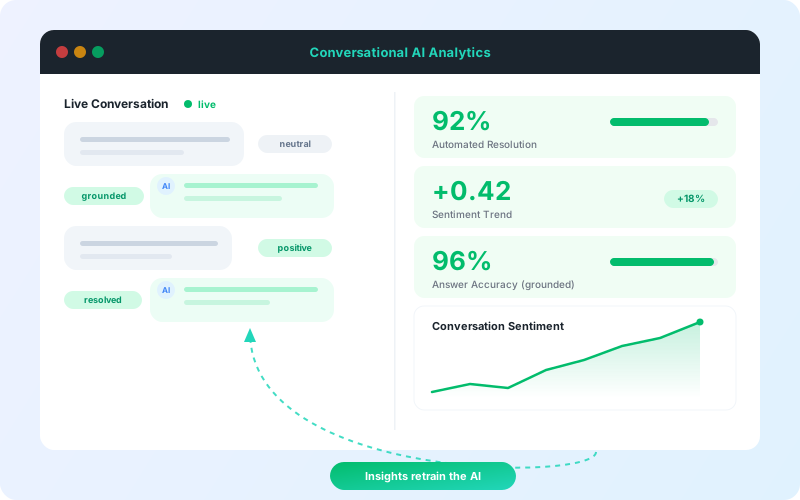
Conversational AI analytics is the practice of measuring, analyzing, and acting on the data produced by automated conversations: the chats, voice calls, and tickets handled by chatbots and AI agents. Where traditional support analytics counted tickets and tracked human handle time, conversational AI analytics looks inside the conversation itself. It tracks what customers asked, whether the AI actually resolved the issue, where it failed or escalated, how the customer felt, and whether the answer it gave was grounded in fact.
In other words, it is the feedback loop that tells you whether your AI agent is helping customers or quietly frustrating them. As more support volume shifts from human agents to AI, conversational AI analytics becomes the primary way to know if that automation is working, and the only practical way to improve it at scale.
Why conversational AI analytics matters
When a chatbot handles thousands of conversations a week, you cannot read them all. Without analytics, an AI agent is a black box: it might be deflecting 60 percent of tickets, or it might be confidently giving wrong answers to half of them, and the raw resolution count alone will not tell you which. Conversational AI analytics turns that black box into a measurable system.
Three things make it different from classic contact-center reporting:
It is conversation-level, not ticket-level. A single ticket might contain a dozen turns, a topic switch, a moment of frustration, and a failed handoff. Analytics that only count the ticket miss all of it.
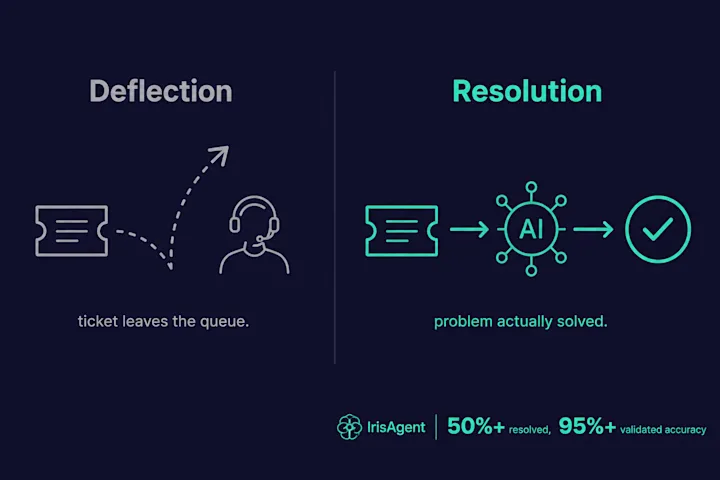
It measures answer quality, not just volume. Deflection without accuracy is a vanity metric. A modern analytics layer scores whether the AI's answer was correct and grounded, not just whether the customer stopped replying.
It is built for continuous improvement. The output is not a monthly slide. It is a stream of signals (intents that fail, knowledge gaps, sentiment drops) that feed directly back into the bot's content and configuration.
The metrics that matter
Not every number is worth tracking. These are the conversational AI analytics metrics that actually drive decisions.
Resolution and deflection
Automated resolution rate: the share of conversations the AI fully resolved without a human. This is the headline ROI metric.
Deflection rate: the share of conversations that never reached a human agent. Always read this alongside accuracy and CSAT, because deflection on its own can hide unresolved, abandoned customers.
Escalation rate: how often the AI hands off to a human, and crucially, why. A rising escalation rate on one intent is a precise signal of a knowledge gap.
Quality and trust
Answer accuracy / groundedness: whether the AI's responses are factually correct and supported by your knowledge base rather than hallucinated. This is the metric that separates safe automation from risky automation. See AI hallucination for why grounding matters.
Containment quality: of the conversations the bot contained, how many were genuinely solved versus silently abandoned.
Customer experience
Conversational sentiment: how the customer's emotion trends across the conversation, and whether the AI made it better or worse. This is the heart of customer sentiment analysis.
CSAT on AI-handled conversations: measured separately from human-handled ones so you can compare like for like.
Operational
Intent coverage: which customer intents the AI handles well, which it handles poorly, and which it does not recognize at all.
Time to resolution: how fast the AI closes a conversation compared with the human baseline.
Knowledge gap detection: the questions customers ask that your knowledge base cannot answer, surfaced automatically as a content backlog.
How conversational AI analytics works
A capable analytics layer runs through four stages:
Capture. Ingest the full transcript of every conversation across channels: chat, voice, email, and ticketing, along with metadata such as channel, customer tier, and outcome.
Understand. Use large language models to classify intent, detect sentiment, and judge whether the issue was actually resolved. Because LLMs read meaning rather than match keywords, they can tell the difference between "thanks, that worked" and "thanks, I'll just call instead."
Score and ground. Evaluate each AI answer against the knowledge base it should have used, flagging responses that were unsupported or contradicted source content. Grounded scoring is what keeps the analytics honest and prevents an AI from grading its own hallucination as a success.
Act. Roll the signals up into dashboards and, more importantly, into specific actions: new knowledge articles for detected gaps, configuration changes for failing intents, and alerts when sentiment or accuracy drops on a topic.
The last stage is the one that gets skipped most often, and it is the one that matters. Analytics that only describe are reporting. Analytics that feed back into the bot are improvement. For a vendor-by-vendor look at platforms that cover AI and human conversations, see our comparison of the best contact center analytics software in 2026.
Conversational AI analytics vs traditional support analytics
Dimension | Traditional support analytics | Conversational AI analytics |
|---|---|---|
Unit of measure | Ticket / case | Full conversation, turn by turn |
Core question | How many, how fast? | Was it resolved, was it correct, how did the customer feel? |
Quality signal | Manual QA on a small sample | Automated scoring of every conversation |
Sentiment | Survey after the fact | Real-time, in-conversation |
Output | Periodic reports | Continuous feedback into the AI |
How IrisAgent approaches it
IrisAgent treats analytics as part of the AI agent, not a separate dashboard bolted on afterward. Every conversation its AI customer support agent handles is scored for resolution and grounded against the customer's own knowledge base, so accuracy is measured, not assumed. Built-in customer sentiment analysis tracks emotion across the conversation, and automatic knowledge-gap detection turns the questions the AI could not answer into a prioritized content backlog. The result is a closed loop: the same data that measures the AI also makes it better.
Frequently Asked Questions
What is conversational AI analytics?
Conversational AI analytics is the practice of measuring and analyzing the conversations handled by chatbots and AI agents to track resolution, deflection, answer accuracy, sentiment, and knowledge gaps, then using those signals to improve the AI.
How is conversational AI analytics different from chatbot analytics?
Basic chatbot analytics often stops at volume and deflection counts. Conversational AI analytics adds answer-quality scoring (is the response correct and grounded?), conversation-level sentiment, and automated knowledge-gap detection, so you measure whether automation actually helped, not just whether it happened.
What conversational AI analytics metrics should I track first?
Start with automated resolution rate, answer accuracy or groundedness, escalation rate by intent, and CSAT on AI-handled conversations. Together these tell you whether your AI is resolving issues correctly, where it is failing, and how customers feel about it.
Can conversational AI analytics detect when the AI gives a wrong answer?
Yes. Grounded scoring compares each AI response against the source knowledge it should have used and flags answers that are unsupported or contradict that source. This is how teams catch hallucinations before they erode trust.
Why does deflection rate alone mislead teams?
A high deflection rate can mean the AI solved the issue, or it can mean the customer gave up. Reading deflection alongside resolution quality, accuracy, and CSAT prevents you from celebrating abandoned customers as a win.
Loading the form. Prefer email? Reach us at info@irisagent.com or call +1 617 249 3312.