
What Is an AI Hallucination? Definition, Causes & Examples
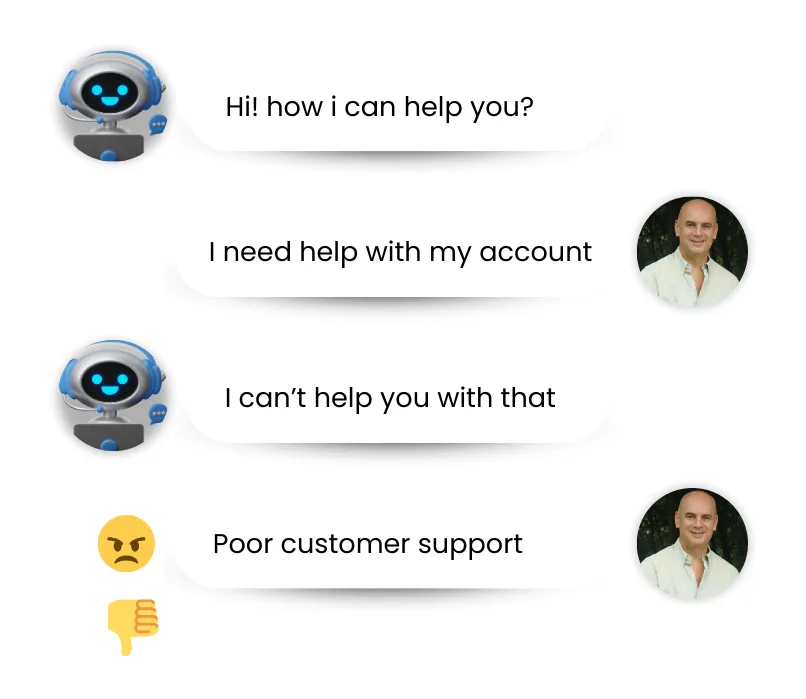
An AI hallucination is a confidently stated output that is factually wrong or entirely made up. The model presents invented facts, policies, citations, or details as if they were true. The term matters because the error reads as credible, which is exactly what makes it dangerous in customer support, legal, and healthcare settings.
AI Hallucination: Definition and Meaning
An AI hallucination happens when a generative AI model produces information that is not grounded in any real source. Large language models (LLMs) generate text by predicting the next word from statistical patterns, not by looking up verified facts. So when the model hits a gap in its training data, it fills that gap with a plausible guess. The output sounds fluent and authoritative, but it has no basis in reality. Researchers estimate ungrounded LLMs hallucinate on 15% to 30% of responses, depending on the task.
Why Do AI Hallucinations Happen?
Hallucinations are a byproduct of how these models work, not a random bug. Five causes account for most of them:
Probabilistic generation: The model predicts likely word sequences, so it favors a fluent answer over an accurate one.
Training data gaps: When the model lacks exposure to a topic, it improvises instead of admitting uncertainty.
Biased or outdated data: LLMs trained on the open internet absorb errors, stereotypes, and stale facts.
Overfitting: A model tuned too tightly to its training set struggles to generalize to new questions.
No grounding: Without a link to a verified knowledge base, the model has nothing to check its answer against.
Types of AI Hallucinations
Factual hallucination: The model states a wrong fact, such as an incorrect date, statistic, or product detail.
Fabricated source hallucination: The model invents citations, URLs, or legal cases that do not exist.
Policy hallucination: The model makes up a company rule, like a refund or bereavement policy the business never had.
Contextual hallucination: The model contradicts information it was given earlier in the same conversation.
AI Hallucination Examples
Two cases show the business stakes. An airline chatbot invented a bereavement refund policy, and a tribunal held the airline responsible for honoring it. Separately, a New York attorney filed a legal brief built on AI-generated case citations, then learned in court that the cases did not exist. In both, the AI was fluent, confident, and wrong.
Three Hallucinations That Reached Real Customers
In November 2022, an Air Canada support chatbot told a grieving passenger he could apply for a bereavement discount retroactively, within 90 days of the ticket being issued. No such policy existed. Air Canada refused the refund and argued it was not responsible for what its own chatbot said. The British Columbia Civil Resolution Tribunal disagreed, found negligent misrepresentation, and ordered the airline to pay. The ruling in Moffatt v. Air Canada is the clearest statement yet that a company owns its chatbot's answers.
In April 2025, an AI support agent at the code editor Cursor invented a policy restricting logins to a single device. The real cause was a session bug. Users read the invented policy as a deliberate pricing change, posted the exchange publicly, and cancelled subscriptions over a rule that never existed.
In March 2024, New York City's MyCity business chatbot told employers they could take a cut of workers' tips and told landlords they could turn away tenants with housing vouchers. Both answers described illegal conduct as permitted.
The pattern is identical in all three. The model was asked about a policy its source material did not cover, and instead of saying it did not know, it produced a confident, specific, plausible answer. That is the retrieval gap described above, reaching a real customer.
Why AI Hallucinations Matter in Customer Support
At enterprise scale a hallucination is a compliance event, not just a bad answer. See how the major platforms handle grounding and governance in enterprise AI support, and what to demand in writing before a pilot starts.
In support, a hallucination is not an abstract risk. It is a wrong answer sent straight to a customer. A fabricated policy can become a binding commitment, a wrong troubleshooting step can break a product, and a confident error erodes trust that took years to build. That is why hallucination-free output is the baseline requirement for any AI that touches customers, not a premium feature.
How to Prevent AI Hallucinations
No single fix removes hallucinations. A layered defense does. Four controls do most of the work:
Retrieval-augmented generation (RAG): Force the model to answer from your verified knowledge base instead of its training data.
Intent recognition: Classify the customer question correctly so the system retrieves the right source.
Programmatic guardrails: Check every output against its source for groundedness before it reaches the customer.
Human-in-the-loop review: Route low-confidence or high-stakes answers to an agent before sending.
IrisAgent combines these layers in its Hallucination Removal Engine, which validates each answer against the source it cites before sending. The result is validated accuracy above 95% across enterprise deployments including Dropbox, Zuora, and Teachmint, while ungrounded chatbots hallucinate on 15% to 30% of responses.
Learn More About AI Hallucinations
For a full breakdown of why hallucinations happen and the four-layer framework that prevents them, read Understanding AI Hallucinations: Challenges and Solutions for Users. For seven practical techniques to cut hallucinations in your support queue, read How to Reduce AI Hallucinations in Customer Support.
IrisAgent is built to prevent this in production. See how the AI customer support platform keeps every answer grounded in your verified sources.
Frequently Asked Questions
What is an AI hallucination?
An AI hallucination is a response that sounds confident and coherent but is factually wrong or unsupported by any real source. In customer support, this happens when a chatbot invents a refund policy, a feature that does not exist, or a step in a process that does not match the actual knowledge base. The output looks like a normal answer, which is what makes it risky: nothing in the tone signals to the customer or the agent that the model is guessing.
What causes AI hallucinations in customer support tools?
Hallucinations mostly come from a retrieval gap: the model is asked a question its knowledge base does not actually answer, and instead of saying so, it fills the gap with a plausible-sounding guess drawn from its general training data. Stale or conflicting knowledge base articles, over-broad retrieval that pulls in loosely related content, and prompts that do not force the model to cite a source all make the problem worse.
How do you prevent AI hallucinations in a support chatbot?
The most reliable fix is grounding every answer in a specific, cited source (a knowledge base article or a past resolved ticket) and having the model explicitly decline or escalate when no source matches closely enough. IrisAgent's Hallucination Removal Engine checks each generated answer against its cited source before it reaches the customer, and routes to a human when the retrieval confidence is too low, rather than letting the model improvise.
How common are AI hallucinations in enterprise chatbots?
Rates vary widely by vendor and by how narrowly the bot's knowledge base is scoped, but ungrounded generative chatbots can hallucinate on a meaningful share of edge-case and out-of-scope questions, since nothing stops the model from answering when it has no real source. Grounded, citation-checked systems reduce this substantially by treating 'no confident source' as a valid, expected outcome instead of a failure to route around.
Loading the form. Prefer email? Reach us at info@irisagent.comor call +1 617 249 3312.