
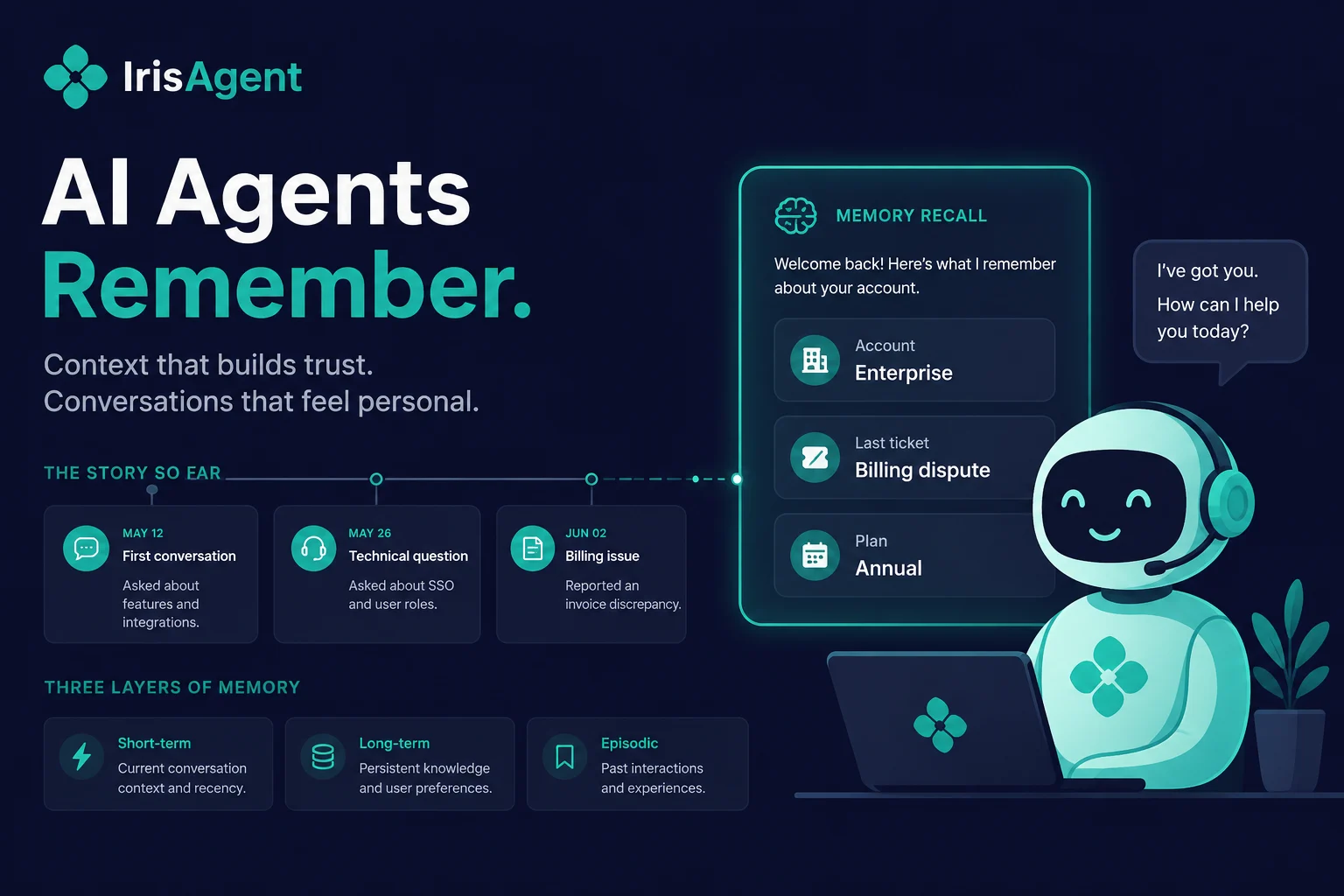
What Is AI Agent Memory in Customer Support?
AI agent memory is the ability of an AI support agent to retain and reuse information about a customer across messages and across separate conversations, instead of starting from zero every time. It is what separates a stateless chatbot that asks "how can I help you?" on every visit from an agent that already knows the customer's plan, their last three tickets, and the issue they reported yesterday. As support AI moves from suggesting answers to autonomously resolving them, memory is fast becoming the feature that decides whether resolution feels human or robotic. IrisAgent grounds that memory in your verified data so the agent remembers accurately, at over 95 percent validated accuracy, rather than confidently misremembering.
That is the short version. The rest of this guide covers the three types of AI agent memory, why it has become the real battleground in customer support, what good memory makes possible, and the privacy guardrails that keep it safe.
Key takeaways
AI agent memory is persistence: the agent remembers the customer within a conversation and across conversations, instead of resetting every time.
There are three types: short-term (working) memory, long-term (persistent) memory, and episodic memory. Real deployments need all three.
Memory is the new battleground because autonomous resolution at higher levels of autonomy is impossible without it. A forgetful autopilot breaks on the first multi-step ticket.
The cost of forgetting is concrete: customers repeat themselves, agents lose context on handoff, and multi-step workflows fall apart.
Memory must be governed. What the agent remembers, for how long, and who can see it are privacy and compliance decisions, not just engineering ones.
What is AI agent memory?
In plain terms, memory is the difference between a goldfish and a good account manager. A stateless chatbot treats every message as if it were the first. It has no idea the customer asked about the same failed payment an hour ago, or that they are a ten-year enterprise account, or that the last agent already promised them a refund. An AI agent with memory carries that context forward and acts on it.
Technically, memory in a support agent has two sources that work together. The first is the model's context window: the working space where the current conversation lives. The second is an external memory store that the agent reads from and writes to, holding what matters beyond the current window. Retrieval-augmented generation pulls the right facts from that store into the conversation at the right moment. The context window is short-term by nature; durable memory comes from the external store, which is why the architecture underneath matters as much as the model.
Why memory is the new battleground in customer support
For the first wave of support AI, memory was optional. A copilot that suggests a reply to a human agent does not strictly need to remember yesterday, because the human supplies the context. But the moment you move up the levels of autonomy toward an autopilot that resolves tickets on its own, memory stops being optional and becomes load-bearing.
Consider an autonomous agent handling a billing dispute. To resolve it, the agent has to remember what the customer said three messages ago, what their subscription is, what was already tried on the previous ticket, and what it itself just promised. Drop any of that and the resolution falls apart or, worse, the agent contradicts an earlier commitment. Autonomy without memory is not autonomy. It is a confident stranger answering each message in isolation.
This is why memory has become the feature vendors now compete on, and why specialized agent-memory infrastructure has emerged as its own category. The teams that win autonomous support are the ones whose agents remember accurately and act on that memory, while staying grounded so they do not invent a history that never happened.
Memory is what the agent stores. AI context management is what it does with that store at query time, deciding what to retrieve and what to leave out of each model call.
The three types of AI agent memory
Real deployments need three distinct kinds of memory, each doing a different job.
Short-term (working) memory.
This is the current conversation: what the customer just said, the clarifying question the agent asked, the answer in progress. It lives largely in the model's context window and exists only for the length of the session. It is what lets an agent handle a multi-turn exchange without losing the thread between messages.
Long-term (persistent) memory.
This is what the agent knows about the customer across all conversations: their account, their plan, their preferences, their history of issues, the resolutions that worked. It lives in an external store and persists indefinitely (subject to your retention policy). It is what lets the agent greet a returning customer already knowing who they are.
Episodic memory.
This is the memory of specific past events: "you reported this exact bug last Tuesday," "we issued you a credit two weeks ago," "your last three tickets were all about the same integration." It sits between the other two, recalling discrete episodes rather than the whole running profile, and it is what makes an agent feel like it actually remembers your relationship rather than just your record.
The best support agents combine all three: working memory to handle the live conversation, persistent memory to know the customer, and episodic memory to connect the current issue to what came before.
What AI agent memory makes possible
When an agent remembers, four things change for the customer and the operation.
No more repeating yourself.
The customer never has to re-explain who they are or what happened last time. The single most common complaint about support, made worse by bad chatbots, simply goes away.
Multi-step resolution actually works.
Workflows that span several messages or several sessions (a verification, then a fix, then a confirmation) hold together because the agent remembers where it left off.
Cleaner escalation.
When the agent does hand off to a human, it passes the full remembered context, so the human does not start cold. This is the difference between a handoff that feels like a promotion and one that feels like starting over, and it is core to good agent assist.
Proactive, personalized service.
An agent that remembers the customer's history can anticipate the issue, reference the right past resolution, and tailor the answer, instead of treating a loyal enterprise customer exactly like an anonymous first-time visitor.
Underneath all of this sits retrieval. Memory is only useful if the agent can find the right piece of it at the right moment, which is why unified search across your fragmented systems is the practical engine behind memory that works.
The cost of forgetting
It is worth naming what stateless support actually costs, because the failure is quiet. A forgetful agent does not crash. It just quietly degrades every interaction. Customers re-authenticate and re-explain on every contact. Agents inherit handoffs with no context and waste the first two minutes reconstructing the story. Multi-session issues never resolve cleanly because each session starts blind. And the customer's read on all of it is simple and damaging: this company does not know me. For a high-value account, that perception is a retention risk, not just a CSAT dip.
AI agent memory, privacy, and data retention
Memory is powerful, which is exactly why it has to be governed. What an agent remembers is customer data, and storing it long-term is a privacy and compliance decision, not just an engineering one. Three guardrails matter most.
Scope and retention.
Decide what the agent should remember and for how long. Persistent memory should follow your data-retention policy, with the ability to expire or delete on request, especially under regimes like GDPR.
Access and isolation.
Memory about one customer must never leak into another customer's conversation, and it should never be used to train shared models on your data without explicit control. Isolation is the baseline.
Accuracy and grounding.
A memory store that holds wrong information is worse than no memory, because the agent will act on it confidently. Grounding memory in your verified systems of record, and validating before the agent uses it, is what keeps "remembering" from becoming "confidently misremembering." This is the same discipline that keeps hallucinations out of answers, applied to memory.
Leaders need visibility into all of this: what the agent remembered, what it acted on, and why. That oversight is part of what support analyst provides across the AI layer.
How AI agent memory fits the bigger picture
Memory is one of four foundations that autonomous support runs on, alongside grounded retrieval, orchestration, and guardrails. It rarely works alone: in a multi-agent setup, memory is shared and coordinated through AI agent orchestration, so the triage agent, the resolution agent, and the QA agent all draw on the same remembered context. And the level of memory you need scales with how autonomous you let the AI be, which is the whole point of the levels of autonomy framework. A copilot can be forgetful. An autopilot cannot. IrisAgent provides grounded, governed memory as part of its AI customer support platform, so autonomy and accuracy rise together instead of trading off.
See how IrisAgent's autonomous AI agent uses memory to resolve issues across a full conversation.
Next steps
AI agent memory is the quiet foundation under good autonomous support: it is what turns a forgetful chatbot into an agent that knows your customer. Decide which of the three memory types you need, govern what the agent remembers and for how long, and make sure that memory is grounded so the agent remembers accurately rather than confidently inventing a past. To see grounded, governed agent memory working on your own tickets, book a demo.
Frequently Asked Questions
Does AI customer service remember past conversations?
It depends on the system. A basic stateless chatbot does not: it treats every conversation as new. An AI agent with persistent memory does: it retains the customer's account, history, and past issues across separate conversations and uses that context to resolve faster. If remembering the customer matters to you, confirm the vendor supports long-term memory, not just a single-session context window.
What are the types of AI agent memory?
Three. Short-term or working memory holds the current conversation and lives in the model's context window. Long-term or persistent memory holds what the agent knows about the customer across all conversations and lives in an external store. Episodic memory recalls specific past events, like a particular bug report or a credit issued two weeks ago. Robust support agents use all three together.
Is AI agent memory a privacy risk?
It can be if it is ungoverned, which is why memory must follow your data-retention policy, support deletion on request, isolate each customer's data, and be grounded in verified systems of record. Handled correctly, memory is both safe and compliant. The risks come from storing data indefinitely without controls or letting memory from one customer leak into another's conversation.
Why does AI agent memory matter for autonomous support?
Because autonomous resolution requires context. An AI that resolves tickets on its own has to remember what the customer said earlier in the conversation, what their account is, what was tried before, and what it already promised. Without memory, autonomy breaks on the first multi-step ticket. Memory is what lets an autopilot resolve issues end to end rather than answering each message in isolation.
Loading the form. Prefer email? Reach us at info@irisagent.comor call +1 617 249 3312.