
Best Conversational AI Companies in 2026 (for Customer Support and CX)
Conversational AI has crossed a threshold. The category used to mean scripted chatbots that matched keywords and handed off the moment a question got hard. In 2026, the leading conversational AI companies ship agentic AI agents that understand intent, hold multi-turn conversations, and take real actions: looking up an order, issuing a refund, updating an account, and confirming the outcome with the customer.
If you are evaluating conversational AI companies for customer support or customer experience, the market has consolidated around a handful of serious platforms. They differ less on whether they can hold a conversation and more on three things that determine whether they work in production: how they keep answers accurate, how they deploy, and how they charge. This guide ranks the leading conversational AI companies in 2026, explains who each is best for, and gives you a framework to choose.
What is a conversational AI company?
A conversational AI company builds software that understands natural language and holds a useful, goal-directed conversation with a customer or employee. The best conversational AI companies for business support do three things well:
Understand intent across messy, real-world phrasing, not just exact keyword matches.
Ground their answers in your own knowledge base and data, so the AI does not invent policies or facts.
Act, not just answer, by completing workflows inside the systems you already run.
Conversational AI sits next to, but is broader than, a chatbot. A chatbot is one delivery surface. Conversational AI is the underlying capability, and modern platforms apply it across chat, email, voice, and in-app messaging. For the full picture of how this works in support, see our guide to AI for customer support, and for the journey beyond support, AI for customer experience.
How we evaluated the conversational AI companies
We scored each company on the five factors that separate a demo from a production deployment:
Grounding and accuracy.
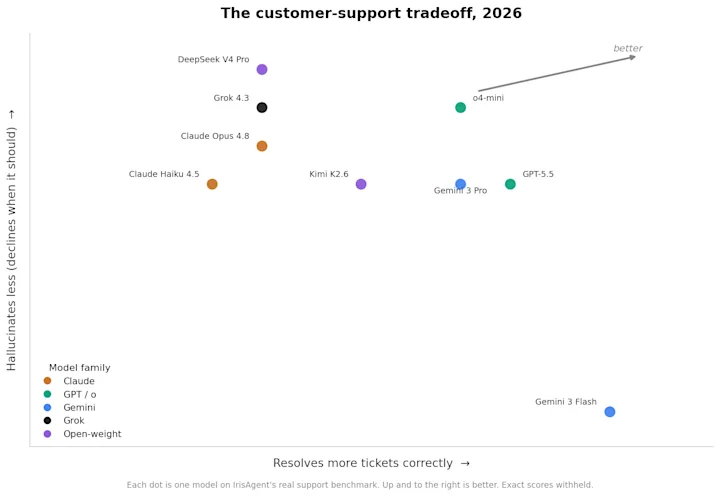
Does it validate answers against your content, or can it hallucinate? This is the single biggest predictor of whether customers trust the AI.
Deployment model.
Does it layer on your existing helpdesk, or require a rip-and-replace project?
Pricing model.
Predictable and matched to your volume, or per-resolution fees that scale your cost up as the AI succeeds?
Time to value.
Days, or a multi-quarter implementation?
Best-fit buyer.
Mid-market, enterprise, or Fortune 500.
Conversational AI companies at a glance
Company | Best for | Deployment | Pricing model | Grounding |
IrisAgent | Mid-market and enterprise on an existing helpdesk | Layers on Zendesk, Salesforce, Intercom, Freshdesk | Flexible: usage or resolution-based | Hallucination Removal Engine, grounded in your KB |
Decagon | Large enterprises building custom agent workflows | Often central to the stack | Custom, enterprise | Workflow plus model precision |
Sierra AI | Fortune 500, services-led rollouts | Platform build | Outcome-based, enterprise floor | Brand-tuned agents |
Intercom (Fin) | Teams standardized on Intercom | Native to Intercom | Per resolution plus per seat | Tuned on Intercom content |
Ada | No-code, multilingual chatbot builders | Standalone, integrations | Quote, per-resolution economics | Knowledge-based, some ingestion gaps |
Global teams prioritizing voice and many languages | Broad platform | Custom | Multi-channel, multilingual |
The best conversational AI companies in 2026
1. IrisAgent
Best for: mid-market and enterprise teams that want grounded conversational AI on the helpdesk they already use, deployed fast.
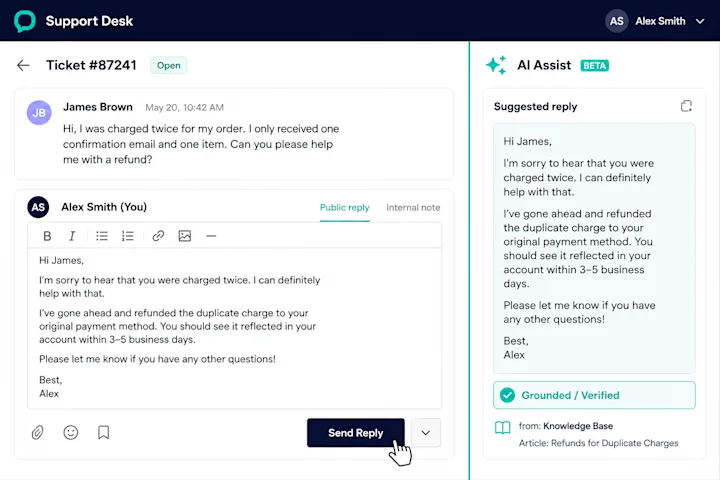
IrisAgent is a conversational AI platform that layers AI agents onto Zendesk, Salesforce, Intercom, and Freshdesk to resolve 60%+ of support interactions across chat, email, and voice. Its differentiator is accuracy: the Hallucination Removal Engine validates every answer against your knowledge base and past tickets before it reaches a customer, and routes low-confidence cases to a human with a source-cited summary. That is what makes it safe to put conversational AI in front of customers on regulated or high-stakes topics.
Deployment:
installs from your helpdesk marketplace, typically live in about 24 hours, no rip-and-replace.
Pricing:
flexible, with usage-based or resolution-based options so you can match cost to how you run support.
Proof:
Dropbox and Zuora run over a million tickets a month through IrisAgent; Dropbox saved 160,000 agent minutes in a single half-year.
Extras:
AutoQA scores 100% of AI and human conversations, and the platform covers voice (see voice AI).
Trade-off:
built for teams that have an existing helpdesk; not aimed at tiny teams with no support stack.
2. Decagon
Best for: large enterprises building heavily customized agent workflows.
Decagon offers Agent Operating Procedures that blend natural-language workflow design with code-level precision, backed by a high valuation and marquee logos. It is a strong fit when you have engineering resources to model complex, bespoke flows.
Trade-offs:
it generally expects to sit at the center of your support stack rather than layer onto it, configuration can feel like a black box once set, and contracts skew toward large enterprise budgets.
See IrisAgent vs Decagon for a detailed comparison.
3. Sierra AI
Best for: Fortune 500 brands that want a high-touch, services-led rollout.
Founded by Bret Taylor, Sierra markets an “Agent OS” for large brands and brings significant brand credibility and polish.
Trade-offs: a high entry point, substantial professional-services cost, and a longer implementation timeline. Best when budget and timeline are not constraints.
See IrisAgent vs Sierra.
4. Intercom (Fin)
Best for: teams already standardized on Intercom.
Fin is Intercom’s conversational AI agent, tightly integrated with the Intercom Messenger and content. If your support already lives in Intercom, Fin is the path of least resistance.
Trade-offs: pricing is the main watch-out. A per-resolution fee plus a per-seat cost means spend scales as the AI succeeds, which can make budgeting hard at volume. It is also weakest when you want to keep a different primary helpdesk.
5. Ada
Best for: brands wanting a no-code, multilingual chatbot builder.
Ada is an agentic CX platform with broad language coverage and enterprise compliance, popular with teams that want marketing and support to configure flows without engineering.
Trade-offs: buyers report a time-consuming implementation and gaps ingesting some document types (for example PDFs or wiki content), and pricing is quote-only with per-resolution economics.
See IrisAgent vs Ada.
6. Yellow.ai
Best for: global teams prioritizing voice and many languages.
Yellow.ai has a large multilingual and voice footprint, especially across APAC, and a broad platform surface.
Trade-offs:
breadth is a double-edged sword. Fit depends on how much of the platform you will actually use, and depth on any single channel varies.
Conversational AI agents for businesses: where they deliver value
“Conversational AI agents for businesses” is a broader search than support alone, because the technology now shows up across functions. The highest-ROI business use cases in 2026:
Customer support.
Resolve routine tickets end to end (password resets, order status, refunds), draft replies for agents, and auto-tag and route the rest. This is the most mature use case and where grounding matters most.
Sales and pre-sales.
Answer product questions, qualify leads, and book meetings inside chat, with handoff to a human when intent is high.
IT and HR helpdesks.
Deflect internal tickets (access requests, policy questions, onboarding) against internal knowledge bases.
Voice.
Handle phone and companion-app conversations with the same grounded answers as chat. See voice AI.
The common thread: a conversational AI agent for a business is only as good as the data it is grounded in and the actions it is allowed to take. Pick a vendor that grounds answers in your systems and can act inside them, not one that only chats.
Voice is now a first-class channel for these platforms. For production voice AI benchmark data on resolution, handle time, and accuracy, see our 2026 benchmarks.
What changed in 2026
From chatbots to agents.
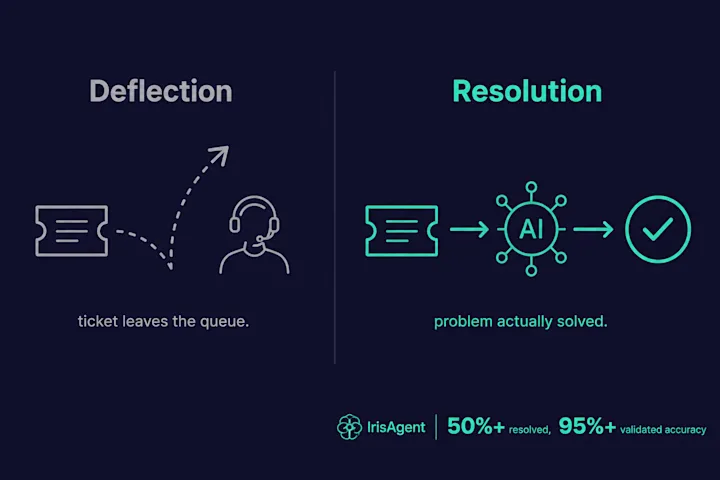
Vendors are judged on resolution rate, not deflection. An agent that completes the task beats a bot that merely answers.
Grounding is the dividing line.
The companies winning enterprise deals are the ones that can prove their AI does not hallucinate. “Grounded in your content” has moved from a nice-to-have to a requirement.
Pricing scrutiny.
Buyers are pushing back on per-resolution pricing because it penalizes success. Flexible, usage-based models are gaining ground.
Layer, do not replace.
The fastest deployments layer onto the existing helpdesk. Rip-and-replace projects are losing to platforms that go live in days.
Vertical fit matters more than a vendor list suggests. Subscription businesses should weigh billing, renewal, and onboarding coverage specifically, which is the lens we apply to AI agents for SaaS customer support teams.
How to choose a conversational AI company
You want grounded AI on your existing helpdesk, flexible pricing, and a 24-hour deploy:
start with IrisAgent.
You are Fortune 500 with budget and timeline for a services-led platform build:
evaluate Sierra or Decagon.
You are committed to Intercom and comfortable with per-resolution pricing:
look at Fin.
You want a no-code builder with broad language coverage:
consider Ada or Yellow.ai.
Whatever you shortlist, run the same proof in your evaluation: load your real knowledge base, ask 20 hard, edge-case questions, and check three things. Did it answer accurately, did it admit when it did not know, and did it complete the action? For a deeper buyer’s view of the support category specifically, see our AI customer service software guide.
Frequently Asked Questions
What are the best conversational AI companies for customer service?
Leading options include IrisAgent, Decagon, Sierra, Intercom Fin, Ada, and Yellow.ai. IrisAgent is the strongest fit for teams that want grounded, hallucination-free conversational AI on their existing helpdesk, with flexible pricing and a 24-hour deploy.
What is the difference between a chatbot and conversational AI?
A chatbot follows fixed rules and predefined flows. Conversational AI uses large language models to understand intent and respond naturally, and agentic conversational AI goes further by taking actions to resolve a request end to end.
What are conversational AI agents for businesses used for?
The top use cases are customer support (resolving and routing tickets), sales and pre-sales (qualifying leads and answering product questions), internal IT and HR helpdesks, and voice support. The best results come from agents that are grounded in your data and allowed to act in your systems.
Do conversational AI companies charge per resolution?
Some do, for example Intercom Fin and Ada, which means cost scales with success. Others, like IrisAgent, offer flexible usage-based or resolution-based pricing, so you can pick the model that fits your volume and keep budgeting predictable.
How fast can a business deploy conversational AI?
With a platform that layers onto your existing helpdesk, like IrisAgent, deployment takes about 24 hours. Rip-and-replace platforms can take a quarter or more.
How do I stop conversational AI from hallucinating?
Choose a vendor that grounds every answer in your own knowledge base and validates responses before they reach the customer. IrisAgent's Hallucination Removal Engine does this and escalates low-confidence questions to a human instead of guessing.
Loading the form. Prefer email? Reach us at info@irisagent.com or call +1 617 249 3312.