
Best LLMs for Customer Support Chatbots: 100 Tickets Tested
Quick verdict (2026)
Across roughly 100 real support tickets, scored on resolution accuracy and hallucination resistance together, the strongest production model was an open-weight one: DeepSeek V4 Pro, at a fraction of the price of the frontier flagships. Claude Opus 4.6 is the best proprietary option just behind it, o4-mini is the best value, and Grok 4.3 is the fastest for live chat. The takeaway: the model that wins generic leaderboards is often the one most likely to confidently tell a customer something false. Pick on accuracy and hallucination resistance, not benchmark fame. Full results and the tradeoff chart are below.
A while back we published a benchmark answering one deceptively simple question: if you are building an AI chatbot to answer support tickets, which large language model should sit at the center of it? Back then the contenders were GPT-4, GPT-3.5, Llama 2, and Mistral. (Here is that original post.)
A lot has changed. We now have GPT-5.x, Claude Opus 4.x, the Gemini 3 family, Grok 4, and a wave of open-weight models that have quietly closed the gap. (We wrote about the open-source surge in our open-source LLM landscape.)
So we re-ran the test on the latest models, scored against real support data. And the headline finding is not “model X won.” It is that the two things you actually care about in support pull in opposite directions, and picking a model is really about choosing where you want to sit on that line.
The one thing most LLM benchmarks get wrong
Public leaderboards measure the wrong things for support. Knowing a model can pass the bar exam or solve competition math tells you almost nothing about whether it will correctly answer “why was I double charged last month?” without inventing a refund policy that does not exist.
In customer support, two things matter, and they fight each other:
Resolution accuracy. When the customer’s question has a correct answer in your knowledge base, does the model find it and answer correctly?
Hallucination resistance. When the question cannot be answered from your knowledge base, does the model correctly hold back, or does it confidently make something up?
Here is the uncomfortable part. A model that answers everything will score brilliantly on resolution and terribly on hallucination, because it never knows when to stop. A model that is cautious will score brilliantly on hallucination and terribly on resolution, because it bails on questions it could have answered. The same trait that makes a model safe makes it unhelpful, and vice versa.
That is why a single number on a generic leaderboard is useless here. You have to measure both, then decide how you want to balance them.
How we tested
We ran each model inside the exact setup we ship to customers, not a stripped-down demo:
Real, anonymized support tickets
drawn from live support queues across our customer base: billing, account access, product how-to, troubleshooting, and policy questions. Across both evals that is roughly 100 real tickets, not synthetic prompts.
Two separate graded sets:
A resolution set that genuinely have a correct answer in the customer’s knowledge base. We check whether the model resolved it correctly, graded against the real article content, not just the title.
A hallucination set of around 17 tickets that deliberately have no good answer (vague internal forwards, unrelated notifications, requests needing data the bot does not have). Here the correct behavior is to decline or hand off, not to invent an answer.
Retrieval-augmented and agentic. Every model got the same agentic setup: it can call tools and retrieve from the customer’s real knowledge base before answering. This is how a production support bot actually works. No model was asked to answer from memory.
Everything held constant except the model. Same retrieval, same prompt, same tools. The only variable we changed was the LLM.
We grade both and weight them equally, then look at where each model lands on the two axes together. The best model is not the one that wins either metric outright. It is the one that sits high on both at once: helpful and safe in the same breath.
The 2026 results
The full scoreboard, including p50 to p99 latency and cost per resolution for every model tested, is live and dated in the IrisAgent Support Model Arena, updated September 22, 2026.
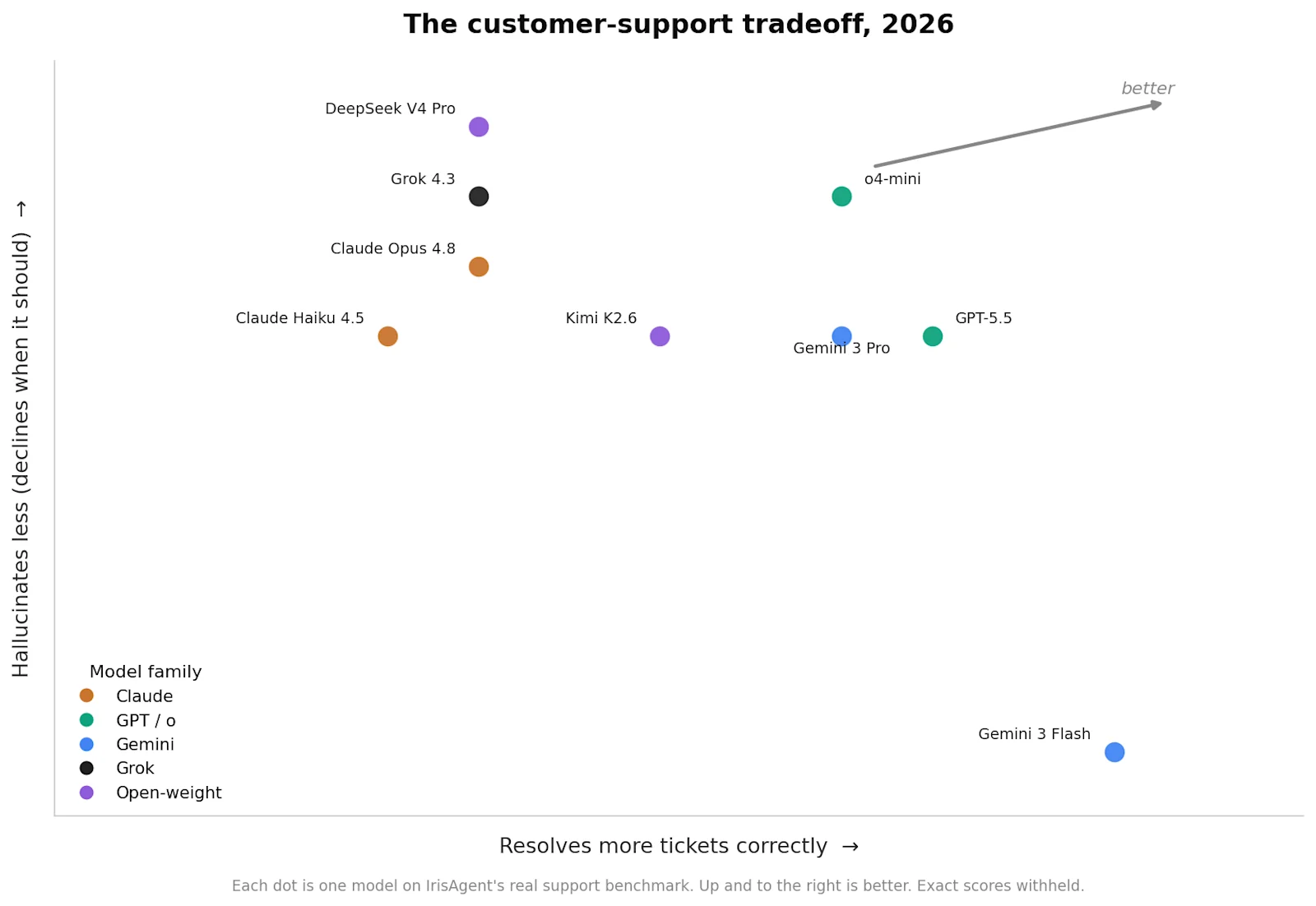
We are not going to hand you a table of raw scores. They move every time we re-run the suite, and frankly they say as much about our internal grading pipeline as about how a model will behave on your tickets. What holds up is the shape of the field. So here it is: every model plotted by how often it resolves answerable tickets (the horizontal axis) against how reliably it holds back when it should not answer (the vertical axis). Up and to the right is better, helpful and safe at the same time.
A few things jump out.
The leaders are not who you would expect. The model sitting furthest into the top-right corner, strong on both axes at once, is an open-weight model: DeepSeek V4 Pro, at a fraction of the price of the frontier flagships. Right behind it is Claude Opus 4.6. The “best” model for support is the one that refuses to be either reckless or timid, and increasingly that is no longer the most expensive name on the list.
Now find the dot alone in the bottom right. That model resolves almost every answerable ticket, a near-perfect score on the horizontal axis, and yet it would rank dead last overall, because it answers everything, including the questions it should have declined. On a generic leaderboard it looks like a winner. In production it is the model most likely to confidently tell a customer something false. This is the entire point of plotting both axes instead of one.
Which LLMs Specialize in Customer Service Tasks
If you want | Pick | Why |
Best overall balance | DeepSeek V4 Pro | Highest on resolution accuracy and hallucination resistance at once, at a fraction of frontier price (open-weight) |
Best proprietary option | Claude Opus 4.6 | Sits at the balanced, high-quality end just behind DeepSeek |
Best value | o4-mini | High resolution, fast, and reasonably priced |
Fastest for live chat | Grok 4.3 | Best speed-to-quality ratio, single-digit-second responses |
The hallucination axis above measures behaviour, not cause. If the underlying mechanism matters to your evaluation, why LLMs hallucinate breaks down the root causes, including why a model with no grounded source still produces a specific, confident answer rather than declining to answer at all.
The tradeoff, made concrete
The clearest way to see the tension is to look at the two ends of the chart.
Gemini 3 Flash
is the eager intern, alone in the bottom right. It resolves nearly everything, but its hallucination resistance is the worst on the chart. It will answer anything you put in front of it: wonderful when the answer exists, dangerous when it does not. On a generic leaderboard its resolution score makes it look like the winner. In production it is the model most likely to make something up.
DeepSeek V4 Pro
sits at the balanced end, up in the top right. It resolves nearly as much as the eager models, and in exchange it almost never makes things up. That combination, the strongest on the chart, is exactly what a high-stakes support team wants, and here it comes at open-weight prices.
Same dial, two positions. The eager model maximizes one number at the cost of the other. The balanced model gives up a few points of raw resolution to stay safe, and wins overall because in support, being wrong is far more expensive than being briefly unhelpful.
The important nuance: where a model lands is not purely a fixed property of the model. It is also a tuning decision. We saw this directly. An earlier configuration of Claude Opus 4.8 was truncating its own output and looked like it resolved only a fraction of its tickets. Once we fixed it, the same model jumped back into the front of the pack. Move the dial (prompt, retrieval thresholds, output limits, when to hand off) and the same model behaves very differently. The model sets your range. Your configuration sets your position on it.
Speed is the hidden third axis
Notice that two of the best all-rounders (Claude Opus 4.6 and Kimi K2.6) are also among the slowest to respond, on the order of a minute per answer. For an email or case-answer workflow, that is invisible. For a live chat widget where a customer is staring at a typing indicator, it is a dealbreaker.
This is why the fast tier matters so much. Grok 4.3, Gemini 2.0 Flash, and Claude Haiku 4.5 all land respectably on both axes while answering in single-digit seconds. For high-volume, latency-sensitive chat, these are the models that let you serve most traffic instantly and reserve a slower, more careful model for the hard escalations.
Open source has genuinely caught up
The biggest shift since our last benchmark is at the value end of the chart. Open-weight models are no longer the budget compromise.
DeepSeek V4 Pro sits at the very top-right of the chart, matching or beating every proprietary model on the combined picture while costing a fraction as much on output tokens. Kimi K2.6 is right there with it. For teams that care about cost control, data residency, or not being locked to a single vendor’s roadmap, the open-weight options are now first-class choices, not fallbacks. (We dug into this trend in depth in our 2025 open-source LLM breakdown.)
Beyond the scores: what each model family is actually good at
Our benchmark measures two things precisely. But choosing a model also means knowing the character of each family, the qualities that do not show up in a single accuracy column. Here is how the families behave in support workloads, based on our testing and the broader pattern of how each lab tunes its models.
Claude (Opus and Haiku). The careful one. Anthropic’s models lean toward “I would rather hand off than guess,” and within the Claude line Opus 4.6 and 4.8 post the strongest hallucination resistance, which makes the Opus family a default pick for regulated and high-stakes support. Claude is also unusually good at holding a brand voice and following multi-step instructions without drifting. The tradeoff is cost and, on the larger models, latency.
GPT and the o-series (OpenAI). The generalist. The GPT family is the safe, broadly capable default with the deepest ecosystem and the most mature tool-calling and function-calling, which matters a lot once your bot has to do things (look up an order, issue a refund, file a ticket) rather than just answer. GPT-4.1 and o4-mini are particularly strong value picks: high resolution, fast, reasonably priced. The flagship GPT-5.x models are excellent but priced at the top of the market.
Gemini (Google). The high-volume workhorse. Gemini’s strengths are very large context windows (useful when you want to stuff long knowledge-base articles or whole conversations into a single prompt), native multimodal handling (screenshots, photos of a broken product, PDFs), and an exceptionally strong cheap-and-fast tier. Gemini 2.0 Flash answers in ~3.6 seconds at roughly a dime per million input tokens. The catch, as our data shows, is that the fastest Gemini models can be over-eager and need tight grounding to keep hallucinations in check.
Grok (xAI). The balanced speedster. Grok 4.3 posted one of the best speed-to-quality ratios in the test: single-digit-second responses with solid scores on both axes. A strong candidate for live chat.
Open-weight models (DeepSeek, Kimi, GLM). The control option. These now match or beat the proprietary models on quality while costing a fraction as much, and because you can self-host them, they are the answer when data residency, privacy, or vendor independence is non-negotiable. The practical cost is operational: you (or your vendor) own the hosting, scaling, and reliability.
The checklist: what to weigh before you commit
The original version of this post laid out the dimensions that actually decide a support deployment. They still hold, so here is the 2026 version of the checklist:
Resolution accuracy. Can it answer correctly when the answer exists? Necessary, but not sufficient on its own.
Hallucination resistance. Will it shut up when it should? The single most underrated metric, and the one most likely to cause real damage if you ignore it.
Speed. Email and case workflows tolerate slow models. Live chat does not. Match the tier to the channel.
Cost. Per-token price times your volume times your average context size. A “cheap” model with a huge retrieved context can cost more than a pricier model with tight retrieval. Model the real number.
Instruction following and tone. Can it stay on-brand, follow your escalation rules, and return structured output (JSON, specific formats) reliably? This is where Claude and the frontier GPT models shine.
Proprietary vs open-weight. Closed models are turnkey. Open-weight models give you cost control, data residency, and no lock-in, at the price of running them yourself.
No single model wins all six. The right choice is the one that wins the dimensions your business cannot compromise on.
Where this is heading
Two shifts are worth planning for. First, the gap between proprietary and open-weight models has effectively closed on support tasks, so vendor lock-in is now a choice rather than a necessity. Second, the frontier is moving from “answer the question” to “take the action,” meaning tool use, multi-step agentic workflows, and multimodal inputs (a customer’s screenshot, a photo of a damaged item) are becoming table stakes. The models that win the next round will be the ones that can safely act, not just respond. That raises the stakes on hallucination resistance even further: a model that invents a fact is bad; a model that invents an action is worse.
So which one should you pick?
The honest answer is that the model is no longer the hard part. Here is how we think about matching the model to the business, the same way we framed it in the original post:
High-stakes, low-tolerance-for-error support
(airlines, financial services, healthcare, enterprise B2B): lean toward the high-hallucination-resistance end. The strongest there are the open-weight DeepSeek V4 Pro and Kimi K2.6, followed by Grok 4.3 and Claude Haiku 4.5; among the flagship Claude models, Opus 4.6 and 4.8 hold the line best. The cost of one confidently wrong answer about billing or eligibility dwarfs the cost of an extra human handoff.
High-volume, cost-sensitive support
(e-commerce, gaming, freemium SaaS): the fast value tier is your friend. Grok 4.3, Gemini 2.0 Flash, and the open-weight models give you strong accuracy at low cost and low latency, with safeguards layered on top.
Live chat where speed is non-negotiable:
start with a fast model (Grok 4.3, Gemini 2.0 Flash, Claude Haiku 4.5) as your default and escalate the genuinely hard tickets to a slower, more careful model.
And keep cost in perspective. A cheaper model that hallucinates is the most expensive option of all. Prices also move month to month, so treat the dollar figures above as a snapshot and run your own numbers against your real traffic mix.
The part the leaderboard does not show
Here is the truth behind every number above: the model is maybe 20% of what makes a support bot good.
Every model in our test got the same retrieval, the same grounding, the same tools, and the same carefully built agentic setup. That scaffolding is why even the middle of the table is production-viable. Swap in a naive “stuff the docs in the prompt and hope” setup and the best model on this list will hallucinate its way to the bottom.
What actually moves the needle in production:
Retrieval quality.
If the right article never makes it into context, no model can answer correctly. Most “the AI hallucinated” failures are really retrieval failures.
Grounding and citations.
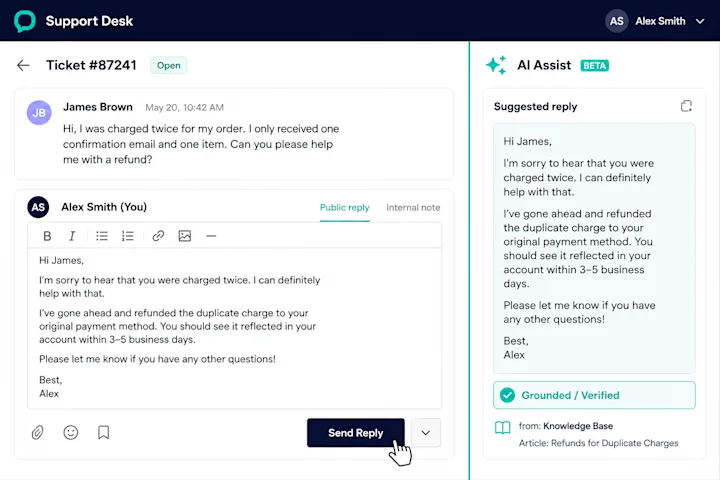
Forcing answers to cite their sources, and refusing when nothing relevant is retrieved, is what keeps hallucination resistance high regardless of which model you use.
Knowing when to hand off.
As the Gemini-3-Flash-versus-DeepSeek-V4-Pro contrast shows, the answer-versus-decline decision is the whole ballgame. That logic lives in your orchestration, not in the raw model.
Continuous evaluation.
The only reason we can publish this table is that we run this benchmark on every model and prompt change. If you are not measuring resolution and hallucination on your own real tickets, you are flying blind.
This is exactly the layer IrisAgent's AI for customer support is built around. We run model-agnostic on top of frontier and open-weight LLMs, with retrieval, grounding, hallucination detection, and continuous evaluation tuned on your real support data. You get top-of-table balance without rebuilding the scaffolding yourself, and without being locked to one vendor’s model when the leaderboard reshuffles again next quarter (and it will).
The bottom line
There is no single best LLM for customer support, and anyone who hands you one number is selling you something. The latest models are all capable. What separates a support bot customers trust from one they learn to ignore is where you set the dial between answering and declining, how fast you answer, and everything wrapped around the model: retrieval, grounding, escalation, and relentless evaluation on your own data.
Pick a model that matches your tolerance for risk. Then spend your real energy on the other 80%.
Want to see how this performs on your support tickets, not our benchmark? Book a demo with IrisAgent and we will run your real cases through it.
Frequently Asked Questions
Which LLMs specialize in providing customer service and chatbot functionalities?
No major LLM is purpose-built only for customer service, so the real question is which model's strengths match which support job. From our 2026 production testing on real support tickets, the split is consistent. Claude models specialize in hallucination resistance, correctly declining when a knowledge base has no answer, which matters most on policy, billing, and account questions where a confident wrong answer creates liability. GPT-5.x models specialize in instruction following and tone control, which suits high-variance conversational queues. Gemini 3 Flash and Claude Haiku specialize in latency and cost at volume, making them the practical choice for live chat and tier-one deflection. Open-weight models such as DeepSeek and Kimi now match closed models on resolution accuracy for self-hosted and data-residency-constrained deployments. In production the model is rarely the deciding factor: retrieval quality, grounding, and escalation thresholds move resolution rate more than swapping model families does.
How did IrisAgent test these LLMs for customer support?
We ran each model inside the exact production setup we ship to customers, not a stripped-down demo, using roughly 100 real, anonymized support tickets across billing, account access, product how-to, troubleshooting, and policy questions. We graded two separate sets: a resolution set of questions that genuinely have a correct answer in the customer's knowledge base, scored against the real article content rather than just the title, and a hallucination set of questions with no answer in the knowledge base, to measure whether the model correctly held back instead of guessing.
Which LLM is best for a customer support chatbot in 2026?
There is no single best LLM for a customer support chatbot. The right model depends on two metrics that matter in support: resolution accuracy (answering correctly when the answer exists) and hallucination resistance (holding back when it does not). In IrisAgent's 2026 benchmark on real tickets, the open-weight DeepSeek V4 Pro sat highest on both axes at once, with OpenAI's o4-mini and Grok 4.3 close behind at lower cost and faster speeds.
What is the best open-source LLM for customer support?
DeepSeek V4 Pro is currently the strongest open-weight LLM for customer support, matching or beating proprietary models on combined resolution and hallucination resistance while costing a fraction as much on output tokens. Kimi K2.6 resolves nearly as well but gives up more ground on hallucination resistance and is slower. Open-weight models are the right choice when data residency, privacy, or vendor independence is non-negotiable.
Do LLMs hallucinate in customer support?
Yes. Ungrounded large language models hallucinate in 15 to 30% of customer service responses, inventing refund policies, features, or account details that do not exist. The fix is not picking a smarter model. It is grounding every answer in your verified knowledge base, validating responses against source documents, and declining when nothing relevant is retrieved. IrisAgent's Hallucination Removal Engine brings the error rate under 5%.
Is GPT-5 or Claude better for a customer support chatbot?
They optimize for different things. The GPT and o-series models are the broadly capable default with the deepest, most mature tool-calling, which matters once your bot has to look up orders or issue refunds. The Claude family (Opus 4.8 and the cheaper, faster Haiku 4.5) leans toward declining rather than guessing, which makes it a strong pick for regulated and high-stakes support. For high-volume chat, o4-mini and Claude Haiku 4.5 both deliver strong accuracy in single-digit-second responses.
How fast does an LLM need to be for live chat?
For a live chat widget, answers should return in single-digit seconds, because the customer is watching a typing indicator. Claude Haiku 4.5, Grok 4.3, and o4-mini all hit that bar while scoring well on accuracy and hallucination resistance. The strongest open-weight models like DeepSeek V4 Pro and Kimi K2.6 can take half a minute or more per answer, which is fine for email and case workflows but a dealbreaker for live chat.
Does the model matter most for a good support bot?
No. The model is roughly 20% of what makes a support bot good. Retrieval quality, grounding and citations, knowing when to hand off, and continuous evaluation on your own real tickets matter more. Most AI hallucination failures are actually retrieval failures: the right knowledge base article never made it into context. Swap a strong model into a naive setup and it will hallucinate its way to the bottom of the chart.
Loading the form. Prefer email? Reach us at info@irisagent.com or call +1 617 249 3312.