
AI for KYC and Identity Verification Customer Support in Fintech
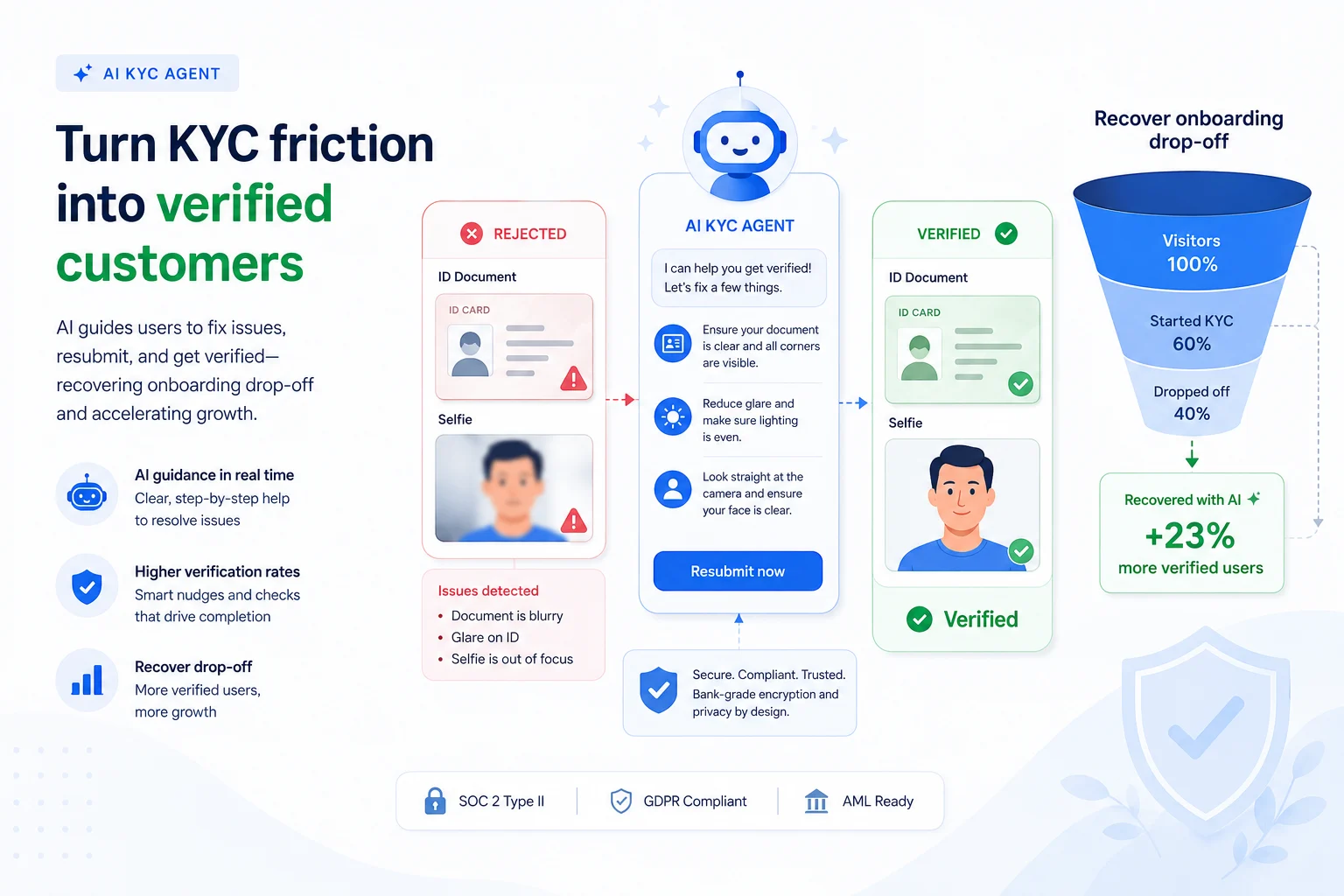
AI for KYC and identity verification support means an AI agent resolves the tickets that pile up around identity checks during fintech onboarding: it explains exactly which documents are needed, tells the customer why a submission was rejected and how to fix it, checks live verification status, and guides resubmission, in seconds and in the customer's language. This matters because identity verification is the single biggest drop-off point in fintech onboarding. Every customer who abandons at a rejected ID is lost revenue at the most expensive point in your funnel. IrisAgent automates this verification-support workflow end to end while escalating genuine compliance edge cases to a human, so onboarding conversion goes up without weakening your KYC controls.
That is the headline. The rest of this guide is the operator's version: why KYC friction kills conversion, which verification tickets to automate, where the line is between support automation and the compliance decision itself, and what to measure.
Key takeaways - Identity verification is where fintech onboarding goes to die. A blurry photo, an unsupported document, or an unexplained rejection, and a customer minutes from funding an account simply gives up. - AI should automate the support around KYC (explaining requirements, decoding rejections, checking status, guiding resubmission), not the compliance decision itself. - The four workflows worth automating first: document-requirement questions, rejection explanations, verification-status checks, and resubmission guidance. - The non-negotiable guardrail: the AI never approves or denies a KYC decision. It helps the customer get a clean submission in front of your compliance system and escalates true edge cases to a human. - Track three numbers: onboarding completion rate, verification-ticket resolution rate, and time-to-verified.
Why KYC friction kills onboarding conversion
Fintech onboarding has a brutal funnel. A customer downloads the app, gets excited, starts the flow, and then hits identity verification. They have to photograph a government ID, sometimes take a selfie, sometimes prove an address. Any small failure here ends the journey.
The failure modes are mundane and constant: a blurry photo, an unsupported document type, a name that does not match the application, an address document that is too old, a glare on the ID, an expired passport. The verification system rejects the submission, often with a cryptic error code, and the customer is left confused and frustrated at exactly the moment they were about to become a funded account.
Signicat and other onboarding researchers have repeatedly found that a large share of would-be fintech customers abandon during identity verification, and that the abandonment is driven less by unwillingness than by friction and confusion. The customer wanted to finish. They just could not figure out what went wrong.
This is a support problem disguised as a product problem. The verification engine is doing its job. What is missing is the layer that helps a stuck customer understand the rejection and recover, instantly, at 2 a.m., in their own language. That layer is what AI provides.
The cost-of-doing-nothing math
Identity verification drop-off is expensive in a way that ordinary support tickets are not, because the lost customer never becomes a customer at all. If you are acquiring users at a meaningful cost per install and a measurable percentage abandon at KYC, every point of recovered completion flows straight to revenue and pays back your entire acquisition spend on those users.
A human support team cannot economically catch these customers in real time. By the time an agent responds to "my ID got rejected," the customer has already closed the app. AI closes that gap by responding in the moment of frustration, inside the onboarding flow, before the customer gives up.
The four KYC support workflows worth automating first
Start with the high-volume, rule-bound interactions that do not require a compliance officer's judgment.
1. Document-requirement questions
"What documents do I need?" and "Do you accept a driver's license?" are pure information tickets. The AI answers them precisely based on the customer's country, account type, and your accepted-document rules, before a bad submission ever happens. Preventing the wrong upload is cheaper than explaining a rejection.
2. Rejection explanations
This is the highest-value workflow. When a submission is rejected, the AI translates the verification engine's error code into plain language: the photo was too blurry, the document was expired, the name did not match the application. The customer finally understands what went wrong, which is the prerequisite for fixing it. This is the core of the automate KYC and identity verification use case.
3. Verification-status checks
"Is my verification done yet?" generates a steady stream of anxious tickets, because customers are waiting to use money. The AI checks live status against your verification provider and gives a straight answer: approved, still processing, or needs resubmission, removing the uncertainty that drives repeat contacts.
4. Resubmission guidance
Once the customer understands the rejection, the AI walks them step by step through a clean resubmission: better lighting, the right document, a matching name, and confirms when the new submission lands. This is the difference between a recovered account and an abandoned one.
The critical line: support automation versus the compliance decision
This is the part that separates a responsible deployment from a reckless one.
The AI must never make the KYC decision. It does not approve or deny identities. It does not override your verification provider. It does not decide whether a customer passes anti-money-laundering screening. Those are regulated compliance functions that belong to your compliance system and your compliance team, governed by frameworks like FATF customer due diligence guidance and, in the US, the expectations the CFPB set out in its 2023 spotlight on chatbots in consumer finance.
What the AI does is everything around that decision: it helps the customer get a clean, correct submission in front of your compliance system, explains outcomes the system produced, and escalates anything ambiguous to a human. When a case looks like a genuine compliance edge case (a possible identity mismatch, a sanctions-list near-hit, a suspicious pattern), the AI does not improvise. It routes to a compliance specialist with full context. This handoff discipline is the same principle that governs agent assist: the AI does the legwork and the human owns the judgment call.
Get this line right and AI lifts conversion while strengthening your controls, because more customers reach a clean submission and humans spend their time only on the cases that truly need them. Get it wrong and you have automated a compliance liability. The architecture has to enforce the boundary, not rely on a prompt to remember it.
What "AI resolves a verification ticket" looks like end to end
Here is the workflow for a customer whose ID was just rejected.
Trigger. The verification provider returns a rejection, or the customer messages "my ID was rejected."
Authentication. The AI matches the customer to their onboarding application and pulls the verification record.
Rejection decoding. The AI reads the provider's error code and the submission metadata, then explains in plain language what failed.
Guidance. The AI tells the customer exactly how to fix it and what a good resubmission looks like for their document type and country.
Resubmission. The customer resubmits inside the flow. The AI confirms receipt and checks the new status.
Escalation if needed. If the case is a compliance edge case rather than a quality issue, the AI routes it to a human specialist with the full record attached. It never makes the call itself.
The customer goes from confused-and-leaving to verified-and-funded in minutes, at any hour, without a human agent on routine cases. This is the same agentic capability the AI customer support for financial services and fintech page describes, applied to the onboarding funnel where it has the most revenue leverage.
How KYC support AI fits the rest of your fintech support stack
Onboarding verification is one slice of fintech support. The same AI agent that recovers a stuck KYC submission also handles the post-funding tickets that follow: card activation, failed transfers, and transaction disputes. Those flows are covered on the card activation, failed transfers, and transaction disputes use cases, and the strategic picture of where AI fits across the regulated fintech support journey lives on the fintech support AI hub.
For the wider context on AI in regulated financial support, see our guide on AI customer service for banking and financial services and the piece on AI's role in redefining fintech customer support. The general product capability is covered on the AI for customer support page.
What to measure
Three numbers tell you whether KYC support automation is working.
Onboarding completion rate: the share of customers who start verification and finish a funded account. This is the revenue number and the one that justifies the project.
Verification-ticket resolution rate: the share of verification tickets the AI closes without a human. Watch this climb as the AI learns your document rules and rejection patterns.
Time-to-verified: how long it takes a stuck customer to go from rejection to a clean, approved submission. Shrinking this is what recovers customers before they abandon.
Model the revenue impact of recovered onboarding with the ROI calculator.
Frequently Asked Questions
Does AI make the KYC approval decision?
No. The AI handles the support around verification: explaining document requirements, decoding rejections, checking status, and guiding resubmission. It never approves or denies an identity. The compliance decision stays with your verification system and your compliance team, and edge cases escalate to a human.
How does AI reduce KYC onboarding drop-off?
It responds in the moment of friction. When a customer's document is rejected, the AI immediately explains why in plain language and walks them through a clean resubmission, instead of leaving them confused with a cryptic error code. That real-time recovery is what turns an abandoning customer into a funded account.
Is AI for KYC support compliant?
It can be, when designed correctly. The AI stays on the support side of the line, never making the regulated compliance decision, and escalates true compliance edge cases to a human specialist with full context. Keeping that boundary in the architecture is what makes the deployment safe under guidance from bodies like the CFPB and FATF.
What verification systems does this work with?
The approach integrates with common identity-verification and KYC providers through their APIs to read submission status and rejection reasons, then layers the support and resubmission guidance on top.
Loading the form. Prefer email? Reach us at info@irisagent.com or call +1 617 249 3312.