

Best Decagon Alternatives in 2026: 6 Tools Compared
Last updated: June 2026
The best Decagon alternatives in 2026 are IrisAgent, Intercom Fin, Ada, Sierra, Forethought, and Freshworks Freddy AI. The right choice depends on three things: whether you want to keep your existing helpdesk, whether you want flexible and predictable pricing, and whether you can wait weeks to deploy. IrisAgent leads the list for teams that want grounded, hallucination-free answers without a rip-and-replace project.
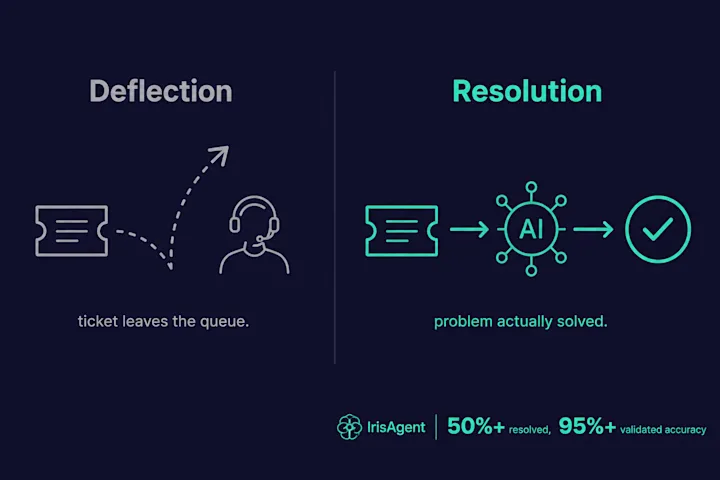
IrisAgent's Hallucination Removal Engine holds validated accuracy above 95% across enterprise deployments including Dropbox, Zuora, and Teachmint, and it deploys in 24 hours on the helpdesk you already run. That combination is the core reason support leaders evaluate a Decagon alternative in the first place: they want the resolution rate without the six-week build or the six-figure floor.
This guide compares six genuine Decagon alternatives. For each one, you get where it wins, where it does not, and who it fits best. Credit where it is due: Decagon is a capable enterprise platform, and a few of these competitors beat IrisAgent on specific dimensions. The goal here is to help you decide, not to sell you a single answer.
Why Teams Look for a Decagon Alternative
Decagon is built for large enterprises running agentic AI support. It is a strong product for that buyer. The friction shows up when a team that is not a Fortune 500 tries to adopt it, or when the total cost and timeline do not match the urgency of the project.
Three patterns drive most of the searches for a Decagon alternative.
First, cost. Decagon does not publish pricing. Public breakdowns put the platform fee at roughly $50,000 per year on top of per-conversation or per-resolution charges, with median annual contracts reported near $386,000 (source: eesel AI, 2026). That floor prices out most mid-market teams.
Second, time to value. Decagon's onboarding is a structured enterprise engagement that runs about six weeks: discovery, Agent Operating Procedure development, testing, and a controlled rollout. For a support leader who needs to show results this quarter, six weeks of nothing is a hard sell to the CFO.
Third, control and configuration. Decagon's Agent Operating Procedures (AOPs) blend natural language with code, and teams report needing developer involvement and Git version control to manage AI behavior. Some users also describe the configured agent as a black box: it works, but it is hard to see why it made a given decision.
If any of those three apply to you, the alternatives below solve at least one of them directly.
What to Look for in a Decagon Alternative
Before you compare vendors, set your criteria. The following six factors separate a tool that resolves real tickets from one that just demos well.
Helpdesk independence. Does the AI layer on top of Zendesk, Salesforce, Intercom, or Freshdesk, or does it force you to replace your helpdesk? A layer ships faster and carries less risk.
Grounded accuracy. Does every answer get validated against your knowledge base before it sends, or can the model make things up? Ungrounded models hallucinate on 15% to 30% of responses.
Pricing model. Can you choose a model that fits your business, usage-based or resolution-based, or are you locked into one structure with a six-figure floor? Flexible, predictable pricing protects your budget as volume climbs.
Time to deploy. Can you go live in 24 hours, or is it a multi-week implementation with a services contract attached?
No-code configuration. Can a support ops lead change workflows and tone, or does every change need an engineer and a code review?
Built-in QA and monitoring. Can you score every AI and human conversation continuously, or are you back to sampling 5% by hand?
Score each alternative against these six, and the right fit for your team usually becomes obvious.
The 6 Best Decagon Alternatives in 2026
1. IrisAgent
IrisAgent is the AI support resolution platform that automates 50%+ of tickets with grounded answers, no hallucinations, and 24-hour deployment. It layers onto your existing helpdesk instead of replacing it, and it prices flexibly so you can match the model to your business.
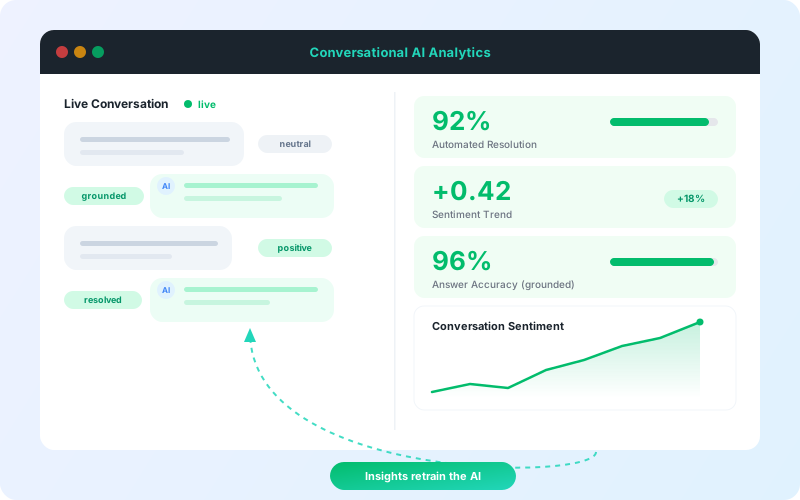
Where it wins: IrisAgent's Hallucination Removal Engine validates every response against your knowledge base and past tickets before delivery, holding validated accuracy above 95%. It deploys in 24 hours on Zendesk, Salesforce, Intercom, or Freshdesk, so the first ticket resolves the same day. Pricing is flexible, with usage-based and resolution-based options and no $50,000 platform floor, so you choose the model that fits your volume instead of inheriting Decagon's enterprise minimum. AutoQA scores 100% of AI and human conversations against your rules, the kind of monitoring that sits buried inside Decagon's Watchtower.
Where it does not: IrisAgent is not the right pick if you actually want to rip out your helpdesk and run everything inside one vendor's platform. Very small teams handling under 50 tickets a day will not see the same return. And as a younger brand than Sierra or Decagon, IrisAgent does not carry the same boardroom name recognition, even though the accuracy numbers hold up.
Best for: mid-market and enterprise SaaS teams (roughly 200 to 2,000 employees) that want grounded resolution on the helpdesk they already own. See the full IrisAgent vs Decagon comparison for a feature-by-feature breakdown.
2. Intercom Fin
Fin by Intercom is one of the most widely deployed AI agents on the market, and it is the natural alternative if your support already lives in Intercom.
Where it wins: Fin sets up quickly inside Intercom, draws on a large reference base, and runs on a vertical support model that Intercom tunes specifically for resolution. If you are already an Intercom shop, the native experience is hard to beat.
Where it does not: Fin charges $0.99 per resolution on top of $29 to $132 per seat, plus a $35 copilot add-on. That stack gets unpredictable as volume grows, and the per-resolution fee means success raises your bill. Reviewers also note that setup is harder than the marketing claims, and that Fin struggles on complex, multi-step queries. Outside the Intercom ecosystem, the value drops.
Best for: teams already standardized on Intercom that can absorb usage-based pricing. Compare the two directly on the IrisAgent vs Intercom page.
3. Ada
Ada is a mature agentic CX platform with deep enterprise credentials and broad international reach.
Where it wins: Ada supports customers across 85+ countries with strong multilingual coverage, and it carries serious compliance posture (HIPAA, SOC 2, GDPR). For a global enterprise with heavy security review, Ada clears the bar.
Where it does not: Ada charges $1 to $3.50 per resolution, so like Fin and Decagon, your cost scales with your success. Customers describe the implementation as large and time-consuming, and Ada cannot natively ingest some common knowledge sources such as PDFs, Confluence, or Notion without extra work. Pricing is quote-only, so budgeting takes a sales cycle.
Best for: global enterprises that need wide language coverage and can fund a longer rollout. See the IrisAgent vs Ada comparison for the details.
4. Sierra
Sierra is the enterprise agent platform from Bret Taylor's team, and it carries the strongest brand in the category.
Where it wins: Sierra delivers a polished agent experience, real engineering depth, and an outcome-based pricing model that some large enterprises prefer because they only pay on results. The brand alone gets it into Fortune 500 evaluations.
Where it does not: Sierra starts around a $150,000 annual minimum plus $50,000 to $200,000 in setup services, which prices it out of the mid-market entirely. Implementation is slow, and like Decagon, it often means replacing rather than augmenting your existing stack. Some G2 reviewers describe generic responses despite the premium price.
Best for: Fortune 500 teams with a large budget and an appetite for a full platform commitment. The IrisAgent vs Sierra comparison covers the tradeoffs.
5. Forethought (Now Part of Zendesk)
Forethought is a solid AI support tool that was acquired by Zendesk in March 2026, which changes its outlook.
Where it wins: Forethought has a strong track record in ticket triage, discovery, and routing, and it fits naturally if you are already a Zendesk customer. The Zendesk acquisition could deepen that native integration over time.
Where it does not: the acquisition also creates roadmap and lock-in uncertainty while the products merge. Forethought historically required a 20,000-ticket minimum and a 30 to 90 day implementation, both of which are heavier than a 24-hour deploy. If you are not on Zendesk, the strategic fit is now weaker than it was a year ago.
Best for: established Zendesk shops with high ticket volume that are comfortable betting on the combined roadmap. The IrisAgent vs Forethought comparison sits alongside the rest of the alternatives.
6. Freshworks Freddy AI
Freddy AI is Freshworks' built-in AI agent, and it is the easiest path if you already run Freshdesk or Freshworks.
Where it wins: Freddy is native to the Freshworks suite, so there is no separate integration project. It switches on quickly, and session-based pricing can be reasonable for teams at lower volume. For a Freshworks customer who wants AI without adding a vendor, Freddy is the path of least resistance.
Where it does not: Freddy is tied to the Freshworks ecosystem, so the value drops if you run a different helpdesk. It offers less depth on grounding and hallucination control than a purpose-built platform, and it is weaker on complex, multi-step resolution that needs to read a customer's account and take action in a backend system.
Best for: existing Freshworks and Freshdesk teams that want native AI with minimal setup.
Decagon Alternatives Compared
This table summarizes how the six alternatives stack up on the factors that matter most when replacing or avoiding Decagon.
Tool | Helpdesk model | Pricing | Time to deploy | Grounded accuracy |
|---|---|---|---|---|
IrisAgent | Layers on existing helpdesk | Flexible: usage or resolution based, no platform floor | 24 hours | 95%+ validated |
Decagon | Often replaces helpdesk | ~$50K+ fee plus per-conversation | ~6 weeks | No dedicated engine |
Intercom Fin | Native to Intercom | $0.99/resolution plus seats | Days, setup varies | Vertical model |
Ada | Standalone platform | $1 to $3.50/resolution | Weeks | Minimization, not removal |
Sierra | Often replaces helpdesk | $150K+ plus setup | Weeks | Generalist agent |
Forethought | Native to Zendesk | Quote-based | 30 to 90 days | Triage-focused |
Freshworks Freddy | Native to Freshworks | Session-based | Days | Ecosystem-dependent |
How to Choose the Right Decagon Alternative
Start from your stack, not the vendor's pitch. If your support runs on Zendesk, Salesforce, Intercom, or Freshdesk and you do not want to replace it, prioritize a tool that layers on top. That alone removes the heaviest cost and risk in any AI support rollout.
Then weigh the pricing model against your growth. The risk is not usage-based pricing itself, it is being locked into one rigid structure with a high floor, the way Decagon pairs a six-figure minimum with per-conversation fees. Look for a vendor that lets you choose the model that fits, and check whether the floor and per-seat add-ons fit your budget at scale. IrisAgent, for example, offers both usage-based and resolution-based options with no platform minimum. If you are choosing between several options at once, the IrisAgent vs alternatives overview lays the field out side by side.
Finally, insist on grounding. The single biggest risk in support AI is a confident wrong answer in front of a customer. Ask every vendor how they validate a response before it sends, and ask to see the accuracy number. IrisAgent's answer is the Hallucination Removal Engine and a documented 95%+ validated accuracy. Make each vendor show you theirs.
Next Steps
The best Decagon alternative is the one that fits your helpdesk, your budget, and your timeline. To recap the shortlist:
IrisAgent for grounded, hallucination-free resolution on your existing helpdesk with flexible pricing and a 24-hour deploy.
Intercom Fin if you already live in Intercom and can absorb per-resolution fees.
Ada for global enterprises that need wide language coverage.
Sierra for Fortune 500 teams with the budget for a full platform.
Forethought for high-volume Zendesk shops betting on the combined roadmap.
Freshworks Freddy for Freshworks-native teams that want minimal setup.
If grounded accuracy and speed are your priorities, the fastest way to test a Decagon alternative is to run it against your own tickets. Book a 20-minute IrisAgent demo and see the first ticket resolve the same day, on the helpdesk you already use.
Frequently Asked Questions
What is the best Decagon alternative?
The best Decagon alternative depends on your stack and budget, but IrisAgent leads for most teams. It automates 50%+ of tickets with grounded, hallucination-free answers, deploys in 24 hours on your existing helpdesk, and offers flexible usage-based or resolution-based pricing with no platform floor. Strong alternatives also include Intercom Fin, Ada, Sierra, Forethought, and Freshworks Freddy AI, each fitting a different helpdesk and price point.
How much does Decagon cost?
Decagon does not publish a price. Contracts are quote-only. Third-party procurement data (Vendr) has shown six-figure annual contracts. IrisAgent publishes Standard from $500/month. The sharper contrast: Decagon AOPs version in Git and engineering keeps the tools; IrisAgent is no-code on the helpdesk.
Why do companies look for Decagon alternatives?
Three reasons drive most Decagon alternative searches: quote-only enterprise pricing, a six-week engineering-led build, and AOPs that live in Git so engineering keeps the tools. Teams that want grounded accuracy this quarter on the helpdesk they already have usually evaluate a no-code overlay instead.
Does Decagon take six weeks to implement?
Yes. Decagon's onboarding is a structured enterprise engagement that runs about six weeks, covering discovery, Agent Operating Procedure development, testing, and a controlled rollout. For support leaders who need results in the current quarter, that timeline is a hurdle. By comparison, IrisAgent layers onto your existing helpdesk and deploys in 24 hours, so the first ticket can resolve the same day.
Is IrisAgent a good Decagon alternative?
IrisAgent is a strong Decagon alternative for mid-market and enterprise SaaS teams that want to keep their helpdesk. Its Hallucination Removal Engine holds validated accuracy above 95%, it deploys in 24 hours on Zendesk, Salesforce, Intercom, or Freshdesk, and pricing is flexible, with usage-based and resolution-based options and no platform floor. It is less suited to teams that actually want to replace their helpdesk entirely, where Decagon or Sierra fit better.

Loading the form. Prefer email? Reach us at info@irisagent.comor call +1 617 249 3312.