
What Is Retrieval-Augmented Generation (RAG)?
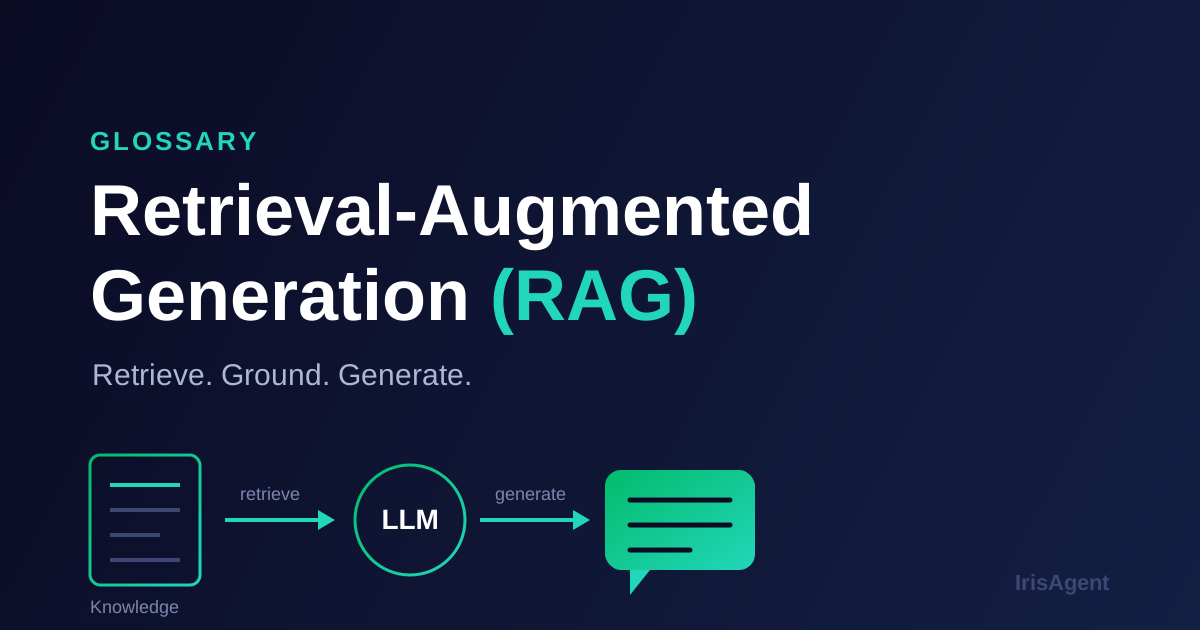
Retrieval-augmented generation (RAG) is an AI technique that retrieves relevant information from an external knowledge source at the moment a question is asked, then feeds that information to a large language model so the answer is grounded in real, verifiable content instead of the model's training data alone. RAG is the dominant method for making AI answers accurate, current, and traceable to a source, which is why it sits at the core of most enterprise customer support AI.
What Is Retrieval-Augmented Generation?
Retrieval-augmented generation combines two systems: a retriever that finds relevant documents, and a generator (a large language model) that writes the answer. On its own, an LLM answers from patterns learned during training, so it cannot know your refund policy, your latest release notes, or anything published after its cutoff date. RAG closes that gap. It looks up the right information from a knowledge base you control, hands that text to the model as context, and asks the model to answer using it.
The result is an answer that reflects your actual content, can cite the source it came from, and stays up to date the moment you update the underlying document. No model retraining required.
How Does RAG Work?
A RAG system runs in four steps:
Indexing: Your knowledge (help center articles, product docs, past tickets, policies) is split into chunks and converted into numeric representations called embeddings, then stored in a vector database.
Retrieval: When a customer asks a question, the system converts the question into an embedding and searches the vector database for the chunks whose meaning is closest to the question. This is semantic search, so it matches on intent, not just keywords.
Augmentation: The most relevant chunks are inserted into the prompt alongside the original question, giving the model the exact context it needs.
Generation: The large language model reads the question plus the retrieved context and writes an answer grounded in that source material, often with a citation back to the document.
Many production systems add a reranking step between retrieval and generation to push the single most relevant passage to the top, and a validation step after generation to confirm the answer is actually supported by the retrieved source.
RAG vs Fine-Tuning
RAG and fine-tuning are often compared, but they solve different problems.
Retrieval-Augmented Generation | Fine-Tuning | |
|---|---|---|
What it changes | The information given to the model at query time | The model's internal weights |
Best for | Factual accuracy, fresh knowledge, citations | Tone, format, and specialized skills |
Updating knowledge | Edit the source document, changes apply instantly | Retrain the model |
Cost to maintain | Low | High |
Traceable to a source | Yes | No |
For customer support, where answers must reflect current policy and be defensible, RAG is usually the right foundation. Fine-tuning is a complement, useful for locking in voice and structure, not for teaching the model facts.
Why RAG Matters in Customer Support
An ungrounded chatbot hallucinates on roughly 15% to 30% of responses, inventing policies, steps, and details that sound convincing but are wrong. In support, that is not a harmless quirk. It is a wrong answer sent straight to a customer, and it can create commitments the business never made.
RAG is the primary defense. By forcing the AI to answer from your verified knowledge base, it keeps responses tied to what your company has actually documented. It also means the AI improves the instant your content does: update an article, and every future answer reflects the change.
IrisAgent builds on retrieval-augmented generation and adds a validation layer that checks each answer against the source it cites before sending. The result is validated accuracy above 95% across enterprise deployments including Dropbox, Zuora, and Teachmint, compared with the 15% to 30% hallucination rate of ungrounded systems.
Learn More About RAG and Grounded AI
RAG is one part of a broader discipline for keeping AI answers accurate. For the wider technique it belongs to, read Grounding LLMs: Innovating Performance and Productivity. To understand the failure mode RAG prevents, read What Is an AI Hallucination?. For background on the models RAG feeds, see Understanding LLM: Large Language Model and Best LLMs for Customer Support Chatbots.
To see retrieval and validation working together in production, explore the AI customer support platform and how IrisAgent keeps every answer accurate and grounded in your sources.
Frequently Asked Questions
What is retrieval-augmented generation in simple terms?
Retrieval-augmented generation (RAG) is a way of making an AI answer from real, up-to-date information instead of only what it memorized during training. When a question comes in, the system searches a knowledge base you control, finds the most relevant content, and hands it to the language model to write the answer. The result is grounded in your actual sources and can cite where it came from.
What is the difference between RAG and fine-tuning?
RAG changes the information you give the model at the moment it answers, while fine-tuning changes the model's internal weights through retraining. RAG is best for factual accuracy, fresh knowledge, and citations, and you update it by editing a document. Fine-tuning is best for locking in tone, format, and specialized skills. For customer support, RAG is usually the foundation and fine-tuning is a complement.
Does RAG stop AI hallucinations?
RAG sharply reduces hallucinations by forcing the model to answer from retrieved, verified sources rather than guessing, but retrieval alone does not guarantee accuracy. The strongest systems add a validation step that checks each answer against the source it cites before sending. IrisAgent pairs retrieval with that validation layer to reach validated accuracy above 95%, versus the 15% to 30% hallucination rate of ungrounded chatbots.
Why is RAG used in customer support?
Support answers have to reflect current policy and be defensible, and an ungrounded model cannot know your refund rules or latest release notes. RAG grounds every answer in your help center, product docs, and past tickets, so responses match what your company has actually documented. It also updates instantly: change an article and every future answer reflects it, with no retraining.
Loading the form. Prefer email? Reach us at info@irisagent.com or call +1 617 249 3312.