
What Is Ticket Routing? Definition, Methods & Best Practices
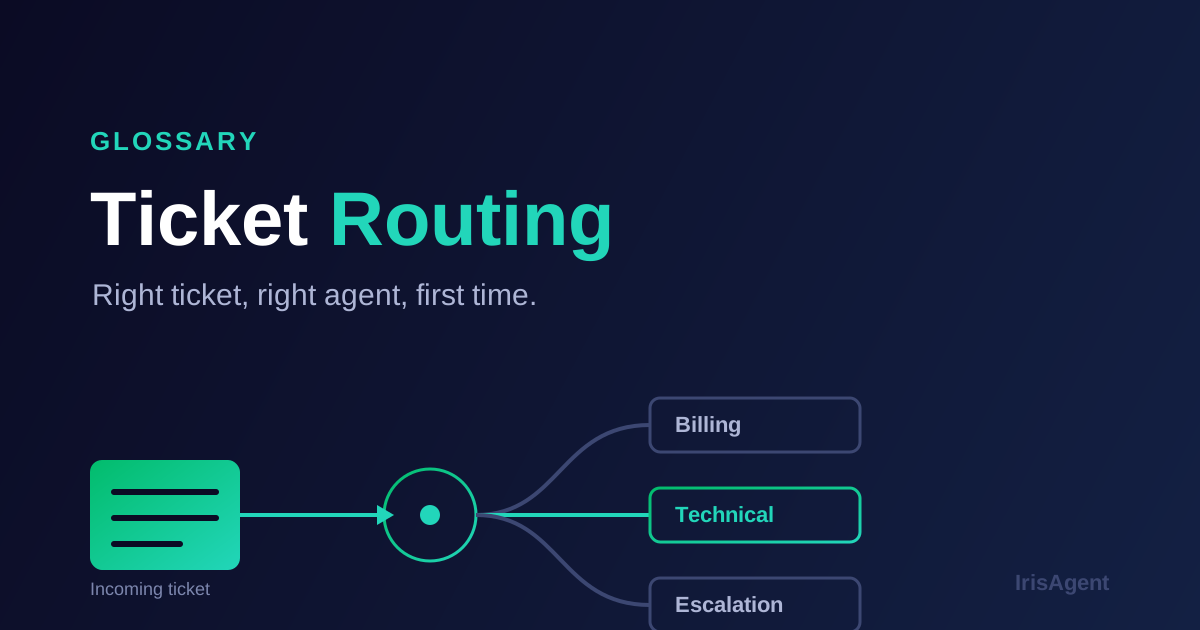
Ticket routing is the process of assigning each incoming support request to the right agent, team, or queue based on the issue, the customer, and available capacity. Good routing gets a ticket to the person best equipped to resolve it on the first try, which is why it is one of the biggest levers on resolution time and customer satisfaction in any support operation.
What Is Ticket Routing?
Ticket routing is the traffic control layer of a support operation. Every message that arrives, whether by email, chat, phone, or web form, has to reach someone who can actually resolve it. Routing is the set of rules and logic that decides who that is.
At its simplest, routing sends billing questions to the billing team and technical questions to technical support. In practice it also weighs urgency, customer tier, language, agent skill, current workload, and service level agreements (SLAs). The goal is to minimize the number of hops a ticket takes before it lands with the right owner, because every reassignment adds delay and repetition.
Ticket Routing Methods
Support teams use several routing methods, often in combination:
Rule-based routing: Fixed if-then rules assign tickets by keyword, channel, product, or region. Simple to set up, but brittle as the rules multiply.
Round-robin routing: Tickets are distributed evenly across available agents in turn. It balances load but ignores skill and complexity.
Skills-based routing: Tickets are matched to agents with the right expertise, language, or certification. More accurate, but depends on well-maintained skill profiles.
Load-based routing: Assignment accounts for each agent's current open volume so no one is overwhelmed while others sit idle.
AI-based routing: A model reads the actual content of the ticket, classifies intent and urgency, predicts the right team, and routes accordingly, learning from past resolutions rather than relying on static rules.
Why Ticket Routing Matters
Misrouting is expensive and invisible. A ticket sent to the wrong queue waits, gets reassigned, and only then reaches someone who can help. Each hop adds handle time, delays the first meaningful response, and forces the customer to re-explain the issue.
Strong routing does the opposite. It shortens time to resolution, raises first-contact resolution, protects SLAs by pushing urgent issues to the front, and keeps workload balanced so agents are neither idle nor buried. Because routing sits at the very start of the support workflow, small improvements there compound across every downstream metric.
Rule-Based vs AI-Based Routing
Traditional rule-based routing depends on humans anticipating every scenario and encoding it. As products and edge cases grow, the rule set becomes a maze that is hard to maintain and quick to fall out of date.
AI-based routing reads the ticket the way a person would. It understands what the customer is actually asking, factors in sentiment and priority, and assigns the ticket to the team most likely to resolve it, drawing on patterns from thousands of past tickets. It adapts as new issue types emerge, without someone rewriting rules each time.
IrisAgent routes tickets automatically using intent detection and sentiment analysis, sending each issue to the right team with the priority it deserves and connecting cleanly into Salesforce, Zendesk, and HubSpot.
Learn More About Ticket Routing
Routing works best alongside the other stages of intelligent triage. To see how it connects to CRM workflows, read Best AI Routing for Salesforce, Zendesk & HubSpot. For the step that decides what a ticket is about, read Ticket Triage Meaning: Benefits & Applications and AI Ticket Prioritization: How It Works. To understand how the best routing decision is often no ticket at all, see Ticket Deflection: Definition, Formula & Tips.
To automate routing end to end, explore IrisAgent's AI ticket routing.
Frequently Asked Questions
What is ticket routing in customer support?
Ticket routing is the process of assigning each incoming support request to the right agent, team, or queue based on the issue, the customer, and available capacity. It is the traffic control layer of a support operation, and it decides how many hops a ticket takes before it reaches someone who can actually resolve it.
What are the main ticket routing methods?
The common methods are rule-based routing (fixed if-then rules by keyword, channel, or region), round-robin routing (even distribution across agents), skills-based routing (matching tickets to agent expertise or language), load-based routing (accounting for current workload), and AI-based routing (a model that reads the ticket, classifies intent and urgency, and assigns the right team). Most teams combine several.
What is the difference between rule-based and AI-based routing?
Rule-based routing depends on people anticipating every scenario and encoding it, which becomes hard to maintain as products and edge cases grow. AI-based routing reads the actual content of the ticket, understands intent and sentiment, and assigns it to the team most likely to resolve it, learning from thousands of past tickets and adapting as new issue types appear.
Why is ticket routing important?
Because it sits at the very start of the support workflow, small improvements compound across every downstream metric. Strong routing shortens time to resolution, raises first-contact resolution, protects SLAs by pushing urgent issues to the front, and keeps workload balanced. Misrouting does the opposite: it adds delay, forces reassignment, and makes customers repeat themselves.
Loading the form. Prefer email? Reach us at info@irisagent.com or call +1 617 249 3312.