
Best Enterprise AI Support Software 2026: Security & Compliance
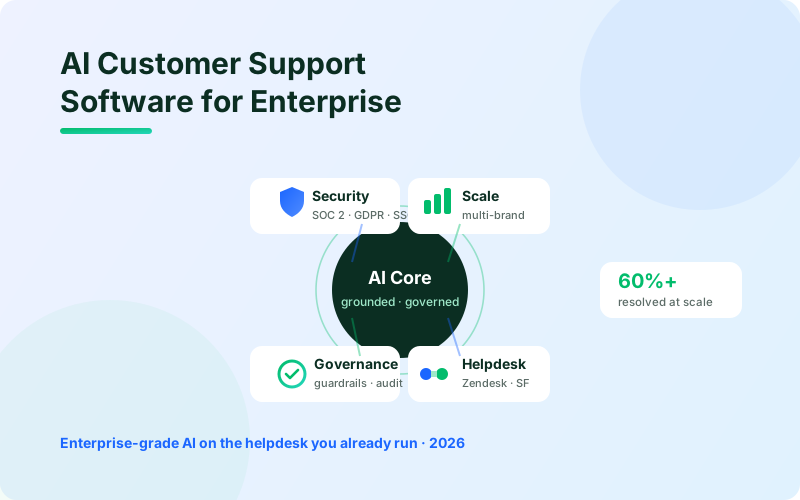
The best AI customer support software for enterprise resolves high volumes of support across every channel, grounds its answers in your own data so it does not invent policies, and meets the security, compliance, and governance bar that large organizations require. At enterprise scale, the question is not whether AI can answer a question. It is whether the platform can do it safely across millions of conversations, multiple brands and regions, and the systems you already run, without putting your data or your customers at risk.
If you are evaluating AI customer support software for a large organization, the shortlist matters less than the criteria. This guide ranks the leading enterprise platforms in 2026, explains who each is best for, and gives you the evaluation framework that separates a slick demo from something that survives a security review and a production rollout.
For a broader shortlist beyond enterprise security requirements, see the best AI customer service software in 2026.
What makes AI customer support software enterprise-grade?
Consumer-grade and enterprise-grade AI support tools can look similar in a demo. They diverge on six requirements that only matter at scale:
Grounding and accuracy. Every answer is validated against your knowledge base and data, with low-confidence cases escalated rather than guessed.
Security and compliance. SOC 2, GDPR, role-based access, data residency, audit trails, and PII handling that a security team will actually approve.
Scale and reliability. Consistent performance across high volume, multiple brands, languages, and regions.
Integration depth. It works with your existing helpdesk, CRM, and internal systems instead of forcing a rip-and-replace.
Governance and control. Guardrails, approval workflows, and the ability to define exactly what the AI is and is not allowed to do.
Time to value. A path to production measured in weeks, not multiple quarters.
The first requirement is the one that breaks most pilots. If the AI can hallucinate a policy, no amount of scale matters. For the category overview, see AI for customer support.
How we evaluated the enterprise platforms
We scored each platform on five factors that determine enterprise fit:
Grounding and accuracy. Can it hallucinate, or is every answer validated against your content?
Security and compliance. Does it clear an enterprise security review out of the box?
Deployment model. Does it layer onto your existing stack, or require a platform rebuild?
Scale. Multi-brand, multilingual, multi-region, high volume.
Pricing and total cost. Predictable at enterprise volume, or does cost balloon with success?
Enterprise AI customer support software at a glance
Platform | Best for | Deployment | Channels | Grounding |
|---|---|---|---|---|
IrisAgent | Enterprises on an existing helpdesk wanting grounded AI fast | Layers on Zendesk, Salesforce, Intercom, Freshdesk | Chat, email, voice | Hallucination Removal Engine, grounded in your KB and tickets |
Zendesk Suite Enterprise | Large CX orgs standardized on Zendesk | Native to Zendesk | Chat, email, voice | Tuned on Zendesk content |
Salesforce Service Cloud (Agentforce) | Enterprises invested in the Salesforce platform | Native to Service Cloud | Chat, email, voice | Grounded via Data Cloud |
Decagon | Large enterprises building custom agent workflows | Platform build | Chat, email, voice | Workflow plus model precision |
Sierra AI | Fortune 500, services-led rollouts | Platform build | Chat, voice | Brand-tuned agents |
Intercom (Fin) | Enterprises standardized on Intercom | Native to Intercom | Chat, email | Tuned on Intercom content |
Sprinklr | Large brands prioritizing social and omnichannel | Broad platform | Many channels | Knowledge-based |
Gladly | Consumer brands wanting a people-centered model | Platform | Chat, email, voice, messaging | Knowledge-based |
Trust and Governance, Vendor by Vendor
Trust and governance in enterprise AI support software means four things: an independent security attestation such as SOC 2 Type II, documented handling of regulated data, per-answer audit logging, and a written guarantee that your content is not used to train a shared model. Ask for all four in writing before a pilot starts.
Most evaluations of AI helpdesk software for enterprise teams stall at the same gate, and it is not the demo. It is the security review. The table below records what each platform enumerates on its own public security or trust page, checked on August 19, 2026.
Platform | SOC 2 Type II | HIPAA | ISO 27001 | Data residency |
|---|---|---|---|---|
IrisAgent | Yes | Yes | Not listed | Self-hosted, your own VPC on AWS, Azure, or GCP, or air-gapped |
Zendesk Suite Enterprise | Yes, under NDA | Paid add-on required | Yes, 27001:2022 | Paid add-on required |
Salesforce Service Cloud | Via trust portal | Via trust portal | Via trust portal | Via trust portal |
Decagon | Yes | Yes | Yes | Not listed |
Sierra AI | Not listed publicly | Not listed publicly | Not listed publicly | Not listed publicly |
Intercom (Fin) | Yes | Yes | Yes, plus 27701 and 42001 | US, EU, or AU |
Sprinklr | Yes | Not listed | Yes | US and Europe |
Gladly | Yes | Yes, with BAA | Not listed | Not listed |
Read "not listed" precisely: it means the vendor does not enumerate that item on its public security page, not that the certification does not exist. Salesforce and Sierra both route attestations through a trust portal rather than a public list, so ask them directly. Every vendor here should hand you a current report on request, and any vendor that will not is telling you something.
What a security review actually asks
Enterprise security reviews do not ask whether a vendor has AI. They ask six questions, and the answers decide whether a pilot ever reaches production.
Where does our data live, and can we pin it to a region? Who can see a conversation after the fact, and is that access logged per answer rather than per session? What happens to personally identifiable information before it reaches the model? Is our content used to train a shared model? What is the documented accuracy floor, and who measures it? And when the model is not confident, what does it do instead of guessing?
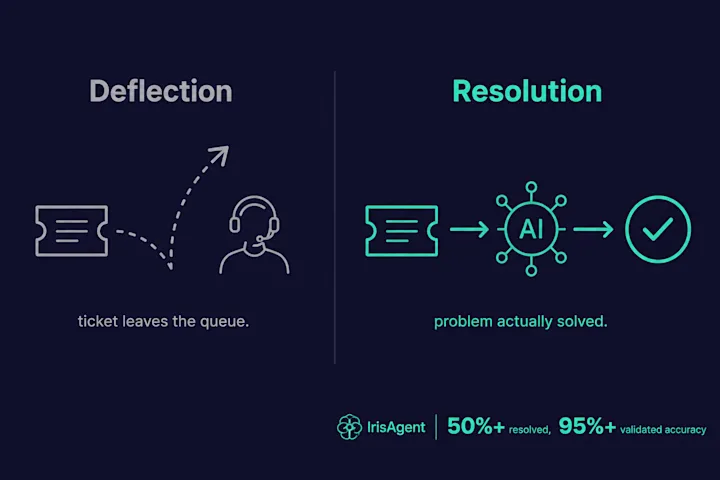
That last question is where most enterprise rollouts fail after the security review passes. A platform that answers confidently when it should escalate creates a support incident and a compliance incident at the same time. IrisAgent's Hallucination Removal Engine validates every response against the source it cites before sending, which holds validated accuracy above 95% and keeps hallucinations under 5%, against 15% to 30% for ungrounded models. Low-confidence cases route to a human instead of resolving.
Ask each vendor on your shortlist for their confidence threshold and their escalation behavior in writing. The ones who cannot answer in a sentence are the ones to worry about.
The best AI customer support software for enterprise in 2026
1. IrisAgent
Best for: enterprises that want grounded, secure AI support on the helpdesk they already run, live in weeks rather than quarters.
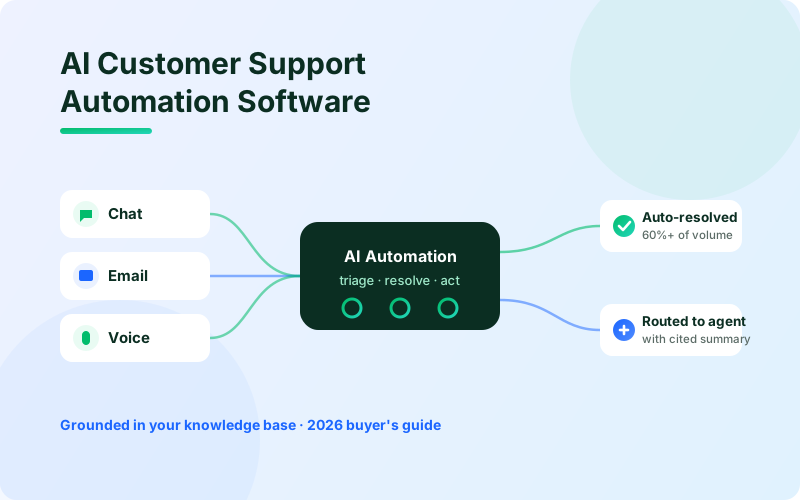
IrisAgent is an enterprise AI customer support platform that layers onto Zendesk, Salesforce, Intercom, and Freshdesk to resolve more than 60% of interactions across chat, email, and voice. Rather than asking a large organization to rebuild its support stack, it augments the systems already in place, which is what makes a weeks-not-quarters rollout realistic at enterprise scale.
The core differentiator is accuracy under governance. The Hallucination Removal Engine validates every answer against your knowledge base and historical tickets before it reaches a customer, and escalates low-confidence cases to a human with a source-cited summary. Smart operating procedures let you encode exactly how the AI should handle specific situations, and confidence-based routing governs when the AI acts versus when it hands off. For the highest end of automation, managed resolution lets IrisAgent own the outcome on a defined set of intents.
Grounding: Hallucination Removal Engine, validated against your KB and tickets.
Security: built for enterprise review, with the governance controls a security team expects.
Deployment: installs from your helpdesk marketplace, no rip-and-replace, typically live in weeks.
Channels: chat, email, and voice, across brands and languages.
Pricing: flexible, with usage-based or resolution-based options so cost maps to how you run support at scale.
Watch-out: it augments your existing helpdesk rather than replacing it, so it is the wrong pick if your goal is to consolidate onto a single new system of record.
2. Zendesk Suite Enterprise
Best for: large CX organizations already standardized on Zendesk.
Zendesk Suite Enterprise pairs a mature, widely deployed helpdesk with AI agents, intelligent triage, and admin controls built for scale. If your organization already runs Zendesk, the appeal is consolidation: one vendor for ticketing, workflows, and AI. The trade-offs are that the strongest AI capabilities sit in premium tiers and add-ons, and resolution quality depends heavily on how well-maintained your Zendesk content is.
Strength: deep, native fit for existing Zendesk enterprises.
Watch-out: advanced AI is gated behind higher tiers; Zendesk-centric by design.
3. Salesforce Service Cloud (Agentforce)
Best for: enterprises heavily invested in the Salesforce platform.
Service Cloud with Agentforce brings autonomous AI agents into the Salesforce ecosystem, grounded through Data Cloud so the AI can reason over CRM data. For organizations standardized on Salesforce across sales and service, the value is a unified platform and data layer. The cost is implementation complexity: getting real value typically requires a Data Cloud foundation and a substantial rollout.
Strength: unifies service, sales, and data for Salesforce enterprises.
Watch-out: time to value depends on Data Cloud and CRM maturity.
4. Decagon
Best for: large enterprises building custom, deeply tailored AI agent workflows.
Decagon focuses on enterprise AI agents with strong workflow precision, and is often positioned at the center of a support transformation rather than as a layer on top. For organizations with the budget and timeline to build, it can produce highly customized automation. The consideration is scope: it tends to be a larger platform commitment and a longer build than an overlay model. See IrisAgent vs Decagon for a comparison.
Strength: precise, custom enterprise agent workflows.
Watch-out: larger build and platform commitment.
5. Sierra AI
Best for: Fortune 500 brands pursuing a services-led, brand-tuned rollout.
Sierra builds brand-tuned AI agents, typically through a services-led engagement, and targets the largest brands. The strength is a highly polished, on-brand experience. The trade-offs are an enterprise price floor, outcome-based pricing to model carefully, and a build timeline that suits organizations with the resources to invest. See IrisAgent vs Sierra for a side-by-side.
Strength: premium, brand-tuned agent experience.
Watch-out: enterprise floor, services-led timeline, outcome-based pricing.
6. Intercom (Fin)
Best for: enterprises standardized on Intercom that want strong chat resolution.
Fin is among the more capable resolution bots for chat and is quick to deploy for existing Intercom customers. For enterprises whose primary support surface is Intercom, it is a natural extension. The main consideration is per-resolution pricing, which makes cost scale directly with volume and can complicate enterprise budgeting. We compare them in IrisAgent vs Intercom.
Strength: strong native chat automation for Intercom shops.
Watch-out: per-resolution pricing at scale.
7. Sprinklr
Best for: large brands that prioritize social and omnichannel reach.
Sprinklr is a broad customer experience management platform with particularly strong social and omnichannel coverage, used by many large enterprises. If your support footprint spans dozens of channels including social, its breadth is a real advantage. The trade-off is that breadth brings complexity and a heavier implementation than a focused support-automation overlay.
Strength: very wide channel and social coverage.
Watch-out: platform breadth means more complexity to implement.
8. Gladly
Best for: consumer brands that want a people-centered, customer-not-ticket model.
Gladly organizes support around the customer rather than the ticket and is popular with retail and consumer brands that want a lifelong-conversation experience. For the right brand, the model is differentiated. The consideration is that it is most compelling when you adopt Gladly as your platform, a larger commitment than layering AI onto your current helpdesk.
Strength: customer-centered model for consumer brands.
Watch-out: strongest as a full-platform adoption.
Enterprise buyers on Intercom face one extra variable after the Salesforce agreement. The alternatives to Fin for enterprise support guide covers how to weigh vendor independence alongside the governance criteria above.
How to choose enterprise AI customer support software
If Sierra AI is on your shortlist and the annual floor is the blocker, compare the six best Sierra AI alternatives side by side on pricing, deploy time, and grounded accuracy.
You want grounded, secure AI on your existing helpdesk, live in weeks, with pricing that maps to your volume: start with IrisAgent.
You are consolidating on one suite (Zendesk or Salesforce) and want native AI: evaluate that vendor's enterprise tier first.
You have the budget and timeline for a custom, services-led build: look at Decagon or Sierra.
Your support is social-heavy and omnichannel: consider Sprinklr.
At enterprise scale, run a structured proof of concept before you commit. Load your real knowledge base, send a representative sample of hard tickets across your brands and languages, and measure four things: resolution accuracy, escalation behavior on low-confidence cases, security and data-handling fit, and total cost at your real volume. For the broader category buyer's view, see our AI customer service software guide, and for the automation-capability angle specifically, see our companion guide to the best AI customer support automation software.
Frequently Asked Questions
What is the best AI customer support software for enterprise?
Strong options in 2026 include IrisAgent, Zendesk Suite Enterprise, Salesforce Service Cloud with Agentforce, Decagon, Sierra, Intercom Fin, Sprinklr, and Gladly. IrisAgent is the best fit for enterprises that want grounded, secure AI on their existing helpdesk, deployed in weeks, with flexible pricing.
What makes AI customer support software enterprise-grade?
Enterprise-grade means grounded accuracy with escalation, security and compliance that clears a real review (SOC 2, GDPR, role-based access, data residency, audit trails), reliability at high volume across brands and regions, deep integration with your existing systems, and governance controls over what the AI can do.
How accurate is enterprise AI customer support?
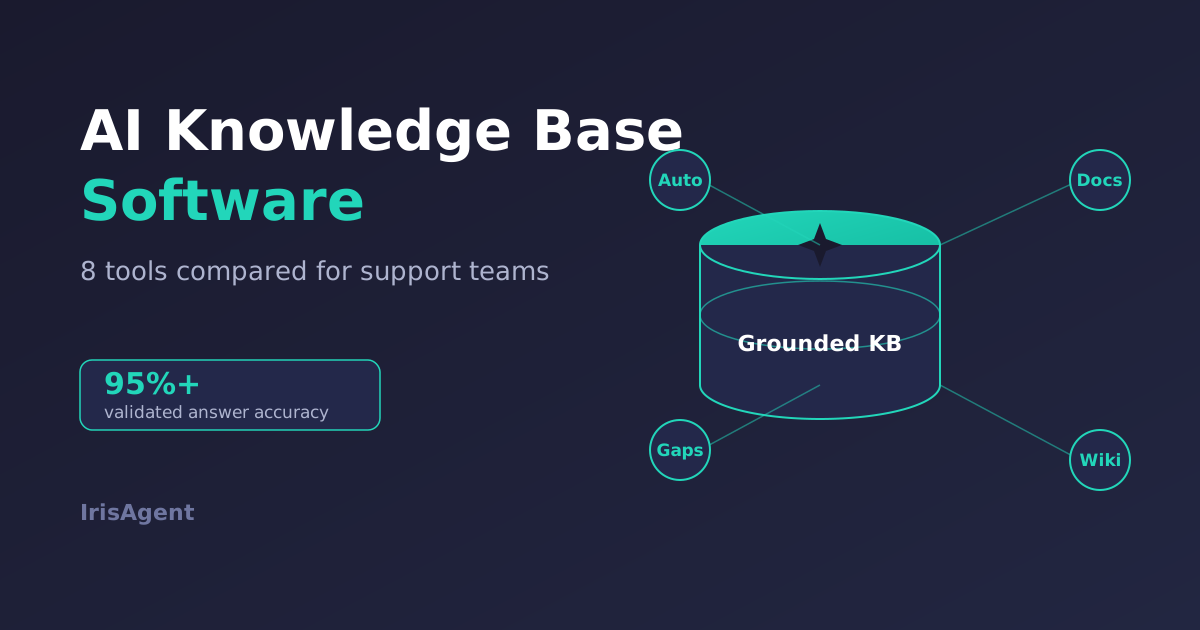
Accuracy depends almost entirely on grounding. Platforms that validate every answer against your own knowledge base and escalate low-confidence cases, like IrisAgent with its Hallucination Removal Engine, are safe to put in front of customers. Tools that generate answers without validation are not.
How long does it take an enterprise to deploy AI customer support software?
Platforms that layer onto your existing helpdesk, like IrisAgent, can go live in weeks. Rip-and-replace or services-led platform builds commonly take one to several quarters before reaching production value.
Does enterprise AI customer support software replace agents?
No. It automates high-volume, repetitive resolution so agents can focus on complex, sensitive cases, and it assists those agents with drafted replies and summarized context. The strongest enterprise deployments combine automation with agent assist.
How is enterprise AI customer support priced?
Models vary. Some vendors charge per resolution, so cost scales with success and volume. Others, including IrisAgent, offer flexible usage-based or resolution-based pricing so enterprises can choose the model that fits their volume and budget.
Is enterprise AI customer support software SOC 2 compliant?
It varies by vendor, and the honest answer is to check rather than assume. As of August 2026, IrisAgent, Decagon, Intercom Fin, Sprinklr, and Gladly all state SOC 2 Type II on their public security pages, and Zendesk provides its report under NDA. Salesforce and Sierra route attestations through a trust portal instead of listing them publicly. Ask any shortlisted vendor for a current report, plus their position on HIPAA, ISO 27001, and data residency.
Do AI support platforms train on your customer data?
Not all of them, and this is the single question most worth getting in writing. Grounded platforms retrieve answers from your knowledge base at query time rather than absorbing your content into a shared model. IrisAgent does not train on your private data and can run fully self-hosted, inside your own VPC on AWS, Azure, or Google Cloud, or air-gapped. Decagon states zero-day retention with its model providers. Ask every vendor whether your content trains a shared model, and require the answer in the contract.
Loading the form. Prefer email? Reach us at info@irisagent.com or call +1 617 249 3312.