
AI Support SOPs: Build Reliable Playbooks
What Are Standard Operating Procedures for AI Customer Support Agents?
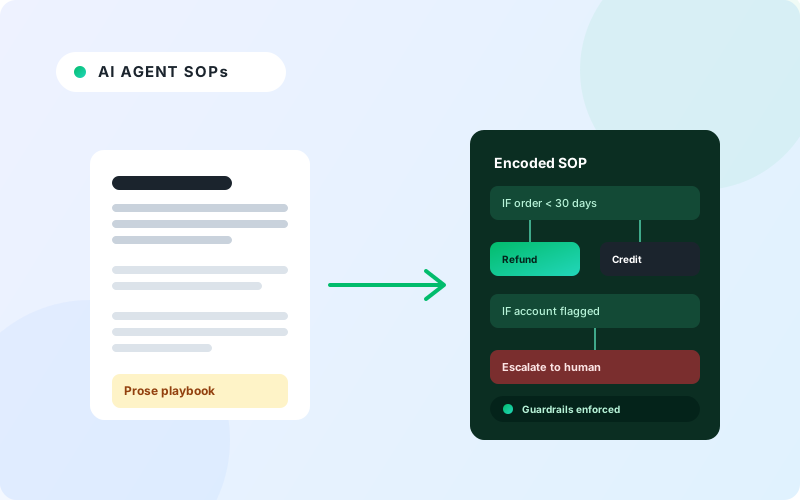
Standard operating procedures (SOPs) for AI customer support agents are structured, step-by-step rules that define exactly how an AI should handle a specific type of request: what conditions trigger the procedure, what checks it must run, what actions it can take, and when it must stop and hand off to a human.
This is different from a human SOP. A human agent reads a paragraph of instructions and fills in judgment where the wording is ambiguous. An AI agent cannot do that safely. If the instruction says "check the account is in good standing" without defining what "good standing" means in your billing system, a language model will guess. A human might guess well. An AI agent guessing on a refund, a compliance disclosure, or an account cancellation is a liability, not a shortcut.
The fix is not more instructions in the prompt. It is converting prose playbooks into explicit conditional logic: if this, check that, do this, otherwise escalate. That structure is what a bot can actually execute the same way every time.
Why AI Agents Ignore Your Playbooks (Even When You Prompt Them)
Most teams' first attempt looks the same: take the existing SOP document, paste it into the system prompt, and hope the model follows it. It works in a demo and breaks in production. Four reasons show up again and again.
Prose does not compile into logic. A sentence like "offer a refund if the order is recent and the customer is a good account" contains two undefined thresholds ("recent," "good account") and no explicit fallback. A language model resolves that ambiguity probabilistically, which means the same request can get two different outcomes on two different days.
Long prompts drift. The more procedures you stack into a single system prompt, the more the model has to hold in context at once. Instructions buried in the middle of a 3,000-word prompt get less weight than instructions at the start or end. This is not a bug you can prompt your way out of. It is how attention works in a language model.
There is no guardrail outside the model. A prose instruction is a suggestion the model can override if a user pushes back convincingly. A refund cap, an identity check, or an escalation trigger needs to live as a rule the AI cannot execute past, not as a sentence it is supposed to remember.
Nobody tested the edge cases before launch. Teams test the happy path (a straightforward refund request) and skip the messy one (a partial refund on a subscription that was upgraded mid-cycle). SOPs fail in exactly the cases that were never run through the procedure before it went live.
The Anatomy of an SOP an AI Agent Can Actually Execute
A procedure a bot can follow reliably has five parts, and a written playbook usually only has the first one spelled out.
Trigger condition. The specific intent or keyword pattern that starts the procedure (for example, "customer requests a refund" or "customer reports a service outage").
Data lookups. What the AI must pull from your systems before acting: order date from the CRM, subscription tier from billing, account status from your helpdesk. Explicit fields, not "check if eligible."
Decision branches. The actual if/then logic: if the order is inside the refund window and the account is not flagged, proceed; if the order is outside the window, offer store credit; if the account is flagged, escalate regardless of order date.
Action steps. What the AI is allowed to execute directly: issue the refund via API, update the ticket status, send the confirmation message. Anything outside this list requires a human.
Escalation and guardrails. The conditions that stop the procedure entirely and route to a person, and the hard caps (dollar amount, account tier, request type) the AI cannot cross no matter how the conversation is phrased.
Most Confluence-style playbooks stop at step 1 and step 4, and leave 2, 3, and 5 as implied context a human agent is trusted to infer. That gap is exactly where an AI agent goes wrong.
How to Encode Your Playbooks in 5 Steps
1. Audit what you actually have
Pull your existing macros, canned responses, and SOP documents into one list. Most support teams find three categories: procedures that are already close to structured (a refund macro with clear conditions), procedures that exist only as tribal knowledge (your best agent "just knows" when to waive a fee), and procedures that conflict with each other across documents. Fix the conflicts before you encode anything. An AI agent will faithfully execute a contradiction the same way it executes a rule.
2. Convert prose into conditional logic
For every SOP, rewrite the instruction as an explicit if/then/else statement with named fields, not adjectives. Replace "recent order" with "order placed within 30 days of the case creation date." Replace "good account standing" with "no open disputes and subscription in active status." If you cannot fill in the specific field and value, the procedure is not ready to hand to an AI yet, it is ready for a follow-up conversation with whoever owns that policy.
3. Define the guardrails and escalation paths separately from the happy path
Write the exit conditions before you write the success path. What dollar amount requires human approval? What customer tiers are always escalated? What phrases (threats of legal action, mentions of self-harm, fraud indicators) end the automated procedure immediately? These guardrails should sit outside the model's discretion entirely, enforced as rules the AI cannot execute past regardless of how the conversation is framed.
4. Test against edge cases before launch, not after
Build a test set of 15 to 20 real conversations that stress the procedure: a refund request at exactly the boundary of the eligibility window, a customer who qualifies for two conflicting procedures at once, an account with missing data in one of the lookup fields. Run the procedure against every case in a simulation before it touches a live customer. This is the step teams skip most often, and it is the one that determines whether the SOP holds up on day one or breaks on the first unusual ticket.
5. Version, monitor, and update the SOP as policy changes
A written playbook goes stale quietly. An encoded SOP going stale is visible immediately, because you can track how often it fires, how often it escalates unexpectedly, and how often customers push back on its outcome. Treat SOP updates like code changes: version them, test the new version against your edge-case set, and roll back if accuracy drops.
Common Mistakes to Avoid
Treating the system prompt as the SOP. A prompt is where you describe tone and scope. It is not a substitute for structured, testable rules with explicit guardrails.
Skipping the escalation path because "it will not come up often." The requests that skip your SOP are disproportionately the sensitive ones: fraud, safety, legal threats. These are exactly the cases where an undefined escalation path causes the most damage.
Letting the SOP and the knowledge base disagree. If your refund macro says 30 days and your public help center article says 14, the AI will cite whichever one it retrieves first. Reconcile source documents before encoding the procedure, not after a customer complaint.
Writing one giant procedure instead of several specific ones. A single "handle all billing issues" procedure with a dozen nested conditions is harder to test and harder to debug than five narrow procedures, each with a clear trigger.
Never testing after the first launch. Support policy changes (a new pricing tier, a new refund window during a promotion) and the SOP has to change with it. An outdated encoded procedure is worse than no procedure, because it fails with confidence.
How IrisAgent's Smart Operating Procedures Solve This
This is the exact gap Smart Operating Procedures is built to close. Instead of pasting a playbook into a prompt and hoping, your team writes the procedure once in plain English and IrisAgent compiles it into executable logic: explicit trigger conditions, data lookups against your CRM, billing, or order management system, decision branches, and hard guardrails the AI cannot execute past.
The same procedure runs everywhere the conversation happens: chat, voice, automated ticket replies, and the draft an agent sees in Agent Assist. Write the refund policy once, and it applies consistently whether the customer reaches you by chat on Tuesday or calls in on Friday.
Guardrails for identity verification, refund caps, and compliance-sensitive requests are enforced structurally, not as prompt suggestions, so the AI escalates to a human the moment a request falls outside what the procedure authorizes. And because every procedure runs through a simulation environment against real edge cases before it goes live, you catch the boundary conditions (the partial refund, the flagged account, the conflicting policy) before a customer does, not after.
Once procedures are live, AutoQA scores every conversation against them continuously, so you can see exactly how often each SOP fires, where it escalates unexpectedly, and which procedures need a rewrite, instead of finding out from a downvoted resolution three weeks later.
Next Steps
If your playbooks already live in Confluence or a stack of macros, the fastest path is not rewriting them from scratch. It is auditing what you have, converting the highest-volume procedures into structured logic first, and testing them against real edge cases before they touch a live customer. See how Smart Operating Procedures encode your playbooks so your AI agent follows them exactly the same way, every time.
Frequently Asked Questions
What is the difference between a macro and an SOP for an AI agent?
A macro is a canned response template. An SOP is the decision logic that determines which response, action, or escalation applies to a given situation, including the conditions, data checks, and guardrails a macro alone does not capture.
Can I just put my existing playbook into the AI's system prompt?
You can, and it will work for the cases the prompt author thought of. It breaks on ambiguous wording, long-context drift, and edge cases nobody tested, which is why structured, guardrail-based procedures outperform prompt-only instructions for anything involving money, compliance, or account access.
How many SOPs does a typical support team need to encode first?
Start with the five to ten procedures that touch the highest ticket volume or the highest risk: refunds, cancellations, identity verification, and outage communication are the most common starting points. Expand from there once the first set is tested and stable.

Loading the form. Prefer email? Reach us at info@irisagent.com or call +1 617 249 3312.