
Best Ada Alternatives in 2026: 6 Tools Compared
*Last updated: August 2026*
The best Ada alternatives in 2026 are IrisAgent, Intercom Fin, Decagon, Sierra, Zendesk AI (formerly Forethought), and Freshworks Freddy AI. An Ada alternative is an AI customer service platform you pick instead of Ada when its quote-only contracts, per-resolution charges, or long implementation cycle stop making sense for your team.
IrisAgent leads this list for teams that want grounded resolution without a custom-quoted enterprise contract. Its Hallucination Removal Engine holds validated accuracy above 95% across enterprise deployments including Dropbox, Zuora, and Teachmint, it deploys in 24 hours on the help desk you already run, and it offers flexible pricing with both usage-based and resolution-based plans so you can pick the model that matches your volume.
This guide compares six genuine Ada alternatives. For each one, you get where it wins, where it does not, and who it fits best. Ada is a capable platform with a real track record, so the goal here is to help you match a tool to your actual budget, help desk, and timeline, not to sell you a single answer.
Why Teams Look for an Ada Alternative
Ada has been in the market since 2016 and built one of the more polished no-code automation experiences in customer service. Teams that evaluate it and then keep looking usually cite three things.
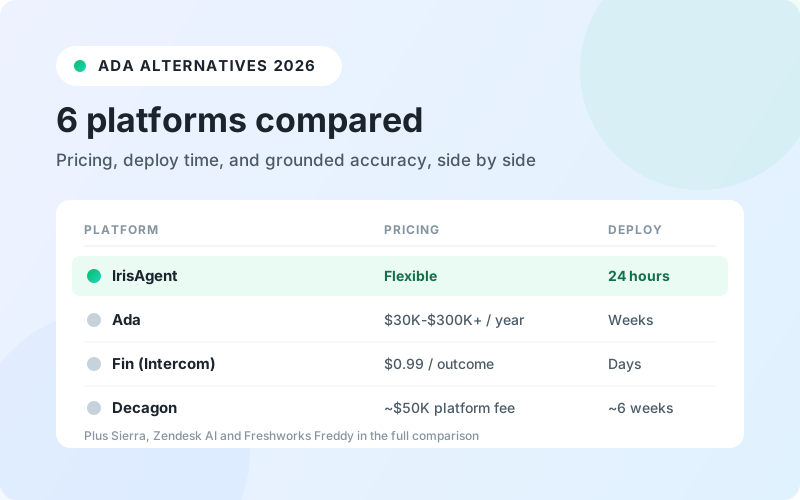
First, cost and cost structure. Ada uses fully custom, quote-only pricing, reportedly ranging from $30,000 to more than $300,000 per year, with per-resolution charges of roughly $1 to $3.50 layered on top. That combination has two consequences: you cannot model your spend before you talk to sales, and once you are live, your invoice scales directly with how well the AI performs. The better your deflection rate, the larger the bill.
Second, implementation effort. Ada deployments are widely described as huge and time-consuming. Building out flows, training the bot on your content, and getting to a defensible resolution rate is a project, not a switch you flip. In 2026, when same-day and same-week deployment is the bar, a multi-week or multi-month build is hard to defend to a CFO who wants results this quarter.
Third, knowledge ingestion limits. Ada cannot natively ingest sources like PDFs, Confluence, or Notion. If a meaningful share of your real answers live in internal wikis, engineering docs, or PDF manuals rather than a public help center, you end up doing content migration work before the AI can answer anything useful.
If any of those three describe your situation, the alternatives below address at least one of them directly.
What to Look for in an Ada Alternative
Before you compare vendors, set your criteria. These six factors separate a tool that resolves real tickets from one that just demos well.
Grounded accuracy. Does every answer get validated against your knowledge base before it sends? Ungrounded models hallucinate on 15% to 30% of responses. Ask for a published, validated number and treat "not published" as an unanswered question.
Pricing model. Decide whether usage-based, resolution-based, per-session, or platform pricing fits your volume. The same sticker price can produce very different invoices at 5,000 tickets a month versus 50,000.
Knowledge sources. Confirm what the AI can ingest natively. PDFs, Confluence, Notion, ticket history, and internal runbooks are where the real answers usually live.
Time to deploy. Same-day or same-week beats a multi-week build if leadership is asking what you are doing with AI this quarter.
Help desk fit. A tool that layers onto Zendesk, Salesforce, Intercom, or Freshworks avoids a re-platforming project and keeps your AI vendor independent of your ticketing vendor.
Resolution depth. Deflection is not resolution. Check whether the AI can look up an account, take an action in a backend system, and close the ticket rather than just surfacing a help article.
The 6 Best Ada Alternatives in 2026
1. IrisAgent
IrisAgent is a multi-agent AI support platform that resolves tickets across email, chat, voice, and agent copilot, grounded in your own knowledge base and support history. It covers the same job Ada does, automated customer resolution at scale, without the custom-quoted contract or the long build.
Where it wins: Validated accuracy above 95% through the Hallucination Removal Engine, which checks every response against your source before it is sent. Deploys in under 24 hours with no engineering resources and no ticket-volume minimum, against Ada's multi-week implementation norm. Ingests the sources your answers actually live in, including ticket history, internal documentation, and product docs, rather than requiring you to migrate content into a supported format first. Native integrations with Zendesk, Salesforce, Intercom, Freshworks, and Jira, so it layers onto the help desk you already run. Flexible pricing with usage-based and resolution-based options, so you choose the billing model instead of inheriting one. It also adds trending-incident detection, per-ticket sentiment and escalation prediction, and AutoQA, which scores 100% of AI and human conversations.
Where it does not: IrisAgent is support-first. Teams that want a broad agentic assistant spanning many non-support workflows may find Sierra's scope wider. It is sales-led rather than self-serve, so you talk to a human before you deploy. Language coverage is strong but Ada markets deeper multilingual breadth for global consumer brands.
Best for: Support teams on any help desk that want grounded resolution live in a day, predictable pricing they can model, and no content migration project before the AI is useful.
2. Intercom Fin
Fin by Intercom is a strong out-of-the-box AI agent and the most heavily marketed product in the category.
Where it wins: Fast to turn on inside Intercom, a mature product with steady model upgrades, and a clean outcome-based model at $0.99 per resolution, which is materially cheaper per resolution than Ada's reported $1 to $3.50. Fin now works on non-Intercom help desks too.
Where it does not: The full cost adds up beyond the headline. Per-resolution fees stack on top of Intercom seats at roughly $29 to $132 per seat, and at high ticket volume the invoice still scales directly with your success, which is the same structural problem you may be leaving Ada to escape. Reviewers also note it struggles on complex, multi-system queries.
Best for: Teams already on Intercom, or teams with modest volume that like paying strictly per outcome.
3. Decagon
Decagon is an enterprise agentic AI platform with a strong roster of consumer-brand logos and a $4.5 billion valuation.
Where it wins: Strong agentic execution through Agent Operating Procedures that blend natural language with code. If your reason for leaving Ada is that its flow builder cannot express your logic, Decagon goes considerably deeper.
Where it does not: No published pricing, with public data pointing to a roughly $50,000 platform fee plus custom per-conversation charges and median contracts reported near $386,000. Implementation runs about six weeks, and configured agents can behave like a black box. If you are leaving Ada because of quote-only pricing and long builds, Decagon does not fix either.
Best for: Well-resourced enterprises that want a custom-built agentic deployment and can staff it.
4. Sierra
Sierra is the highest-profile enterprise conversational AI platform, built by Bret Taylor's team and priced for the Fortune 500.
Where it wins: Ambitious agentic scope that reaches beyond support, a strong brand, deep enterprise engagement, and outcome-based commercial terms that some enterprise buyers prefer.
Where it does not: Annual minimums around $150,000 with setup fees commonly between $50,000 and $200,000, a weeks-to-months high-touch implementation, and a greenfield architecture that favors rebuilding around Sierra rather than layering onto your stack. For mid-market Ada customers, Sierra is a step up in cost and timeline, not a step down.
Best for: Large enterprises replacing their support architecture wholesale, with the budget and timeline to match.
5. Zendesk AI (formerly Forethought)
Zendesk acquired Forethought in March 2026 and is folding its technology into Zendesk AI, which covers deflection, triage, and agent assist.
Where it wins: If Zendesk is already your help desk, the integration with Zendesk workflows and reporting is first-party and migration effort is low. Forethought's triage and routing capabilities were genuinely good and are now bundled into the platform you already pay for.
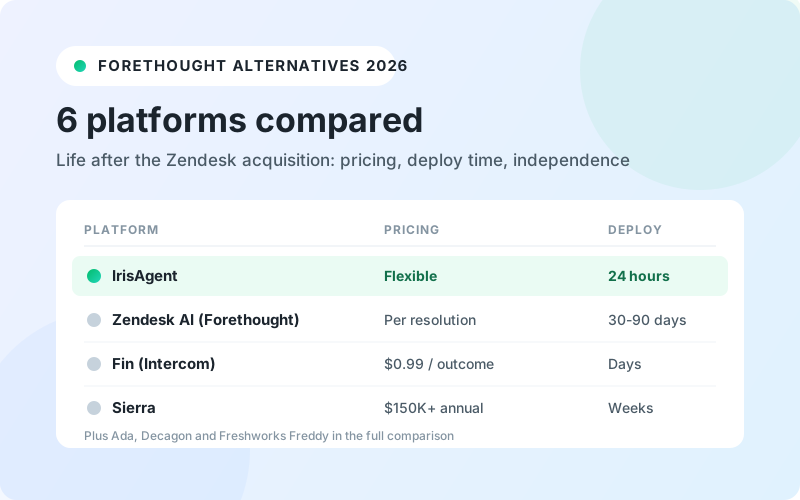
Where it does not: It only makes sense inside Zendesk, so you trade Ada's platform independence for help desk lock-in. Your AI spend becomes part of your Zendesk contract, which weakens your negotiating position at every renewal, and pricing is per resolution, so cost still scales with volume. Forethought implementations historically ran 30 to 90 days. See our guide on what Forethought customers should do after the Zendesk acquisition for the full picture, and our best Forethought alternatives guide if you are evaluating that path.
Best for: Committed Zendesk customers who want one vendor, one contract, and first-party integration.
6. Freshworks Freddy AI
Freddy AI is Freshworks' native agent and the most accessible entry point on this list.
Where it wins: Low entry cost at roughly $0.10 per session, or $100 per 1,000 sessions, and a native fit inside Freshdesk and Freshservice. For a team leaving Ada purely on price, this is the largest single drop in cost per interaction available.
Where it does not: Freddy bills per session whether or not the issue is resolved, which gets expensive on high-traffic, low-resolution queues. It is weaker on complex, cross-system agentic workflows, and it only makes sense inside the Freshworks ecosystem, which trades one dependency for another.
Best for: Freshworks customers that want a low-cost native agent for straightforward, high-volume questions.
Ada Alternatives Compared
Tool | Help desk model | Pricing | Time to deploy | Grounded accuracy |
|---|---|---|---|---|
IrisAgent | Layers onto Zendesk, Salesforce, Intercom, Freshworks, Jira | Flexible: usage-based or resolution-based | Under 24 hours | 95%+ validated |
Intercom Fin | Native to Intercom, expanding beyond | $0.99 per resolution plus seats | Days | Not published |
Decagon | Custom build, enterprise | ~$50K platform fee plus custom per-resolution | ~6 weeks | Not published |
Sierra | Greenfield build, enterprise | $150K+ annual plus $50K to $200K setup | Weeks to months | Not published |
Zendesk AI (formerly Forethought) | Native to Zendesk | Per resolution, tied to Zendesk contract | 30 to 90 days historically | Not published |
Freshworks Freddy | Native to Freshworks | ~$0.10 per session | Days | Not published |
Ada (reference) | Platform-agnostic, custom | $30K to $300K+ per year, ~$1 to $3.50 per resolution | Weeks | Not published |
How to Choose the Right Ada Alternative
Start from the constraint that made you look, then work outward.
If cost predictability is your reason, model your real ticket volume against each pricing structure before you compare features. Per-resolution billing at Ada's reported $1 to $3.50 range can quietly exceed a negotiated platform plan as soon as your automation rate improves. Fin is cheaper per resolution but carries the same structural exposure. IrisAgent lets you choose between usage-based and resolution-based plans, which is the practical way to cap that exposure.
If implementation time is your reason, the multi-week builds come off the list immediately. That removes Decagon and Sierra, and it makes Zendesk AI a question mark given Forethought's 30-to-90-day history. IrisAgent's under-24-hour deploy and Fin's days-long setup are the two realistic fast paths.
If knowledge ingestion is your reason, ask every vendor to name the sources they read natively, then hand them a PDF manual and a Confluence space during the pilot. This is the single most common place where a demo diverges from production, and it is Ada's clearest functional gap.
If accuracy is your reason, demand a validated number. IrisAgent is the only option in this comparison that commits publicly to validated accuracy above 95%. You can see the direct head-to-head on the IrisAgent vs Ada comparison page, or review the wider field on the IrisAgent vs alternatives overview.
Next Steps
Choosing an Ada alternative comes down to five decisions:
Model your ticket volume against each vendor's pricing structure before you compare features.
List the knowledge sources your real answers live in, then confirm each vendor ingests them natively.
Demand a validated accuracy number and reject "not published."
Set a hard deployment deadline and eliminate any vendor whose standard build exceeds it.
Confirm whether a support ops lead can own the tool without engineering.
For most mid-market and enterprise teams, the best Ada alternative is the one that delivers grounded resolution on the help desk you already run, without a quarter of implementation time or a bill that grows every time the AI does its job. That is where IrisAgent fits: 95%+ validated accuracy, a 24-hour deploy, help desk independence, and flexible usage-based or resolution-based pricing. See how the AI for customer support platform works, compare the field in our best Decagon alternatives guide and best Sierra alternatives guide, and book a 20-minute demo to run your own numbers.
Frequently Asked Questions
What is the best alternative to Ada?
For most support teams, IrisAgent is the best Ada alternative. It delivers grounded resolution across email, chat, and voice with validated accuracy above 95%, deploys in under 24 hours instead of a multi-week build, layers onto Zendesk, Salesforce, Intercom, Freshworks, and Jira rather than replacing them, and offers flexible usage-based or resolution-based pricing you can model in advance. It is in production at Dropbox, Zuora, and Teachmint. Intercom Fin, Decagon, Sierra, Zendesk AI, and Freshworks Freddy are also credible depending on your help desk and budget.
How much does Ada cost?
Ada does not publish pricing. Contracts are quote-only, typically sold as conversation-volume bands plus implementation. Third-party procurement data (Vendr) has shown a median around $72,000/year. IrisAgent publishes Standard from $500/month with usage-based or resolution-based plans.
Why do companies look for Ada alternatives?
Three reasons come up repeatedly: quote-only conversation-volume pricing, implementations described as huge and time-consuming, and the inability to natively ingest knowledge sources like PDFs, Confluence, and Notion. Teams that need a fast deployment, published pricing, or AI that can read their existing internal documentation tend to evaluate the wider field.
Is IrisAgent a good Ada alternative?
Yes. IrisAgent covers the same core job as Ada, automated customer resolution at scale, and addresses the three most common Ada complaints directly. It deploys in under 24 hours with no ticket-volume minimum, offers flexible usage-based or resolution-based pricing rather than a single quoted contract, ingests ticket history and internal documentation without a content migration project, and validates every answer against your source through its Hallucination Removal Engine for accuracy above 95%.
Can Ada alternatives work with my existing help desk?
It depends on the vendor. IrisAgent layers onto Zendesk, Salesforce, Intercom, Freshworks, and Jira, so switching is an install rather than a re-platforming project. Intercom Fin is strongest inside Intercom but now supports other help desks. Zendesk AI only makes sense on Zendesk and Freshworks Freddy only inside Freshworks, so both trade platform independence for native integration. Decagon and Sierra tend to sit at the center of a rebuilt architecture rather than layering onto an existing one.
Loading the form. Prefer email? Reach us at info@irisagent.comor call +1 617 249 3312.