
Conversational AI Platform Pricing: What the Four Models Actually Cost
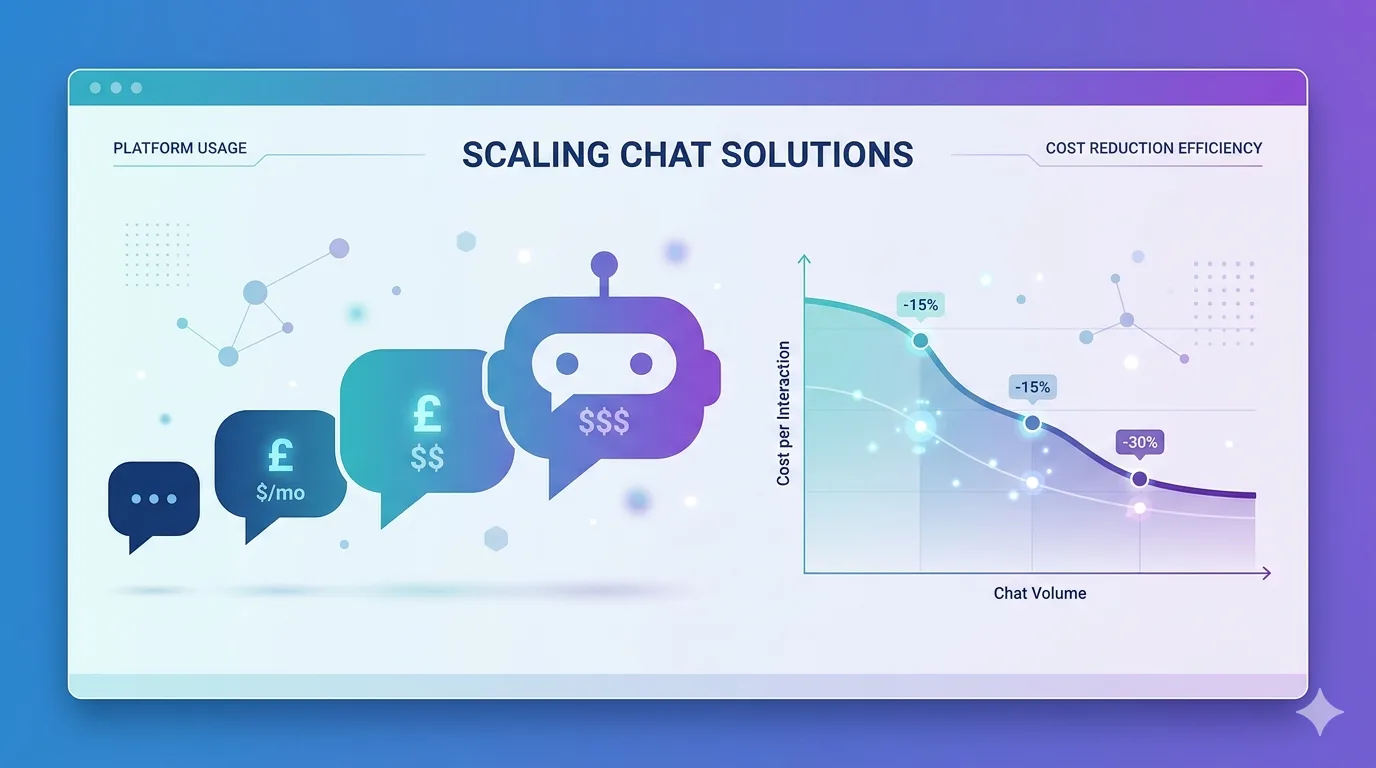
Conversational AI platform pricing splits across four billing models, and the model matters more than the sticker price. This guide breaks down per seat, per conversation, per resolution, and flat platform fees, with worked costs at three ticket volumes and an honest look at which model stops making sense as your automation rate climbs.
Ask a vendor what their conversational AI platform costs and you will usually get a number. The number is not the useful part. Two platforms quoting what sounds like the same price can differ by 6x on your actual invoice, because they are billing you for completely different things.
One charges for every agent seat whether that agent touches the AI or not. One charges for every conversation the bot opens, including the ones it fails to solve. One charges only when a ticket is genuinely closed without a human. One charges a flat platform fee and then meters everything interesting as an add-on.
The uncomfortable part is that the ranking flips depending on your deflection rate. The model that is cheapest at 20% automation is often the most expensive at 70%, and vendors know this when they quote you. This guide is about reading the model, not the number.
For cost bands by company size and what typical organizations actually spend, see the companion guide on AI chatbot pricing and total cost of ownership.
What Conversational AI Platform Pricing Actually Covers
Before comparing models, be clear about what is inside the fence and what is billed separately. Across most vendors the base subscription buys you the conversational engine, a set number of interactions or seats, standard channel support, and basic analytics.
What is very often outside the fence, and what turns a $2,000 quote into a $6,000 invoice:
Implementation and onboarding. Anywhere from included to $200,000, and the largest single source of first-year surprise.
Backend integrations. Reading a knowledge base is usually standard. Taking an action in your order system, billing platform, or CRM usually is not.
Additional channels. Web chat is the base case. Email, voice, WhatsApp, and in-app are commonly priced per channel.
Agent-facing AI. Copilot, summarization, and agent assist are frequently a separate per-seat add-on on top of the customer-facing bot.
Overage. The rate you pay once you pass your committed volume, which is almost never the same as your contracted rate.
Compliance and residency. SSO, audit logging, data residency, and a signed BAA are typically enterprise-tier gates rather than line items.
Every model below should be priced with those six included, not excluded. A quote that omits them is not a quote.
The Four Conversational AI Pricing Models
1. Per Seat
You pay a monthly fee for each agent licensed on the platform, typically $29 to $150 per seat, often with an additional AI or copilot add-on of $30 to $50 per seat on top.
Per-seat pricing is inherited from the helpdesk world and it is structurally at odds with what conversational AI is for. The entire point of automation is to handle more volume without adding headcount, but per-seat billing only falls when you remove people. Deflect 60% of your tickets and your seat bill is unchanged on the day the automation goes live.
Best for: teams whose primary use case is agent assist rather than customer-facing deflection, and teams with stable headcount and unpredictable ticket volume.
Worst for: anyone buying automation to absorb growth without hiring.
2. Per Conversation
You pay each time the bot opens a conversation, commonly $0.10 to $1.50, regardless of whether it solves anything.
This is the model with the worst incentive alignment in the category. The vendor is paid identically for a conversation that resolves a billing dispute and one where the bot says it does not understand and hands off. You absorb the cost of the failures. It also means a bad month of bot quality raises your bill rather than lowering it, because frustrated customers open more conversations.
Watch specifically for how a conversation is defined. Some vendors reset the counter after 24 hours of inactivity, so one customer returning three times about the same order is billed three times.
Best for: low-complexity, high-certainty deployments such as FAQ deflection on a narrow catalog, where the failure rate is genuinely low.
Worst for: complex or regulated support, where a meaningful share of conversations should escalate by design.
3. Per Resolution
You pay only when the AI closes a ticket end to end with no human involvement, commonly $0.50 to $6.00. Handoffs are free.
This is the best-aligned model on paper and the most variable in practice, because the rate spread is more than tenfold and the definition of resolution is set by the vendor. Two questions decide whether a per-resolution quote is good: what counts as a resolution, and what happens when the customer disagrees that it was resolved.
Insist on a written definition. A reasonable one requires that the customer did not reopen or escalate within a defined window, usually 24 to 72 hours. A weak one counts any conversation the bot did not explicitly hand off, which quietly bills you for every customer who gave up.
Best for: teams that want cost to track outcomes, and teams whose volume is seasonal or spiky, because the bill falls with the volume.
Worst for: teams that need a fixed number for budgeting and cannot tolerate a variable line item, and teams buying from a vendor with a loose resolution definition.
4. Flat Platform Fee
A fixed annual or monthly commitment, commonly $1,500 to $10,000 per month at the mid-market and a $150,000 or higher annual minimum at the enterprise end, often with a separate implementation fee.
Flat fees are predictable, which is genuinely valuable, and they are the only model where high automation does not increase your bill. The catch is the floor. A flat fee means you pay the same in a quiet month as a peak one, and enterprise minimums frequently exceed what a mid-market team's actual usage would cost under any metered model. Several vendors in this category also gate access behind a ticket-volume minimum, so smaller teams simply do not qualify.
Best for: high-volume operations above roughly 50,000 monthly conversations, and teams for whom budget predictability outranks unit cost.
Worst for: anyone under about 10,000 monthly tickets, who will almost always overpay.
The Four Models Side by Side
Model | Typical rate | Bill rises when | Vendor is paid for | Predictable? |
|---|---|---|---|---|
Per seat | $29 to $150 per seat, plus $30 to $50 AI add-on | You hire | Headcount | Yes |
Per conversation | $0.10 to $1.50 | Customers contact you more | Attempts, including failures | No |
Per resolution | $0.50 to $6.00 | The AI succeeds more | Outcomes | No |
Flat platform fee | $1,500 to $10,000+ per month | Never, within the tier | Access | Yes |
Worked Cost at Three Ticket Volumes
The table below models the same team at three sizes, each automating 50% of inbound tickets, with agent headcount scaled at roughly one agent per 400 monthly tickets. Per-conversation is priced at $0.75, per-resolution at $0.50, and per-seat at $80 including the AI add-on. Rounded, and excluding implementation.
Monthly tickets | AI resolutions | Agents | Per seat | Per conversation | Per resolution | Flat fee |
|---|---|---|---|---|---|---|
2,000 | 1,000 | 5 | $400 | $1,500 | $500 | $1,500 (tier floor) |
10,000 | 5,000 | 25 | $2,000 | $7,500 | $2,500 | $4,000 |
50,000 | 25,000 | 125 | $10,000 | $37,500 | $12,500 | $9,000 |
Three things fall out of that table, and none of them are obvious from a price list.
Per-conversation is the worst model at every size shown, because it bills the 50% of conversations the bot does not resolve. It only competes when the failure rate is very low.
Per-seat looks cheapest until you notice what it is measuring. It is cheap here only because headcount is held proportional to volume. The entire reason to buy automation is to break that proportionality, and the moment you do, the per-seat column stops falling while your ticket volume keeps rising.
Flat fee wins at 50,000 and loses badly at 2,000. The crossover in this model sits somewhere around 20,000 to 30,000 monthly tickets. Below it you are buying a floor you do not use.
Model your own numbers rather than trusting the illustration, using the support automation ROI calculator.
Which Model Loses the Vendor Money at High Deflection
This is the question most pricing pages avoid, and it is the one that predicts how your renewal will go.
Under per-resolution pricing, the vendor's revenue rises with your automation rate, so a vendor on that model has a direct financial reason to make the AI resolve more. That alignment is real, and it is the main argument for the model.
But it cuts both ways, and honestly stating the tradeoff matters more than selling the model. Push deflection from 50% to 80% and a per-resolution bill rises 60% for the same inbound volume. Automation working better costs you more. Teams that succeed fastest with per-resolution pricing are sometimes surprised by their own invoice, and the correct response is to compare it against the human cost avoided, not against last month's bill.
Under a flat platform fee the incentive inverts. Once the contract is signed, every additional resolution the vendor delivers costs them inference and support time and earns them nothing until renewal. That is the structural reason flat-fee vendors tend to gate the highest-value automation behind the next tier up.
Under per-seat, the vendor's revenue is tied to your headcount, which means their commercial interest is served if your automation never lets you stop hiring.
None of this makes any single model dishonest. It does mean you should ask a vendor what happens to their revenue when your deflection rate doubles, and treat a vague answer as information.
How IrisAgent Prices
IrisAgent charges $0.50 per resolution with no seat fees and no platform fee, and nothing is billed for conversations handed off to your team. At 5,000 monthly AI resolutions that is $2,500 a month, against $17,500 for the same volume at the $3.50 top of the per-resolution band.
A resolution has to be earned: the ticket closes without a human and the customer does not reopen or escalate it. Conversations the AI declines or escalates are free, which is the point. Under outcome-based managed resolution IrisAgent owns the outcome on an agreed set of intents rather than selling access to a tool.
The honest caveat, stated for the same reason as the tradeoffs above: a per-resolution bill is variable, and it rises as the automation gets better. If your finance team requires a fixed annual number, a metered model will create friction no matter how favorable the rate is. Full plan detail is on the pricing page.
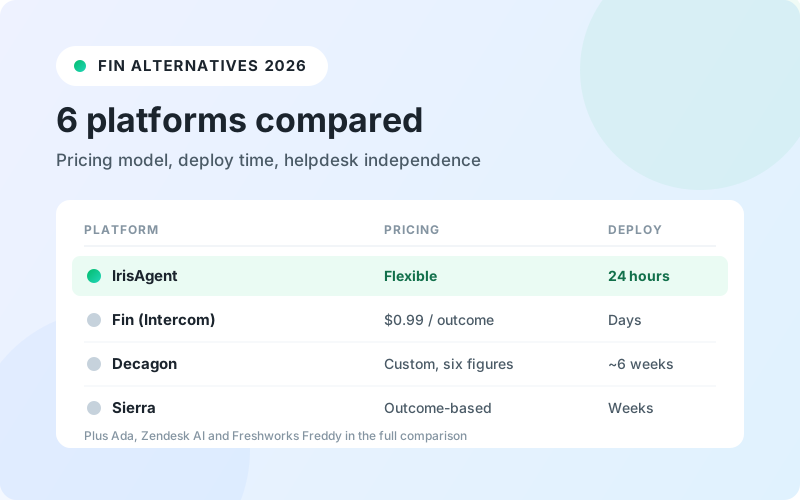
The per-outcome model is easiest to judge against a real vendor. We worked through how Fin pricing compares to the alternatives, including what an assumed resolution costs when the customer simply gives up.
Seven Questions to Ask Before You Sign
Six-figure annual floors are the clearest case for asking these questions early. See what Sierra AI and its alternatives actually cost once implementation is loaded into the first-year number.
What is your written definition of a resolved conversation, and what reopen window does it use?
What is the overage rate once we pass our committed volume, and how is the commitment set in year one when nobody knows our deflection rate?
Which integrations are included, and which ones are professional services? Ask specifically about taking actions, not just reading data.
Is agent-facing AI included, or is it a separate per-seat add-on?
What is the total first-year cost including implementation, and what is the cost in year two without it?
What happens to your revenue if our deflection rate doubles?
Is there a ticket-volume minimum, and what is the exit if we fall below it?
Final Thoughts
Conversational AI platform pricing is not really a price comparison. It is a bet on how well the automation will work, and each model shifts that risk somewhere different. Flat fees put the risk on you, since you pay the same whether the bot resolves 10% or 70%. Per-conversation puts the risk on you too, and slightly worse, because failures bill at the same rate as successes. Per-seat sidesteps the question entirely by measuring something unrelated to whether the AI works.
Per-resolution is the only common model that puts the risk on the vendor, and it is the one to prefer, provided the resolution definition is written down and the rate is at the low end of the band. At $0.50 the model is genuinely cheaper than the alternatives at every volume above a few thousand tickets. At $3.50 it is the most expensive option in this guide.
Price the model, not the number. Then read the full AI chatbot cost breakdown for what teams at your size actually end up spending, and see how the platform fits alongside a customer service AI chatbot already running on your helpdesk.
Frequently Asked Questions
How much does a conversational AI platform cost?
Conversational AI platform pricing depends far more on the billing model than on the vendor. Per-seat plans run $29 to $150 per agent per month, often with a $30 to $50 AI add-on on top. Per-conversation pricing runs $0.10 to $1.50 per conversation opened. Per-resolution pricing runs $0.50 to $6.00 and bills only when the AI closes a ticket. Flat platform fees run $1,500 to $10,000 or more per month at the mid-market, and $150,000 or more annually at the enterprise end.
What are the four conversational AI pricing models?
Per seat charges for each licensed agent regardless of whether they use the AI. Per conversation charges each time the bot opens a conversation, whether or not it resolves anything. Per resolution charges only when the AI closes a ticket end to end with no human involvement. A flat platform fee is a fixed monthly or annual commitment, usually with a separate implementation fee and often a ticket-volume minimum.
Which conversational AI pricing model is cheapest?
It depends on your ticket volume and your automation rate, and the ranking flips between them. At 2,000 tickets a month a flat platform fee is usually the worst value because you pay a tier floor you do not use. At 50,000 tickets a month a flat fee is often the best. Per-conversation pricing is the weakest model at most volumes because it bills for the conversations the bot fails to resolve. Per-resolution pricing at the low end of the band, around $0.50, is cheaper than the alternatives at almost any volume above a few thousand tickets.
Why does per-resolution pricing cost more as automation improves?
Per-resolution pricing bills for outcomes, so the invoice rises as the AI succeeds more often. Pushing deflection from 50% to 80% raises a per-resolution bill by roughly 60% on identical inbound volume. That is the model working as designed, and the right comparison is against the human support cost avoided rather than against last month's invoice. It is also why the per-resolution rate matters so much: 5,000 resolutions cost $2,500 at $0.50 each and $17,500 at $3.50 each.
What should be included in a conversational AI platform quote?
Six items are commonly quoted separately and turn a $2,000 quote into a $6,000 invoice: implementation and onboarding, backend integrations that take actions rather than just read data, additional channels beyond web chat, agent-facing copilot or summarization as a per-seat add-on, the overage rate once you pass committed volume, and compliance features such as SSO, audit logging, data residency, and a signed BAA. Price every model with those included.
What counts as a resolution in per-resolution pricing?
The definition is set by the vendor and should be written into the contract. A reasonable definition requires that the ticket closed without a human and the customer did not reopen or escalate within a defined window, usually 24 to 72 hours. A weak definition counts any conversation the bot did not explicitly hand off, which bills you for every customer who simply gave up. Always ask what happens when a customer disagrees that the issue was resolved.
Loading the form. Prefer email? Reach us at info@irisagent.com or call +1 617 249 3312.