
Best Fin (Intercom) Alternatives in 2026: 6 Tools Compared
Last updated: September 2026
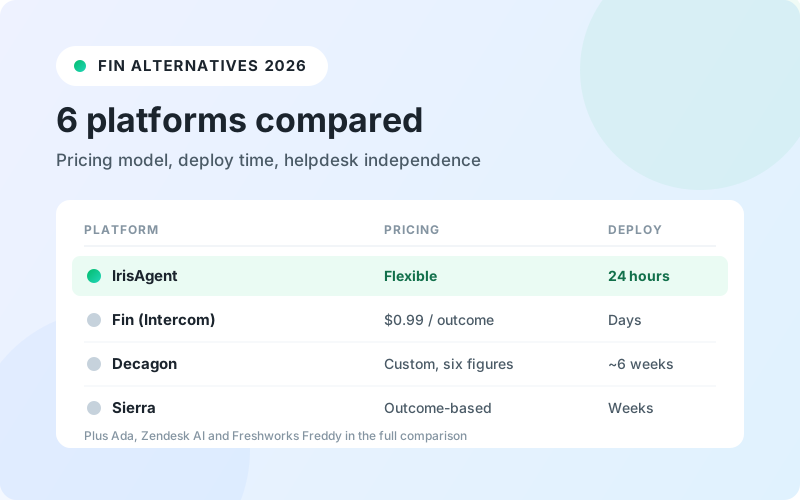
The best Fin alternatives in 2026 are IrisAgent, Decagon, Sierra, Ada, Zendesk AI, and Freshworks Freddy AI. Most teams start looking after one of two things happens: the per-outcome bill grows faster than the ticket volume it was supposed to absorb, or Salesforce announced it was buying Fin and the roadmap suddenly stopped feeling like their own.
IrisAgent leads this list for teams that want grounded, hallucination-free resolution on the helpdesk they already run, with a pricing model they can choose rather than inherit. Validated accuracy holds above 95% across enterprise deployments including Dropbox, Zuora, and Teachmint, and deployment takes 24 hours rather than a quarter.
This guide compares six genuine Fin alternatives. For each, you get where it wins, where it does not, and who it fits. Credit where it is due: Fin is a genuinely strong product, it resolves a high share of incoming conversations, and some of the tools below lose to it on specific dimensions. The goal is to help you decide, not to sell you a single answer.
Fin by Intercom alternatives that work with my existing helpdesk
If your search is for Fin by Intercom alternatives that work with my existing helpdesk, start with overlay platforms rather than a suite rip-and-replace. IrisAgent layers onto Zendesk, Salesforce, Intercom, and Freshworks so you keep the desk your agents already know. Fin is Intercom-native: it is strongest inside the Intercom suite, with a separate Fin for platforms path when you want Fin on a non-Intercom desk.
That overlay versus native split is the first filter on this list. Teams that want AI resolution without migrating tickets usually shortlist IrisAgent. Teams standardized on Intercom Messenger and product tours should still read the IrisAgent vs Intercom Fin comparison before they decide whether to stay native or layer on top.
Why Teams Are Looking for a Fin Alternative in 2026
Three patterns drive most Fin alternative searches this year.
First, the acquisition. On June 15, 2026, Salesforce signed a definitive agreement to acquire Fin (the company formerly known as Intercom) for approximately $3.6 billion. It is Salesforce's largest AI-agent acquisition to date and its fifth of 2026. For the roughly 30,000 customers running Fin today, the question is not whether the product works. It is who owns the roadmap in eighteen months.
Second, pricing predictability. Fin bills $0.99 per outcome on Intercom plans, with a minimum of 50 outcomes per month. An outcome is a resolution, a procedure handoff, or a disqualification. Lead qualification bills at $9.99. The standalone "Fin for platforms" deployment, which runs Fin on a non-Intercom helpdesk, carries a $49 per month base that includes 50 resolutions, with each additional outcome at $0.99. The model is transparent, and for low-volume teams it is genuinely cheap. The problem is directional: every ticket the AI successfully handles increases the invoice, so the better it works, the more you pay.
Third, what counts as a resolution. Fin bills both confirmed resolutions, where the customer says the answer helped, and assumed resolutions, where the customer simply leaves without asking anything else. A customer who gives up and closes the tab can look identical to a customer who got what they needed. That definitional gap is the single most common complaint in Fin billing discussions, and it is worth pressure-testing against your own transcripts before you renew.
What the Salesforce Acquisition Changes (and What It Does Not)
Be clear-eyed here, because a lot of the commentary is overheated.
What has not changed: the deal is signed, not closed. Salesforce expects it to close in the fourth quarter of its fiscal year 2027, subject to customary conditions and regulatory clearances. As of August 2026, Fin's product, support, and pricing are unchanged. Nobody is being migrated anywhere. If Fin is working for you today, there is no emergency.
What is worth watching: acquisitions of this size tend to converge roadmaps. Salesforce already sells Agentforce, a customizable agent platform, and has positioned Fin as the fast-to-value packaged counterpart aimed at SMB and commercial orgs. Two products serving adjacent buyers inside one company usually resolve into a tiering decision, and tiering decisions tend to arrive attached to repricing. Renewal terms that extend past the close date are the ones to read carefully.
The honest summary: this is a reason to run an evaluation on your own timeline, not a reason to panic-migrate. Teams that went through the Forethought and Zendesk acquisition learned the same lesson. The cost of switching under pressure is always higher than the cost of switching by choice.
What to Look for in a Fin Alternative
Set your criteria before you take demos. These six factors separate a tool that resolves real tickets from one that demos well.
Helpdesk independence. Does the AI layer on top of Zendesk, Salesforce, Intercom, or Freshworks, or does it require replacing your helpdesk? A layer ships faster and carries far less migration risk.
Grounded accuracy. Is every answer validated against your knowledge base before it sends, or can the model improvise? Ungrounded models hallucinate on 15% to 30% of responses, and in support that is a refund policy invented on the spot.
Pricing flexibility. Can you choose the model that fits your business, usage-based or resolution-based, or are you locked into one structure? The question is not whether per-resolution pricing is bad. It is whether you had a choice.
Resolution definition. How does the vendor decide a ticket was resolved, and do you get to audit it? Ask to see the difference between confirmed and assumed resolutions in your own data.
Time to deploy. Can you go live in 24 hours, or is this a multi-week implementation with a services contract attached?
Built-in QA. Can you score every AI and human conversation continuously, or are you back to hand-sampling 5% of them?
The 6 Best Fin Alternatives in 2026
1. IrisAgent
IrisAgent is the AI support resolution platform that automates 60%+ of tickets with grounded answers and 24-hour deployment. It layers onto your existing helpdesk instead of replacing it, and it prices flexibly so you can match the model to your business rather than inherit one.
Where it wins: the Hallucination Removal Engine validates every answer against your knowledge base and past tickets before it sends, which is why validated accuracy holds above 95% in production. It runs on Zendesk, Salesforce, Intercom, and Freshworks without a migration. Deployment is measured in hours. Pricing is flexible, including usage-based and resolution-based options, so a team worried about per-outcome exposure can pick a different structure. Built-in Auto QA scores 100% of conversations rather than a hand-picked sample.
Where it does not: IrisAgent is not the cheapest option for a very small team with light volume. Fin's $49 entry point is genuinely hard to beat below a few hundred tickets a month. IrisAgent is also not trying to be your helpdesk, so if you want one vendor for ticketing and AI, Fin or Zendesk fits that shape better.
Best for: mid-market and enterprise support teams, roughly 200 to 2,000 employees, that already run a helpdesk and need accuracy they can defend to a compliance team. See the full IrisAgent vs Intercom Fin comparison.
2. Decagon
Decagon is an enterprise agentic AI platform built around Agent Operating Procedures, which blend natural language instructions with code-level precision.
Where it wins: genuinely strong on complex, multi-step workflows, and the AOP model gives engineering teams real control over agent behavior. Strong Fortune 500 traction and a $4.5 billion valuation behind the roadmap.
Where it does not: Decagon does not publish pricing, and public breakdowns put median annual contracts near $386,000 with a platform fee around $50,000 on top of per-conversation charges. Onboarding runs roughly six weeks. Managing AOPs typically needs developer involvement and version control.
Best for: large enterprises with engineering capacity and a budget that clears six figures comfortably. More detail in our Decagon alternatives guide.
3. Sierra
Sierra, founded by Bret Taylor, sells outcome-based AI agents to large enterprises and carries a $15.8 billion valuation.
Where it wins: excellent conversational quality, strong brand-voice control, and an outcome-based commercial model that aligns vendor incentives with results. The engineering bar is high and it shows.
Where it does not: the entry point is steep, with reported annual floors around $150,000. Sierra generally expects to own more of the customer interaction surface, which means a heavier implementation. Outcome-based pricing has the same directional property as Fin's: success costs more.
Best for: large enterprises with the budget and the appetite for a strategic, high-touch deployment. See the Sierra alternatives comparison.
4. Ada
Ada is a long-established automation platform with deep e-commerce and consumer-brand presence.
Where it wins: mature product, strong multilingual coverage, and a large library of prebuilt integrations. If you sell direct to consumers at volume, Ada has seen your use case before.
Where it does not: pricing is quoted per resolution and is no longer published publicly, which is the same structural exposure that pushes teams off Fin in the first place. Some reviewers describe the configuration surface as dated relative to newer agentic platforms.
Best for: consumer and e-commerce brands with high multilingual volume. See the IrisAgent vs Ada comparison.
5. Zendesk AI
Zendesk AI is the native automation layer inside Zendesk, now including the Forethought technology Zendesk acquired.
Where it wins: if you already run Zendesk, this is the shortest path to something working. Native data access, no integration project, one vendor relationship, one invoice.
Where it does not: you are buying deeper into a single ecosystem at the moment you are trying to reduce vendor concentration risk, which is an odd trade if the Salesforce acquisition is what sent you looking. Zendesk has also repackaged its AI tiers more than once, and grounded accuracy generally trails specialist platforms. Teams navigating the Forethought transition wrote up their experience in what Forethought customers should do after the Zendesk acquisition.
Best for: Zendesk-committed teams that value consolidation over best-of-breed accuracy. See Zendesk AI and IrisAgent.
6. Freshworks Freddy AI
Freddy AI is the automation layer across Freshdesk and Freshservice, with an agent studio and MCP gateway added in 2026.
Where it wins: strong value for the money, straightforward setup, and a good fit for teams already standardized on Freshworks. The 2026 agent studio meaningfully closed the capability gap.
Where it does not: capability outside the Freshworks ecosystem is limited, and on complex or ambiguous queries it trails the specialist platforms on this list.
Best for: existing Freshworks customers who want competent automation without a separate vendor.
Fin AI Alternatives Compared
Platform | Pricing model | Time to deploy | Keeps your helpdesk | Best for |
|---|---|---|---|---|
IrisAgent | Flexible: usage-based or resolution-based | 24 hours | Yes | Mid-market and enterprise wanting grounded accuracy |
Fin (Intercom) | $0.99 per outcome, 50/mo minimum | Days | Via Fin for platforms | Small teams and existing Intercom customers |
Decagon | Custom, ~$386K median annual | ~6 weeks | Often replaces | Large enterprise with engineering capacity |
Sierra | Outcome-based, ~$150K floor | Weeks | Often replaces | Large enterprise, high-touch deployment |
Ada | ~$1.00 to $3.50 per resolution | Weeks | Partial | Consumer and e-commerce, multilingual |
Zendesk AI | Per-seat plus AI add-on tiers | Days | Zendesk only | Zendesk-committed teams |
Freshworks Freddy | Per-seat plus AI add-on | Days | Freshworks only | Existing Freshworks customers |
Fin vs Forethought on Resolution Accuracy
These two count a resolution differently, and that matters more than any headline accuracy number. Fin bills both confirmed resolutions, where the customer says the answer helped, and assumed resolutions, where the customer simply stops replying. Forethought, now part of Zendesk following the March 2026 acquisition, historically required a 20,000-ticket history before it could be trained and ran a 30 to 90 day implementation, so its accuracy is largely a function of how much of your ticket history it ingested. Neither vendor publishes an audited accuracy figure. Ask both for a grounded evaluation on your own knowledge base, and insist on seeing confirmed and assumed resolutions reported separately. IrisAgent holds validated accuracy above 95% in production because every answer is validated against your knowledge base before it sends, and it carries no ticket-volume minimum to start.
Fin vs Ada for Automated Ticket Resolution
Both bill per resolution, so the structural exposure is identical: the bill scales with the exact thing you are trying to automate. The difference is fit. Ada is strongest for consumer and e-commerce brands with high multilingual volume and a mature integration library. Fin is strongest inside Intercom, where it has native access to the conversation and the fastest path to a working agent. If you are comparing the two because per-resolution billing is what sent you looking, neither one solves that. The question to put to each is whether you can choose a usage-based structure instead, and what an assumed resolution costs you when the customer simply gave up.
How to Choose the Right Fin Alternative
Start with the constraint that actually binds you.
If the acquisition is your concern, the question is vendor independence, not features. Ask every vendor on your shortlist who owns them, who is likely to, and what happens to your contract if that changes. Then weight helpdesk independence heavily, because the ability to leave is what keeps a renewal negotiation honest.
If pricing predictability is your concern, model your actual volume against each structure before you talk to sales. Take last quarter's ticket count, apply your expected deflection rate, and multiply. Per-outcome models that look cheap at 500 tickets a month look very different at 15,000. Our AI chatbot pricing guide walks through the math.
If accuracy is your concern, ask for a grounded evaluation on your own knowledge base, not a canned demo. Any vendor can answer questions about a fictional company. Ask what happens when the knowledge base does not contain the answer, because that is where hallucinations live. See how IrisAgent approaches accuracy.
If speed is your concern, ask for the deployment plan in writing with named milestones. "A few weeks" in a sales call is reliably a quarter in practice.
One more filter: your industry decides which criterion binds hardest. Healthtech and financial services teams should weight grounded accuracy and audit trail above everything, because an invented answer is a compliance event rather than just a bad ticket. See AI support for healthcare and AI support for financial services. Ecommerce teams should weight multilingual coverage and peak-season elasticity, covered in AI support for ecommerce. Product teams at SaaS companies usually find helpdesk independence binds first, since replatforming the helpdesk is the one migration nobody budgeted for. See AI customer support for SaaS teams.
Are there Fin by Intercom alternatives that work with my existing helpdesk?
Yes. IrisAgent layers onto Zendesk, Salesforce, Intercom, and Freshworks so you keep the helpdesk you already run, usually live in about 24 hours. Fin is Intercom-native: it is built for the Intercom suite first, with Fin for platforms available when you want Fin on another desk. If your priority is grounded resolution on the stack you have today, an overlay like IrisAgent is the closer Fin alternative than a rip-and-replace suite.
Next Steps
The Salesforce acquisition of Fin does not close until Salesforce's fiscal Q4 2027, so you have time to run this properly. Use it. Shortlist two or three platforms, run each against a real slice of your ticket history, and compare grounded accuracy and true resolution rate rather than demo polish.
If you want to see what grounded resolution looks like on your own tickets, book a demo or read the IrisAgent vs Intercom Fin breakdown first.
Frequently Asked Questions
Are there Fin by Intercom alternatives that work with my existing helpdesk?
Yes. IrisAgent layers onto Zendesk, Salesforce, Intercom, and Freshworks so you keep the helpdesk you already run, usually live in about 24 hours. Fin is Intercom-native: it is built for the Intercom suite first, with Fin for platforms available when you want Fin on another desk. If your priority is grounded resolution on the stack you have today, an overlay like IrisAgent is the closer Fin alternative than a rip-and-replace suite.
What is the best alternative to Fin (Intercom)?
For most mid-market and enterprise support teams, IrisAgent is the best Fin alternative. It layers onto the help desk you already run, deploys in about 24 hours, and holds validated accuracy above 95% through its Hallucination Removal Engine. Crucially, it offers a choice of pricing models, usage-based or resolution-based, rather than a single per-outcome structure. Decagon, Sierra, Ada, Zendesk AI, and Freshworks Freddy are also credible alternatives depending on your budget and help desk.
Is Salesforce buying Fin (formerly Intercom)?
Yes. On June 15, 2026, Salesforce signed a definitive agreement to acquire Fin, the company formerly known as Intercom, for approximately $3.6 billion. It is Salesforce's largest AI-agent acquisition to date. Importantly, the deal is signed but not closed: Salesforce expects it to close in the fourth quarter of its fiscal year 2027, subject to customary conditions and regulatory clearances.
What happens to Intercom and Fin customers after the Salesforce acquisition?
Nothing changes immediately. As of July 2026 the deal has not closed, and Fin's product, support, and pricing are unchanged. No customers are being migrated. The longer-term question is roadmap convergence, since Salesforce already sells Agentforce and has positioned Fin as the packaged, fast-to-value counterpart. Teams with renewals extending past the expected close date should read repricing and roadmap terms carefully, but there is no need to migrate under pressure.
How much does Fin AI cost per resolution?
Fin bills $0.99 per outcome on Intercom plans, with a minimum of 50 outcomes per month. An outcome is a resolution, a procedure handoff, or a disqualification, while lead qualification bills at $9.99. The standalone Fin for platforms deployment, which runs Fin on a non-Intercom help desk, carries a $49 monthly base that includes 50 resolutions, with additional outcomes at $0.99 each. The model is transparent, but costs scale directly with how well the AI performs.
What counts as a resolution in Fin's pricing?
Fin bills both confirmed and assumed resolutions. A confirmed resolution is when the customer indicates the answer helped. An assumed resolution is when the customer leaves the conversation without asking anything further. That means a customer who gave up and closed the tab can bill the same as one who was genuinely helped. Before renewing, audit your own transcripts to see how your confirmed and assumed resolution split actually breaks down.
Why do teams look for a Fin alternative?
Three reasons dominate in 2026. First, vendor independence concerns following the Salesforce acquisition announcement. Second, pricing predictability, since a per-outcome model means every ticket the AI successfully handles increases the invoice. Third, the resolution definition itself, because assumed resolutions can inflate billed outcomes. Teams that value best-of-breed accuracy over ecosystem consolidation also tend to evaluate specialist platforms.
Loading the form. Prefer email? Reach us at info@irisagent.comor call +1 617 249 3312.