
The Enterprise AI Chatbot That Passes Security Review and Resolves 60% of Conversations
By Palak Dalal Bhatia, CEO & Co-founder, IrisAgent · Updated July 28, 2026



operations
What Is an Enterprise AI Chatbot?
An enterprise AI chatbot answers customer or employee questions at large scale. It uses large language models grounded in a company's own knowledge base, ticket history, and backend systems. The conversation itself is no longer what makes it enterprise. Any modern model can hold a coherent conversation.
What makes a chatbot enterprise is everything around the model. Who can configure it? Where does the data live? Can you prove which source produced a given answer? Can one deployment serve several brands, regions, and languages without becoming several deployments?
That distinction matters because the failure modes differ. An SMB chatbot that gets an answer wrong annoys a customer. An enterprise chatbot that gets one wrong can quote a policy that does not apply in that region. It can show information to a user who should not see it. It can also create a compliance event that surfaces in an audit months later.
What Makes a Chatbot Enterprise-Grade
Seven properties set enterprise chatbot solutions apart from the rest of the market. None of them show up in a demo. All of them show up in security review.
- Identity and access. Single sign-on through your existing identity provider. Role-based access control keeps a regional admin from reading or changing another region's configuration.
- Data residency and retention. A written answer on where conversation data is stored and processed, and how long it is kept. Plus a contractual promise that your customer data is never used to train shared models.
- Audit logging. A per-answer trail that records which response was served and which source document it came from. It also records who changed the configuration and when. Without this, you cannot investigate an incident. You can only apologize for it.
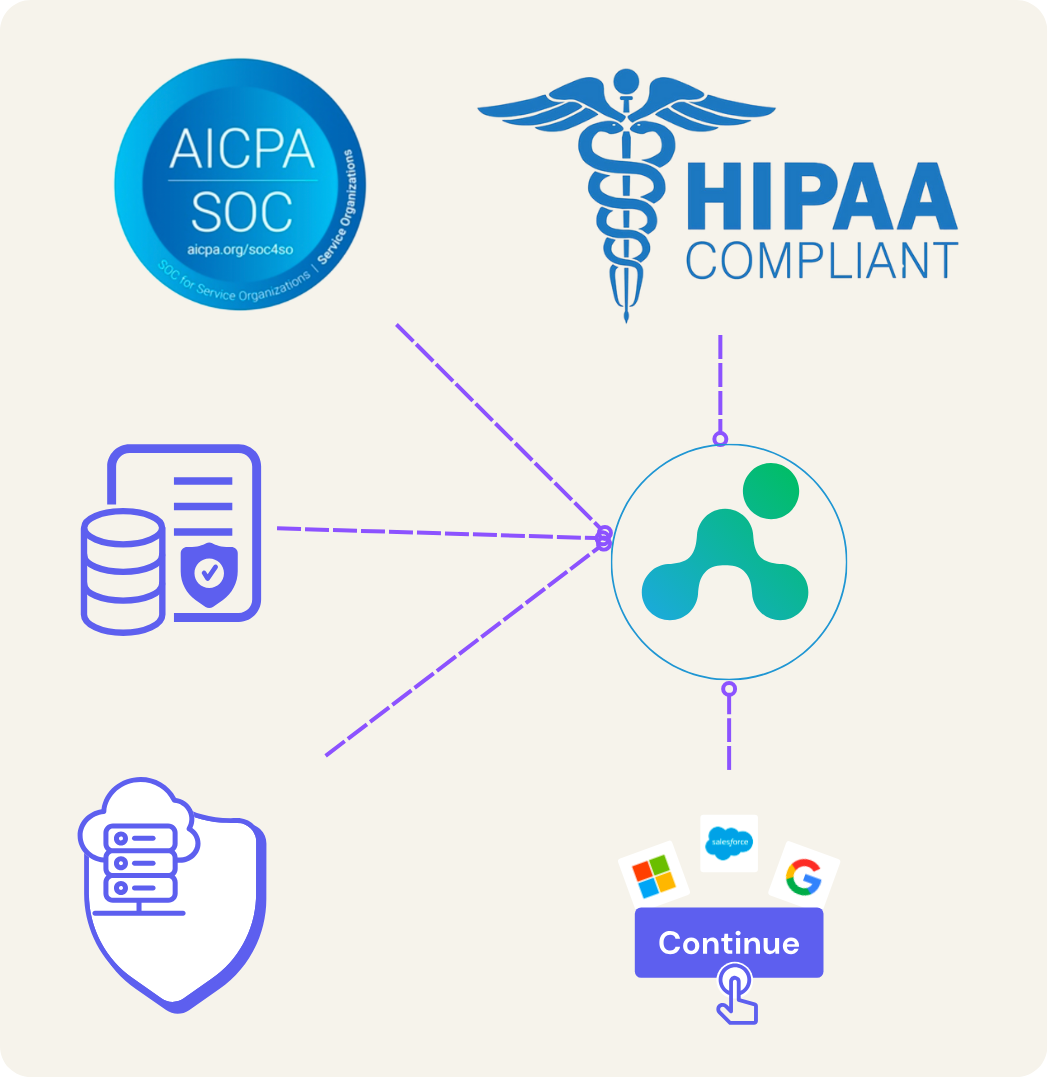
- Certification. SOC 2 Type II as the baseline, and HIPAA coverage with a BAA where PHI is involved. Type II matters more than Type I because it tests controls over time, not at a single moment.
- Multi-language, multi-brand, multi-region. One deployment serves several brands, each with its own knowledge, tone, and escalation rules. It answers natively in each language instead of translating an English answer at the last step.
- Governance over what the AI can do. Clear control over which topics the chatbot answers and which actions it may take in backend systems. It also sets when the chatbot must hand off to a human instead of attempting a resolution.
- Helpdesk-agnostic deployment. It layers onto Zendesk, Salesforce, Intercom, or Freshdesk. It inherits the queues, tags, and routing you already have, so you do not need to re-platform support to adopt a chatbot.
Grounded Answers, Above 95% Accuracy at Enterprise Scale
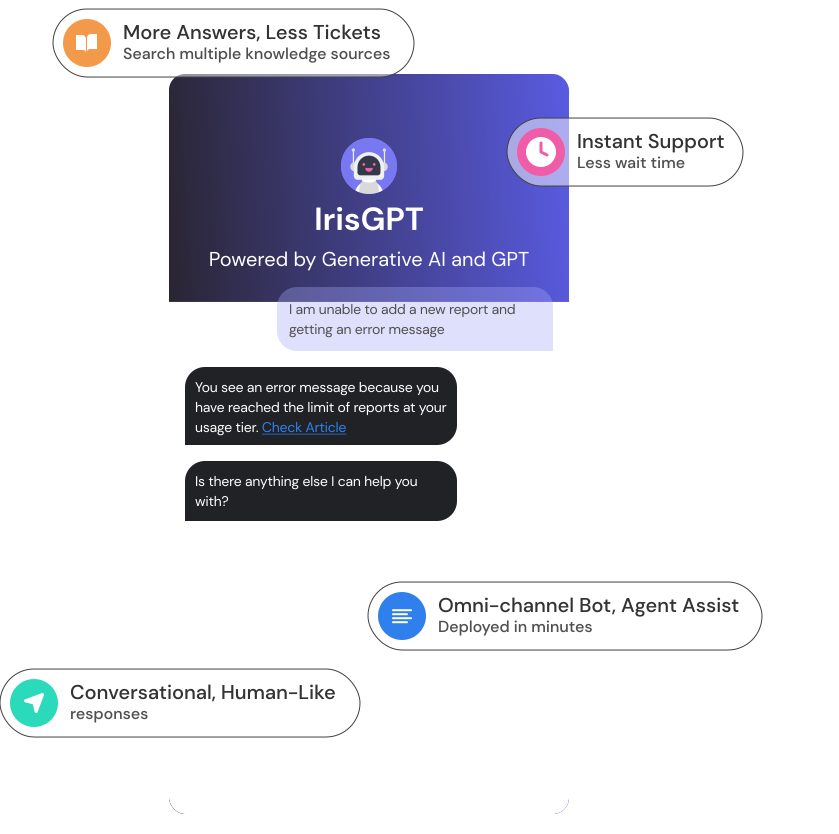
Governance Over What the AI Says and Does
SSO, Audit Logging, SOC 2 Type II, and HIPAA-Ready
Enterprise Chatbot vs SMB Chatbot
An SMB chatbot is built for a fast first answer. An enterprise chatbot is built for control at scale. Both can be the right choice. Teams usually find out they bought the wrong one in month three, not week one.
| Dimension | SMB chatbot | Enterprise AI chatbot |
|---|---|---|
| Identity and access | Shared logins, one admin role | SSO plus role-based access, scoped per brand and region |
| Data handling | Vendor default, residency often unspecified | Defined residency and retention, no training on your data |
| Auditability | Conversation transcripts only | Per-answer source trail plus configuration change history |
| Compliance | Self-attested, sometimes SOC 2 Type I | SOC 2 Type II, HIPAA with a BAA where PHI applies |
| Scope | One brand, one language, one queue | Many brands, regions, and languages in one deployment |
| Knowledge base size | Small enough for a human to review | Too large to review, so grounding has to be automated |
| Cost of a wrong answer | An annoyed customer | A regional policy breach or an audit finding |
Legacy Enterprise Chatbot vs AI-Native Enterprise Chatbot
Most enterprises already own an enterprise chatbot. They bought it between 2018 and 2022. It runs on intents and scripted flows, and it resolves a fraction of what it promised. The main difference from an AI-native system is who maintains the answers.
| Dimension | Legacy enterprise chatbot | AI-native enterprise chatbot |
|---|---|---|
| How answers are built | Humans author intents and scripted flows | Retrieved and composed from your existing content |
| Unmapped questions | Fall through to a human or a dead end | Answered if the knowledge exists anywhere in your content |
| Maintenance | Continuous authoring as the product changes | Updates when your knowledge base updates |
| Typical resolution rate | 10% to 30%, concentrated in a few mapped intents | 60%+ across the long tail |
| Main accuracy risk | Stale flows nobody updated | Hallucination, unless every answer is grounded and validated |
| Multi-language | A separate flow tree per language | Native answers per language from shared knowledge |
Here is the honest tradeoff. A legacy flow-based chatbot cannot say anything you did not write, and that is a real safety benefit. An AI-native chatbot gives you far higher coverage but gives up that benefit. This is why grounding and answer validation are not optional at enterprise scale.
How to Evaluate an Enterprise AI Chatbot: 7 Criteria
Every vendor demos well on a curated dataset. These seven questions show which enterprise chatbots survive production and which stall after the pilot.
- Grounding. Is every answer checked against your own knowledge base and ticket history before it reaches a customer? Then ask the harder question: what does it do when the answer is not in the knowledge base? The honest failure mode tells you more than the demo.
- Identity and access. SSO through your identity provider. Role-based access should let a brand or regional admin see and change only their own configuration.
- Data residency and retention. Where is conversation data stored and processed? How long is it kept? Is there a contractual promise that it never trains a shared model? Get this in writing before security review, not during it.
- Auditability. SOC 2 Type II, and HIPAA with a BAA if you touch PHI. Also a per-answer audit trail that shows the response served, its source, and the configuration in effect at the time.
- Multi-brand and multi-language scope. Can one deployment carry several brands with separate knowledge and escalation rules? Does it answer natively in each language, or translate an English answer at the end?
- Deployment model. Does it layer onto Zendesk, Salesforce, Intercom, or Freshdesk? Or does adopting it become a re-platforming project? This is the most common reason enterprise chatbot rollouts stall before the first customer sees an answer.
- Pricing at your real volume. Model the bill at your actual conversation count, not the pilot. Per-resolution pricing works against you at enterprise scale, because cost grows as the automation improves.
IrisAgent is built for all seven. Answers are grounded through a Hallucination Removal Engine. It has SSO and role-based access, and it is SOC 2 Type II and HIPAA-ready with defined residency and retention. One deployment covers many brands and languages. It works with your helpdesk and goes live in about 24 hours. Pricing is flexible: usage-based or resolution-based.
What Enterprise Teams Actually See
These are production numbers from enterprise deployments. They are not benchmark claims from a controlled test set.
- Dropbox saved 160,000 agent minutes in a single half-year on IrisAgent.
- Zuora reached 10x faster resolution.
- Teachmint runs IrisAgent across its support operation.
- Above 95% accuracy in production, enforced by the Hallucination Removal Engine, not promised by the model.
- 60%+ resolution without human intervention, and 40% to 60% lower average handle time on what still reaches an agent.
- About 24 hours to deploy onto your existing helpdesk, with tuning over the first two weeks.
One caveat: resolution rate depends heavily on how much of your volume is truly repetitive. Some enterprises get many account-specific or contractual questions. They should model their own numbers with the customer support ROI calculator before signing anything.
Go Deeper on AI Chatbots and Support Automation
Enterprise is the deployment context. These guides explain how chatbots and support automation work underneath it.


Any questions?
We got you.

See an Enterprise AI Chatbot Live in 30 Minutes
Bring your hardest queue and your security questionnaire. We will walk through grounding, access control, residency, and audit logging. We will also share a custom ROI projection. No credit card. No sales pressure.
Most enterprise rollouts start with access tickets. The volume is high and the workflow is fixed. See the controls behind AI password reset for enterprise accounts, including action scoping, takeover hard stops, and the full audit trail.
Enterprise buying decisions come down to what passes security review. See the eight enterprise AI support platforms we comparedon SOC 2, HIPAA, data residency, and audit logging.