
Chargeback Automation: How to Stop Disputes Before They Are Filed
Chargeback automation is software that handles the repetitive work of card disputes: resolving the complaint before the cardholder calls their bank, acting on issuer alerts, compiling evidence, filing representment, and tracking outcomes by reason code. The cheapest chargeback is the one that never gets filed, and that stage belongs to your support queue. IrisAgent's agentic actions resolve 50%+ of refund and billing tickets end to end, which is exactly the queue where most avoidable disputes begin.
Most content about chargeback automation is written by representment vendors, so it starts at the moment a chargeback lands. This guide covers the whole lifecycle, including the upstream stage most teams leave manual.
Key takeaways:
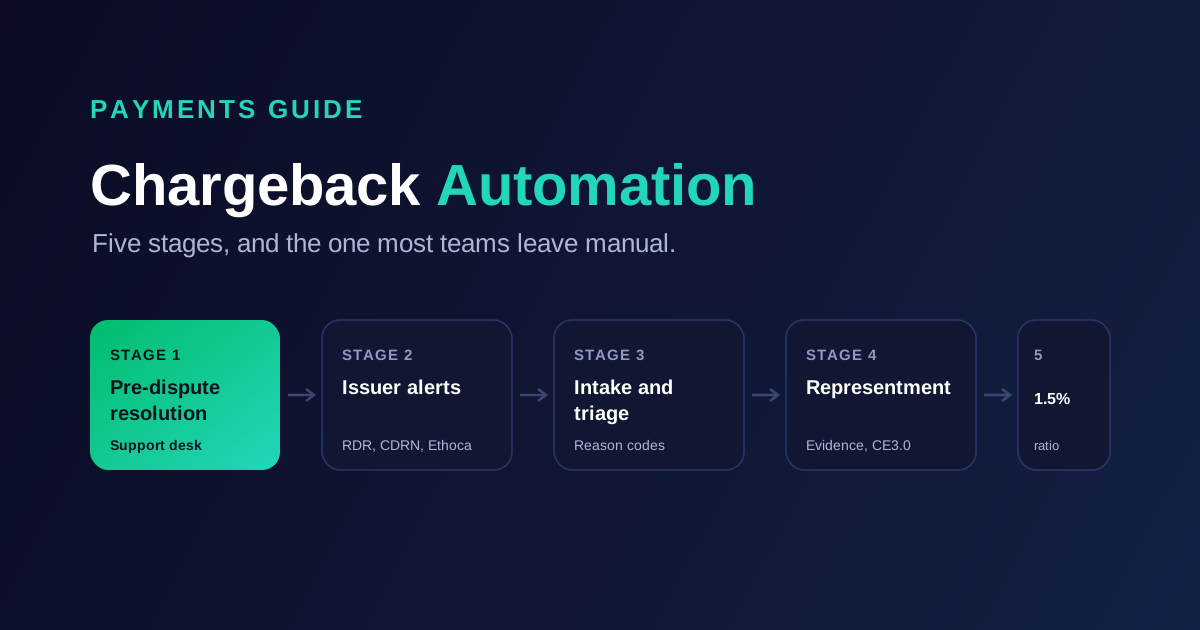
Chargeback automation has five stages: pre-dispute resolution, issuer alerts, intake and triage, representment, and prevention analytics. Different tools own different stages.
The margin for error shrank in 2026. Visa's VAMP "excessive" threshold dropped from 2.2% to 1.5% for US, Canadian, EU, and Asia-Pacific merchants on April 1, 2026.
Dedicated chargeback platforms win at representment. Support AI wins before the dispute exists, when the customer is still asking you instead of their bank.
The metric most teams never track: the share of chargebacks preceded by an unresolved support contact.
The five stages of chargeback automation
A chargeback is not one event. It is a sequence, and each step has a different owner and a different automation tool. Mapping the stages first stops teams from buying a representment platform to fix a problem that started in the help desk.
Stage | What happens | What gets automated | Usually owned by |
|---|---|---|---|
1. Pre-dispute resolution | Customer contacts you about a charge they do not recognize, a refund that has not arrived, or a subscription they cannot cancel | Instant answers from account data, policy-approved refunds, easy cancellation | Support team and support AI |
2. Issuer alerts | The cardholder's bank flags a dispute before it becomes a chargeback | Rules-based auto-refunds through Verifi RDR, Verifi CDRN, and Ethoca Alerts | Payments or risk team, via processor or chargeback platform |
3. Intake and triage | A chargeback arrives with a reason code and a response deadline | Reason-code classification, deadline tracking, accept-or-fight decisioning | Chargeback platform |
4. Representment | The merchant contests the chargeback with evidence | Evidence compilation, reason-code-specific response templates, Visa Compelling Evidence 3.0 matching | Chargeback platform |
5. Prevention analytics | Patterns across outcomes feed back into operations | Root cause by reason code, dispute ratio monitoring against network thresholds | Payments ops, with input from support ops |
Stages 2 through 4 are well served by existing tools. Stage 1 is where most merchants still rely on a human reading a ticket hours later, and stage 5 rarely connects back to it.
Why 2026 raised the stakes
Card networks monitor merchants by ratio, and the ratios got stricter this year.
Visa's Acquirer Monitoring Program (VAMP) combines fraud reports and disputes into one ratio against settled transactions. On April 1, 2026, the "excessive merchant" threshold fell from 2.2% to 1.5% for merchants in the US, Canada, the EU, and Asia-Pacific, with an $8 fee per disputed or fraudulent transaction once a merchant is flagged, as Forter summarizes. A merchant sitting at 1.8% last year was compliant. Today the same merchant is in the program.
Mastercard runs a separate Excessive Chargeback Program. A merchant becomes an Excessive Chargeback Merchant at a 1.5% chargeback-to-transaction ratio with at least 100 chargebacks in a month, and a High Excessive Chargeback Merchant at 3% with at least 300, per the program guide J.P. Morgan publishes for its merchants.
There is good news on the representment side. Visa's Compelling Evidence 3.0 lets merchants defeat card-absent fraud disputes (reason code 10.4) by showing two prior undisputed transactions from 120 to 365 days earlier that share matching data points, such as IP address or device fingerprint, with the disputed one. Stripe's CE3.0 documentation lays out the exact requirements. That rule rewards merchants who automate evidence collection, which is why stage 4 tooling has matured fast.
The combined effect: a tighter threshold means every avoidable dispute counts more, and avoidable disputes are decided at stage 1.
Where dedicated chargeback platforms win
Credit where it is due. Platforms such as Chargeflow, Justt, and Chargebacks911 are built for stages 2 through 5, and a support AI is not a substitute for them.
They connect directly to processors and alert networks, so issuer alerts and chargebacks arrive in one place without manual exports. They maintain evidence templates for each network's reason codes, which is tedious, specialist work that changes whenever Visa or Mastercard revise their rules. They assemble CE3.0 evidence packets automatically from order and device data. Many price on a success fee, so the merchant pays only when a dispute is won.
If your dispute ratio is already above a network threshold, start there. Representment recovers revenue on chargebacks that already exist, and alert enrollment through your processor or one of these platforms stops a share of disputes at stage 2.
What these platforms do not do is answer the customer. By the time an alert or a chargeback reaches them, the cardholder has already decided to go to their bank.
The stage most teams skip: stopping the dispute at the support desk
A large share of chargebacks are not fraud. They are customers who did not recognize a billing descriptor, could not find how to cancel a subscription, or waited too long for a refund and went to their bank instead. Each of those started as a question your support team could have answered.
The support-side version of chargeback automation has three jobs:
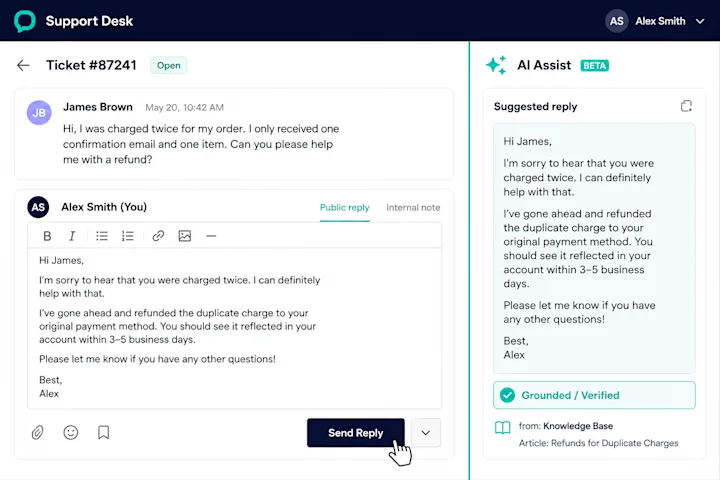
Answer "what is this charge?" instantly, from the customer's real order or invoice history, before they call their bank.
Execute the refund or cancellation that your policy already allows, without a queue wait.
Escalate the cases that look like real fraud or a contested charge, with the transaction record attached.
The mechanics of doing this for SaaS and subscription billing (reading the invoice, citing the specific line item, enforcing refund rules at the action layer) are covered in detail in our guide to AI for refunds, returns, and billing disputes. For card issuers and fintechs taking the dispute from the cardholder's side, see AI for failed payments and transaction disputes, which also explains why the AI opens disputes but never decides them.
Support conversations are representment evidence
The support log feeds stage 4 too. A transcript where the customer acknowledged the purchase, was offered a refund, or confirmed they used the service is evidence for a "product not received" or "credit not processed" dispute. Most teams never export it. When the support AI logs every refund offer and customer acknowledgment in a structured way, the chargeback platform can attach it to the representment packet instead of a payments analyst searching the help desk by hand.
How to set up chargeback automation in 6 steps
Pull 90 days of chargebacks by reason code and split them into two groups: preventable (unrecognized charge, cancelled recurring transaction, credit not processed, product not received) and true fraud. The preventable group is your stage 1 opportunity.
For each preventable chargeback, check whether the customer contacted support first. If they did and the ticket was slow or unresolved, that is a support failure, not a payments failure.
Fix the billing descriptor and receipts. A descriptor that does not match your brand name generates "I do not recognize this charge" disputes on its own.
Put a support AI on the three queues that precede most preventable disputes: refund status, cancellation, and "what is this charge." Give it the refund and cancellation rules your finance team already approved.
Enroll in issuer alerts (Verifi RDR and CDRN for Visa, Ethoca for Mastercard) through your processor or a chargeback platform, and set the auto-refund rules to match your support refund policy so customers get the same answer from both channels. Stripe's overview of dispute prevention is a clear primer on how these alerts work.
Send the chargebacks that remain to representment tooling, and pipe structured support transcripts into it as evidence.
What to measure
Four numbers tell you whether chargeback automation is working across all five stages.
Dispute ratio against network thresholds: your VAMP ratio and Mastercard chargeback ratio, tracked monthly against 1.5%. This is the number that decides whether you enter a monitoring program.
Pre-dispute resolution rate: the share of refund, cancellation, and billing-question tickets resolved on first contact without a human. Target 50% or higher. This is the stage 1 lever.
Representment win rate: the share of contested chargebacks you win. This is the stage 4 lever, and the one your chargeback platform reports.
Chargebacks preceded by a support contact: the share of chargebacks where the customer contacted support in the 30 days before disputing. Almost nobody tracks it, and it is the most useful number here. If it is high, your chargeback problem is a response-time problem.
How IrisAgent fits
IrisAgent works at stage 1. It installs into your existing help desk, answers billing and refund questions from your real order and invoice data with more than 95% validated accuracy, and executes refunds and cancellations inside the rules you define in Smart Operating Procedures. Anything outside those rules, including suspected fraud, escalates to a human with the full transaction history. It deploys in 24 hours and sits alongside your chargeback platform rather than replacing it.
For card and payment-heavy businesses, see AI customer support for fintech. For online retail, where "item not received" and refund delays drive most disputes, see AI customer support for ecommerce. For the dispute intake workflow itself, see the transaction dispute and chargeback intake use case.
Next steps
Pull last quarter's chargebacks, match them against support tickets from the same customers, and count how many started as an unanswered question. That number is the size of your stage 1 opportunity. If it is meaningful, book a demo and we will show IrisAgent resolving your refund and billing queue on your own ticket data.
Frequently Asked Questions
What is chargeback automation?
Chargeback automation is software that handles the repetitive work of card disputes: resolving customer complaints before they become disputes, acting on issuer alerts, classifying chargebacks by reason code, compiling representment evidence, and tracking outcomes. Different tools cover different stages. Support AI handles the pre-dispute stage, alert networks such as Verifi and Ethoca handle issuer alerts, and chargeback platforms handle representment.
Can chargebacks be fully automated?
Most of the workflow can be, but not every decision. Pre-dispute refunds inside policy, alert-based auto-refunds, evidence compilation, and deadline tracking are all automatable. Deciding whether to fight a high-value or ambiguous dispute, and judging suspected fraud, should stay with a payments or risk specialist.
What is the difference between chargeback prevention and representment?
Prevention stops a dispute from becoming a chargeback, either by resolving the customer's complaint directly or by refunding through an issuer alert before the chargeback is filed. Representment is contesting a chargeback that has already been filed by submitting evidence to the issuer. Prevention protects your dispute ratio. Representment recovers revenue but does not remove the dispute from your ratio.
What are the Visa and Mastercard chargeback thresholds in 2026?
Visa's VAMP flags merchants in the US, Canada, the EU, and Asia-Pacific at a combined fraud and dispute ratio of 1.5%, down from 2.2% before April 1, 2026, with an $8 fee per disputed or fraudulent transaction once flagged. Mastercard flags an Excessive Chargeback Merchant at a 1.5% ratio with at least 100 chargebacks in a month, and a High Excessive Chargeback Merchant at 3% with at least 300.
How does customer support reduce chargebacks?
Many chargebacks start as a support question that went unanswered: an unrecognized charge, a hard-to-find cancellation, or a slow refund. Answering those instantly from real account data, and executing the refund or cancellation your policy allows, removes the customer's reason to call their bank. Support transcripts also become evidence when a chargeback is contested.
Loading the form. Prefer email? Reach us at info@irisagent.com or call +1 617 249 3312.