
Conversational AI Assistant: 7-Point Buyer's Guide
A conversational AI assistant is software that understands natural language, holds multi-turn conversations with customers, and answers questions or completes tasks by reading your own knowledge base and systems, instead of following a fixed decision tree the way a scripted chatbot does. IrisAgent's own conversational AI assistant holds validated accuracy above 95% in production and resolves 60%+ of tickets end to end, because every answer is grounded in your knowledge base and validated before it reaches the customer.
Most teams evaluating a conversational AI assistant get stuck comparing feature lists instead of the things that actually determine whether the tool works in production: grounding, integration depth, and what happens when the AI is not confident. This guide defines the category, shows how it differs from a chatbot and an AI agent, and gives you a seven-point checklist to run before you sign a contract.
What Is a Conversational AI Assistant?
A conversational AI assistant uses natural language processing (NLP) to interpret what a customer is asking, holds context across multiple turns in the conversation, and generates a response instead of matching the input to a pre-written script. That is the core difference from a rule-based chatbot, which only handles the exact phrasings and decision branches someone configured in advance.
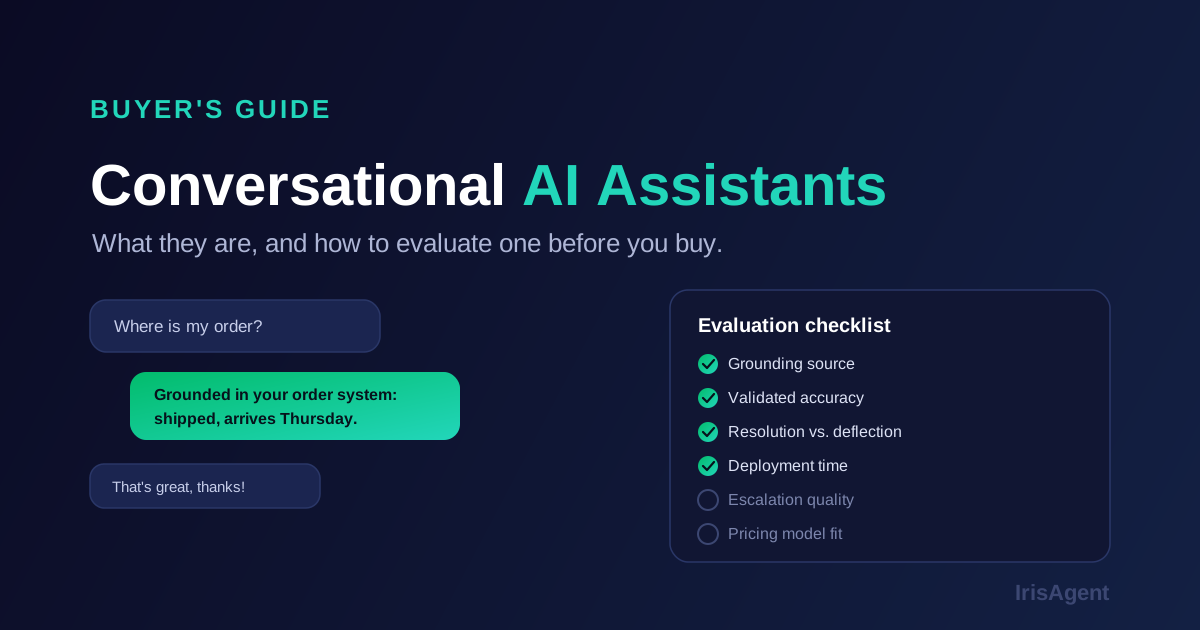
In customer support specifically, a conversational AI assistant typically connects to three sources: your knowledge base (help center articles, SOPs), your ticket history (past resolutions for similar issues), and your backend systems (order status, account state, billing). The assistant reads all three before answering, so a question like "where is my order" gets a real answer instead of a generic article link.
The quality of a conversational AI assistant comes down to grounding. An assistant that answers from its own training data, rather than your verified content, will hallucinate: it invents a plausible-sounding but wrong answer. Ungrounded large language models hallucinate on 15% to 30% of customer support responses (Stanford, 2024). Grounded assistants, which validate every response against a cited source before sending it, bring that rate under 5%.
Why Conversational AI Assistants Matter for Support Teams
Support volume keeps growing faster than headcount, and customers now expect a support interaction to feel like a conversation, not a form. Gartner predicts that conversational AI deployments in contact centers will reduce agent labor costs by $80 billion by 2026, driven by automating roughly one in 10 agent interactions and lifting productivity on the rest.
The cost side is only half the argument. According to Zendesk, 74% of consumers get frustrated when they have to repeat themselves to different agents, and 85% of CX leaders say customers leave a brand entirely when an issue is not solved on the first interaction. A conversational AI assistant that retains context across a conversation, and across channels, directly addresses both numbers: it does not forget what the customer already said, and it can resolve the issue in the same interaction instead of routing them into a queue.
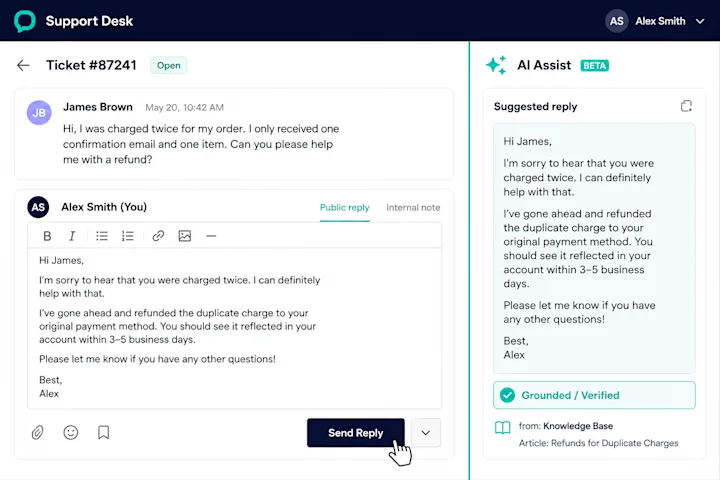
For support leaders, the practical upside shows up in three places: fewer repetitive tickets reaching a human agent, faster first response on the tickets that do, and a searchable, auditable trail of what the AI said and why. That last point matters more than most vendor pitches admit. If the assistant cannot show its source for an answer, you cannot audit it when a customer disputes what they were told.
Conversational AI Assistant vs. Chatbot vs. AI Agent
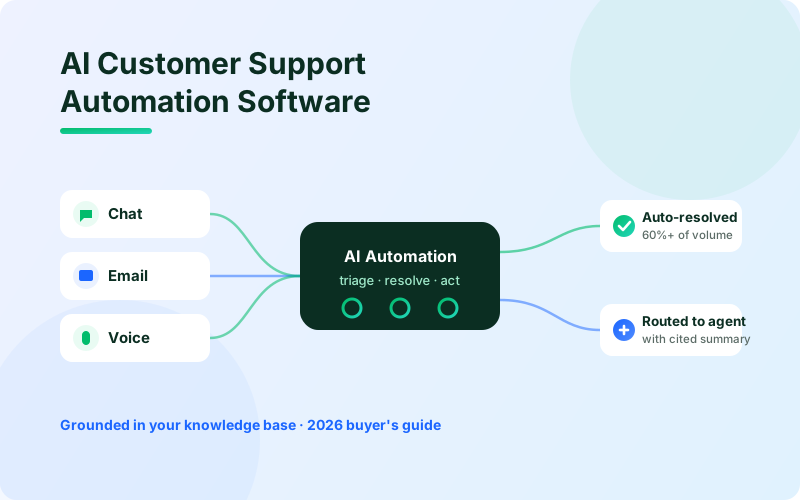
These three terms get used interchangeably in vendor marketing, but they sit at different levels of capability: a chatbot answers from a fixed script, a conversational AI assistant understands natural language and holds context across a multi-turn conversation, and an AI agent goes further and takes autonomous, multi-step action, such as processing a refund, to resolve a ticket end to end rather than just answering a question about it.
For the full three-way breakdown with examples, see AI agent vs. chatbot vs. copilot. For a deeper look at conversational AI as the broader category, see our explainer on what conversational AI is and how it works.
In practice, most production deployments blend all three: a conversational front end for the customer, agent-level automation behind it for the tickets that need real system access, and a copilot for the human agents who handle the rest.
7 Things to Evaluate Before You Choose a Conversational AI Assistant
Vendor demos are built to look good in a 30-minute call. These seven checks are what actually predicts whether the tool holds up in production.
Grounding source. Ask exactly what the assistant reads before it answers: your knowledge base, your ticket history, your backend systems, or its own training data. If the vendor cannot name the specific sources, assume it is closer to an ungrounded chatbot with a conversational skin.
Validated accuracy, not just "accuracy." Ask whether every response is checked against its cited source before it reaches the customer, and ask for the validated accuracy number in production, not in a benchmark. IrisAgent's Hallucination Removal Engine keeps validated accuracy above 95% across enterprise deployments including Dropbox, Zuora, and Teachmint.
Resolution rate, not deflection rate. Deflection means the bot showed the customer something and closed the ticket. Resolution means the customer's actual problem got solved. Ask the vendor to define exactly what counts as a resolution in their reported number.
Deployment time and data prerequisites. Some vendors require weeks of custom development or a minimum ticket volume before they will onboard you. Decagon's median custom deployment runs around $386,000 with a 6-week development cycle. Forethought requires a 20,000-ticket minimum. IrisAgent deploys inside your existing help desk in 24 hours with no ticket-volume floor.
Native help desk integration. Confirm the assistant installs directly into Zendesk, Salesforce, Intercom, Freshdesk, or Jira Service Management, rather than requiring your agents to work in a separate console. A one-click install means your team keeps its existing workflow.
Escalation quality, not just an escalation button. When the assistant is not confident, does it hand off with full context (what the customer asked, what it tried, why it stopped), or does the agent start from zero? A cold handoff erases the time the assistant was supposed to save.
Pricing model fit for your ticket volume. Per-seat, per-conversation, per-resolution, and flat platform fees each favor a different volume profile. Sierra's pricing starts at a $150,000 annual floor. Ada charges $3.50 per resolution. Price out your actual monthly ticket volume against each model before signing, and confirm the vendor offers more than one structure. IrisAgent offers flexible pricing with both usage-based and resolution-based plans, so you pick the structure that fits your ticket profile instead of the one the vendor prefers to sell.
Common Mistakes When Evaluating a Conversational AI Assistant
Three patterns show up repeatedly in failed AI rollouts, based on how support leaders describe their prior vendor experience:
Judging the demo instead of the data. A curated demo conversation proves the model can hold a conversation. It does not prove the assistant can find the right answer in your specific, messy knowledge base with outdated articles and conflicting SOPs.
Skipping the hallucination question. If a vendor does not proactively explain how they prevent hallucinations, ask directly. A conversational AI assistant that answers confidently and wrongly is worse for customer trust than a chatbot that says "I don't know" and routes to a human.
Signing before checking the pricing model against your volume. A per-resolution price that looks cheap at a demo's example volume can become the most expensive option once your actual ticket volume and automation rate are plugged in.
How IrisAgent Approaches Conversational AI for Support
IrisAgent's conversational AI assistant is grounded in your own knowledge base, ticket history, and backend systems, and every response is validated against its cited source before it reaches the customer. That is what keeps validated accuracy above 95% while ungrounded models hallucinate on 15% to 30% of responses.
Behind the conversational front end, IrisAgent also functions as an AI agent: it can look up account details, check product state, and take action across connected systems to resolve a ticket, not just answer a question about one. The knowledge it draws on comes from automatic knowledge generation, which keeps your KB current without manual upkeep, and support ops configures its behavior through natural-language SOPs rather than code.
See the full platform on the AI for customer support page, or compare the approach directly against a custom-build vendor on the IrisAgent vs. Decagon comparison.
Next Steps
A conversational AI assistant is only as good as what it is grounded in, how it handles low-confidence answers, and whether its pricing model fits your actual ticket volume. Before you sign with a vendor:
Confirm exactly what the assistant reads before it answers (KB, ticket history, backend systems, or none of the above)
Ask for a validated accuracy number from production, not a benchmark
Get the resolution rate definition in writing, not just the deflection rate
Price your real monthly ticket volume against every billing model the vendor offers, not just the one in the demo
IrisAgent's conversational AI assistant deploys inside your existing help desk in 24 hours, holds validated accuracy above 95%, and offers flexible pricing with both usage-based and resolution-based plans. See how IrisAgent works with your help desk in a 20-minute demo.
Frequently Asked Questions
What is a conversational AI assistant?
A conversational AI assistant is software that uses natural language processing to understand customer questions, hold context across a multi-turn conversation, and generate answers from your knowledge base, ticket history, and connected systems, instead of matching input to a fixed script the way a rule-based chatbot does.
How is a conversational AI assistant different from a chatbot?
A chatbot answers with scripted responses or basic keyword matching and cannot hold context beyond a single exchange. A conversational AI assistant understands natural language, retains context across the whole conversation, and pulls answers from your actual knowledge base and systems rather than a fixed decision tree.
Is a conversational AI assistant the same as an AI agent?
Not exactly. A conversational AI assistant focuses on understanding and answering in natural language. An AI agent goes further by taking autonomous, multi-step action, such as processing a refund or updating an account, not just answering a question about how to do it. Many production platforms, including IrisAgent, combine both.
How much does a conversational AI assistant cost?
Pricing varies by billing model: per-seat plans run $29 to $150 per agent per month, per-resolution pricing runs $0.50 to $6.00 per resolved ticket, and enterprise flat platform fees can start at $150,000 or more per year. The cheapest model depends on your ticket volume and automation rate, not on the sticker price alone.
How long does it take to deploy a conversational AI assistant?
Deployment time depends on the vendor's architecture. Custom-built platforms can take 6 weeks or longer and may require a minimum ticket volume before onboarding. Platforms that install natively into your existing help desk, like IrisAgent, can deploy in 24 hours with no ticket-volume prerequisite.
Loading the form. Prefer email? Reach us at info@irisagent.com or call +1 617 249 3312.