
AI vs Human Support: When to Use Each in Customer Service

AI and human support each have their strengths and limitations in customer service. AI is perfect for simple, repetitive tasks like answering FAQs, offering 24/7 availability, and reducing costs. Human agents, on the other hand, excel in handling complex, emotional, or high-stakes issues that require empathy and creative problem-solving.
Key Points:
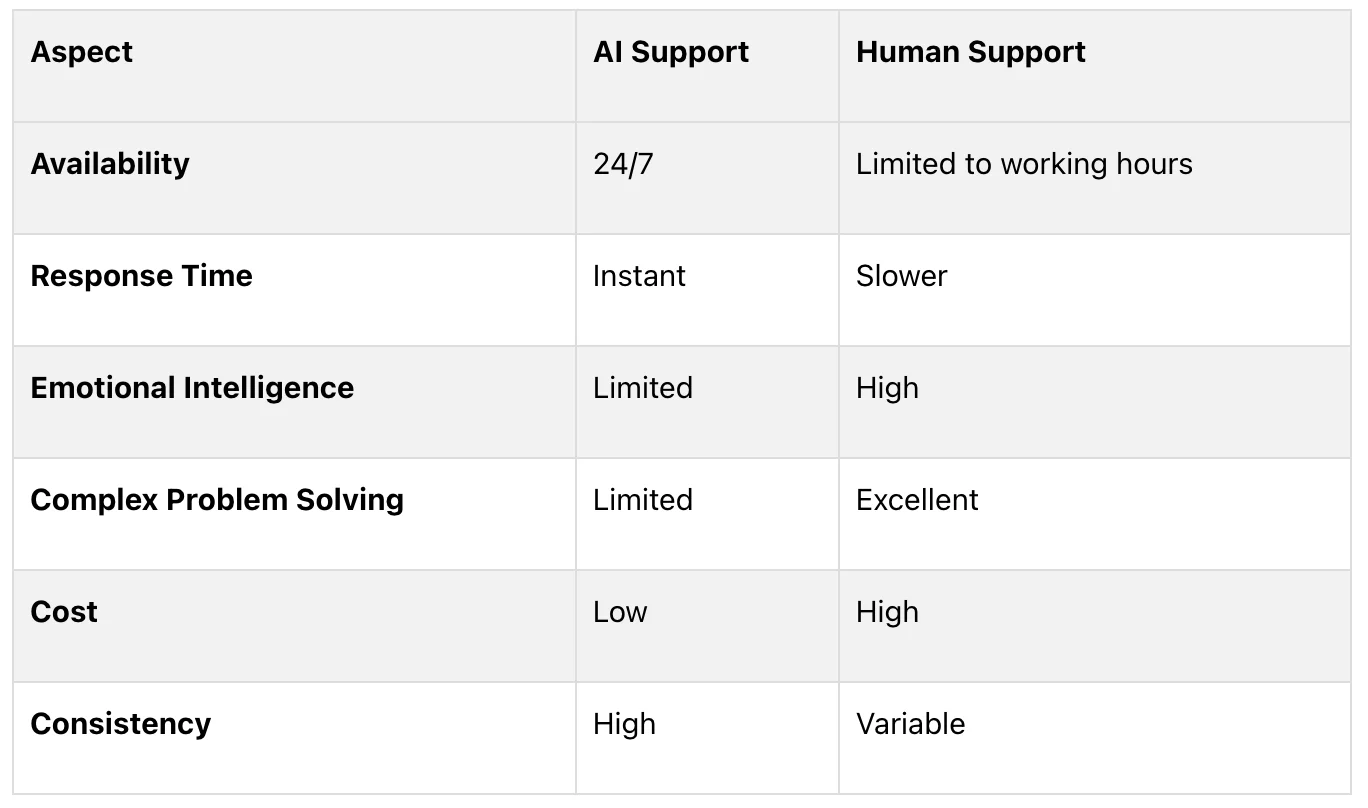
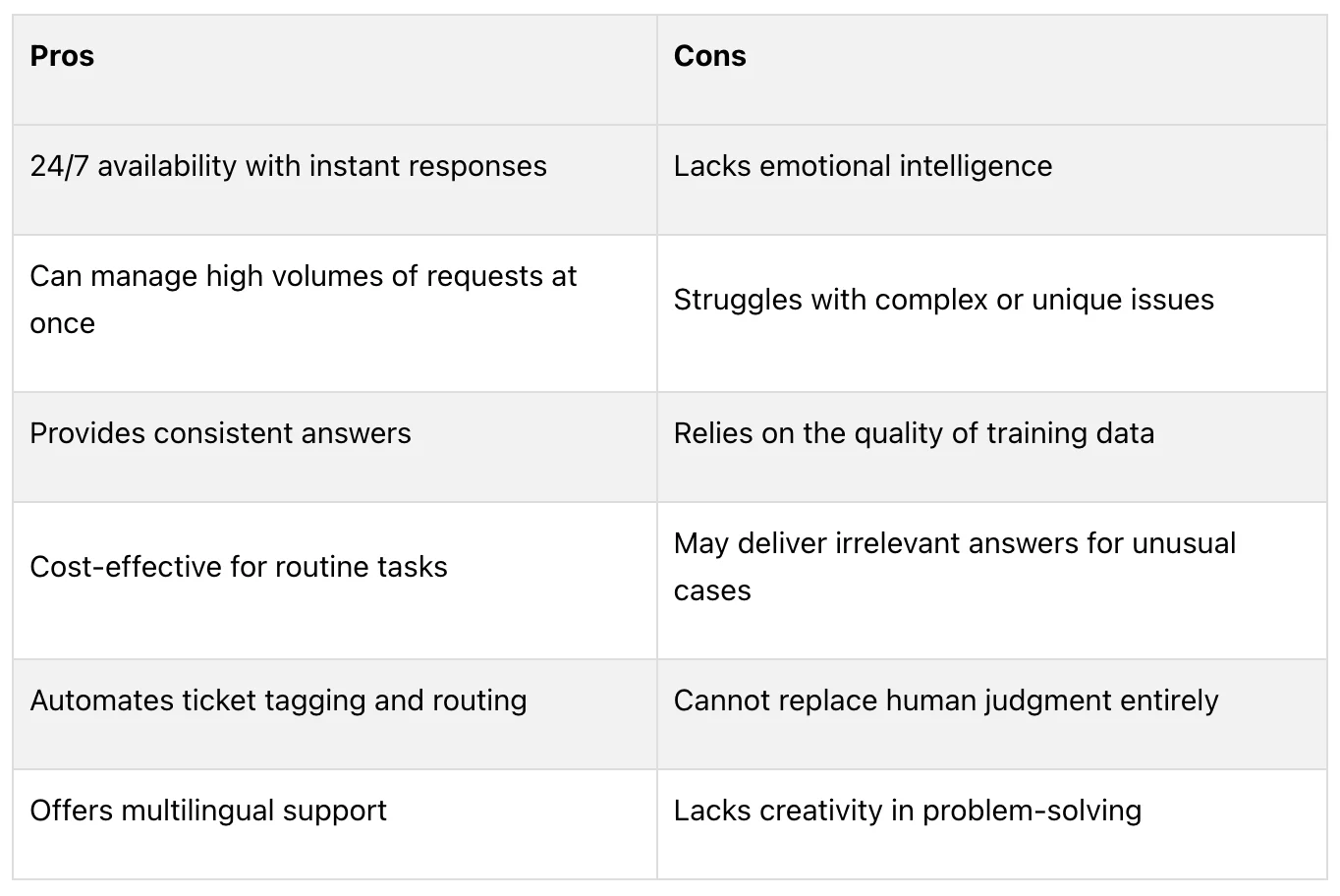
AI Strengths: Instant responses, scalability, cost-effectiveness, and consistency.
AI Weaknesses: Lacks emotional intelligence, struggles with unique or complex problems, and depends on training data quality.
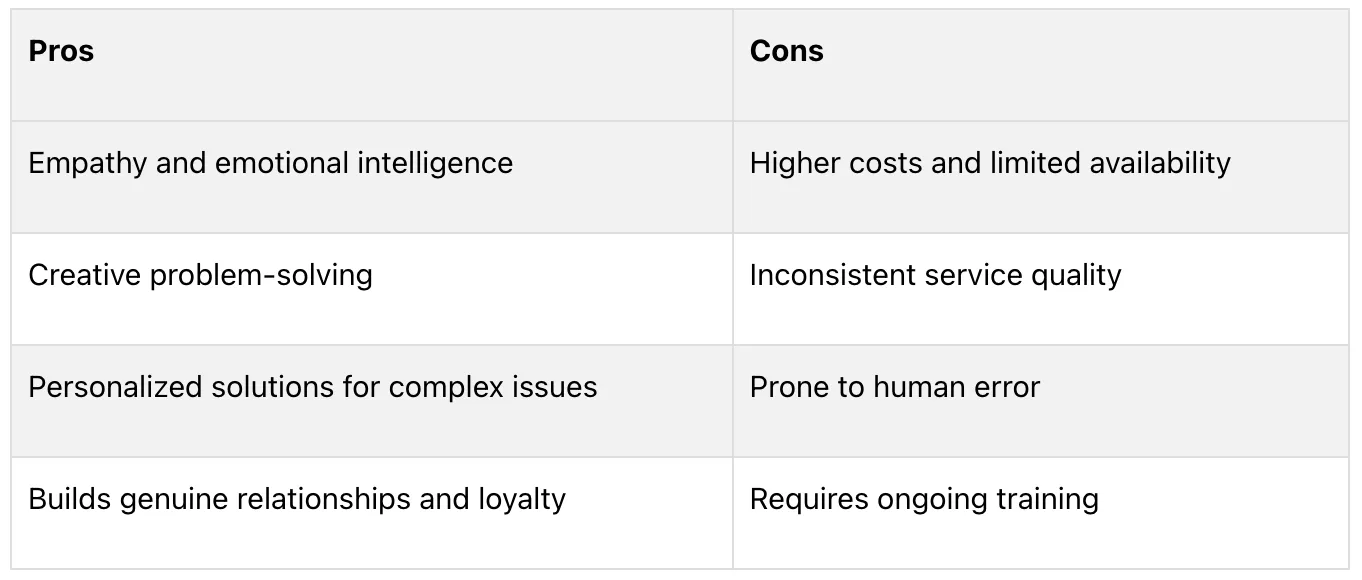
Human Strengths: Empathy, personalized solutions, and adaptability to complex situations.
Human Weaknesses: Higher costs, limited availability, and potential inconsistency.
Quick Comparison Table:
Best Approach:
A hybrid model works best. Use AI for routine tasks and initial interactions, and human agents for complex or emotional issues. This combination ensures efficiency without losing the personal touch customers value.
Strengths and Weaknesses of AI Support
Benefits of AI Support
AI tools are available around the clock, providing immediate assistance no matter the time or day, including holidays and across different time zones. They can handle a massive number of interactions at once without compromising on consistency or accuracy. For example, IrisAgent's AI-powered system can automatically tag, triage, and route tickets while responding in real time across multiple channels.
Another advantage is cost reduction. By automating repetitive tasks, AI minimizes the need for large teams, especially during busy periods. This automation ensures a consistent level of service and reduces the risk of spreading incorrect information.
Challenges of AI Support
One major drawback is AI's inability to understand emotions. It struggles to pick up on subtle emotional cues or offer genuine empathy. When it comes to solving complex or unique problems, AI often falls short, as these situations demand creative thinking that goes beyond its training.
AI's performance also heavily relies on the quality and breadth of its training data. If the data is incomplete or inaccurate, AI can produce irrelevant or incorrect responses, which can erode customer trust.
AI Support: Pros and Cons Table
"44% of customer support professionals endorse AI for its accuracy in handling customer service inquiries".
At the same time,
"42% of customers prefer a combination of human and AI support".
This suggests that while AI offers clear benefits, it works best when paired with human agents to create a balanced and effective support system. AI's efficiency and scalability are undeniable, but human agents bring empathy and creativity to the table - qualities that AI cannot replicate.
Strengths and Weaknesses of Human Support
Benefits of Human Support
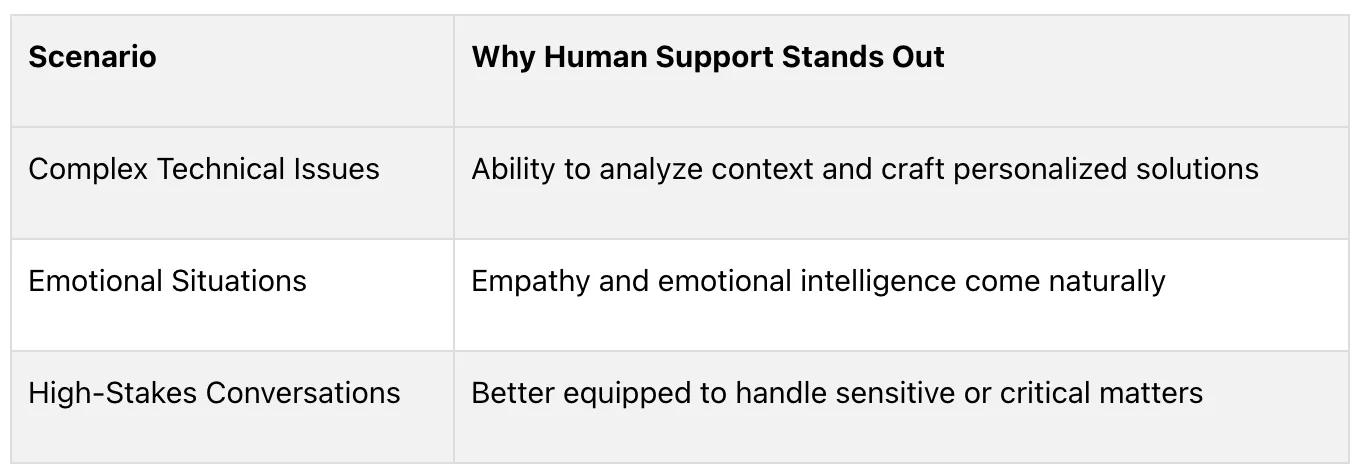
Human support stands out for its ability to provide empathy and handle complex, emotionally sensitive interactions. Unlike AI, human agents bring emotional intelligence and a deep understanding to customer interactions. They can read emotions, adapt their responses, and find connections between unrelated pieces of information to offer creative solutions tailored to unique problems.
"While AI is growing in customer support, human-to-human interaction remains vital"
This blend of emotional understanding and problem-solving makes human agents a valuable complement to AI, creating a balanced customer service strategy.
Challenges of Human Support
However, human support comes with its own set of challenges. It tends to be more expensive, with limited availability due to staffing constraints. Additionally, service quality can vary depending on factors like an agent's mood, experience, or fatigue. These inconsistencies can affect customer satisfaction and even harm a brand's reputation.
Human Support: Pros and Cons Table
"94% of consumers who give a company a 'very good' customer experience rating are likely to recommend that company".
AI vs. Human: Why you don't have to choose when building a customer first service strategy
Automate Customer Support with AI
Streamline your customer support operations with IrisAgent's AI-powered tools. Automate ticket tagging, triaging, and routing while delivering accurate, context-aware responses.
When to Choose AI Support or Human Support
Data reveals that 81% of customers prefer human interactions for complex issues.
Best Uses for AI Support
AI is ideal for managing repetitive tasks that require quick and consistent responses. It works best for:
Answering simple questions and providing 24/7 support: Addressing inquiries about products, orders, or policies any time of day.
Collecting and organizing customer data: Gathering preliminary details before escalating the issue.
Directing customers to the right teams: Efficiently routing inquiries to the appropriate departments.
While AI is great for streamlining routine tasks, it can't replace the human touch needed for more complex situations.
Best Uses for Human Support
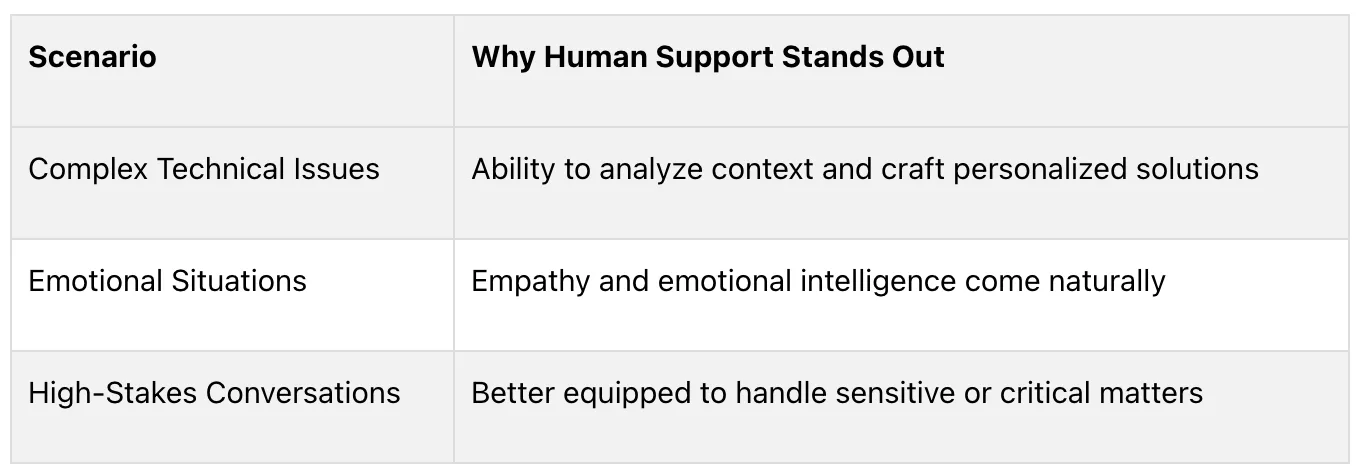
Human agents excel in situations that require deeper understanding and problem-solving skills. Their strengths are highlighted in:
"83% of people prefer to talk directly to a human because they better understand their problems and needs".
Instead of choosing one over the other, the best solutions combine the strengths of both AI and human support.
Combining AI and Human Support
A hybrid approach merges the efficiency of AI with the personal touch of human agents. Here's how businesses can make it work:
Integrated Support System AI manages initial interactions, directing complex issues to human agents using tools like sentiment analysis. It also provides real-time data to agents, speeding up response times. Regular reviews ensure tasks are balanced effectively between AI and humans.
AI-Assisted Human Support Human agents use AI tools for instant access to information and recommendations. This helps them respond faster and more accurately while maintaining a personal connection.
The goal is to create smooth transitions between AI and human support, ensuring every customer gets the right help for their specific situation. This approach boosts efficiency without compromising service quality.
Key Areas of Human-AI Collaboration
Initial Customer Contact and Routing
The first point of customer interaction represents one of the most critical areas for human-AI collaboration. AI-powered chatbots serve as the initial interface, capable of understanding customer intent through natural language processing and handling straightforward inquiries immediately. These tools can handle initial customer inquiries by automating responses to common questions, improving response times and customer satisfaction. These systems can process customer questions, provide instant answers to frequently asked questions, assist with account information, and guide customers through basic processes like password resets or order tracking.
More importantly, AI excels at intelligent routing, automatically directing queries to appropriate teams and assigning priority levels based on problem complexity and customer sentiment. AI technologies efficiently manage and predict customer requests, ensuring that service quality and customer satisfaction are consistently improved. Sentiment analysis capabilities allow AI systems to identify frustrated or urgent customers and prioritize their cases for immediate human attention. This ensures that customers who need empathetic, personalized support receive it quickly, while routine requests are handled efficiently by automated systems.
The seamless handoff protocol represents a crucial component of successful collaboration. When AI determines that a customer inquiry requires human intervention, the transition must preserve all context from the initial interaction. Advanced systems maintain conversation history, customer background information, and the specific issue details, allowing human agents to continue the conversation naturally without asking customers to repeat themselves. Support agents benefit from AI maintaining conversation context, enabling them to resolve issues more efficiently and focus on building stronger customer relationships.
Real-time sentiment analysis during these interactions helps prioritize cases based on customer emotional state rather than just technical complexity. Automating routine tasks streamlines processes and improves response times, allowing support teams to focus on more complex issues. A frustrated customer with a simple billing question might receive higher priority than a calm customer with a complex technical issue, ensuring that emotional needs are addressed alongside technical requirements. Customer conversations play a vital role in building loyalty and fostering community engagement, as ongoing communication helps create a sense of belonging and support.
Knowledge Management, Customer Data, and Decision Support
AI systems excel at curating and accessing vast knowledge bases to provide instant information to both customers and human agents. These systems can recommend relevant articles, troubleshooting guides, and solutions based on the specific context of each customer inquiry. AI can also analyze customer sentiment using natural language processing (NLP) and predictive analytics to assess emotions and opinions, enabling businesses to better understand customer needs and improve satisfaction. For human agents, this means having immediate access to comprehensive information that might otherwise require time-consuming searches through multiple databases.
Real-time guidance represents another powerful collaboration area. AI can provide suggested responses during customer interactions, helping agents craft more effective communications and ensuring consistency in service quality. These suggestions are based on successful resolution patterns from previous interactions, customer history, and the specific context of the current situation.
Predictive analytics take this collaboration further by identifying potential issues before customers report them. By analyzing customer data patterns, usage behaviors, and historical trends, AI systems can alert human agents to proactively address problems. AI also helps support teams understand customer behavior, allowing them to predict needs and deliver proactive, personalized support. For example, if data indicates that a customer’s account shows patterns consistent with previous billing disputes, agents can reach out preemptively to resolve potential issues.
Automated documentation and case summarization ensure that all customer interactions are properly recorded for future reference and follow-up. AI can generate detailed summaries of complex interactions, track resolution steps, and maintain comprehensive customer history that helps human agents provide more personalized service in future interactions.
Quality Assurance and Coaching
AI monitoring of conversation quality provides continuous oversight of customer service interactions without requiring constant human supervision. These systems can identify when conversations deviate from company policies, when customer satisfaction appears to be declining, or when additional support might be needed.
Real-time coaching suggestions help agents during difficult conversations by analyzing tone, customer sentiment, and conversation flow to recommend specific approaches or de-escalation techniques. While AI provides valuable guidance, maintaining a human touch is essential for empathy and nuanced understanding, ensuring that customer interactions remain genuine and personalized. This is particularly valuable for new agents or when handling unusually challenging situations.
Performance analytics help managers identify training opportunities by analyzing patterns in agent performance, customer feedback, and resolution outcomes. Rather than relying on periodic reviews, AI provides ongoing insights into areas where individual agents might benefit from additional support or training.
Customer feedback analysis creates continuous improvement cycles by identifying recurring issues, successful resolution strategies, and areas where either AI systems or human processes might be enhanced. Preserving a personal touch in customer service interactions builds trust and loyalty, ensuring that even as AI evolves, the human element remains central to customer satisfaction. This ensures that the collaboration between AI and human agents continues to evolve and improve over time.
Implementation Best Practices for Human-AI Collaboration
Successfully implementing human-AI collaboration in customer support requires careful planning and attention to both technical and human factors. The foundation of any successful implementation begins with clear role definitions that distinguish human and AI responsibilities while establishing smooth collaboration protocols.
Start by conducting a comprehensive audit of your current customer service operations to identify which tasks are best suited for AI automation and which require human expertise. Routine inquiries like password resets, basic account information, and frequently asked questions are ideal candidates for AI handling. Complex problem-solving, emotional support situations, and relationship-building interactions should remain primarily human-driven with AI providing supportive information and context.

Investment in comprehensive agent training represents a critical success factor that many organizations underestimate. Human agents need training not just on the technical aspects of AI tools, but on how to leverage AI insights effectively, when to trust AI recommendations, and how to seamlessly transition between AI-supported and independent problem-solving. This training should be ongoing rather than a one-time event, as AI capabilities continue to evolve.
Establish transparent escalation protocols that clearly define when and how cases should be transferred between AI and human agents. These protocols should include specific triggers for escalation (such as customer sentiment indicators, complexity thresholds, or time-based criteria) and ensure that context is preserved throughout the handoff process. Customers should never feel like they’re starting over when transferred to a human agent.
Implement continuous feedback loops for AI system improvement by regularly analyzing interaction outcomes, customer satisfaction scores, and agent feedback about AI recommendations. AI systems learn and improve through data, but this improvement requires human oversight and course correction to ensure that the systems are developing in ways that genuinely enhance customer service operations.
Maintain customer choice between AI and human support channels whenever possible. Some customers prefer interacting with AI for quick, straightforward issues, while others always want human interaction. Providing options and respecting customer preferences builds trust and satisfaction with your support model.
A typical implementation timeline should span 6-12 months with specific milestones. Phase one (months 1-2) focuses on system integration and basic AI deployment for simple inquiries. Phase two (months 3-4) introduces more sophisticated routing and begins human agent training. Phase three (months 5-6) implements real-time assistance and coaching features. The final phase (months 7-12) optimizes based on performance data and scales successful practices across the entire operation.
Regular performance monitoring using metrics like first contact resolution rates, customer satisfaction scores, and average handling times provides objective measures of collaboration effectiveness. However, qualitative feedback from both customers and agents often reveals insights that pure metrics might miss.
Tips for Balancing AI and Human Support
Organizations that combine AI with human agents handle 13.8% more inquiries per hour and see a 1.3% boost in resolution rates.
Smooth Transitions Between AI and Humans
Creating a smooth customer experience depends on carefully designed handoff processes. Here’s how it works:
Temu sets a great example by letting customers type, "I want to talk to a human agent", to trigger a transfer. The system automatically shares the full conversation history with the human agent, ensuring a seamless transition.
Using AI to Support Human Agents
AI tools are game-changers for agent productivity. For example, the lowest-performing 20% of agents have seen a 35% improvement in task throughput when supported by AI. Tools like IrisAgent boost efficiency with features like:
Sentiment analysis
Intelligent ticket routing
Predictive analytics
Multilingual support
Improving AI Systems Over Time
MongoDB shows how to refine AI systems by analyzing AI-human handoff data to improve chatbot decision-making. Their approach has measurable results: new agents using AI handle 3.0 inquiries per hour after 5 months, compared to just 2.5 inquiries per hour after 8 months without AI.
To keep AI systems performing well:
Regularly analyze customer feedback and interaction patterns
Update training models with new scenarios and data
Review and tweak handoff criteria based on real-world performance
Gather and act on agent feedback about AI tools
This continuous improvement ensures both AI and human agents work more effectively together.
Measuring Success, Customer Satisfaction, and ROI
Establishing comprehensive measurement frameworks for human-AI collaboration effectiveness requires tracking both quantitative metrics and qualitative outcomes. Key performance indicators should encompass customer satisfaction, operational efficiency, cost optimization, and agent productivity to provide a complete picture of collaboration success.
Customer satisfaction metrics comparing hybrid models with traditional support approaches typically show significant improvements. Track Net Promoter Scores (NPS), Customer Satisfaction (CSAT) scores, and customer effort scores specifically for interactions that involved AI assistance versus human-only interactions. Many organizations find that customers rate hybrid interactions higher than either pure AI or pure human interactions, appreciating the efficiency of AI combined with human understanding when needed.
First contact resolution rates often improve dramatically with effective collaboration, as AI can provide human agents with comprehensive context and suggested solutions before customers need to explain their issues multiple times. Monitor resolution times across different complexity levels to ensure that AI is effectively handling routine inquiries while complex cases receive appropriate human attention.
Cost savings calculations should include both direct savings from reduced handling times and indirect benefits like improved customer retention and increased customer lifetime value. While AI chatbots reduce immediate operational costs, the more significant long-term value often comes from enhanced customer relationships and reduced churn.
Agent productivity measurements should track not just volume metrics but quality indicators like agent satisfaction scores, retention rates, and skill development. Effective collaboration typically results in agents handling fewer total cases but spending more time on complex, valuable interactions that require human expertise.
Establish baseline measurements before implementing collaboration systems to ensure accurate comparison of pre- and post-implementation performance. Regular measurement and adjustment ensure that collaboration continues to deliver value and improve over time.
What Is the Difference Between Human Touch and AI?
AI is great at handling routine tasks quickly, but human agents shine when it comes to empathy and solving more complex problems - something 96% of customers value in support interactions.
Here’s a quick breakdown of how AI and human support differ:
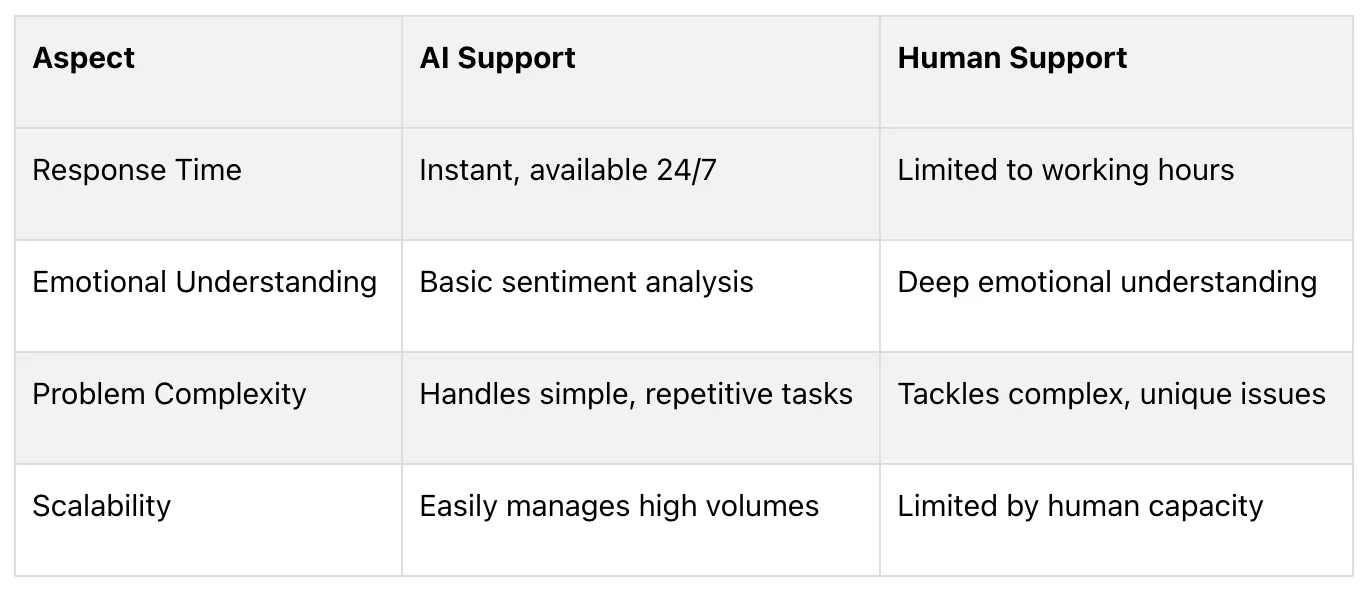
When used together, AI and human support can complement each other perfectly. For example, chatbots can handle up to 80% of routine questions, freeing human agents to focus on the 20% that demand empathy and creative problem-solving. While 51% of customers lean on AI for quick service, human agents are vital for building trust and managing sensitive situations.
"While AI can automate repetitive tasks and provide rapid responses, it cannot replicate the nuanced understanding, empathy and emotional intelligence that human agents offer." - Charles Kergaravat, CMO at Apizee.
The key is balance. Combining AI's speed and efficiency with the emotional intelligence of human agents ensures a well-rounded customer service experience, tailored to every type of interaction. This hybrid approach plays to the strengths of both methods while addressing their individual limitations.
Conclusion
Key Takeaways
Customer service in 2025 revolves around a smart blend of AI and human expertise. Hybrid models are proving their worth, managing 13.8% more inquiries per hour with better resolution rates. AI shines in handling repetitive, high-volume tasks, offering around-the-clock availability and cost savings. Meanwhile, human agents remain essential for tackling complex, emotional, or highly personalized issues.
The stats back this up: 49% of consumers are okay with AI handling basic tasks, but 79% believe human agents will always be necessary in customer service.
What's Next for Customer Service
By 2025, 80% of organizations are expected to rely on AI to enhance customer support. Companies like MongoDB are already leading the way, with AI-supported agents managing 3.0 inquiries per hour after just five months of implementation.
"Instead of viewing AI as a replacement for human agents, businesses should see it as a complementary tool that enhances the capabilities of their customer service teams."
As hybrid models evolve, three trends are shaping the future of customer service:
AI tools offering proactive, tailored support
Smooth integration between AI systems and human agents across channels
Better data analytics for predicting customer needs
The road ahead lies in balancing AI’s efficiency with the empathy and adaptability of human agents, ensuring smooth and satisfying customer experiences at every interaction.
Frequently Asked Questions
How do customers react to AI-human hybrid support models and do they prefer one over the other?
Customer reactions to hybrid models are generally positive when implemented well, especially when customers can choose between AI and human support based on their specific needs. For simple, routine inquiries, customers often prefer AI for its immediate availability and quick resolution. For complex emotional situations or unique problems, customers typically want human interaction. The key is providing smooth transitions and never making customers feel trapped in an automated system when they need human help.
What specific skills should customer service agents develop to work effectively with AI systems?
Customer service agents should develop digital fluency to understand AI recommendations and know when to trust or override AI suggestions. Critical thinking skills help agents evaluate AI-provided context and determine the best course of action. Emotional intelligence becomes even more important as agents handle the complex, sensitive interactions that AI cannot manage. Agents should also develop adaptability skills to work with evolving AI capabilities and curiosity to understand how AI insights can improve their customer interactions.
How long does it typically take to see ROI from implementing human-AI collaboration in customer support?
Most organizations see measurable improvements in customer satisfaction and operational efficiency within 3-6 months of implementation. However, full ROI typically requires 12-18 months as AI systems learn and improve, agents become proficient at collaboration, and optimization based on performance data takes effect. Early wins often include reduced response times and improved routine inquiry resolution, while longer-term benefits include increased customer retention and enhanced agent productivity.
What are the most common integration challenges when connecting AI tools with existing customer service platforms?
The most frequent challenges include data format incompatibilities between systems, maintaining real-time synchronization of customer information across platforms, and ensuring that AI recommendations appear seamlessly within agents' existing workflows. Legacy systems often require custom integration work, and organizations frequently underestimate the complexity of maintaining conversation context during handoffs between AI and human agents. Planning for these integration complexities and working with experienced vendors helps minimize disruption during implementation.
How can small businesses with limited budgets start implementing human-AI collaboration in their customer support?
Small businesses should start with basic chatbot implementations for frequently asked questions and simple routing tasks. Many affordable cloud-based platforms offer AI features that require minimal technical expertise to deploy. Begin by automating the most common customer inquiries-like hours of operation, basic product information, or appointment scheduling. As the business grows and sees results, gradually add more sophisticated features like sentiment analysis and predictive routing. The key is starting small with proven use cases rather than attempting comprehensive implementation immediately.

Loading the form. Prefer email? Reach us at info@irisagent.com or call +1 617 249 3312.