
Best LLM Evaluation Tools in 2026, Compared
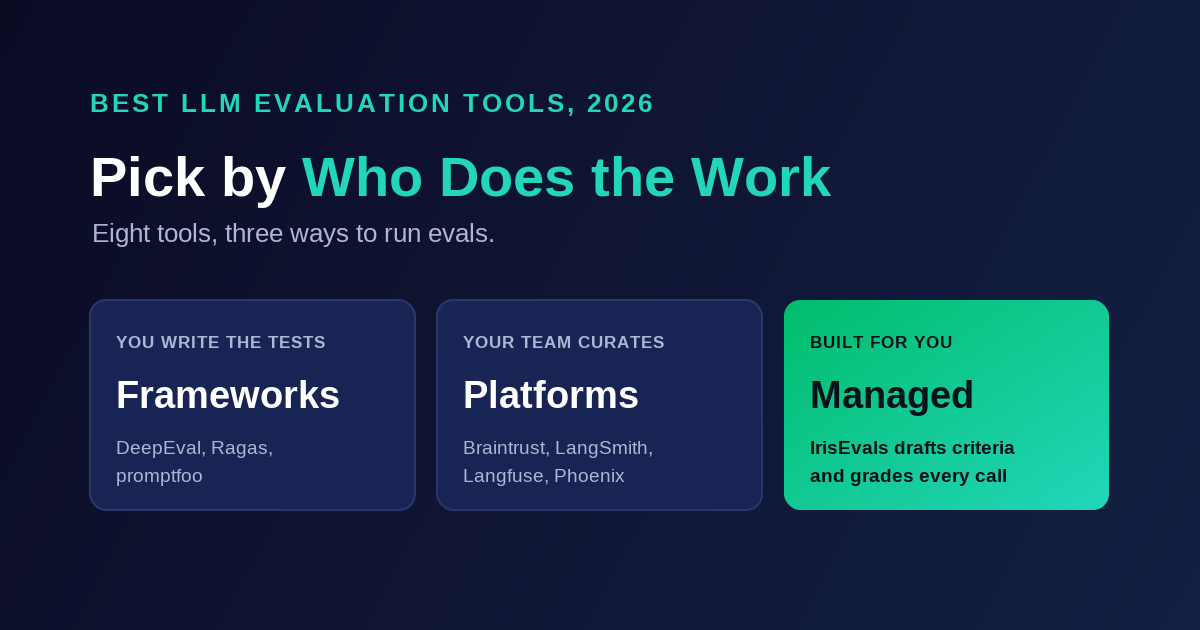
The best LLM evaluation tools in 2026 are DeepEval, Ragas, and promptfoo if your engineers want to write tests in code; Braintrust, LangSmith, Langfuse, and Arize Phoenix if your team will curate datasets and scorers on a platform; and IrisEvals if you want the eval set built and maintained for you.
Why does the choice matter? On IrisAgent's Support Model Arena, GPT-5.5 answers 100% of answerable support tickets correctly, yet cites the right knowledge base article only 74.1% of the time. Pick a tool that only checks the answer, and that gap never shows up.
A disclosure before the list: IrisAgent makes IrisEvals, one of the eight tools below. We placed it by fit, not first, and every claim about the other seven comes from that vendor's own docs, pricing page, or GitHub repo, linked under the comparison table.
Key Takeaways
Pick by who does the work, not by feature count. Frameworks need engineers who write tests, platforms need people who curate data, and managed evaluation does that curation for you.
The open-source options are strong. DeepEval, Ragas, and promptfoo are free libraries under Apache 2.0 or MIT, and Langfuse is free to self-host.
Pricing meters differ. Expect seats (LangSmith), processed data and scores (Braintrust), units (Langfuse), spans (Arize AX), or flat organization tiers (Confident AI).
No tool knows what a good answer is for your product. Someone has to define it, unless the tool drafts it from your own prompts and traffic.
The Short Answer: Which LLM Evaluation Tool Fits Which Team
Most teams can narrow eight tools to two in a few minutes.
Your engineers want tests in CI: start with DeepEval for Python unit tests, or promptfoo for a CLI that also does red teaming.
You are evaluating a RAG pipeline: Ragas has the deepest set of retrieval metrics, and DeepEval covers RAG too.
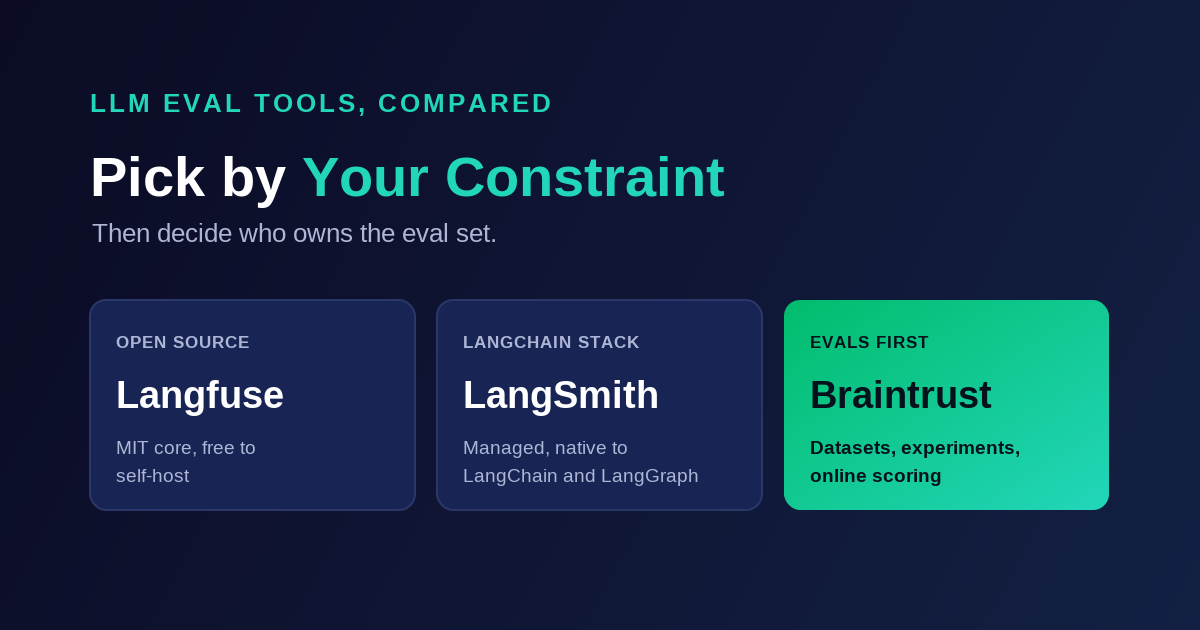
You want one platform for traces, datasets, and experiments: Braintrust if evals come first, LangSmith if you build on LangChain or LangGraph, Langfuse if you need to self-host open source, and Arize Phoenix if you want OpenTelemetry-native tracing you run yourself.
No one has time to own the eval set: IrisEvals drafts the criteria, grades every production call, and keeps the golden set current.
If your AI answers customers, you can see what a finished eval looks like before you choose. Send 10 to 20 example conversations and get a sample eval report with graded results, explanations, and the same prompts replayed on leading models with price.
LLM Evaluation Tools Compared at a Glance
Every cell comes from the vendor's official site, docs, or GitHub repo as of November 25, 2026.
Tool | Category | What it does best | License or entry price | Paid plans |
|---|---|---|---|---|
DeepEval | Code-first framework | Pytest-style unit tests for LLM apps | Apache 2.0, free | Confident AI cloud: Starter $200/month, Team $2,000/month per organization |
Ragas | Code-first framework | RAG and agent metrics, test set generation | Apache 2.0, free | No hosted plan published |
promptfoo | Code-first framework | CLI evals plus red teaming in CI | MIT, free Community edition | Enterprise and on-premise, custom pricing |
Braintrust | Platform | Experiments, versioned datasets, online scoring | Starter free (1 GB, 10k scores) | Pro $249/month, Enterprise custom |
LangSmith | Platform | Tracing and evals for LangChain and LangGraph | Developer free (1 seat, 5k base traces) | Plus $39 per seat per month, Enterprise custom |
Langfuse | Platform | Open-source tracing, evals, and prompt management | MIT core, free to self-host; Hobby cloud free | Core $29, Pro $199, Enterprise $2,499 per month |
Arize Phoenix | Platform | OpenTelemetry tracing, evals, and experiments you host | Elastic License 2.0, free to self-host | Arize AX Pro $50/month, Enterprise custom |
IrisEvals | Managed evaluation | Criteria, grading of every call, and verified fix PRs done for you | Starts with a sample report from 10 to 20 conversations | No published price |
Sources, all official: DeepEval GitHub and Confident AI pricing; Ragas GitHub and docs; promptfoo docs and pricing; Braintrust pricing; LangSmith pricing; Langfuse pricing; Phoenix docs and Arize pricing.
Code-First Frameworks: Your Engineers Write the Tests
These are libraries. They are free, they run where your code runs, and they give you full control. In return, your team writes every test case, picks every metric, and builds whatever reporting it needs.
1. DeepEval
DeepEval is an open-source evaluation framework from Confident AI that works like Pytest for LLM apps: you write test files, and the "deepeval test run" command collects and runs them. It ships a long metric library, including G-Eval for custom criteria, RAG metrics such as faithfulness and contextual recall, agent metrics such as tool correctness and task completion, and multi-turn metrics. It can also generate synthetic datasets.
Best for: Python teams that want LLM checks in the same CI pipeline as their unit tests.
Limitation: You write and maintain the test cases. Most metrics call an LLM judge, so you supply a model and API key. Production monitoring is a separate product, Confident AI.
License and pricing: Apache 2.0. Confident AI has a free plan (2 seats, 1 project, 5 test runs a week), then Starter at $200 per month and Team at $2,000 per month, billed per organization.
2. Ragas
Ragas is an open-source Python library built to move teams from vibe checks to systematic evaluation. Its strength is retrieval: context precision, context recall, faithfulness, and response relevancy are standard metrics for grading RAG pipelines, and it adds agent metrics such as tool call accuracy and goal accuracy, plus automatic test set generation. The latest release, v0.4.4, shipped on November 14, 2026.
Best for: teams evaluating a RAG pipeline who want well-known retrieval metrics they can cite.
Limitation: It is a library only. Ragas publishes no hosted product or paid plan, so storage, dashboards, and production scoring are yours to build. LLM-based metrics make one or more model calls per score.
License and pricing: Apache 2.0, free.
3. promptfoo
promptfoo is an open-source CLI and library for evaluating and red-teaming LLM apps, and the most direct answer to prompt testing. You compare prompts and models against test cases from the command line or in CI/CD, and the same tool runs automated red-team probes for issues such as prompt injection. OpenAI announced it would acquire promptfoo on March 9, 2026, and the project states it remains open source and MIT licensed.
Best for: engineering and security teams that want prompt regression tests and red teaming in one CLI.
Limitation: The free Community edition caps red teaming at 10,000 probes a month, and team features such as SSO, sharing, and a central dashboard are Enterprise only. It is distributed through npm, so Python-only teams add a Node.js tool to their stack.
License and pricing: MIT. Community is free; Enterprise and on-premise are custom priced.
Platforms: Your Team Curates Datasets and Scorers
Platforms add what libraries lack: traces from production, shared datasets, experiment comparison, and online scoring. Your team still decides what to test and how to score it. We compared three of these in depth in Langfuse vs LangSmith vs Braintrust, so this section stays short.
4. Braintrust
Braintrust is the most evaluation-centric platform here. Versioned datasets feed experiments that compare prompt and model versions, and the same scorers run online against production traces. Its open-source autoevals library is MIT licensed, and its Loop agent can create datasets and scorers from what it finds in production traces.
Best for: teams that think in experiments and want offline and online evals in one place.
Limitation: There is no free self-hosted option. SaaS runs on every plan, and running the data plane in your own cloud requires Enterprise.
Pricing: Starter is free with 1 GB of processed data, 10,000 scores, and 14-day retention. Pro is $249 per month with 5 GB, 50,000 scores, and 30-day retention. Enterprise is custom.
5. LangSmith
LangSmith, from the LangChain team, combines tracing with offline and online evaluation. It supports human, code, LLM-as-a-judge, and pairwise evaluators, plus annotation queues for structured human review, and it accepts traces from any OpenTelemetry-compatible agent, not only LangChain.
Best for: teams building on LangChain or LangGraph who want a managed platform.
Limitation: Self-hosted and hybrid deployment are Enterprise only, and per-seat pricing grows with team size.
Pricing: Developer is free for 1 seat and 5,000 base traces a month. Plus is $39 per seat per month with 10,000 base traces. Enterprise is custom.
6. Langfuse
Langfuse is an open-source LLM engineering platform with tracing, prompt management, datasets, experiments, and evaluation. Its online evaluators, either LLM-as-a-judge or code in Python or TypeScript, score production traffic as it arrives.
Best for: teams that need to self-host, or want to read and change the code.
Limitation: Self-hosting means your team runs, upgrades, and secures the stack, and code in the repo's "ee" folders sits outside the MIT license.
License and pricing: MIT core, free to self-host. Cloud: Hobby is free (50,000 units, 2 users), Core is $29 per month, Pro is $199 per month, and Enterprise is $2,499 per month, each with 100,000 units included and then $8 per 100,000.
7. Arize Phoenix
Arize Phoenix is a tracing and evaluation platform you host yourself, built on OpenTelemetry with OpenInference instrumentation. It covers tracing, LLM and code-based evaluations, human labels, datasets, experiments, prompt management, and a playground. Arize AX is the company's managed SaaS for production workloads.
Best for: teams standardized on OpenTelemetry that want an evaluation workbench they run themselves.
Limitation: Phoenix uses the Elastic License 2.0 rather than MIT or Apache, so check its terms if you plan to offer it as a service. A managed version means moving to Arize AX.
License and pricing: Phoenix is free to self-host. Arize AX Free is $0 (25,000 spans a month, 15-day retention), AX Pro is $50 per month (50,000 spans, 30-day retention), and Enterprise is custom.
Managed Evaluation: The Eval Set Is Built for You
Every tool above gives you machinery. None of them knows what a correct answer looks like for your product, and someone still has to keep that definition current as the product changes. Managed evaluation takes that job on.
8. IrisEvals by IrisAgent
This entry is our own product, so read it with that in mind. IrisEvals is an always-on evaluation agent and the evaluation module of Iris Control, IrisAgent's LLM control plane. It drafts evaluation criteria for each workflow from your system prompts, policies, and real conversations, grades 100% of production LLM calls, and alerts your team in Slack or email when quality drops.
When a failure pattern appears, it opens a pull request in your repo, replayed first against the failing conversations and the golden eval set. It keeps that golden set generated from live traffic and refreshed, and replays any new model, including in-house and fine-tuned ones, with cost and latency.
It runs on a copy of your logs, never on the request path, so evals don't add latency.
Best for: teams running customer-facing agents where one bad answer costs revenue, trust, or compliance, and teams already paying people to review AI conversations by hand.
Limitation: It is not a code-first test framework. If your engineers want to write their own tests in CI or own trace-level debugging, a framework or platform above is the better fit. No price is published.
Pricing: Start with a sample report from 10 to 20 example conversations. Contact IrisAgent for pricing.
Our golden dataset guide shows what building that set by hand involves, if you would rather keep it in house.
How to Choose an LLM Evaluation Tool
Run through these steps in order. Each one removes options.
Name who will own the evals. If an engineer will write tests, shortlist a framework. If a team will curate data, shortlist a platform. If nobody has the time, shortlist managed evaluation.
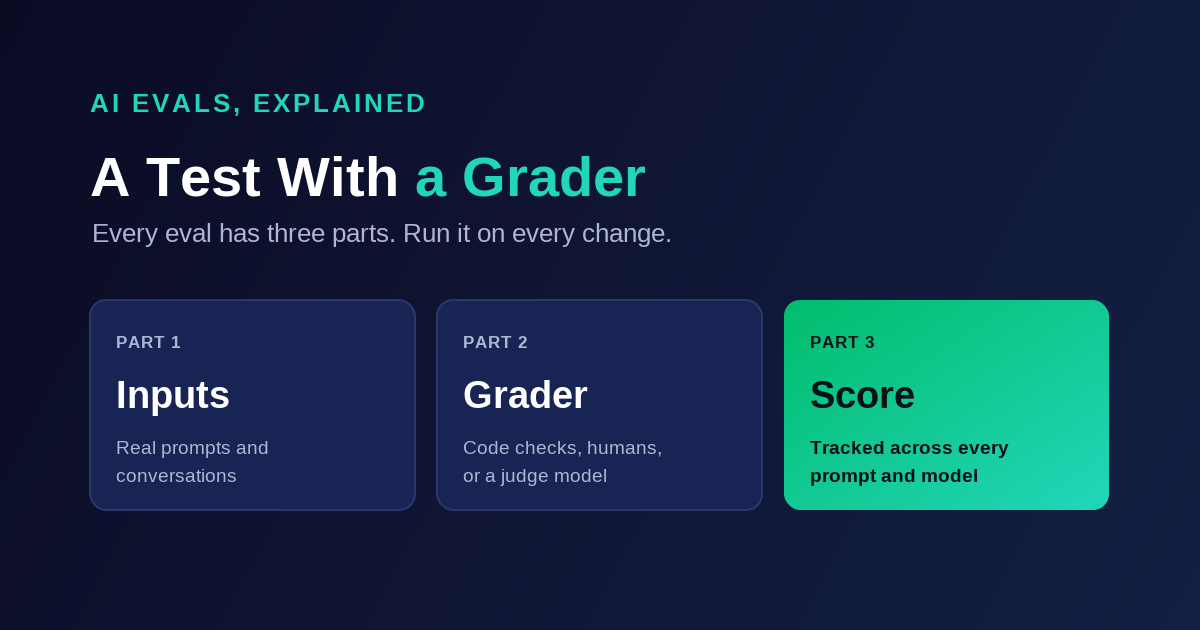
Write down what a good answer means. Pass and fail rules per workflow come before any tool. Our plain-English guide to AI evals explains the parts.
Match the tool to your app type. RAG pipelines need retrieval metrics, agents need tool-call and multi-turn checks, and customer-facing bots need hallucination and refusal checks.
Check deployment constraints early. Langfuse and Phoenix self-host for free. LangSmith and Braintrust need Enterprise for self-hosted or your-own-cloud setups.
Price it on your own volume. Translate seats, traces, units, spans, or gigabytes into one month of your real traffic.
Decide offline, online, or both. Pre-release tests catch regressions; production scoring catches drift. Most teams need both.
Calibrate the judge. Compare LLM-as-a-judge verdicts against a small set of expert reviews before you trust any score.
Trial on 50 real examples. Run your top two candidates on the same production sample, and keep the tool whose failures you would have missed by hand.
Teams that answer customers can also compare models on real support work in our Support Model Arena.
Next Steps
Decide who will own your evals, then shortlist two tools from that category and trial them on the same real examples. If nobody on your team has time to own criteria and datasets, see how IrisEvals evaluates every production call, or send 10 to 20 conversations for a sample eval report.
Frequently Asked Questions
What is the best tool for LLM evaluation?
There is no single best tool, because the right choice depends on who does the work. DeepEval and promptfoo are strong for engineers who write tests in CI. Ragas is the standard for RAG metrics. Braintrust, LangSmith, Langfuse, and Arize Phoenix suit teams that will curate datasets and scorers on a platform. IrisEvals, made by IrisAgent, suits teams that want criteria, grading, and the eval set handled for them.
What's the best LLM evaluation platform?
Among platforms, Braintrust is the most evaluation-centric, with versioned datasets, experiments, and online scoring. LangSmith is the natural pick for LangChain and LangGraph teams. Langfuse is open source and free to self-host, and Arize Phoenix is the choice for OpenTelemetry-native teams that want to run their own stack. Trial two of them on the same 50 production examples before you commit.
Are there free LLM evaluation tools?
Yes. DeepEval and Ragas are free under Apache 2.0, and promptfoo is free under MIT. Langfuse is free to self-host, and Arize Phoenix is free to self-host under the Elastic License 2.0. Braintrust, LangSmith, Langfuse Cloud, Arize AX, and Confident AI all offer free tiers with usage limits. The real cost of free tools is engineering time to write tests, curate data, and maintain reporting.
What is the difference between LLM evaluation and prompt testing?
Prompt testing checks whether a prompt change gives the expected outputs on a fixed set of cases, usually before release. LLM evaluation is broader: it scores model outputs against defined criteria such as correctness, grounding, and policy, both before release and on production traffic. promptfoo is built around prompt testing, while platforms such as Braintrust and Langfuse also score live traces over time.
Which LLM evaluation tools work for RAG applications?
Ragas is built for RAG, with metrics such as context precision, context recall, faithfulness, and response relevancy. DeepEval includes similar RAG metrics, such as contextual recall and faithfulness, inside its Pytest-style framework. Braintrust's open-source autoevals library also ships RAG scorers. Whichever you pick, include questions your knowledge base cannot answer, so you measure whether the model declines instead of inventing an answer.
Do I need an engineer to run LLM evaluations?
For code-first frameworks, yes: someone writes and maintains the test files. Platforms need less code but still need people to curate datasets, write scorers, and review results. Managed evaluation needs the least: IrisEvals drafts criteria from your prompts, policies, and conversations and grades every call without reviewers, though your engineers still review and merge the pull requests it opens.
Loading the form. Prefer email? Reach us at info@irisagent.com or call +1 617 249 3312.