
Sierra vs Decagon (2026): Pricing, Deployment, and Which Fits Your Support Team
Sierra vs Decagon is the head-to-head between the two best-known enterprise AI agent platforms for customer service. Both build custom AI agents that resolve conversations end to end, both sell through enterprise contracts, and both deploy with a vendor team at your side. They differ in how you pay and how your team shapes agent behavior. For contrast, IrisAgent, a helpdesk-native option, holds validated accuracy above 95% and goes live in 24 hours on the helpdesk you already run.
This guide compares Sierra and Decagon directly: pricing model, build approach, deployment, voice, and the buyer each one fits. Neither vendor publishes a rate card, so every price below is a third-party estimate, labeled as such. Confirm current numbers in your own sales process.
Sierra vs Decagon at a Glance
Sierra | Decagon | |
|---|---|---|
Founded by | Bret Taylor and Clay Bavor | Jesse Zhang and Ashwin Sreenivas |
Pricing model | Outcome-based: you pay when the agent completes an agreed result | Per conversation by default, per resolution as an option |
Reported unit price | About $1.00 to $2.50 per outcome (third-party estimates) | About $0.99 per conversation (third-party estimates) |
How behavior is defined | Agent SDK for engineers, no-code Agent Studio for CX teams | Agent Operating Procedures (AOPs): natural-language workflows compiled into versioned logic |
Implementation | High-touch, vendor-led, weeks to months | Structured vendor-led engagement, about six weeks |
Voice | Core channel, positioned as one product with chat | Supported, typically priced above chat |
Typical buyer | Large consumer brands with complex, brand-sensitive journeys | Fast-growing tech and consumer companies with high conversation volume |
The two platforms compete for the same shortlist far more often than they differ on capability. The deciding questions are commercial and organizational: which billing model matches your resolution rate, and who on your team will own the agent after launch.
How Each Platform Is Built
Sierra's pitch is an agent that carries your brand voice and can take real actions: process an exchange, update a subscription, save a cancellation. Engineering teams work in Sierra's Agent SDK, and CX teams can adjust behavior in Agent Studio without code. Sierra leans toward a greenfield build, so the agent becomes a new front door that sits in front of, or alongside, your existing systems.
Decagon organizes agent behavior around Agent Operating Procedures. An AOP reads like a support playbook written in plain language, then compiles into precise logic that can be version controlled and tested. That makes behavior auditable, and it also means changes tend to flow through a review process that looks a lot like software release management. Decagon pairs AOPs with monitoring and QA tooling so teams can watch how the agent performs after launch.
Neither approach is better in the abstract. Sierra suits organizations that want the vendor and their own engineers to co-build a branded agent. Decagon suits organizations that want support operations to write the rules in prose, with engineering reviewing the compiled result.
Pricing: Outcome-Based vs Per Conversation
This is where Sierra and Decagon genuinely diverge, and it is the comparison most buyers get wrong. For the six-figure floors and setup fees each vendor reportedly carries, see the cost sections in our Sierra AI alternatives guide and our Decagon alternatives breakdown. This section covers the billing model, which decides how the invoice moves once you are live.
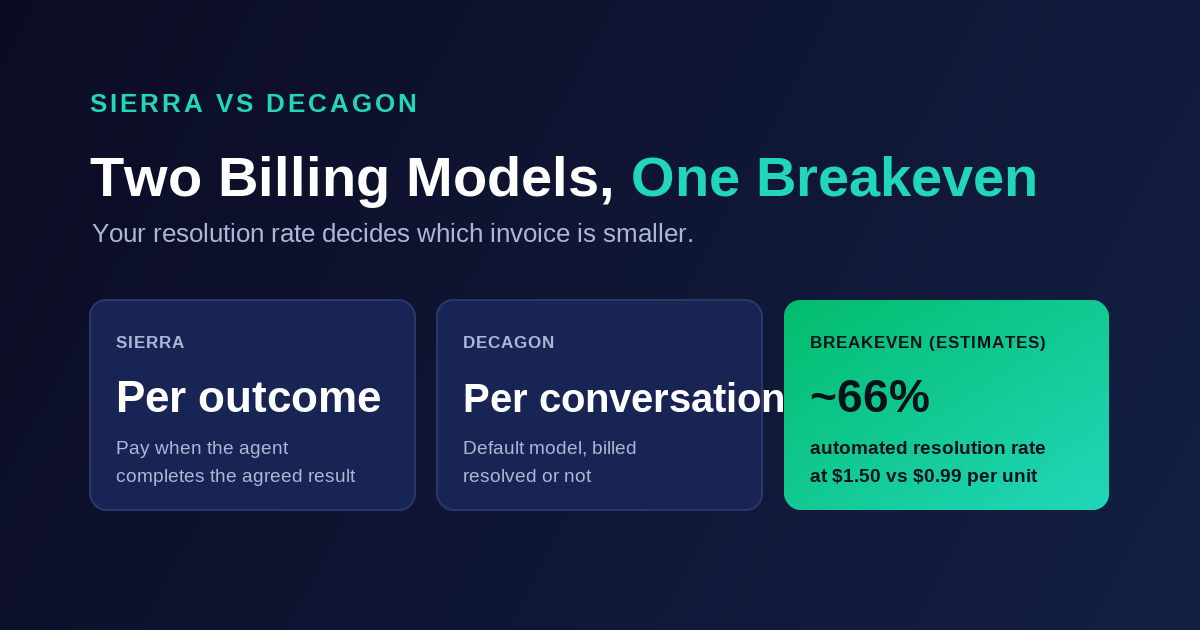
Sierra charges on outcomes. If the agent resolves the issue or completes the agreed action, you pay. If it hands off to a human, you generally do not. Decagon defaults to charging per conversation, whether or not the agent resolves it, and offers a per-resolution option at a higher unit price.
The model that costs less depends on one number: your automated resolution rate. Here is a worked example using the third-party estimates above (about $0.99 per Decagon conversation, about $1.50 per Sierra outcome):
Start with 10,000 AI-handled conversations a month.
On Decagon's per-conversation model, the bill is 10,000 x $0.99 = $9,900, regardless of outcome.
On Sierra's outcome model at a 50% resolution rate, the bill is 5,000 x $1.50 = $7,500.
At a 66% resolution rate, Sierra's bill is 6,600 x $1.50 = $9,900. That is the breakeven point.
At an 80% resolution rate, Sierra's bill is 8,000 x $1.50 = $12,000, and per-conversation pricing is now cheaper.
The takeaway: per-conversation pricing rewards teams that expect high automation, and outcome pricing protects teams that are unsure how well the agent will perform. Before you compare quotes, agree with each vendor on exactly what counts as a resolution or an outcome. A conversation where the customer goes quiet, or reopens the issue two days later, can be counted very differently. For a wider view of how these models compare to seat-based and usage-based plans, see our AI chatbot pricing guide.
Deployment and Who Does the Work
Both vendors run implementation as a services engagement rather than a self-serve setup. Expect discovery workshops, integration work against your order, billing, and identity systems, scripted testing, and a staged rollout.
Decagon's onboarding is commonly reported at about six weeks. Sierra's is commonly reported as weeks to months, depending on how many systems the agent must act in and how many journeys you launch with. In both cases the timeline is driven less by the vendor than by your own readiness: clean knowledge content, API access to backend systems, and a named internal owner.
The ownership question matters after launch, too. With Sierra, plan for engineering involvement whenever the agent needs a new action. With Decagon, plan for a support operations lead who writes and maintains AOPs, plus a review step before changes ship. Ask each vendor for a customer reference whose team looks like yours and ask who edits the agent today.
Voice
Voice is where Sierra has invested most visibly, positioning voice and chat as one agent rather than two products, with broad language coverage. Decagon also supports voice, and third-party pricing reports put voice conversations above chat on a per-unit basis. If phone is your largest channel, run your bake-off on recorded calls, not chat transcripts, and measure containment, transfer rate, and average handle time on transferred calls.
When Sierra Fits
Your brand experience is the product, and you want an agent that sounds unmistakably like you.
Voice is a major channel and you want one agent across phone and chat.
You are uncertain about your achievable resolution rate and want to pay only on outcomes.
You have engineering capacity to co-build actions with the vendor.
When Decagon Fits
You expect a high automation rate, so per-conversation pricing works in your favor.
Your support operations team wants to define behavior in plain-language procedures.
You value version-controlled, testable agent logic and a release-style review process.
You can commit to a roughly six-week implementation with a named owner.
Where Both Fall Short for Many Support Teams
Credit where it is due: Sierra and Decagon are both capable platforms with real enterprise customers, and for a large brand with the budget and staff to run a build program, either can be the right call.
The gap shows up for mid-market and enterprise support teams that already run Zendesk, Salesforce, Intercom, or Freshworks and need results this quarter. Both platforms are built around a vendor-led build and an enterprise contract, which is more project than many teams can absorb. A helpdesk-native platform layers onto the system you already run instead. IrisAgent installs into your existing helpdesk, deploys in 24 hours, validates every answer against your knowledge base through its Hallucination Removal Engine, and offers both usage-based and resolution-based pricing. In production at Dropbox, it saved 160,000 agent minutes. See the side-by-side detail on IrisAgent vs Sierra and IrisAgent vs Decagon.
How to Run a Fair Sierra vs Decagon Bake-Off
Pull 200 recently resolved tickets that represent your real mix, including the messy ones.
Write down your resolution definition before any demo, and make both vendors price against it.
Ask each vendor to run the same tickets and return answers with sources.
Score accuracy, correct escalation, and actions taken, not just deflection.
Model the invoice at three resolution rates (40%, 60%, 80%) on each billing model.
Ask who on your team will own the agent after launch, and what a typical change takes.
Add one helpdesk-native option to the bake-off as a control, so you know what a 24-hour deployment delivers on the same tickets.
Frequently Asked Questions
What is the main difference between Sierra and Decagon?
The biggest difference is the pricing model. Sierra charges on outcomes, so you pay when the agent resolves an issue or completes an agreed action. Decagon charges per conversation by default, with a per-resolution option. They also differ in how behavior is defined: Sierra uses an Agent SDK plus the no-code Agent Studio, while Decagon uses Agent Operating Procedures written in natural language.
Is Sierra or Decagon cheaper?
It depends on your automated resolution rate. Using third-party estimates of about $0.99 per Decagon conversation and about $1.50 per Sierra outcome, the two break even near a 66% resolution rate. Below that, outcome pricing tends to cost less. Above it, per-conversation pricing tends to cost less. Neither vendor publishes pricing, so confirm with a quote.
How long does it take to deploy Sierra or Decagon?
Decagon's implementation is commonly reported at about six weeks. Sierra's is commonly reported at weeks to months, depending on how many backend systems and journeys are in scope. Both are vendor-led engagements. Helpdesk-native platforms such as IrisAgent deploy in 24 hours on Zendesk, Salesforce, Intercom, or Freshworks.
Do Sierra and Decagon support voice?
Yes. Sierra positions voice and chat as one agent with broad language coverage. Decagon also supports voice, and third-party reports put voice conversations at a higher per-unit price than chat. If phone is your main channel, test both on recorded calls rather than chat transcripts.
What is a good alternative to Sierra and Decagon?
For teams that want to keep their existing helpdesk and go live quickly, IrisAgent is a strong alternative. It layers onto Zendesk, Salesforce, Intercom, Freshworks, and Jira, deploys in 24 hours, holds validated accuracy above 95% through its Hallucination Removal Engine, and offers usage-based and resolution-based pricing.
Loading the form. Prefer email? Reach us at info@irisagent.com or call +1 617 249 3312.