
Agentforce Alternatives for Customer Support (2026)
Last updated: October 2026
The strongest Agentforce alternatives for customer support teams on Salesforce in 2026 are IrisAgent, Sierra, Decagon, Ada, Intercom Fin, Forethought (now part of Zendesk) and Netomi. IrisAgent is an AI layer for the Salesforce helpdesk you already run, not a replacement for it. It resolves, assists and scores support conversations across chat, email, voice and text, and goes live in about 24 hours. Teams comparing Agentforce alternatives can test it on their own tickets first.
Most teams searching for an alternative are not unhappy with Salesforce. They are unhappy with how long it takes Agentforce to resolve real tickets. This guide covers what you can keep, what each alternative adds, and how to prove the choice on your own queue before you sign anything.
Why support teams look for Agentforce alternatives
Agentforce is Salesforce's AI agent platform, built on the Atlas reasoning engine and Data Cloud. For a team already deep in Service Cloud, Flow and Data Cloud, it is the native path. The friction support leaders describe to us tends to fall into four buckets:
Build effort. Agentforce resolves multi-step tickets only after your team builds the topics, actions and flows behind them. That is admin and developer time, not support ops time.
Data Cloud dependency. The richest Agentforce use cases assume Data Cloud is licensed and populated. Many Service Cloud orgs are not there yet.
Unpredictable cost. Agentforce launched at $2 per conversation. Salesforce has since added Flex Credits priced per action and per-user add-ons. Each model is workable, but forecasting spend at 2x your ticket volume takes real effort.
Grounding you own. Answer quality tracks the quality of your Knowledge articles and prompts. There is no separate validation step that blocks an unsupported answer before it reaches a customer.
None of this makes Agentforce a bad product. It means the right question is not "Agentforce or something else," but "what is the fastest way to get grounded resolution inside the Salesforce org we already have?"
Do you have to replace Salesforce to use something other than Agentforce?
No. Service Cloud stays your system of record in every option below. Cases, routing, entitlements, reporting and your agents' console all stay where they are. The alternatives differ in how they connect:
Overlay platforms (IrisAgent) install from AppExchange and work inside the Service Cloud console, reading and writing cases, Knowledge and case history directly.
API-connected agent platforms (Sierra, Decagon, Ada, Netomi) run their own agent runtime and sync to Salesforce through APIs. Expect some engineering work on the integration.
Suite-adjacent agents (Intercom Fin, Forethought) come from another helpdesk vendor and connect to Salesforce as one of several supported systems.
If keeping Salesforce as the center of gravity matters to you, the integration model matters as much as the AI.
What does an AI layer do inside the helpdesk you already run?
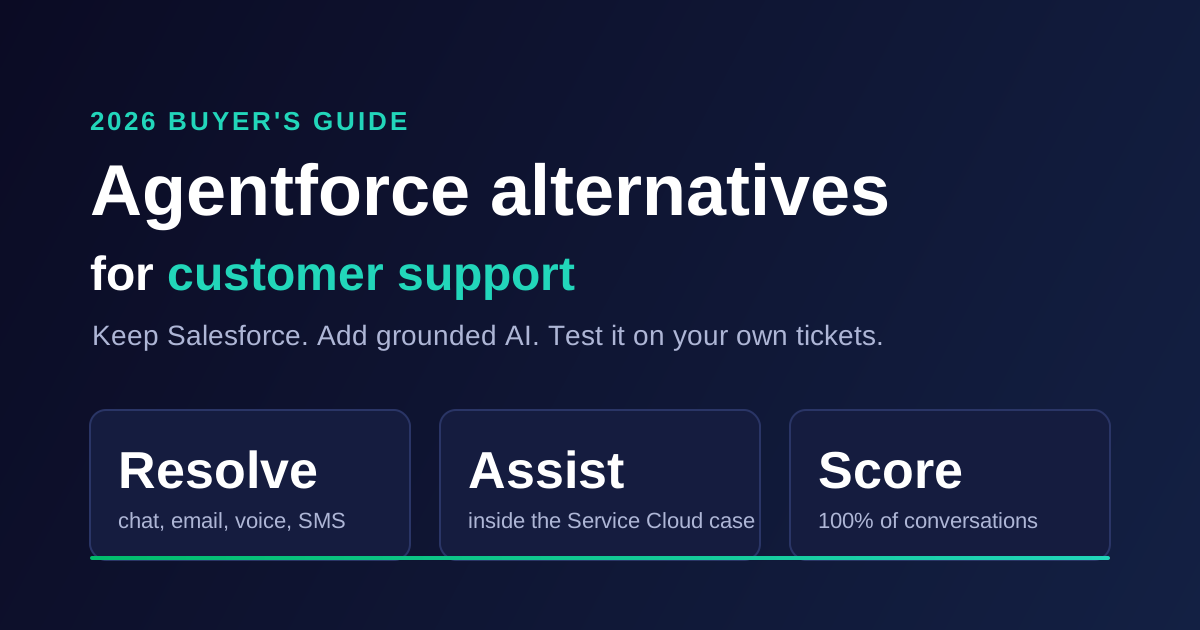
An AI layer adds automation to Service Cloud without moving your data or retraining your team. In IrisAgent's case, that covers three jobs:
Resolve. AI agents answer customers end to end on chat, email, voice and SMS, grounded in your Salesforce Knowledge, past cases and connected sources like Confluence or Google Drive. A Hallucination Removal Engine checks each answer against those sources before it is sent, which is how IrisAgent holds validated accuracy above 95%.
Assist. When a case needs a person, agents get a drafted reply, similar resolved cases and suggested next steps inside the Salesforce case view. Cases are auto-tagged, routed and prioritized, and engineering context from Jira can attach to the case.
Score. AutoQA reviews 100% of conversations, AI and human, against your own rules in plain English, so you are not sampling 5% of tickets and guessing about the rest.
Dropbox uses IrisAgent across its support operation and saved more than 160,000 agent minutes while cutting average handle time by about 2 minutes. Zuora, InvoiceCloud and Teachmint run it in production as well.
The best Agentforce alternatives for customer support in 2026
1. IrisAgent
Best for: Service Cloud teams that want grounded AI resolution this quarter without a rebuild.
IrisAgent installs from the Salesforce AppExchange and goes live in about 24 hours. It covers AI agents, agent assist and AutoQA in one platform, and it also works with Zendesk, Intercom and Freshdesk if part of your queue lives elsewhere.
What it does well:
Validated accuracy above 95%, with every answer checked against your sources before sending
No minimum ticket volume to train on, and no flow-building project before the first resolved case
Chat, email, voice and SMS on one grounded knowledge layer
Flexible pricing, with usage-based and resolution-based options and no six-figure platform floor
Where it is not a fit:
If Agentforce is already tuned and resolving most of your volume, a second vendor may not pay off
If you want a vendor's human agents to work your queue, IrisAgent is software, not a BPO
See how IrisAgent works inside Salesforce
2. Sierra
Best for: very large consumer brands with heavy voice volume and a large AI budget.
Sierra builds premium, brand-tuned AI agents with strong voice capability and an outcome-based pricing model. It connects to Service Cloud through APIs.
What it does well:
Strong voice agents and persona control
Enterprise logo list and deep agent design services
Where it is not a fit:
Reported annual commitments start around $150K, before implementation
Integration is API-driven, so plan on engineering involvement
Sierra often becomes the primary agent surface, with Salesforce behind it
3. Decagon
Best for: enterprises that want a vendor-built agent and have a few months of runway.
Decagon builds agentic workflows for complex support journeys and has well-known SaaS and consumer customers.
What it does well:
Multi-step agent workflows with a solid tooling layer
Thoughtful analytics on agent performance
Where it is not a fit:
Reported minimums around $50K a year, plus per-conversation pricing
Configuration leans on the vendor's team rather than your support ops lead
Implementations are typically measured in weeks
4. Ada
Best for: enterprise brands that want a mature, multilingual customer-facing agent.
Ada is one of the longest-running AI agent platforms, with a Salesforce integration and broad compliance coverage (SOC 2, GDPR, HIPAA tiers).
What it does well:
Polished chat experience and strong multilingual support
Mature enterprise compliance
Where it is not a fit:
Per-resolution pricing, reported at roughly $1 to $3.50 per resolution, so cost tracks volume
Implementation is often described as heavy, and native ingestion of sources like PDFs, Confluence and Notion is limited
5. Intercom Fin
Best for: teams that like Fin's chat experience and are open to Intercom's messenger.
Fin is Intercom's AI agent. It can run on top of Salesforce as well as Intercom's own helpdesk.
What it does well:
Fast to stand up on a clean knowledge base
Transparent public pricing at $0.99 per resolution
Where it is not a fit:
Per-resolution pricing adds up quickly as automation rates grow
The richest Fin features assume the Intercom messenger and inbox, not the Service Cloud console
6. Forethought (now part of Zendesk)
Best for: existing Forethought customers planning their next renewal.
Forethought offered triage and answer automation with a Salesforce integration. Zendesk acquired it in March 2026.
What it does well:
Proven triage and classification models
Real Service Cloud production deployments
Where it is not a fit:
Its roadmap now sits inside Zendesk, Salesforce's direct competitor in the helpdesk market
Historically needed a large ticket history to train, and longer implementations
7. Netomi
Best for: large consumer brands in travel, retail and telecom with high messaging volume.
Netomi covers chat, email, messaging and social channels and integrates with Service Cloud.
What it does well:
Broad channel coverage, including social and messaging apps
Good performance on short, high-volume consumer questions
Where it is not a fit:
Enterprise sales cycle and quote-only pricing
Less suited to complex B2B SaaS support
How do the options compare?
Option | Works inside Service Cloud | Typical time to live | Pricing model | Validates answers before send |
|---|---|---|---|---|
Agentforce | Native | Weeks to months, depending on build | Per conversation, Flex Credits or per user | Relies on your retrieval and prompts |
IrisAgent | Yes, AppExchange overlay | About 24 hours | Usage-based or resolution-based | Yes, Hallucination Removal Engine |
Sierra | Via API | Weeks to months | Outcome-based, reported $150K+ floor | Vendor-managed |
Decagon | Via API | Weeks | Per conversation, reported ~$50K minimum | Vendor-managed |
Ada | Via integration | Weeks | Per resolution | Partial |
Intercom Fin | Via integration | Days to weeks | $0.99 per resolution | Partial |
Forethought | Via integration | Weeks | Quote-based | Partial |
Netomi | Via integration | Weeks | Quote-based | Vendor-managed |
Competitor figures come from public pricing pages and widely reported deal data. Verify current terms with each vendor before you sign.
How fast can you go live?
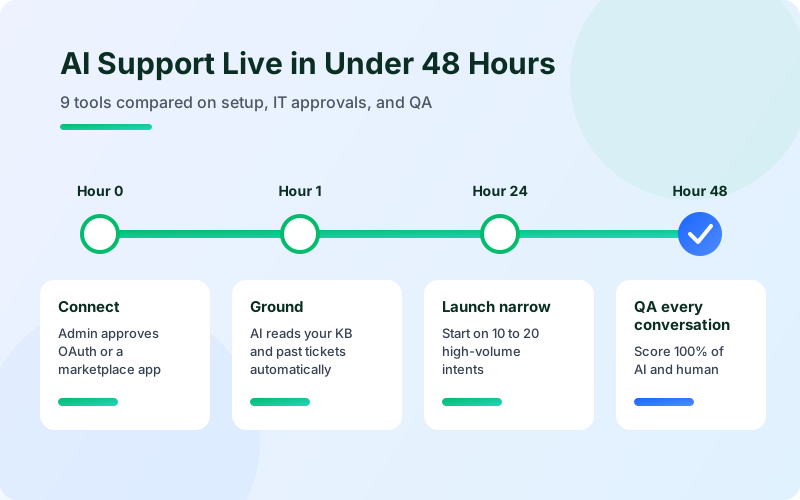
Time to the first resolved case is the clearest split in this category. IrisAgent connects to Service Cloud, indexes your Knowledge and case history, and can be answering in shadow mode in about 24 hours. API-connected platforms usually need an integration project, and Agentforce's timeline depends on how many topics and actions your admins need to build.
A practical way to frame it: every month of implementation is a month of tickets your team still handles by hand. Put that number next to the license cost when you compare.
How do you test an alternative before committing?
Run a shadow test on your own tickets. It takes about a week and removes most of the guesswork:
Pull 20 to 50 recent cases your team considers hard: multi-step, policy-heavy, or ones where the first reply was wrong.
Have each vendor generate answers in shadow mode, with no customer-facing sends.
Score each answer for correctness, source citation and whether it would have closed the case.
Model total cost at your current volume and at 2x.
Ask each vendor what stops an unsupported answer from reaching a customer. The quality of that answer tells you a lot.
IrisAgent runs this test inside your Salesforce org, on your data, before any contract.
When Agentforce is still the right choice
Stay with Agentforce if your Salesforce team has the admin and developer capacity to build and maintain agent actions, Data Cloud is already in place, and procurement strongly prefers a single vendor. In that setup, the native path is reasonable. Many teams also run both: Agentforce for internal Salesforce workflows and an overlay like IrisAgent for customer-facing resolution and QA.
Is IrisAgent right for your team?
IrisAgent fits best if you run Service Cloud (alone or alongside another helpdesk), want grounded resolution live this quarter, and need QA coverage on every conversation. It is less of a fit if Agentforce already resolves most of your volume or you are looking for an outsourced agent team.
The fastest way to know is to see it on your own cases. Book a demo and we will run IrisAgent against a sample of your Salesforce tickets.
For a broader look at Service Cloud options, see our guide to the best AI chatbots for Salesforce Service Cloud or the head-to-head IrisAgent vs Agentforce comparison.
Frequently Asked Questions
What are the best Agentforce alternatives for customer support?
The strongest Agentforce alternatives for customer support in 2026 are IrisAgent, Sierra, Decagon, Ada, Intercom Fin, Forethought and Netomi. IrisAgent is the best fit for teams that want to keep Salesforce Service Cloud and add grounded AI resolution, agent assist and QA in about 24 hours.
Can I use an Agentforce alternative without leaving Salesforce?
Yes. Every option on this list keeps Service Cloud as your system of record. IrisAgent installs from AppExchange and works inside the Service Cloud console, so cases, routing and reporting stay where they are.
How much does Agentforce cost compared to alternatives?
Agentforce launched at $2 per conversation and now also offers Flex Credits priced per action and per-user add-ons. Alternatives range from per-resolution pricing (Fin at $0.99, Ada at roughly $1 to $3.50) to enterprise floors (Sierra reported at $150K+). IrisAgent offers usage-based and resolution-based options with no six-figure platform minimum.
How long does it take to switch from Agentforce?
You do not have to switch off Agentforce to test an alternative. IrisAgent can run in shadow mode on your Salesforce cases in about 24 hours, and many teams run it alongside Agentforce while they compare results.
Is IrisAgent a replacement for Salesforce Service Cloud?
No. IrisAgent is an AI layer on top of Service Cloud. It resolves, assists and scores conversations while Salesforce remains your helpdesk and CRM.
Loading the form. Prefer email? Reach us at info@irisagent.com or call +1 617 249 3312.