
AutoQA Rules in English: Write Your Support QA Gates
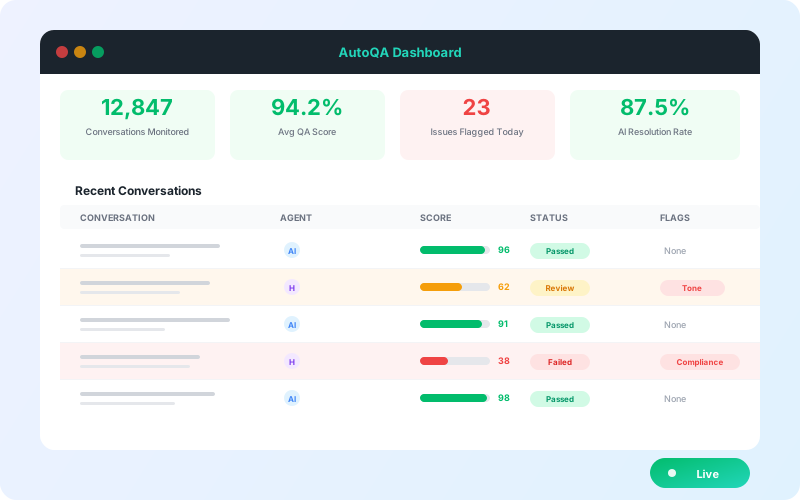
AutoQA rules in English are plain-language enforcement gates that score every AI and human support conversation against the standards your ops team already believes. You write the rule the way a QA lead briefs a new hire. The system applies it on 100% of work and alerts while the ticket is still warm.
A polished AI agent that can be talked into an account change is a process failure, not a model failure. AutoQA turns those standards into rules that run on every conversation, not a lucky sample of fifty.
The real eval is not "does it sound human"
Voice and chat demos optimize for vibe.
Buyers should optimize for gates.
If an agent can reset a password, issue a refund, or change account ownership without verifying identity, you do not have a support system. You have a demo with a phone number or a chat widget.
That problem does not get fixed by prettier TTS. It gets fixed by enforcement gates: AutoQA rules in English that apply on every conversation, AI and human, while the ticket is still warm.
IrisAgent AutoQA is built for that job.
The market noise will keep selling how natural the voice sounds or how fast the chat replies. Those are table stakes. The ops question is whether sensitive actions can run without a check your QA lead would accept on a human handle. If the answer is no for humans, it is no for AI.
Sampling invents a calm week. AutoQA rules in English cover every ticket.
Traditional QA reviews a fraction of conversations.
A sample of 50 tickets can look fine in a calibration meeting and still miss the Tuesday 4pm failure: skipped identity check, closed without a follow-up, refund without policy, tone that tanked CSAT on a VIP.
Full coverage is not a vanity metric. It is how you see the ugly cases that never make the sample.
AutoQA evaluates every conversation against the standards you define, continuously, so QA scales without scaling headcount. That is what AutoQA rules in English are for: one written standard, applied to the full stream.
Calibration meetings still matter for aligning on rubrics. They are not a substitute for coverage. When the sample is calm and production is not, you did not have a good week. You had a lucky sample.
QA leads feel this gap already. The worst misses are rare enough to miss the sample and severe enough to define the brand week: a VIP refund without policy, an ownership change without identity, a close with no follow-up on a high-risk intent. Full coverage is how those cases stop being folklore and start being tickets you can fix.
Write AutoQA rules in English the way you already think
No rigid template required. No code sprint to encode the first standard.
Describe what you want to monitor in plain English, the same way a QA lead would brief a new hire:
"Flag conversations where the agent didn't verify the customer's identity before making account changes."
"Check that the agent offered a follow-up before closing."
"Flag refunds issued without confirming the return policy the customer was given."
"Flag password or ownership changes without a second factor or verified identity."
AutoQA understands the intent, applies it contextually across conversations, and runs continuously. You define the standard once. Every interaction is measured against it.
That is the same plain-English promise on the live AutoQA page: write rules the way you think.
You do not need a taxonomy project before the first gate. You need three sentences your team already believes, written the way they talk in standup, then applied to every thread instead of to a clipboard sample.
That is also why plain English beats a rigid form. Forms freeze last year's checklist. English rules let you encode the standard your ops team already argues about in the war room, then tighten the wording after the first week of flags teaches you where the edge cases live.
Three actions that must never run without a gate
Before you scale voice or autonomous text, list the three actions that must never run ungated. Most teams start here:
Password reset / account unlock
Refund or credit
Account ownership or billing identity change
If those rules are not in the system, pause the scale story. Fix the gates first.
Voice is only the loud example. A password-reset demo that skips identity is the same failure mode as a chatbot that issues a credit because the customer asked twice. The same gates belong on chat, email, and human replies. Same rubrics for AI and human work so customers never feel a "bot cliff."
Soft channel note: Voice AI can surface ungated action risk quickly because the failure is audible. Treat Voice as a channel example for dangerous actions, not as a reason to rewrite your whole QA program around TTS quality. See Voice AI for the channel story; keep the QA idea here: AutoQA rules in English, full coverage, warm alerts.
Alert while the ticket is still warm
QA that only shows up in a monthly review is archaeology.
When a conversation drops below your threshold, AutoQA can notify you in real time: compliance risk, negative sentiment spike, missed process, unresolved path. Intervene before a small miss becomes a chargeback, a churn event, or a screenshot on social.
Warm alerts change the operating rhythm. Instead of discovering a bad refund path three weeks later in a calibration deck, you catch it while the ticket can still be fixed, the customer can still be contacted, and the SOP can still be corrected before the next ten cases follow the same miss.
Failures fix content and workflow
The point of full-coverage QA is not a longer blame list.
Use misses to decide:
Gap in the KB or SOP
Broken handoff
Intent that should never have been automated
Training need that is real because it is frequent, not anecdotal
AutoQA also surfaces improvement signal from unresolved conversations: content gaps, workflow bottlenecks, prioritized recommendations that raise resolution quality over time. Pair that loop with the platform view on AI customer support software.
A flag is a ticket into the system, not a scarlet letter on an agent. When the same identity miss shows up twenty times, you have a process problem. When it shows up once, you have a coaching moment. Coverage is what lets you tell the difference.
Same standards, AI and human
If AI and humans run different rubrics, you will never trust automation.
Write one set of gates. Score both. Keep handoff confidence rules consistent so a human inherits the full story when confidence drops.
Agent-facing work still benefits from assist beside the ticket. Voice remains a channel story on Voice AI. The QA idea stays the same: AutoQA rules in English, full coverage, warm alerts.
Two rubrics create two realities. Agents learn one bar. Automation is measured on another. Customers feel the seam. One rubric closes the seam and makes "resolve or hand off clean" an ops rule instead of a slogan.
Starter list: turn on three AutoQA rules in English this week
If you cannot name three rules, you do not have a QA system. You have a calendar invite called "calibration."
Pick three you already believe:
Identity before account change
Follow-up offered before close on unresolved or high-risk intents
Refund / credit only after policy confirmation
Write them in English. Run them on 100% of AI and human. Review the first week of flags as a workflow meeting, not a performance theater.
If a rule fires constantly, either the process is broken or the rule is too blunt. Either outcome is useful. If a rule never fires on a channel you know is risky, the rule is not reaching the conversations that matter. Tune the English. Do not abandon the gate.
Conclusion: AutoQA rules in English beat vibe demos
AI support quality is not a TTS score. It is whether your enforcement gates are written clearly enough to run on every conversation. AutoQA rules in English give QA leads a way to encode identity, refund, and ownership standards once, score AI and human work the same way, and intervene while the ticket is still warm.
Want to turn your top three QA standards into English rules on every conversation? See AutoQA, then talk scope.
[Contact us](https://irisagent.com/contact/)
Frequently Asked Questions
What is an enforcement gate in AI support?
An enforcement gate is a non-negotiable process check before a sensitive action runs: identity verification before account changes, policy confirmation before refunds, required follow-up before close. Gates belong in the system, not in a slide. AutoQA expresses them as plain-English rules scored on every conversation.
How are plain-English AutoQA rules different from rigid QA forms?
Rigid templates force your team into someone else's checklist. Plain-English AutoQA rules let you describe the standard the way operators already talk ("flag if identity was not verified before an account change"). AutoQA applies that intent across conversations continuously instead of waiting for a sampled review.
Does AutoQA score AI agents and human agents the same way?
Yes. The useful model uses the same rubrics for AI and human interactions so quality does not fork into two standards. That keeps handoffs honest and prevents "bot world" vs "agent world" drift.
Why is sampling 50 tickets not enough?
Sampling invents a calm week. Rare but severe misses (skipped identity, bad refund, VIP tone failure) often sit outside the sample. Scoring 100% of conversations surfaces those failures in real time so you can intervene while the ticket is warm.
What should we do with AutoQA failures?
Treat them as system signal: fix KB and SOPs, repair handoffs, pull unsafe intents out of automation, and coach where frequency proves a real pattern. Do not reduce AutoQA to a monthly blame meeting.


Loading the form. Prefer email? Reach us at info@irisagent.com or call +1 617 249 3312.