
Agent Assist vs AI Agents: What's the Difference?

Here is the short definition I give other support leaders in San Francisco: AI agent assist works alongside a human in the helpdesk and surfaces the next best reply, while an autonomous AI agent talks to the customer and resolves the ticket within guardrails. A chatbot is the customer-facing self-service surface. Vendors blur these labels. Buyers should not.
If you are comparing tools, start from who owns the answer and who clicks send. That single test separates AI agent assist from an AI support agent, and it maps cleanly onto the levels of autonomy framework. For the broader three-way breakdown of bots, agents, and copilots, keep using our guide to AI agent vs chatbot vs copilot. This piece goes deeper on assist versus autonomous agents so the two pages do not compete.
Agent assist vs AI agents vs chatbot at a glance
Use this table the same way we use it on the agent assist hub. It is the comparison buyers actually need before a demo.
Dimension | Agent assist | AI agent (autonomous) | Customer-facing chatbot |
|---|---|---|---|
Who it talks to | The support agent | The customer, with optional human takeover | The customer, directly |
Who owns the answer | The agent, who edits before sending | The AI, with escalation rules | The model, unsupervised in the moment |
Blast radius of a wrong answer | Low. A human catches it first | Medium to high, depending on confidence gates | High. It reaches the customer |
Primary KPI | Average handle time, first contact resolution | Resolution rate and handoff quality | Containment with real resolution quality |
Right first deployment when | Your knowledge base is incomplete or answers are high-stakes | Intents are documented and confidence thresholds are proven | Your top intents are repetitive and well documented |
What AI agent assist actually does
AI agent assist is software that sits inside the agent workspace, reads the live ticket or conversation, and suggests the next best action: a grounded reply, the exact knowledge base passage, a thread summary, or a workflow to run. The human stays in the loop. That is why assist is usually the safest first AI deployment when your knowledge base is uneven or the cost of a wrong answer is high.
In practice, a strong assist layer will:
Draft citation-backed replies from your knowledge base, similar tickets, and procedures
Surface the right article before the agent goes hunting
Summarize long threads so handoffs do not restart from zero
Trigger approved actions without leaving Zendesk, Salesforce, Intercom, Freshworks, or Jira
Learn from agent edits and thumbs up or down so later automation is safer
On Zendesk, the useful loop is refine the draft, then send to draft in the ticket composer. Overlay on the helpdesk you already run. Do not treat assist as a rip-and-replace project.
What an autonomous AI agent does differently
An autonomous AI agent works on the customer side. It reads the inbound message, retrieves a grounded answer, decides whether confidence is high enough, and resolves the issue end to end, including taking actions like checking order status or issuing a policy-bounded credit when your procedures allow it. A human supervises and handles escalations. The human is not clicking send on every reply.
That is a different operating model, not a louder assist panel. Assist makes each agent faster. Autonomy changes how much volume ever reaches a human queue. Confusing the two is how teams either underinvest (expecting assist alone to cut staffing) or overreach (turning on full autonomy before intents are proven).
IrisAgent's AI support agent is built for that second model: grounded retrieval, confidence gates, and clean handoff with context when the case should not stay automated.
Where chatbots fit (briefly)
A chatbot is still useful. It is the front door for narrow, high-volume questions on web or in-app chat. It answers or collects context. It does not, by itself, own multi-system resolution the way an AI agent does, and it does not sit next to your agent the way assist does.
If you need the full taxonomy with use cases and phased adoption by company type, use AI agent vs chatbot vs copilot. Here the only chatbot point that matters for this decision is sequencing: bots are great for containment on documented FAQs, but they are a poor substitute for either assist or autonomy when the work requires CRM context and actions.
Map the choice to levels of autonomy
I like the autonomy ladder because it forces the per-intent conversation. You do not pick one level for the whole company. You pick a level per intent.
L1 copilot (suggest-only): this is agent assist. AI drafts, human sends.
L2 supervised autopilot: high-confidence tickets auto-send; the rest draft for review.
L3 and L4: conditional to full autonomy inside defined domains. That is the AI agent lane.
The full framework, including how to graduate safely from copilot to autopilot, lives on our levels of autonomy for AI customer support page. The practical rule: earn the level. Do not flip a company-wide autonomy switch on day one.
How to choose: assist first, agent later, or both
Start with agent assist when
Your knowledge base is incomplete, and many good answers still live only in closed tickets
Answers are high-stakes (billing disputes, regulated accounts, VIP relationships)
You need a trust curve: agents must see and edit drafts before customers do
Your main near-term KPI is handle time, first contact resolution, or new-hire ramp
Move intents to an autonomous AI agent when
The intent is high volume, low risk, and policy-bounded (order status, password reset, basic plan FAQ)
Draft acceptance and thumbs-up rates on assist are consistently strong for that intent
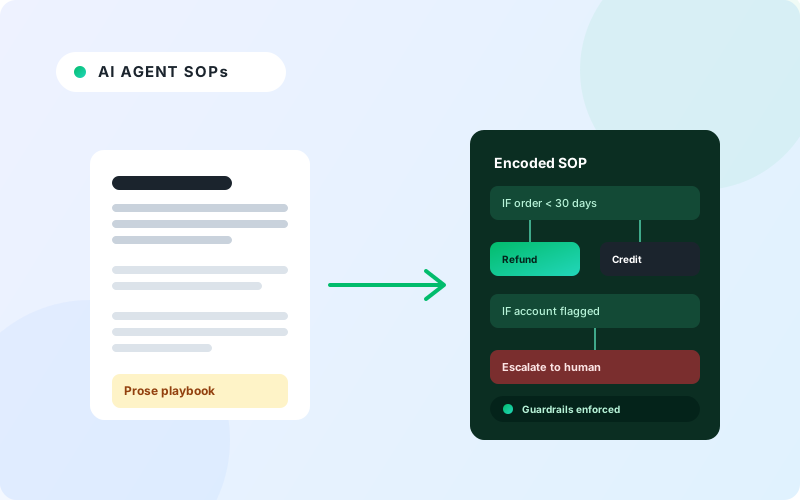
You can enforce what the AI may and may not do with procedures, not tribal knowledge
You can measure resolution quality and CSAT on AI-handled tickets, not just containment
A sequencing playbook that actually works
Connect the helpdesk and sync knowledge plus ticket history.
Run suggest-only assist on a real queue. Treat thumbs down as your roadmap.
Promote one proven intent to supervised auto-send with a confidence threshold.
Widen autonomy intent by intent. Keep humans on exceptions.
Keep assist on for the complex remainder so the human queue still gets faster.
Teams that skip assist and launch a customer-facing bot first often rebuild the knowledge base anyway, just with unhappy customers along the way. Assist gives you the same grounding work and the same procedure quality, with a human gate until the data says an intent is safe.
What to measure (so you do not fool yourself)
For assist, opening the sidebar is not a result. Measure median handle time per intent, first contact resolution, new-agent ramp time, and draft acceptance rate. Draft acceptance below about 40% is usually a knowledge problem, not a model problem.
For autonomous agents, pair resolution rate with CSAT on AI-handled tickets and escalation accuracy. High containment with unhappy customers is a retention problem wearing a deflection costume.
How IrisAgent runs both on one foundation
The reason we built assist and autonomy on the same retrieval and procedure layer is boring and important: if the assist tool and the customer-facing agent use separate answer engines, knowledge drifts. Agents get one answer in the sidebar. Customers get another in the bot. Ops maintains two systems.
IrisAgent keeps them aligned. Agent assist covers the L1 copilot lane inside Zendesk, Salesforce, Intercom, Freshworks, and related workspaces. The AI support agent covers customer-facing resolution with grounding, confidence gates, and escalation. You graduate intents without rewriting the brain.
One evaluation habit that separates real tools from demos: bring 20 of your own hard tickets, ask what happens when there is no good answer, check citation granularity down to the passage, and confirm the same logic can take approved actions through your APIs.
Common mistakes I still see
Treating assist as a headcount plan. Assist speeds agents. Autonomy is what removes volume from the queue.
Choosing one autonomy level for every intent. Password resets and regulated billing disputes do not belong on the same rung.
Promoting to autonomy without machine-enforced guardrails. Tribal policy does not survive an automated send.
Measuring only deflection. Pair it with CSAT and reopen rate or you will optimize for silence.
Ignoring early trust. Three confidently wrong drafts in week one and agents stop reading the panel.
Frequently Asked Questions
What is the difference between AI agent assist and an AI agent?
AI agent assist helps a human support agent inside the helpdesk: it drafts, summarizes, and suggests, and the human sends. An AI agent resolves with the customer under guardrails, and a human supervises and handles escalations. Who clicks send is the cleanest test.
Should we deploy agent assist or an autonomous AI agent first?
If your knowledge base is incomplete or answers are high-stakes, start with agent assist. Use the edit and feedback data to prove which intents are safe, then promote those intents to autonomy. Many teams run both: the agent handles repetitive volume, assist speeds the complex remainder.
Is a chatbot the same as agent assist?
No. A chatbot talks to the customer as self-service. Agent assist talks to your agent inside the workspace. They solve different problems and sit in different places in the stack.
How does agent assist vs AI agents map to levels of autonomy?
Agent assist is L1 copilot. Supervised auto-send is L2. Conditional and full autonomy are L3 and L4. Set the level per intent rather than for the whole company.
Loading the form. Prefer email? Reach us at info@irisagent.com or call +1 617 249 3312.