
AI Call Monitoring Software: Automated Scoring for Every Call
Score 100% of calls against your rules, on the phone stack you already have. No new recorder.
By Palak Dalal Bhatia, CEO & Co-founder, IrisAgent · Updated August 25, 2026




You are running the floor on a 2% sample
You already know the scene. CSAT moves. Someone pulls five calls. The room argues about whether those five represent the week. They do not.
A manual QA team can review 1% to 3% of the queue. On most voice floors that lands around 2%. The other 98% still happened. Missed disclosures, skipped identity checks, unresolved callers, and your best coaching moments are in that 98%. You just never scored them.
Sample QA answers one question: did we hear something concerning? It cannot answer the one that matters: what is repeatedly happening on this queue, and what do we change this week?
That is a coverage problem, not a hiring problem. You cannot staff your way to 100% listen-through. You also should not buy a second recorder to store the same audio you already keep.
For the definition of the category, the feature list, and the longer evaluation guide, read what call monitoring software is. This page is the product: score every call, on the stack you already run.
What 100% AutoQA scoring changes
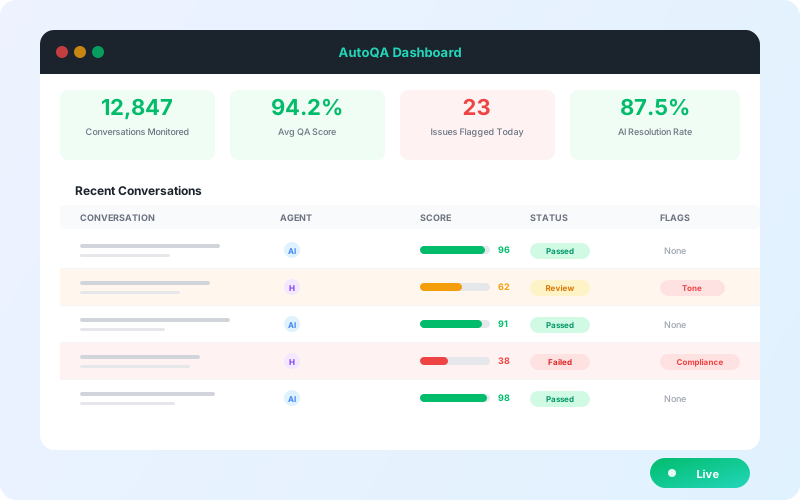
AutoQA evaluates every conversation, AI and human, once it is complete. You write the standard once. Every new call is measured against it.
Rules are plain English, not a vendor template. Two that are already in the product docs:
- Flag conversations where the agent didn't verify the customer's identity before making account changes.
- Check that the agent offered a follow-up before closing.
On voice, the same engine is what you use to catch missed disclosures and policy breaks across the whole phone channel. That is a scoring job, not a recording job.
Each rule has a category and a severity. Categories you can use today: Compliance, Resolution Quality, Process Adherence, Escalation, Tone & Empathy, and Custom. Severity is Critical, Warning, or Info. Each conversation gets a QA score from 0 to 5, plus a scorecard that shows which rules passed or failed and why, with the flagged moment in the transcript.
You still keep humans in the loop. AutoQA scans the full queue. QA reviews the 1% to 3% that need judgment. Managers coach from patterns across the queue, not from a random draw and an argument. Failed rules show up on the scorecard with the flagged moment in the transcript. QA reviews them this week, not after a monthly sample.
We do not own call recording
Say this out loud in the buying meeting.
IrisAgent does not own call recording. We are not a new recorder. We are not a replacement archive.
Your telephony, CCaaS, or carrier already captures audio, plays the consent prompt, and stores the recording. That is their job. Retention, redaction, and who can hit play stay where they already live. Our job is to score the conversation against your rules and put the result where your team already works. Our guide to what a contact center platform includes covers where recording, WFO, and telephony sit in that stack.
If a vendor needs you to stand up a second recorder so they can sell you QA, you are buying storage twice. Buy scoring on the recordings you already have.
Call monitoring software, in the old catalog sense, meant the box that records the line. That is not this page. Recording is a telephony feature. Scoring is the product.
How it sits on the phone stack and helpdesk you already have
IrisAgent is an overlay. Not a standalone dialer. Not a CCaaS rip-and-replace.
- Keep the phone system you run today. Layer IrisAgent on that telephony. No new number required to get QA coverage. A helpdesk is optional.
- Conversations flow into AutoQA. Create a rule in plain English. It is active by default on new conversations.
- If you have a helpdesk, scores and context write back to the ticket. Agents and managers do not leave the console they already live in.
- If you do not have a helpdesk, you still get AutoQA on the calls. Voice does not wait on a ticketing project.
- Same overlay model as chat and email. No re-platforming. You do not hand over the phone line to get a scorecard.
You are not migrating the floor. You are putting a scoring layer on the floor. If you are weighing a phone-system replacement anyway, read how a telephony project differs from a resolution project before you bundle the two.
Sample QA vs a recorder vs IrisAgent AutoQA
A recorder that never scores is an archive. A QA team that scores 2% is a sample. Neither is 100% coverage. Read the cells. IrisAgent is the first scoring column, not the recording column.
| Job | Sample QA | Recorder-only stack | IrisAgent AutoQA |
|---|---|---|---|
| Coverage | Humans review 1% to 3% of calls. Most floors sit near 2%. The rest of the queue never gets a score. | Every call can be recorded. A recording is not a score. Scoring still waits on a reviewer or a bolted-on rubric. | AutoQA evaluates every conversation, AI and human, once it is complete. You score 100% of calls against your rules. |
| Scorecard owner | QA writes a rubric. Reviewers apply it by ear. Two reviewers can score the same call differently. | Vendor templates, keywords, or script checks. Hard to encode verify identity before account changes. | You write rules in plain English. Categories: Compliance, Resolution Quality, Process Adherence, Escalation, Tone & Empathy, Custom. Severity: Critical, Warning, Info. Conversation score 0 to 5. |
| Recording ownership | Telephony or the CCaaS records. QA listens later, if the call was in the sample. | The recorder owns capture, consent playback, retention, and the archive. That is the product. | IrisAgent does not own call recording. Your telephony records. We score. No second archive. |
| Helpdesk write-back | The score lives in a spreadsheet or a QA tool. It rarely lands on the ticket. | The score, if any, lives in the WFO or recorder console. Agents leave the helpdesk to see it. | Overlay on the helpdesk and phone stack you already have. Write-back to the ticket if you run a helpdesk. Helpdesk is optional. |
| AI + human | Human calls only, and only the sample. AI voice agents usually sit outside the QA program. | Same recorder for every call. QA still samples. AI and human are an afterthought in the scorecard. | Same rules on AI calls and human calls. AutoQA on 100% of both, one program. |
| Time to first scored call | After the weekly or monthly QA cycle. Feedback arrives after the moment is gone. | Immediate recording. Scoring still waits for a person to press play. | Create a rule. It is active on new conversations. Scoring runs on every new conversation. |
| Coaching loop | One flagged call, one delayed 1:1, an argument about whether the sample was fair. | Managers can pull a recording if they already know which one. No systematic loop. | Each scored conversation shows which rules passed or failed. QA reviews the 1% to 3% that need judgment. Coaching from patterns across the full queue. |
Resolve the call, and grade every call
Two jobs. One overlay.
Voice AI answers and resolves on the phone system you already have. It is not a standalone dialer. A helpdesk is optional. AutoQA grades every call that runs through that line, AI and human.
You cannot trust a voice agent you cannot score. You cannot coach a floor you only hear 2% of.
Turn on AutoQA whether or not you automate the phone. Start Voice AI on after-hours or overflow if you want a low-risk first slice. The scoring layer does not wait for the automation project.
Production proof, labeled honestly
The proof that belongs on this page is coverage. AutoQA on every call, AI and human, against rules you wrote.
The same overlay is already in production on the helpdesk side. Dropbox saved 160,000 email minutes in H1 2025 and cut email AHT by 2 minutes. Zuora cut escalations 40%. Those are not call-QA numbers. Do not present them as call-QA numbers. They are proof the product sits on the stack you already run, and that support leaders use it in production.
Score the calls you already record
You do not need a new recorder. You need a score on every call, against the rules your operation actually runs.
Book a demo and bring one rule you already wish QA could apply to the whole queue. Or go read AutoQA and Voice AI if you want the product surfaces first.
For the definition and the buyer's guide, stay on what call monitoring software is.
Any questions?
We got you.
Call monitoring is one input into a broader support strategy. See how AI customer support software ties call insights back into ticket automation and knowledge base grounding.